This book is dedicated to my favorite teacher Ms. McClendon, My Parents , and my Savior God

About The Author
This Author is a full fledged scientist. Ha! I am just kidding I was born in Winneba, Ghana. I came to the U.S when I was just 4 years old and I now I am 11 years old. As a small boy my mom said I would always be talking and asking other people question so I found a passion of speech and God has helped me to get here where I have made my first book. So enjoy the book that I truly treasure.

Table Of COntents
Chapter 1 : Beginning of the Universe
Chapter 2 : The Moon phases
Chapter 3 : Solar Eclipse, Lunar Eclipse and Supermoon.
Chapter 4: Spring and Neap Tides
Glossary
Hi guys, my name is Adom the Author of this book. This book is about moon phases and how and why they are created so buckle your seat belts for this Galactic ride to the moon.

Chapter 1 : Beginning of the Universe.
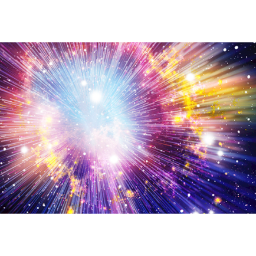
Have you ever wondered how the Earth was even created? Well some scientist think it all started with a Big BOOM!!!! They called this theory The Big Bang Theory. They believed the whole universe was created by a dot that we can't even see with our bare eyes, but today I want to tell you about our spectacular moon.
This is how The Big Bang probably looked.
For years and years scientist have been wondering how the moon was created but the most accepted theory is the GIANT IMPACT THEORY this theory states that Theia ( the ancient planet) hit the Earth and little pieces of the Earth came out of it and that part turned into the moon we know today by coalescing
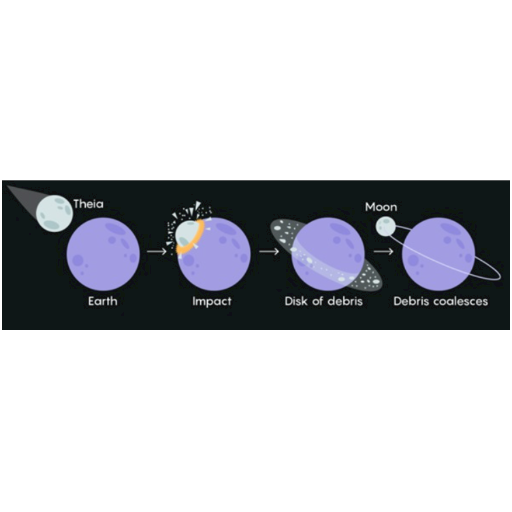
This is the process it went in .

WOW!
After the moon coalesced, it became Earth's one and only moon that stayed in Earth's gravity and was in orbit around the Earth. Several of years later, we are able to see our moon, but how are we able to see it? How does the moon change its face day by day? Well, this is called the lunar or moon phases. The reason you see different phases of the moon
Fun Fact : The moon actually produces no light at all it is actually just the sunlight from the Sun that actually refracts off the moon so we can see it on Earth. Amazing!!!!
Chapter 2 : The Moon Phases
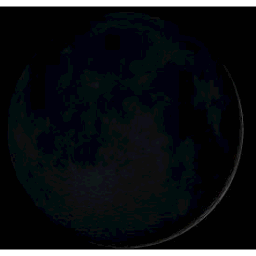
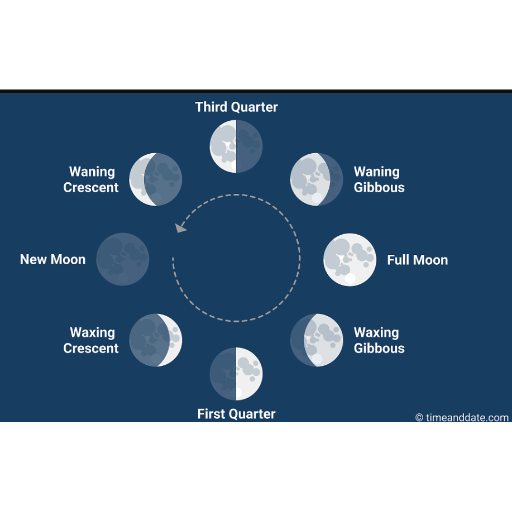
There are 8 moon phases that our moon has starting from a New Moon. The New Moon is the first phase of the Moon. If you would look at a New you would probably see nothing. This is because the Sun's sunlight is shining on the other side or half of the Moon this is why you may not be able to see a new moon .
This is how a New Moon looks like
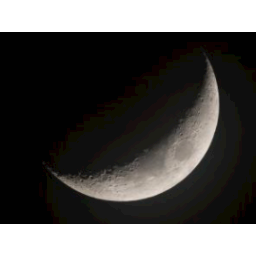
The second stage or phase of the Moon is called the waxing crescent this stage is the 1st stage we can see a little illumination. The illumination is a little part of the moon we can see which kind of looks like a crescent . It comes 2-3 days after the new moon
This is how a waxing crescent moon looks like
Fun Fact : The moon is always half illuminated it is just because Sun always illuminates the Moon no matter which position it is in
Did you know that 1.3 million earths can fit inside the Sun? That is so Big!!!!
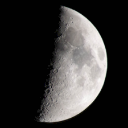
The third stage or phase of the moon is the 1st quarter this moon is 1 out of the 2 quarter phases of the Moon. When you look at this Moon you see that it is halfly illuminated in the night sky. A 1st quarter is made when the moon has made a 90 degree angle with the Earth and Sun. This moon comes 7 days after the New Moon
This is how a 1st quarter moon looks like.
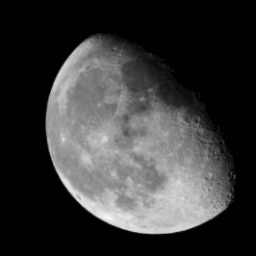
The fourth moon or lunar phase is called a waxing gibbous.This Moon is more than half of the Moon but less than full of the moon. This stage of the Moon is the last phase before the full moon. This Moon is 1 out of 2 of the Gibbous Moons. It takes 8-9 days to go from a New Moon to a Waxing Gibbous moon
This is how a Waxing Gibbous Moon looks like
Did you know : There is a man in the moon? Scientists have been wondering how and why they see this face but the reason has not been found.
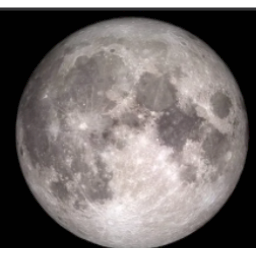
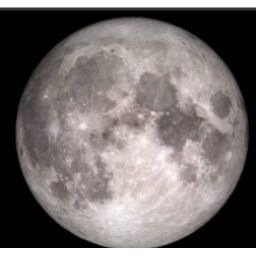
The fifth moon phase is called the Full Moon this moon comes 14 days after a New Moon. This Moon is fully illuminated so you can finally the whole face of the Moon, but the Moon phase cycle isn't over yet.
This is how a full moon looks like
Did you know : Our Moon is the 5th largest moon in the whole Solar System? That is probably really big!
The 6th phase of the Moon is called a Waning Gibbous which is the second Gibbous moon this moon is also more than half of the moon but still less than full. The cool thing about this moon is that instead of increasing it decreases unlike a Waxing Gibbous that increases. This moon comes 18- - 19 days after a New Moon.
This is how a Waning Gibbous looks like

Did you know you can sometimes see the moon in the morning? You have to pay very close attention
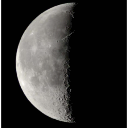
The 7th phase is the Last or Third Quarter Moon this moon is similarly like the 1st Quarter Moon which has a 90 degree angle to the Sun and the Earth which is the same for this Moon Phase. This is the second of the Quarter Moons. Also it comes 22 days after the New Moon and 15 days after the 1st Quarter Moon.
This is how a Third Quarter Moon looks like
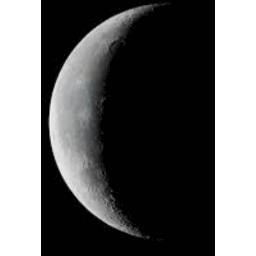
The last and final Moon phase is called the Waning Crescent this Moon is the last moon phase and is 1 of the 2 Crescent Moons it comes 26 - 27 days after a New Moon and 22 - 23 days after a Waxing Crescent after this moon the whole process repeats itself over and over again.
This is how a waning crescent looks like
Did you know : The Moon is actually Fully Dark on its surface it is just the sunlight beaming on the Moon's Surface

So this is the process it goes in. Get ready for a new chapter Beyond the Moon
Chapter 3 : Solar Eclipse, Lunar Eclipse, and Supermoons
I'm sure you still have many questions about our Moon, but there is one thing I have not covered Solar and Lunar Eclipses these 2 things are very cool to see.
Below you will see a Lunar Eclipse and Solar Eclipse
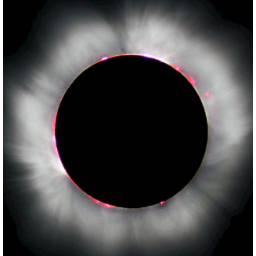
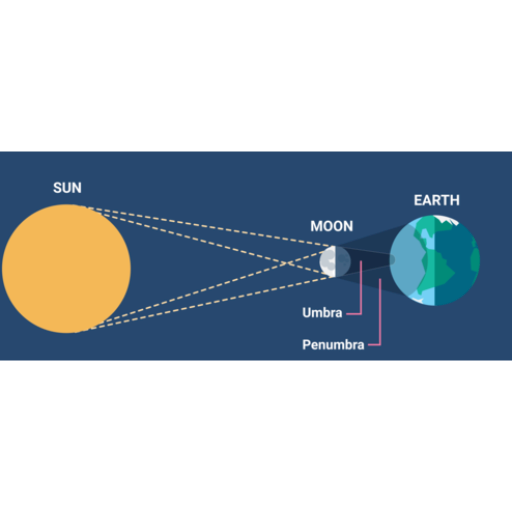
Solar Eclipse
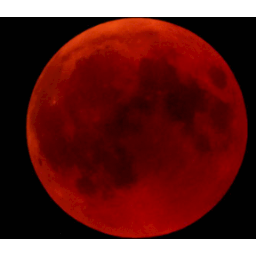
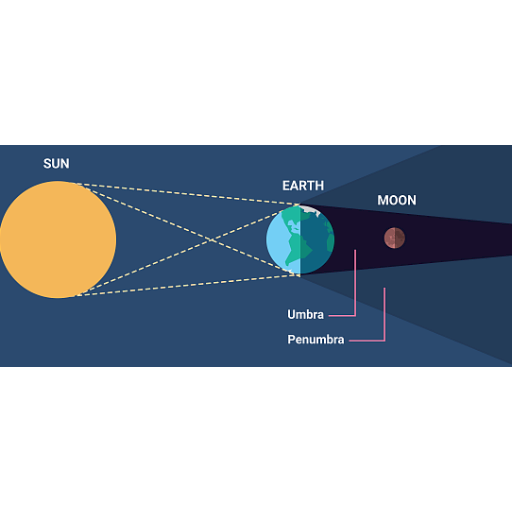
Lunar Eclipse
We are talking about a phenomenon called the Solar Eclipse this is only made when there is a New Moon it can either be a partial Solar Eclipse or a Full Solar Eclipse like on the first page of chapter 3. A Solar Eclipse happens when the moon is in the middle of the Sun and the Earth making straight line. Then the Moon blocks the Sun's sunlight making the sun rays on the outside of the Moon this is an example of a Solar Eclipse . WARNING! NEVER EVER LOOK AT SOLAR ECLIPSES WITHOUT ANY SPECIAL GLASSES.
We are talking about another phenomenon similar to the Solar Eclipse called the Lunar Eclipse this phenomenon is only created when there is a full moon. This is when the Moon is behind the Earth and the Sun. The sunrays hit the Moon cause a reddish - yellowish moon. Sometimes it can even look like a blood moon, but this only happens when there is an abundance of rays in the atmosphere this how a Lunar Eclipse is made. Lunar Eclipses are ok to look at with your normal eyes.
- Full access to our public library
- Save favorite books
- Interact with authors
In this book you will learn about the moon's phases and how and why you see them. you will also learn what solar and lunar eclipses are how and why they are created. Then you wiLL also learn what neap and Spring tides are and what cause Them.
- < BEGINNING
- END >
-
DOWNLOAD
-
LIKE
-
COMMENT()
-
SHARE
-
SAVE
-
BUY THIS BOOK
(from $5.79+) -
BUY THIS BOOK
(from $5.79+) - DOWNLOAD
- LIKE
- COMMENT ()
- SHARE
- SAVE
- Report
-
BUY
-
LIKE
-
COMMENT()
-
SHARE
- Excessive Violence
- Harassment
- Offensive Pictures
- Spelling & Grammar Errors
- Unfinished
- Other Problem
"Beyond The Moon"






COMMENTS
Click 'X' to report any negative comments. Thanks!