


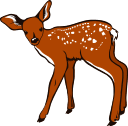



Want to learn about Mammals you are lucky this book tells more and more about mammals.

Mammals have very well-developed brains. Most mammals have hair on their body. Human beings, along with dog, cat, lion, elephant, deer, cow, buffalo, hippopotamus, zebra, giraffe, monkey, and rabbit are some examples of mammals. Whales and dolphins are mammals found in water, but they do not have hair on their body.
Aquatic mammals
Most mammals live on land and breathe through lungs. Do you know how a whale or a dolphin breathes? Whales and dolphin also breathe through lungs. They take in air through 'blowholes' present on the top of their heads. Hence, they have to come to the surface of water frequently to breathe in air.
Just as our parents look after us, all other mammals look after their babies. Most of them build houses to protect their babies from enemies, and also hunt for food. The mother feeds her babies her own milk. She cleans them and keeps them warm
Birds, too, look after their babies. They build nests to keep them warm. Since the chicks cannot fly, parent bird get food for their chicks and also protect them from any danger
Mammals tell us about the vertebrates belong to Mammalian class. The word mammal is taken from Latin. It means breast. They have mammary glands, three middle ear bones, hair, and neocortex in the brain, which differentiate the mammals from reptiles and birds. The mammary glands of female mammals produce milk to nurse their young.
Mammals are a group of vertebrate animals constituting the class Mammalia, and characterized by the presence of mammary glands which in females produce milk for feeding their young, a neocortex, fur or hair, and three middle ear bones. These characteristics distinguish them from reptiles and birds, from which they diverged in the Carboniferous, over 300 million years ago.
Around 6,400 extant species of mammals have been described. The largest orders are the rodents, bats and Eulipotyphla. The next three are the Primates, the Artiodactyla, and the Carnivora
Higher classification: Tetrapod
Scientific name: Mammalia
Phylum: Chordate
Biological rank: Class
Superclass: Tetrapoda
Warm-blooded vertebrates – Mammals are endothermic, meaning they have a constant body temperature. Mammals are also vertebrates, meaning they have a backbone
Red Blood Cells Without Nucleus – Mammals have adult (mature) red blood cells, known as erythrocytes, that lack a nucleus. This is unique compared to other vertebrates.
Has hair or fur – Mammals commonly have hair, or fur.
Though hair and fur are chemically similar and both made of keratin, they are characteristically different. Hair is normally longer and thinner than fur, while fur is usually shorter and coarser
- Full access to our public library
- Save favorite books
- Interact with authors

- < BEGINNING
- END >
-
DOWNLOAD
-
LIKE(1)
-
COMMENT()
-
SHARE
-
SAVE
-
BUY THIS BOOK
(from $2.99+) -
BUY THIS BOOK
(from $2.99+) - DOWNLOAD
- LIKE (1)
- COMMENT ()
- SHARE
- SAVE
- Report
-
BUY
-
LIKE(1)
-
COMMENT()
-
SHARE
- Excessive Violence
- Harassment
- Offensive Pictures
- Spelling & Grammar Errors
- Unfinished
- Other Problem

COMMENTS
Click 'X' to report any negative comments. Thanks!