
TABLE OF CONTENTS
pp. 4-5 ... Introduction
pp. 6-7... Background
pp. 8-9 ... Setting and Start of Conflict
pp. 10-13 ... Important Groups and Key Players
pp. 14-15 ... Women's Efforts
pp. 16-17 ... Consequences
pp. 18-19 ... A Resolution At Last
pp. 20-end ... Works Cited

Hi! My name is Verity Vote. Today I’m going to talk to you all about the Women’s Suffrage Movement from a LONG time ago- the 1800s and 1900s to be exact. Now, I know what you might be thinking: “What the heck is the Women’s Suffrage Movement and why does it have to do with me?” To that, I say that it has EVERYTHING to do with you. The Women’s Suffrage Movement was when women decided to fight so that they could vote, or choose the leaders of the United States.
Suffrage - Suffrage simply means the right to vote or choose who you want to lead you.


At the time we will be talking about today, the average woman who was married could not have any land to herself or look after any land she inherited. She could also not gain full custody of her own children. Imagine if your mom couldn’t look after you all of the time. Please remember if you don’t know a word, look down below at the glossary on each page.
Inherited - When you inherit something, you get it from a family member that has passed away.
Custody - When you have custody of something, you own it or control it.

We’ll start in the 1800s when the Movement first took place in America. The Civil War ended in more rights for African Americans. Women saw this and said, “Why can’t we have rights, too?” So they started to do something about it. In 1848, a bunch of women went to the Seneca Falls Convention in New York, which is like a big meeting for important people. The women thought that they could get voting rights, but at that convention the Constitution was only changed for African American men.
The Civil War - This was an American war where the north and south sides of the US fought over slavery.
Constitution - A constitution is a piece of paper with a list of laws or rulers for the country to follow.

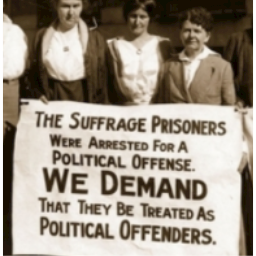
After this, two big groups of Suffragettes came together and combined to make one big group in 1888, called the “National American Woman Suffrage Association.” In this group, they peacefully lobbied Congress for women’s rights.
Suffragettes - This is a woman who fights for suffrage.
Lobbied - Lobbying is where you influence public people like Congress members to get them to do what you want them to do.
Congress - Congress is the group of people in the US that makes laws.

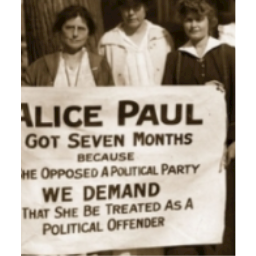
You might be asking yourself, “who did this?” Many women around the country did this. However, this movement did have outliers or people that stood out. Those people include Lucretia Mott, Elizabeth Cady Stanton, Susan B. Anthony, and Alice Paul. These women were all activists, writers, reformers, and Alice Paul was even a lawyer.
Activists - An activist is someone who fights for an issue, in this case it is suffrage.
Reformers - A reformer is someone who fights to fix something or take away its problems.
Lawyer - A lawyer is someone who defends someone accused of doing something wrong or tells them what they should do.

Their efforts were not always for nothing, as every year an act for women’s rights was shown to Congress, but they just said no every time. The movement just continued for forty years. During President Woodrow Wilson’s first inauguration in 1913, some women led a parade down the same street as the White House.
Act - An act is a law made by a group of people, like Congress.
- Full access to our public library
- Save favorite books
- Interact with authors

- < BEGINNING
- END >
-
DOWNLOAD
-
LIKE(1)
-
COMMENT()
-
SHARE
-
SAVE
-
BUY THIS BOOK
(from $4.79+) -
BUY THIS BOOK
(from $4.79+) - DOWNLOAD
- LIKE (1)
- COMMENT ()
- SHARE
- SAVE
- Report
-
BUY
-
LIKE(1)
-
COMMENT()
-
SHARE
- Excessive Violence
- Harassment
- Offensive Pictures
- Spelling & Grammar Errors
- Unfinished
- Other Problem

COMMENTS
Click 'X' to report any negative comments. Thanks!