This book is dedicated to our partners from the eTwinning project "Winter traditions" and to those who like our country or just simply want to learn something new and interesting about Ukraine

Ukraine is a diverse country with many unique and interesting traditions. Different ethnic groups and religions enriched and our culture throughout the centuries. Before Christianity our ancestors had been pagan. However, they didn’t discard pagan traditions entirely after changing their religion. It is because of this that now in many Ukrainian religious holidays, we can observe a peculiar combination of ancient pagan customs and Christian belief. Winter is rich for many Ukrainian traditional holidays.
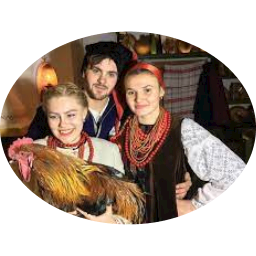
The holiday of St Catherine was supposed to be very helpful for young people because it was the Day of Girls’ Destiny.
When our grannies were young girls, they were hoping for good destiny. So, they used to fortune-tell. On St Catherine’s Day they used to cut a branch of a cherry tree, put it in water in the sacred corner (pokuttya) next to the icons and then they waited. If the branch gave flowers before St Melania’s Day (New Year’s Day), it meant that the girl would surely get married soon.
St.Catherine's Day
( the 5th of December)
St.Andrew's Day
( the 13th of December)
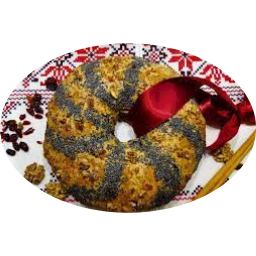
In Ukraine, St. Andrew’s Day was celebrated by our ancestors with fortune-telling and parties where pancakes and pastries were used for games which were supposed to help girls find a husband. It was also a time for pranks such as putting a plough on a house roof or taking a gate off its hinges. This holiday absorbed pre-Christian traditions connected with courtship and marriage. St. Andrew was considered to be the patron saint of the young people.
The Feast Day of St. Andrew was called vechornytsy because it was held in the evening. Young men and girls usually played a game called kalyta. The name of the game coincides with the word for a flat dry bread called kalyta. It had a hole in the centre and was decorated with poppy seeds, dried cherries or raisins. Then it was smeared with honey and hung in the middle of the house.
St.Nicholas Day
This holiday is celebrated annually on the 19th of December. It is one of the most beloved children's holidays.
The traditions of this holiday are borrowed from other countries. Germany first began to celebrate the day of Nicholas (December 6). Students of church schools on that day were treated to sweets. After a while, the holiday passed from schools to each house. Obedient children waited for gifts and disobedient one’s birches.
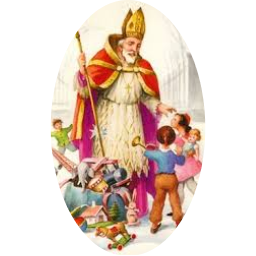
Ukrainian children waited for the arrival of Nicholas on the night of 18 to 19 December. In different regions the place of the gift is different. In Western Ukraine, children find gifts in shoes, and in the east under the pillow.
Now in each family of our country, the child receives a gift for the St. Nicholas Day. In addition, the traditions of this holiday are honored in every school and kindergarten. Children receive as gifts not only sweets but other pleasant souvenirs and gifts.
If a person makes a wish this night, it will come true.

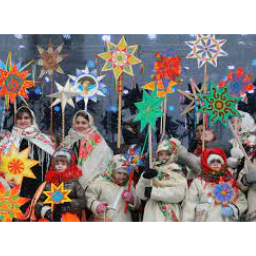
Traditional Christmas in Ukraine starts on January 6 (Christmas Eve in the Julian calendar). It lasts until the Feast of Epiphany on January 19. At the same time, more and more Ukrainians celebrate Christmas according to the Gregorian calendar on December 25. Mid-December is when the Christmas atmosphere begins to fill Ukrainian cities, with all Christmas markets and festivals, decorations and magic lights.
Christmas
Christmas Eve
Christmas Eve (Holy Eve) is marked by traditional family gatherings in the evening in Ukraine – the so-called Sviata Vecheria (‘Holy Dinner’). The festivities start with the appearance of the first star, though all preparations traditionally start from the very dawn.
The table should be served with 12 dishes, which symbolize the twelve apostles.
Christmas symbols
The main house decoration that you’ll see is the didukh (a sheaf of wheat stalks) that symbolizes our ancestors’ spirits. It is believed that during these holy days – our ancestors return to spend time with their families. That is also why some Kutia and other dishes should be left on the table – as a treat for deceased relatives.
- Full access to our public library
- Save favorite books
- Interact with authors
- < BEGINNING
- END >
-
DOWNLOAD
-
LIKE
-
COMMENT()
-
SHARE
-
SAVE
-
BUY THIS BOOK
(from $4.19+) -
BUY THIS BOOK
(from $4.19+) - DOWNLOAD
- LIKE
- COMMENT ()
- SHARE
- SAVE
- Report
-
BUY
-
LIKE
-
COMMENT()
-
SHARE
- Excessive Violence
- Harassment
- Offensive Pictures
- Spelling & Grammar Errors
- Unfinished
- Other Problem






COMMENTS
Click 'X' to report any negative comments. Thanks!