What led to the outbreak of the bloodiest conflict in the history of North America? A common explanation is that the Civil War was fought over the moral issue of slavery. In fact, it was the economics of slavery and political control of that system that was central to the conflict. A key issue was states' rights.

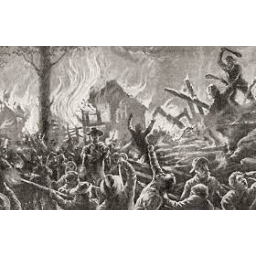
Bleeding Kansas describes the period of repeated outbreaks of violent guerrilla warfare between pro-slavery and anti-slavery forces following the creation of the new territory of Kansas in 1854. In all, some 55 people were killed between 1855 and 1859.
Most of the violence was relatively unorganized, small scale violence, yet it led to mass feelings of terror within the territory.
Bleeding Kansas

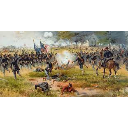
The American Civil War was a civil war in the United States between the Union and the Confederacy. The central cause of the war was the status of slavery, especially the expansion of slavery into territories acquired as a result of the Louisiana Purchase and the Mexican–American War.
Results: Dissolution of the Confederate States,U.S. territorial integrity preserved, Slavery abolished, Beginning of the Reconstruction era, Passage and ratification of the 13th, 14th and 15th amendments to the Constitution of the United States
Civil War Begins

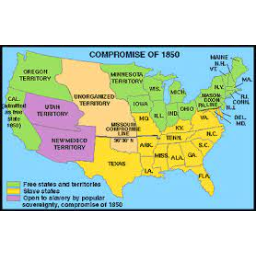
Compromise of 1850
The Compromise of 1850 was a package of five separate bills passed by the United States Congress in September 1850 that defused a political confrontation between slave and free states on the status of territories acquired in the Mexican–American War.

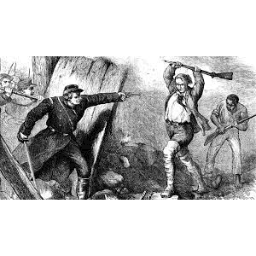
John Brown’s Raid at Harpers Ferry
John Brown's raid on Harpers Ferry was an effort by abolitionist John Brown, from October 16 to 18, 1859, to initiate a slave revolt in Southern states by taking over the United States arsenal at Harpers Ferry, Virginia. It has been called the dress rehearsal for, or Tragic Prelude to the Civil War.

Kansas-Nebraska Act
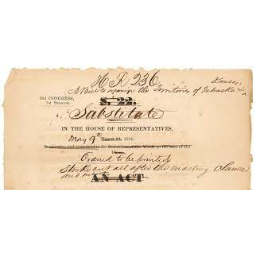
The Kansas–Nebraska Act of 1854 was a territorial organic act that created the territories of Kansas and Nebraska. It was drafted by Democratic Senator Stephen A. Douglas, passed by the 33rd United States Congress, and signed into law by President Franklin Pierce.


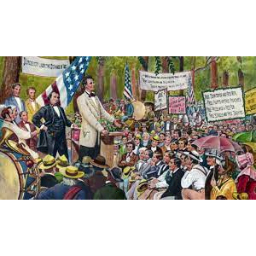
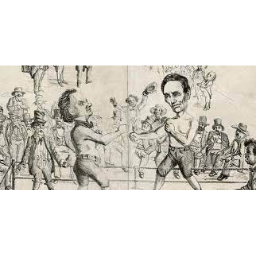
The Lincoln–Douglas debates were a series of seven debates between Abraham Lincoln, the Republican Party candidate for the United States Senate from Illinois, and incumbent Senator Stephen Douglas, the Democratic Party candidate.
Lincoln-Douglas Debates


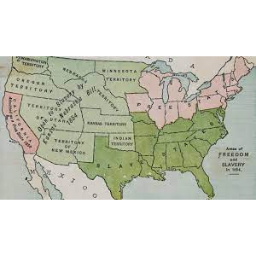
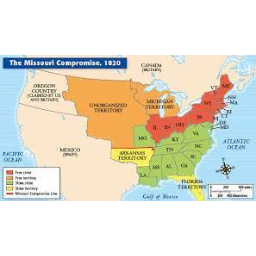
Missouri Compromise, (1820), in U.S. history, measure worked out between the North and the South and passed by the U.S. Congress that allowed for admission of Missouri as the 24th state (1821). It marked the beginning of the prolonged sectional conflict over the extension of slavery that led to the American Civil War.
Missouri Compromise

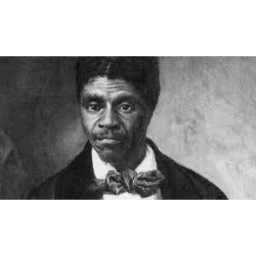
Was a landmark decision of the United States Supreme Court in which the Court held that the United States Constitution was not meant to include American citizenship for people of African descent, regardless of whether they were enslaved or free, and so the rights and privileges that the Constitution confers upon American citizens could not apply to them. The Supreme Court's decision has been widely denounced, both for how overtly racist the decision was and its crucial role in the start of the Civil War four years later.
The Dred Scott Decision

- Full access to our public library
- Save favorite books
- Interact with authors

- < BEGINNING
- END >
-
DOWNLOAD
-
LIKE
-
COMMENT()
-
SHARE
-
SAVE
-
BUY THIS BOOK
(from $2.99+) -
BUY THIS BOOK
(from $2.99+) - DOWNLOAD
- LIKE
- COMMENT ()
- SHARE
- SAVE
- Report
-
BUY
-
LIKE
-
COMMENT()
-
SHARE
- Excessive Violence
- Harassment
- Offensive Pictures
- Spelling & Grammar Errors
- Unfinished
- Other Problem

COMMENTS
Click 'X' to report any negative comments. Thanks!