 This book is dedicated to ALL students who explore the world of science!
This book was created and published on StoryJumper™
©2014 StoryJumper, Inc. All rights reserved.
Publish your own children's book:
www.storyjumper.com



To become scientists we must tap into our
curiosity. We must think like scientists and ask
questions, using the scientific method as our
guide!


 Let's Become Scientists
Let's start our
experiments!
The scientific method is a way to ask and answer scientific
questions by making observations and doing experiments.
Using the scientific method will help you on your journey to
discover the mystery and magic of science!


 We Use the Scientific Method
We will
remember to
use the
Scientific
Method!

1. Observe an activity in the world around you and ask a
question. Tip: ask yourself what do I want to learn?
2. Research the question! Find information about the
topic.
3. Make a possible explanation for that activity, an
educated guess, called a hypothesis. Use your
hypothesis to make predictions!
4. Test those predictions.
5. Write down your findings.
6. Come to a conclusion about your hypothesis.
for you to remember while doing the labs..

In this book we will use the scientific
method to explore chemical changes
and reactions!


Hi! I'm Rusty I.
Ern, but you can call
me Rusty! I'll be
your tour guide!

In chemistry, a reaction happens when two or
more molecules interact and the molecules
change. What molecules are they? How do they
interact? What happens? The possibilities are
infinite.
When you are trying to understand reactions,
imagine that you are working with the atoms.
Imagine the building blocks are right in front of
you on the table, instead of billions of reactions
in your beaker. Sometimes we do this using our
chemistry materials to help us visualize the
movement of the atoms.
 What is a Chemical Reaction?
1. A chemical change must occur. You start with one
compound and turn it into another. That's an example of a
chemical change. A steel garbage can rusting is a chemical
reaction. That rusting happens because the iron (Fe) in the
metal combines with oxygen (O2) in the atmosphere.
2. A chemical reaction can happen with anything, just as
long as a chemical change occurs (not a physical one). A
reaction could include atoms, ions, compounds, or
molecules of a single element. If you put pure hydrogen gas
(H2) and pure oxygen gas in a room, they might be
involved in a reaction to form water (H2O).
 There are a few key points you
 should know about chemical reactions:

1) Combustion: A combustion reaction is when oxygen combines with another compound
to form water and carbon dioxide. These reactions are exothermic, meaning they produce
heat.
2) Synthesis: A synthesis reaction is when two or more simple compounds combine to form
a more complicated one.
3) Decomposition: A decomposition reaction is the opposite of a synthesis reaction - a
complex molecule breaks down to make simpler ones.
4) Single displacement: This is when one element trades places with another element in a
compound.
5) Double displacement: This is when the anions and cations of two different molecules
switch places, forming two entirely different compounds.
6) Acid-base: This is a special kind of double displacement reaction that takes place when
an acid and base react with each other.
Here they are, in no particular order:

In this book, we will complete two lab
experiments to explore chemical
properties and reactions :
1) Acid and Bases Lab
2) Tie Dye Lab



I'm ready to be a scientist
and use the scientific
method to explore
chemical reactions!
 Let's get
 started then!


Introduction
In this lab you will learn about acids and bases. Every liquid
you see will probably have either acidic or basic traits. So
what makes an acid or a base? A chemist named Svante
Arrhenius came up with a way to define acids and bases in
1887. He saw that when you put molecules into water,
sometimes they break down and release an H+ (hydrogen)
ion. At other times, you find the release of an OH-
(hydroxide) ion. When a hydrogen ion is released, the
solution becomes acidic. When a hydroxide ion is released,
the solution becomes basic. Those two special ions
determine whether you are looking at an acid or a base.
Properties of acids include the following:
React with most metals to form hydrogen gas
Taste sour (like lemons)
Frequently feel "sticky"
Usually gases or liquids
Properties of bases include:
Feel "slippery". (FYI: The slippery feeling is caused because your
skin dissolves a little when you touch them.)
Taste bitter (like baking soda)
React with oils and greases (that's why they're used as drain and window cleaners)
Frequently solids (though ammonia is a gas that's usually dissolved in water)
When an acid and a base are placed together, they react to neutralize the acid and
base properties, producing a salt. The H(+) cation of the acid combines with the
OH(-) anion of the base to form water. The compound formed by the cation of the
base and the anion of the acid is called a salt. The combination of hydrochloric acid
and sodium hydroxide produces common table salt, NaCl:






Here we will write our lab
together using the
scientific method. Fill in as
you complete the lab.

Purpose/Research Question: What do acids and bases tell
us about chemical properties and reactions?
__________________________________________
Hypothesis: What do you predict will happen to each
solution?____________________________________
__________________________________________
Materials:
- Test Substances
- Red and Blue Litmus Paper
- Goggles
- Small beakers or cups
Safety Precaution:
The first thing we do before any chemistry experiment is
gear up. We put on gloves and goggles to make sure we are
not harmed by any acids. No one wants to accidentally squirt
of citric acid (lemon juice) in their eye! Ouch!


Procedure:
1. Put on gloves and goggles and prepare
lab station.
2. Arrange the solutions in order (1,2,3...).
There should be 7 separate solutions total.
Predict the outcome of each solution.
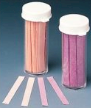
3. Get your red and blue litmus paper. Test
each solution by dipping one blue strip and one red strip into each
solution. Make sure not to get any on your hands! The litmus acts as an
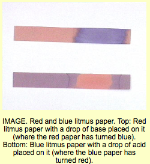
indicator by turning red in an acidic solution or turning blue in a basic
solution or remaining the same colors if it is neutral.
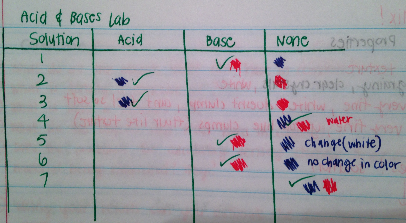
4. Indicate the color change or lack of color change in your data table.
5. Clean up your lab area completely.
Data Table:
Red - indicated red litmus paper was tested
Blue - indicated blue litmus paper was tested
You've previewed 15 of 24 pages.
To read more:
Click Sign Up (Free)- Full access to our public library
- Save favorite books
- Interact with authors


- < BEGINNING
- END >
-
DOWNLOAD
-
LIKE(2)
-
COMMENT()
-
SHARE
-
SAVE
-
BUY THIS BOOK
(from $4.79+) -
BUY THIS BOOK
(from $4.79+) - DOWNLOAD
- LIKE (2)
- COMMENT ()
- SHARE
- SAVE
- Report
-
BUY
-
LIKE(2)
-
COMMENT()
-
SHARE
- Excessive Violence
- Harassment
- Offensive Pictures
- Spelling & Grammar Errors
- Unfinished
- Other Problem





COMMENTS
Click 'X' to report any negative comments. Thanks!