
Facts:
Adams and Congress passed an act which created new courts, added judges, and gave the president more control. James Madison ignored this so it was not allowed to happen. Marbury got mad and told him to do his job.
Majority Opinion:
They could not change the issue because Congress didn't have the power to modify or change the Constitution because the Constitution is placed before the laws.
Legacy:
They created the power to call a law unconstitutional.
Marbury v. Madison 1803
Facts:
The state of Maryland passed rules to collect money from people that had money in The Second Bank of the United States. James McCulloch, who worked at the bank, decided not to pay the money because he was mad at the rule.
Majority Opinion:
Congress had the power to control the rules of the banks and Maryland couldn't take peoples money.
Legacy:
Congress created a national bank.
McCulloch v Maryland 1819
Facts:
People were being taken to fight in the war. Charles Schenck was against the war and attempted to get people to agree with him on being peaceful. He ended up getting in trouble with the law. Schenck argued that he was allowed to be against the war because he has the power to speak up about what he believes.
Majority Opinion:
Holmes said that the freedom of speech does not work in this situation because it could create a problem while they are already dealing with a war.
Legacy:
The supreme court created a test to decide when a state could legally limit a person's free speech rights.
Schenck v United States 1919
Facts:
Children of different colors were not allowed to go to the same school as other white children. This is called segregation. People of color argued that this segregation went against their rights.
Majority Opinion:
Separate but equal schools for children is unequal and it goes against peoples privileges.
Legacy:
It ended segregation of color in schools. It also overruled the "separate but equal" idea made in Plessy v. Ferguson.
Brown v Board of Education 1954
Facts:
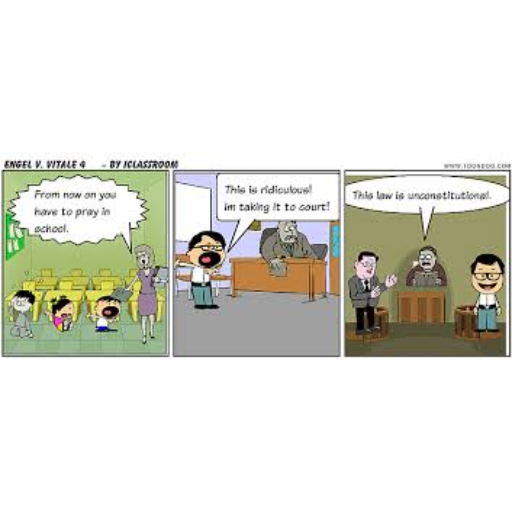
New York State schools created a voluntary prayer for the start of each day. Groups disliked the prayer and took the problem to court.
Majority Opinion:
The uses of prayers went against the establishment clause. The establishment clause says that congress will make no law making a official religion.
Legacy:
Prayers are not allowed to be held in public schools
Engel v Vitale 1962
Facts:
Charles Baker and other Tennessee citizens votes were devalued. They argued that they were denied equal protection of the laws.
Majority Opinion:
Redistricting is a an understandable question under the equal protection clause.
Legacy:
Federal courts can hear cases that have a favoring party and redrawing of Congressional District lines.
Baker v Carr 1962
Facts:
Clarence Gideon was charged in Florida for breaking and entering. When he showed up in court without a lawyer, Gideon asked if he could be given one. The court did not give him one.
Majority Opinion:
Anyone that is accused of a felony where they might go to prison is allowed a lawyer for free.
Legacy:
People facing serious criminal charges have a right to a lawyer, paid by the state, if they cant afford one.
Gideon v. Wainwright 1963
Facts:
A group of students in Des Moines held a meeting to plan a way to show their support for a truce in the Vietnam war. They decided to wear black armbands throughout the holiday season and to fast on December 16 and New Year's Eve. The principals of the schools found out and said that anyone wearing an armband would be asked to take it and if not would be taken out of school.
Majority Opinion:
The Supreme Court said that the armbands represent pure speech.
Legacy:
Students keep their first amendment rights when they step onto school property.
Tinker v Des Moines Independent Community School 1969
Facts:
The Nixon Administration tried to stop the New York Times and Washington Post from publishing papers from a secret Defense Department study talking about the history of United States activities in Vietnam. Nixon argued that stopping this was necessary to protect national security.
Majority Opinion:
The government said that the claim of prior restraint of the press in this case was not necessary.
Legacy:
The Court is very likely to find cases of government secrecy unconstitutional.
New York Times Co. v United States 1971
- Full access to our public library
- Save favorite books
- Interact with authors
- < BEGINNING
- END >
-
DOWNLOAD
-
LIKE(1)
-
COMMENT()
-
SHARE
-
SAVE
-
BUY THIS BOOK
(from $5.99+) -
BUY THIS BOOK
(from $5.99+) - DOWNLOAD
- LIKE (1)
- COMMENT ()
- SHARE
- SAVE
- Report
-
BUY
-
LIKE(1)
-
COMMENT()
-
SHARE
- Excessive Violence
- Harassment
- Offensive Pictures
- Spelling & Grammar Errors
- Unfinished
- Other Problem






COMMENTS
Click 'X' to report any negative comments. Thanks!