
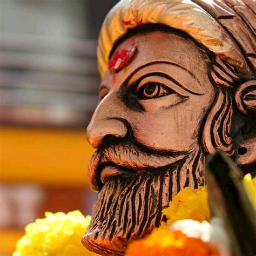
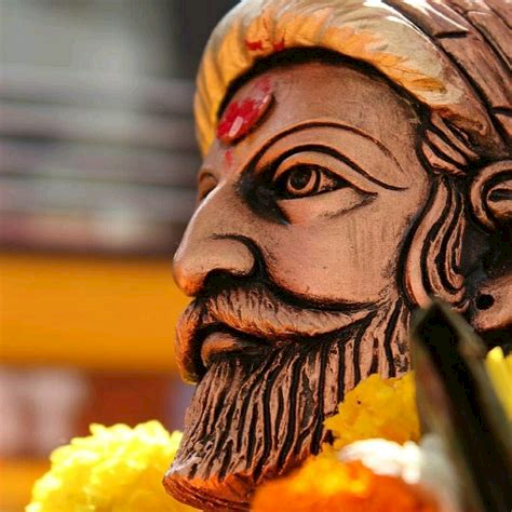
I, Sahyadri is here to tell a story of my bravest child... Chhatrapati Shivaji Raje Bhonsale.
Chhatrapati Shivaji Raje Bhonsale united all the tribes in maharashtra under one Chatra. Hence he became the first Chhatrapati.
Chhatrapati Shivaji Raje Bhonsale is the father of Indian Navy and lead many naval expeditions.
Since his childhood, Chhatrapati Shivaji Raje Bhonsale was fond of listen to stories of Ram and Krishna and he grey up listening to the stories of victory of good over the evil from his Mother Rajmata Jijabai.
Chhatrapati Shivaji Raje Bhonsale took oath at Raireshwar and laid down the foundation of his very own swarajya.
He not only changed the history but also showed the people how women should be respected.
Let us read more about Chhatrapati Shivaji Raje Bhonsale through this flipbook.
At the time when the whole Indian Continent was entering upon a new phase of political life and bold schemes of social and political re-construction are being daily pressed for acceptance, no apology would seem to be necessary for the publication of a new life of Shivaji
For among the glittering multitude of mighty kings whose names adorn the pages of Indian History, the name of Shivaji stands forth in bold relief as the author of a momentous national revival that changed the destinies of India. And this is a fact allowed by all historians, even though the editors of the Rulers of India Series have chosen to ignore him and denied him a place in their Series, while including many other "Rulers" who were more or less mediocrities, when compared with the great Shivaji.
If ever in the pre-British period of Indian History, there was anything that might be compared with the great national movements of Western countries, it was the political movement which laid the foundations of the Maratha Swarajya and that movement would have been utterly destitute it all. its national glory and significance, were it not for the genius and originality of one master mind who presided over the whole event, built a nation out of chaos and breathed life and purpose. Such a man was Shivaji.
Of the empire which he built up, only a few fragments have escaped the ravages of
time. The rest has crumbled down and gone the way that all great empires in the world have gone. But the spirit of it has remained behind. But the name of Shivaji still lives to kindle and inspire the growing manhood of Maharashtra. Inspired by the stirring events of the late war, when the Maratha soldiers were called upon to display their native valour on the battle-fields of the West, this work. At the time when this work was undertaken,
there was no worthy biography in the English language of the life and career of the great
King who during the night of Mahomedan despotism dreamt the dream of national independence and realized it. It seemed a standing reproach to the Indian community,
with their newly awakened political consciousness, commensurate with
the greatness of the national hero, in that language which has done more than anything else to unite us into a nation and stimulate our national aspirations.
This English version was taken in hand about severe years ago. As the work proceeded it was found necessary to make considerable alterations in the original Marathi
text of Mr. Keluskar's Life, as published in 3907. It was found necessary to take notice of the mass of new material and discoveries which have accumulated in the course of
the last fourteen years. In its final draft the present English version has practically become a new and independent work and has already served as a basis for the second Marathi
edition, which in a revised and considerably
enlarged form, as compared to the first edition, was published by Mr. Keluskar early in 1921. This work has been thoroughly revised and retouched from time to time during
the last seven years. It is quite up-to-date, so far as our knowledge of Shivaji and the men and things of his time extends and the conflicting theories that have been proposed
as regards the purpose or policy for which he strove and the men of wisdom or action who counselled or co-operated in his plans.
While the preparation of this work was in its various stages of progress, three important English works on Shivaji appeared in print, one of which has already gone into a second edition. Some explanation would seem to be
necessary to justify the publication of a fourth work on the same subject. The first and obvious answer is that none of these works can be called a faithful biography of Shivaji,
that is to say, a biography which is at once full and exhaustive and traces the development of his life-work from beginning to end in order.
The work of Mr. Kincaid reviews the work of Shivaji as a fragment of the History of the Maratha People, that of Prof. Jadunath Sarkar discourses upon " Shivaji and his Times " and
often forgets the hero while discoursing upon his " Times ", that of Prof. Rawlinson is avowedly a monograph, too meagre in its scope to comprise the life-work of a great hero like Shivaji. The thanks of the Maratha reader are due to all these scholars for the new light they have thrown on many obscure points in the life of their national hero,
and to Prof. Rawlinson and Mr. Kincaid in particular for the generous way in which they have interpreted the motives and character of the great King. The earliest of this triad is the Life of Shivaji by Principal Rawlinson. It
is a generous appreciation of Shivaji's work and character. But the monograph, besides being too meagre in size for the magnitude of the task, devotes a good deal of its contents to discussions upon somewhat irrelevant topics. The impression that remains after a perusal of the book is that the author's purpose is to
show that the new era of Shivaji after all inaugurated a new type of bureaucracy, and the author seems to suggest that from the times of Ashoka and Chandragupta down to present times, the bureaucratic form of government has prevailed in India and must inevitably prevail for all time. The author forgets that there are bureaucracies and bureaucracies and that a bureaucracy with a Shivaji at its head ceases to be a bureaucracy, both in form and substance. Mr. C. A. Kincaid, who writes in collaboration with Rao Bahadur D.
B. Paraenis, has devoted some 170 pages of the first volume of his History of the Maratha People to the story of Shivaji. The authors have taken little notice of the stirring events of the career of Shahaji and have chosen to ignore many a controversy which has caused an acute tension of feeling among scholars. This history is full of legends and folk-lore tales and apparently attaches as much importance to
them as to matters of serious history.
Its highest virtue is its picturesqueness. Although Mr. Kincaid has repeated
the orthodox version as to the date, when Shivaji enrolled himself as a disciple of
Ramdas Swami, it is some consolation to think that Mr. Kincaid has not allowed the infatuation of the Ramdas cult to blind him to such an extent as to ascribe to the preceptor the credit of Shivaji's glorious achievements.
He has had sense enough to see, as some
patriotic and over-zealous Maharashtra scholars have not that such a representation of the relations between the preceptor and the disciple would reduce the national hero to
a mere puppet. The supreme merit of Mr. Kincaid's work is his enthusiastic and unreserved admiration of the Maratha
people. Prof. Jadunath Sarkar's " Shivaji and His Times " is the last of this triad. 1 It is a noble work marred with strange flaws.
Mr. Kincaid's History and Prof. Sarkar's
Shivaji stand at two opposite extremes of historical method and style. The one is romantic in conception and uncritical in method, the other is hypercritical in method and skeptical in its intellectual outlook. The merits of Sarkar's work are great. He has had access to a wealth of Mahomedan and British sources and authorities, the very existence or which had not been previously suspected. The fundamental fault of the work is that it appears as an overflow of the vast amount of
historical material he had collected for his monumental work upon Aurangzeb. His sympathies are with the Moguls and the commanders of the Mogul empire. His sympathies are with the British factors at Surat and Bijapur. His sympathies are anywhere except with Shivaji and his gallant companions. Shivaji has fallen into the "back-ground. Sarkar's paeans of praise are poured forth in unstinted measure, now in honour of ShaistaKhan, now
in honour of Jay Singh.
He conducts his reader into the Mogul camp, he brings him in the wake of the Mogul armies
and the Mogul standards. Shivaji is at best patronized here and there with a nodding familiarity and spoken of as a familiar underling with the name of " Shiva ". This is not intended, but such is the effect produced. The critical estimate of Shivaji's character and work in the last seven pages of this work is an appreciative review of the character and life-work of the great King and is, strange to say, quite at variance with the hyper-critical
denunciations expressed in the fourteen pages that immediately precede it, and on the whole gives the lie direct to many of the generalizations which are found interspersed in the earlier part of the work. By far the most valuable service rendered by Prof. Sarkar is his vindication of Shivaji from the charge of
murdering Afzal Khan. Again he has not fallen into the error of exaggerating the influence of Ramdas Swami upon Shivaji.
- Full access to our public library
- Save favorite books
- Interact with authors
- < BEGINNING
- END >
-
DOWNLOAD
-
LIKE
-
COMMENT()
-
SHARE
-
SAVE
-
BUY THIS BOOK
(from $9.79+) -
BUY THIS BOOK
(from $9.79+) - DOWNLOAD
- LIKE
- COMMENT ()
- SHARE
- SAVE
- Report
-
BUY
-
LIKE
-
COMMENT()
-
SHARE
- Excessive Violence
- Harassment
- Offensive Pictures
- Spelling & Grammar Errors
- Unfinished
- Other Problem






COMMENTS
Click 'X' to report any negative comments. Thanks!