


Dedicating this book to all the lovely collectors of vocabulary and those who have to write them down first, for them to stick!

Allomorphs
Predictable variations in the pronunciation of morphemes. For instance, the plural morpheme in English is /s/ following nouns ending in an unvoiced sound (e.g. cats) and /z/ following a voiced sound (e.g. dogs).
Examples:
[s] _ Hats [z] _ Cars
Bound Morpheme
A morpheme that cannot stand alone but needs to be attached to a free morpheme. The word premeasured contains two bound morphemes: pre- and -ed.
Derivational
- Prefixes: de, pre, in, un
_ Suffixes: ion, ly, able, er
Inflectional
-Suffixes: ing, ed
Clause
A syntactic unit that can be analyzed into clause functions. For instance, The car is old is a clause because it contains a subject, The car; a predicator, is; and a subject complement, old.
Because he gave her a puppy

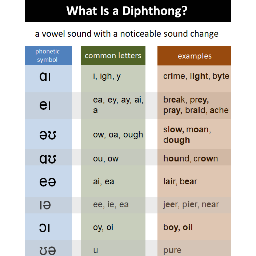
Diphthong
A type of vowel occurring within a single syllable whose quality changes during its articulation. Examples of diphthongs in English include the middle sounds in words such as house /haυs/ and fight /faIt/.

Embedding
A structure occurring within some other structure. In the phrase, the leader of the company, of the company is a prepositional phrase occurring within a noun phrase. Therefore, the prepositional phrase is embedded in the noun phrase.
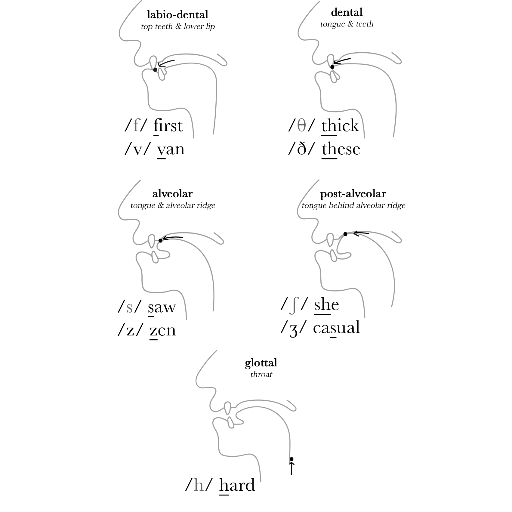
Fricatives
A manner of articulation associated with consonants such as /s/ in sip and /z/ in zip in which the airstream is constricted in the oral cavity, lead- ing to a certain degree of turbulence.

Grammar:
The study of rules of language at various levels of structure, from the individual speech sound up to the level of the sentence. A grammar of English, for instance, would contain all the rules necessary for studying the structure of the English language.

Hypernym:
A word whose meaning would include the meaning of a more specific word. For instance, the word flower is a hypernym of tulip because the meaning of tulip is included in the meaning of the more general word flower. Compare with hyponym.

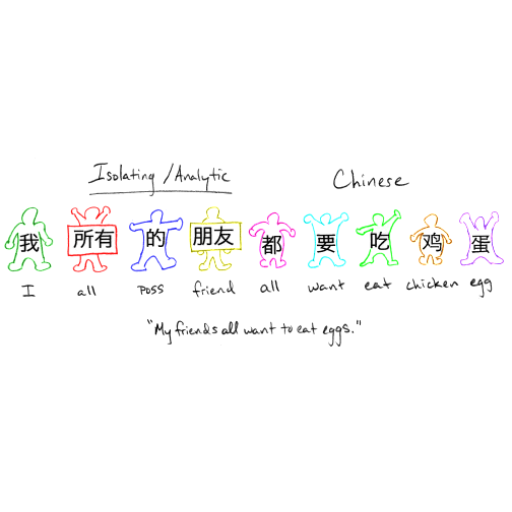
Isolating
Languages that tend to express meaning in separate morphemes. Chinese is a heavily isolating language lacking any inflections: words tend to be monosyllabic. Although English has inflections, it has lost most of its inflections over time and is moving towards being a more isolating language.

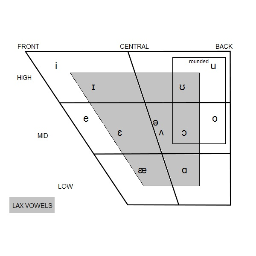
Lax Vowel
A vowel such as /i/ in bit and // in back can only occur in a closed syllable.

Minimal Pairs
Words that differ by only one sound in the same position (e.g. fit /fIt/ and kit /kIt/). Minimal pairs are useful for determining which sounds in a language are phonemes.
Nasal
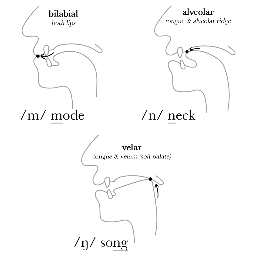
A manner of articulation associated with consonants, such as /m/ in moon, during whose articulation the air flows through the nasal cavity.

- Full access to our public library
- Save favorite books
- Interact with authors

- < BEGINNING
- END >
-
DOWNLOAD
-
LIKE
-
COMMENT()
-
SHARE
-
SAVE
-
BUY THIS BOOK
(from $3.99+) -
BUY THIS BOOK
(from $3.99+) - DOWNLOAD
- LIKE
- COMMENT ()
- SHARE
- SAVE
- Report
-
BUY
-
LIKE
-
COMMENT()
-
SHARE
- Excessive Violence
- Harassment
- Offensive Pictures
- Spelling & Grammar Errors
- Unfinished
- Other Problem

COMMENTS
Click 'X' to report any negative comments. Thanks!