









This book is dedicated to every person who reads it...
...thank you, readers!

This book will be your easy-to-understand handbook to the world of money. After all, managing money is an important skill because regardless of what we do or where we are, we are all affected by it.


What is finance?
Good question!

the management of money
It includes activities such as borrowing, lending, and saving money.
FINANCE is...

A business keeps track of four main elements of finance, which are:
1. the balance sheet
2. owner's equity (found at the end of a balance sheet)
3. the cash flow statement
4. the income statement
These terms may not make sense to you now, but together, we will make sense of these words.

Part 1: What is the Balance Sheet?
The balance sheet reports all of a company's assets and liabilities.
A company's assets include all of which it OWNS.
A company's liabilities include everything it OWES.
So, your assets include your bed, toys and books, desk, and everything else you own.

Meanwhile, your liabilities might include paying back your mom for the vase you accidentally broke the other day.
So maybe a company owes money to an investor, marketer, bank, or another producer. For example, it may still need to pay back a loan from the bank it borrowed to start the business. This will be recorded under liabilities.
And, a company's assets include the machinery, equipment, cash, and the other things it owns.
Whatever is left after the liabilities are subtracted from the company's assets will be divided EQUALLY among the owners. The share of assets that owners receive is called owner's equity.
Calculating equity is simple. Follow this rule:
assets -- liabilities = owner's equity
One last thing: the owner's equity is usually found at the bottom of a company's balance sheet.
Part 2: What is Owner's Equity?

If you and a friend join efforts to run a lemonade stand, you might agree to share the money you make equally to be fair.

Not all the money you make is equity because you and your friend had to use the money to buy the supplies.
Pretend you and your friend each have $50 in your allowances. Your parents spend $5 on supplies for the stand but you have to pay them back. Each kid's liabilities include these $5. Your assets are the $50.
At the stand you make a total of $20, so each of you gets $10.
Your current assets are $60. After paying to pack your liabilities (the $5), you have $55.
Remember the rule: assets -- liabilities = equity
The equation applied here: $60 -- $5 = $55
Part 3: What is the Income Statement?
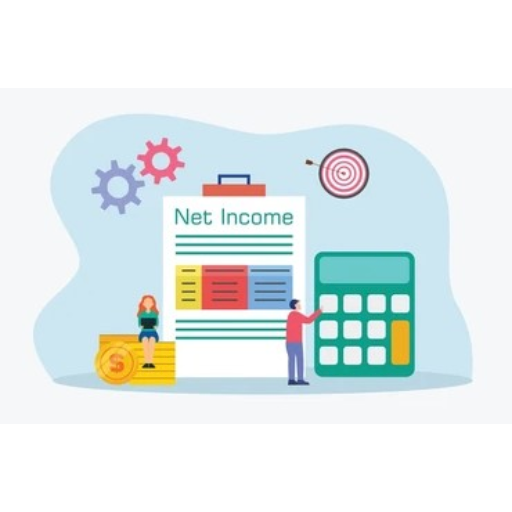
A business's income statement provides a summary of its profit over some time.
It includes information including total revenue and expenses during a certain cycle of time, both of which are used to calculate the net income.
total revenue -- expenses = Net income


A business's total revenue refers to the money it makes without subtracting the money it needs to pay.
A business's expenses include everything it needs to pay; wages, rent, advertising costs, and more are all counted as expenses.
There are three important things to know about a business's net income.
1. They are calculated at the end of a business cycle (a period when the business is operating).
2. The net income can change over time. This is natural.
3. Companies look at their net income to see the "big picture" of financial operations over time.

- Full access to our public library
- Save favorite books
- Interact with authors

- < BEGINNING
- END >
-
DOWNLOAD
-
LIKE
-
COMMENT()
-
SHARE
-
SAVE
-
BUY THIS BOOK
(from $5.19+) -
BUY THIS BOOK
(from $5.19+) - DOWNLOAD
- LIKE
- COMMENT ()
- SHARE
- SAVE
- Report
-
BUY
-
LIKE
-
COMMENT()
-
SHARE
- Excessive Violence
- Harassment
- Offensive Pictures
- Spelling & Grammar Errors
- Unfinished
- Other Problem

COMMENTS
Click 'X' to report any negative comments. Thanks!