« Firstly, to God for the opportunity he gives us to study and also to our teacher Antonio de Jesús Chicas, who has been our guide and mentor on this exciting learning journey. »

BLOCK # 1 (BY VICENTA TORRES)
1.0 Meeting and Greeting People
1.1 Vocabulary
1.2 Formal and casual presentations
1.3 Verb To Be - Simple Present
1.4 The verb To Be is used with singular and plural nouns and pronouns.
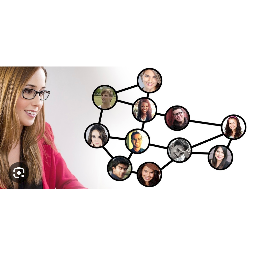
1.0 Meeting and Greeting People
-In this topic, we will deal with 2 very important concepts that are
Meeting: Have treatment and communication
with someone.
Greeting: It is a gesture of daily and professional life, a sign of respect and consideration for other people

1.1 Vocabulary
Words we use when greeting other people, whether formal or informal.
FORMAL INFORMAL
*Hello! * Hi!
*Good to see you * Hey there!
*Good morning! * How is it going?
*Good afternoon! * How you doing *Good evening * Alright!
*How are you? * How's life
*what's happening * Long time,no see you
*Hello good



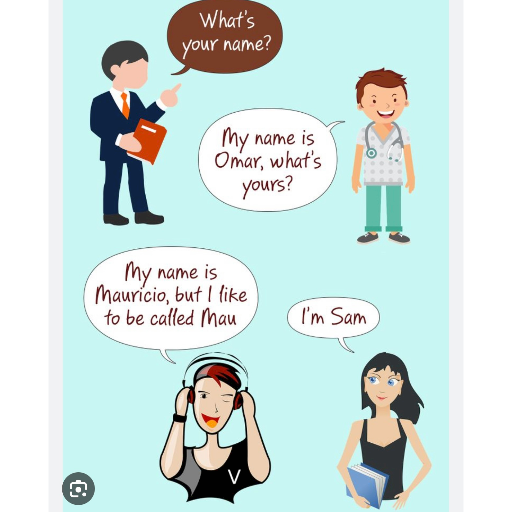
1.2 Formal and casual presentations
Formal Formal
My name is Maria.
What is your name? What is your name?
Casual Casual
I'm Marcela, My name is Leonel what
What's your name? your name voice?



1.3 Verb To Be- simple present
This verb is frequently used in English so it is fun to understand its difference. We have many ways to use the verb To Be but it is important to know how to write sentences using the correct structure and forms. This allows you to speak and communicate using simple phrases.
The verb To Be is used as a main verb or as an auxiliary verb
Main: to write a person, object, activities, and more
examples
I am Mario
I am Mexican
I am not a plumber, I am a teacher.

1. 4 The verb To Be is used in singular and plural nouns and pronouns:
Examples
-I am in my car
-They are Teacher
-He is a good player
-We are footballers
We have many ways to use the verb To Be but it is important to know how to write sentences using the correct structure
example:
positive: I am from Jamaica
negative: I am not a Teacher
interrogative: You are married?
BLOCK # 2 (BY VICENTA TORRES)
2.0 Asking for and giving personal information.
2.1 Why it is important to ask questions and answers
2.2 Questions and possible answers in each category.
2.3 Conversation examples of how to ask and give information.
2.4 Vocabulary.
2.0 Asking for and giving personal information

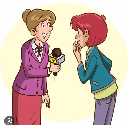
This topic is of great importance since people occasionally and in different places can ask for personal information such as name, address, and date of birth. This is the basis of any conversation in English and therefore they are important when you meet someone. someone for the first time. It is essential for the rest of the conversation.
2.1 Why it is important to ask questions and answers
1 Through questions we can learn a lot in life
2- If we question ourselves more, we will get better answers
3- Asking makes them more flexible
4- Asking the right questions allows you to create a perfect environment
5- Answering questions creates security in the person
2.2 Questions and possible answers in each category
Name: Lucia
What is your name My name is: Roberto
what is your surname? My surname is: Pereira
Job or Occupation I am a Pilot
What do you do?
Where do you work? I work in Avianca
Age: How old are you? I am 35 years old
Phone number:
What is your cellphone number? My cellphone number is: 202 345 67 44
My address is 123 Metzerot
Address: street, 5th ave.
What is your address?
Where do you live? I live in Washington
Marital status I am single
What is your marital status
2.3 Conversation examples of how to ask and give information
2.4 Vocabulary
Below are keywords to obtain information from another person.
Vocabulary Explanation Example
Name word a that identifies animate What's your name?
or inanimate beings
Address the place one people live .where you live?
Jobs place where a person works where do you work?
what is your job?
BLOCK # 3 (BY VICENTA TORRES)
3.0 Talking about job and activities
3.1 Jobs and professions around the world
3.2 Simple present
3.3 What about the structure?
Our topic will be about people's jobs and activities to earn money without money. Jobs and benefits are critical to society because they boost the economy and satisfy people's needs.

3.0 Talking about jobs and activities
3.1 Jobs and professions around the world
Job Definition
Chef a person who cooks for restaurants
Doctor a person who treats and helps prevent some ailments.
Teacher controls the class prepares the material and the evaluation
Architect designs a wide variety of structures, houses, schools, and more.




3.2 Simple present
It is an activity that is real, regular, or habitual and there are three main uses while they are
1-for daily routines or habits:
Convey an action, a hobby, a habit, or something that occurs frequently
Examples:
I play basketball every day
He always leaves late in the morning
The store opens at 8 am


2-For things which are generally true.
The present simple is also used to indicate that something is true, was true and will be true.
Examples:
My mom lives in Mexico
My cousin doesn't play soccer
3- Scheduled events in the near future
Many times the present simple is used also for upcoming activities that are already scheduled in the future.
Examples:
The plane leaves at 8 PM
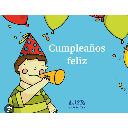
My birthday will start at 3 PM



3.3 What about the structure?
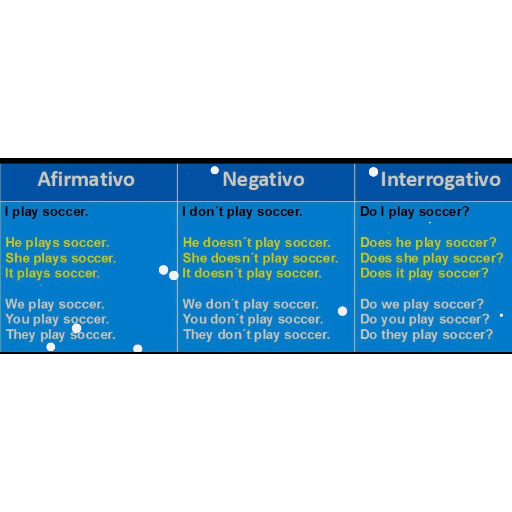
To write sentences correctly in present simple it is important to follow the structure
positive: subject+verb+complement
Negative: subject+don't/doesn't+verb+complement
Question: do/does+subject+verb+complement
Dialogue ( Maria and Saul)
S: Hello
M: Hello what is your name?
S: My name is Saul
M: Nice to meet you
S: Nice to meet you too
M: Where do you live Saul?
S: I live in El Salvador
S: Are you married, Maria?
M: No Saul, I'm very young.
M: Saul, what do you do in your free time?
S: Maria sometimes goes to the gym and other times listens to music.

M: Excellent, Saul
S: Maria, where do you work?
M: Saul, I have two jobs, one at school and one at the office
S: Congratulations Maria
M: Saul, nice to talk to you, nice to see you
S: Maria, thank you, nice to see you too.

BLOCK #4
4.0 Frequency Adverbs
4.1 The general rule of frequency adverbs
4.2 Adverbs Frequency
4.3 Extra adverbs vocabulary
BY: SABRINA REYES

4.0 FREQUENCY ADVERB
What are Frequency Adverbs??
These adverbs allow us to show how regularly something happens.
That is when we want to talk about how often we do something, or how often something happens.
For example: Sometimes I like to exercise
1.1 The general rule of frequency adverbs:
1- The general rule is that they are placed before the verb.
Subject+Adverb of frequency+verb+complement
*She always makes her breakfast.
2- The second most used is when the adverb comes after the verb To be
Subject+verb to be+adverb of frequency+complement
*You can always count on me.
3- Finally the adverb of frequency can also go at the beginning of a sentence. But only Usually, Frequently, Occasionally, Often and Sometimes. They can start or end a sentence.
Frequency adverb+Subject+Verb+Complement
*Sometimes I see her at the supermarket
Subject+verb+complement+frequency adverb
*I go to the gym regularly.
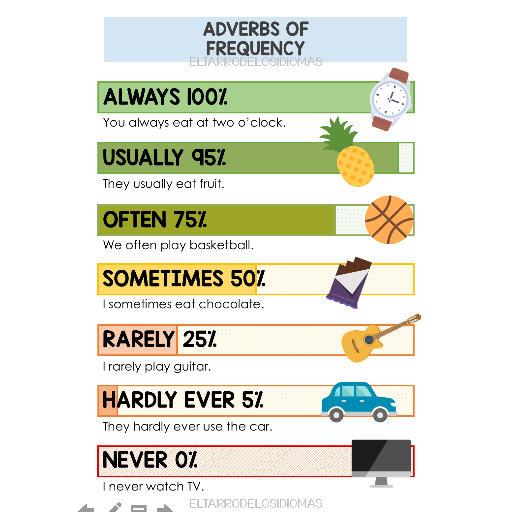
4.2 Adverbs Frequency
Each adverb has a percentage where it indicates how often we carry out an activity.
4.3 Extra Adverbs Vocabulary
Daily
Weekly
Monthly
Annually
Once
Twice
Three times
Diariamente
Semanalmente
Mensualmente
Anualmente
Una vez
Dos veces
Tres veces

BLOCK #5
5.0 Prepositions of time
5.1 What are they and what are they used for?
5.2 Other uses
5.3 Vocabulary
BY: SABRINA REYES
5.0 PREPOSITIONS OF TIME

In this topic we will
see in which cases to
use the prepositions
IN, ON and AT
A preposition of time that allows you to discuss a specific period such as a date on the calendar, one of the days of the week, or the actual time something takes place.
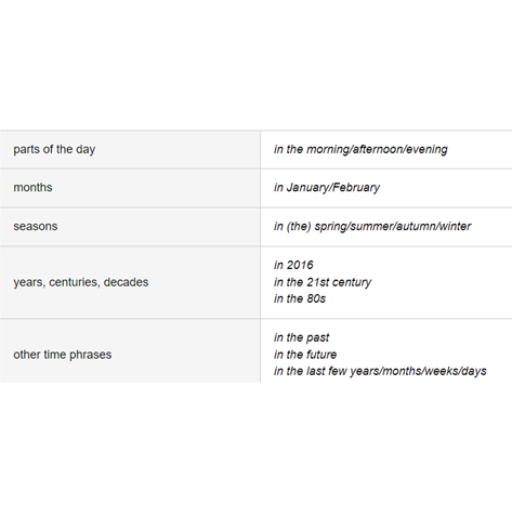
IN: It is used for months, years, periods.
-In August
-In 1989
-In the seventies
We can also use IN to talk about the future
-In a few weeks
In a couple of days
5.1 What are they and what are they used for?
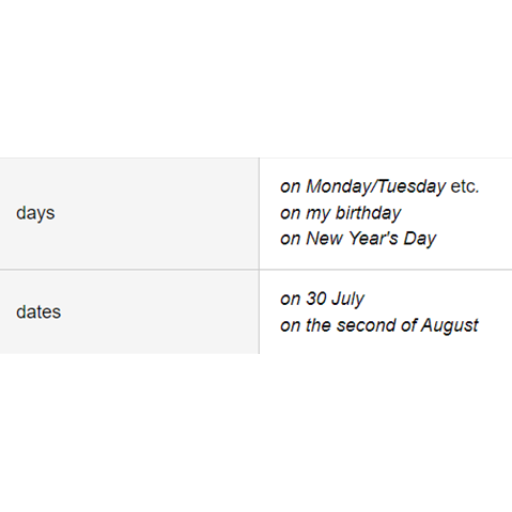
On: It is used for the days of the week and dates
-On Monday
-On Fridays
-On August 7th
-On Christmas day
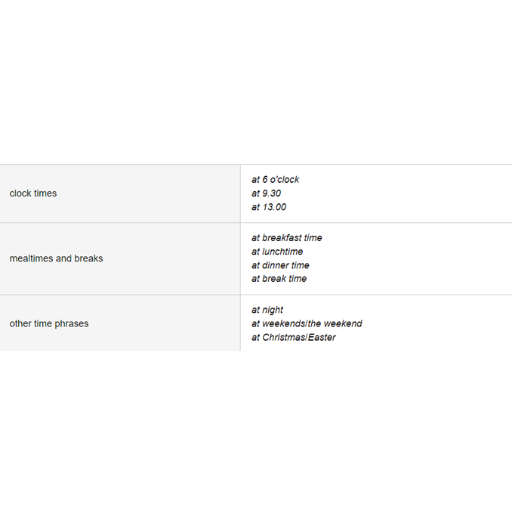
At: It is used for precise hours
-At two o´clock
-At 8:30 pm
5.2 OTHER USES "AT"
"IN"
"ON"
5.3 VOCABULARY
In the morning
In the afternoon
In the evening
In February
In the spring
In the winter
In 2013
In the 1990s
On Sunday
On Monday morning
On my bday
On a holiday
On a weekday
On Tuesday afternoon
On May 10
On the weekend
At night
At 10:30
At sunset
At noon
At midnight
At bedtime
At noon
At lunchtime


BLOCK #6
6.0 Simple present
6.1 Main uses of the Present simple
6.2 How do you use the present simple?
6.3 Structure
6.4 Affirmative structure
6.5 Actions that occur regularly
6.6 Proven facts or permanent actions
6.7 Actions in the future
6.8 To give instructions
6.9 Vocabulary
BY SABRINA MONJARAS
6.0 SIMPLE PRESENT
What is the present simple? The present simple or present indefinite, is a verbal tense in English equivalent to the present indicative in Spanish.
As its name indicates, the present simple is used to talk about the present, mainly in 4 cases.

6.1 Main uses of the Present Simple
1- Actions that occur regularly.
2- Proven facts or permanent actions.
3- Talk about actions in the future that will occur very soon or at a certain time.
4- To give instructions
6.2 How do you use the present simple?
Form #1: Define the subject
That is, you have to be clear about who will be talked about, for which a subject is chosen: He, She, It, I, You, We, They.

One factor to take into account here is that when talking about singular persons (he/she/it), an -s must be added to the end of the verb.
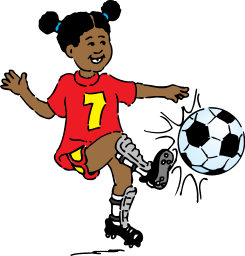
For example: - She plays tennis Every Saturday and they play soccer every sunday.

6.3 STRUCTURE
At the same time, there are different structures to put together sentences using the simple present: affirmative, negative and question.
6.4 Affirmative structure
Subject + Verb + Predicate
Example: He thinks his best friend is lying
Negative
Subject + Negative Auxiliary Verb (do not / does not) + Main Verb Infinitive + Predicate
Example: Sabrina doesn´t like popcorn, so we didn´t but any.
- Carlos is not very happy, you should talk to him.
In the last example, the above structure is not fulfilled because the main verb of the sentence is the verb to be, so only the particle “not” is added to turn it into a negation.
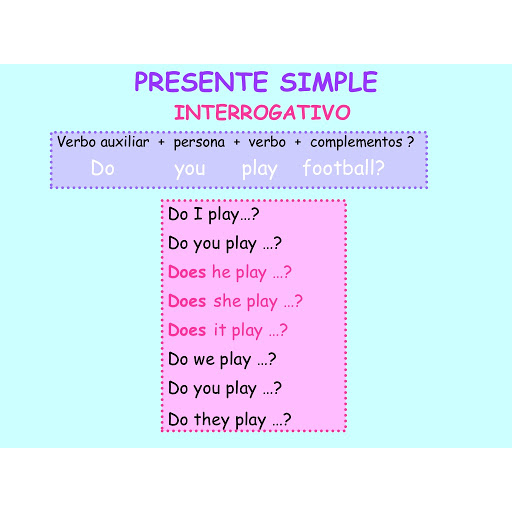
Questions
Auxiliary Verb (to be) + Subject + Verb+Complement
Example:
Uses
6.5 Actions that occur regularly
The present simple is not used to talk about actions that are happening at the same moment, but for those that occur regularly.
Example:
- Mario eats rice everyday
- We go to the club every saturday
- Charlie wakes up at 8 am every morning.


6.6 Proven facts or permanent actions
At the same time, the present simple is used for statements that are conventionally true or considered permanent.
Example:
- My grandmother lives in Chicago.
- The president of El Salvador is Nayib Bukele
6.7 Talk about actions in the future that will occur very soon or at a certain time.
If you have an appointment scheduled and need to tell someone, then the present simple can be your best ally.
Example:
The train leaves every day at 4 pm
6.8 To give instructions
- Don´t leave, I have something to show you.
- Boil 1L of watter and add it to the mix.
Vocabulary
I get up
I take a shower
I get dressed
I have breakfast
I go to work
I start work at 7 am
I watch tv
I go to bed
DIALOGUE
Celeste: Hello Hanna, what are you doing today?
Hanna: Hello Celeste, I'm going to the gym.
Celeste: oh seriously, what time are you going Hanna?
Hanna: I always go at 5:00 o'clock on Fridays
Celeste: Oh really! I usually exercise but playing sports, I really like soccer.
Hanna: I´ts okay at the dinner time after the gym I like to have a little protein for dinner from time to time to regain energy.
Celeste: Good! okay hanna I hope to go to the gym with you one day
Hanna: Clear! just tell me. and let's go! But yes, always remember to bring water.
Celeste: Oh right! see you Hanna
BLOCK # 7 (BY ANA SOLANO)
7.0 IDENTIFYING ITEMS AT THE SHOPPING MALL
7.1 VOCABULARY
7.2 SIMPLE PRESENT VS PRESENT CONTINUOUS
7.3 USES OF THE SIMPLE PRESENT
7.4 USES OF PRESENT CONTINUOUS
7.5 DIALOGUE
- Full access to our public library
- Save favorite books
- Interact with authors
- < BEGINNING
- END >
-
DOWNLOAD
-
LIKE(1)
-
COMMENT()
-
SHARE
-
SAVE
-
BUY THIS BOOK
(from $13.79+) -
BUY THIS BOOK
(from $13.79+) - DOWNLOAD
- LIKE (1)
- COMMENT ()
- SHARE
- SAVE
- Report
-
BUY
-
LIKE(1)
-
COMMENT()
-
SHARE
- Excessive Violence
- Harassment
- Offensive Pictures
- Spelling & Grammar Errors
- Unfinished
- Other Problem





COMMENTS
Click 'X' to report any negative comments. Thanks!