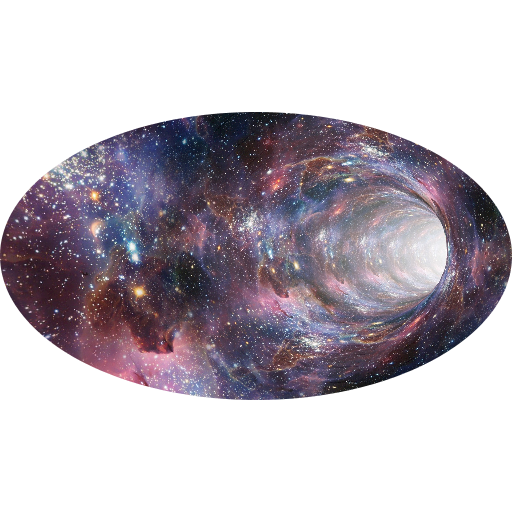
The Universe is a vast space in which we cannot explore with the technology we have right now. It would take us billions of years to develop technology like that. Wormholes are ways for you to connect with different parts of the universe. This is a way that could make time travel possible. The wormholes are also related to the fourth dimension. The problem with wormholes? "We know that they don't exist," says Lawrence Krauss, an astrophysicist at Case Western Reserve University in Cleveland and the author of The Physics of Star Trek. "The mouth of the wormhole would actually collapse to a black hole, and you'd never be able to get out of the mouth."A wormhole is a hypothetical structure connecting disparate points in spacetime, and is based on a special solution of the Einstein field equations.Wormholes are consistent with the general theory of relativity. While scientists have no evidence that wormholes actually exist in our world, they’re good tools to help astrophysicists like me think about space and time. They may also answer age-old questions about what the universe looks like.

Theoretically, a wormhole might connect extremely long distances such as a billion light-years, or short distances such as a few meters, or different points in time, or even a different universe. In 1995, Matt Visser suggested there may be many wormholes in the universe if cosmic strings with negative mass were generated in the early universe. Some physicists, such as Kip Thorne, have suggested how to make wormholes artificially.Because wormholes represent shortcuts through space-time, they could even act like time machines. You might emerge from one end of a wormhole at a time earlier than when you entered its other end.The constant pull of gravity affects every object in the universe, including Earth. So gravity would have an effect on wormholes, too. The scientists who are skeptical about wormholes believe that after a short time the middle of the wormhole would collapse under its own gravity, unless it had some force pushing outward from inside the wormhole to counteract that force. The most likely way it would do that is using what’s called “negative energies,” which would oppose gravity and stabilize the wormhole.

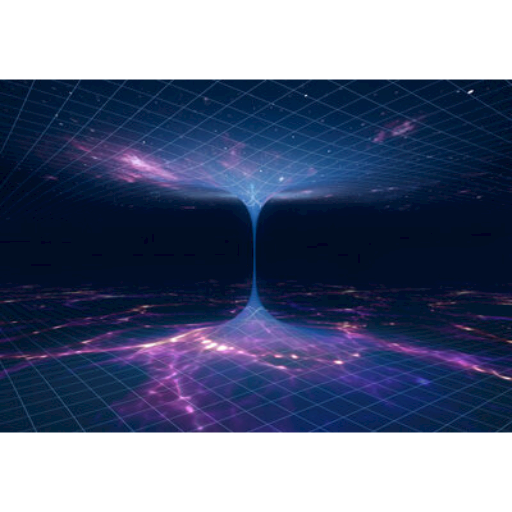
In 1928, German mathematician, philosopher and theoretical physicist Hermann Weyl proposed a wormhole hypothesis of matter in connection with mass analysis of electromagnetic field energy; however, he did not use the term "wormhole" (he spoke of "one-dimensional tubes" instead).For a simplified notion of a wormhole, space can be visualized as a two-dimensional surface. In this case, a wormhole would appear as a hole in that surface, lead into a 3D tube (the inside surface of a cylinder), then re-emerge at another location on the 2D surface with a hole similar to the entrance. An actual wormhole would be analogous to this, but with the spatial dimensions raised by one. Scientists often see wormholes described in the solutions to important physics equations. Most prominently, the solutions to the equations behind Einstein’s theory of space-time and general relativity include wormholes.
This theory describes the shape of the universe and how stars, planets and other objects move throughout it. Because Einstein’s theory has been tested many, many times and found to be correct every time, some scientists do expect wormholes to exist somewhere out in the universe.

- Full access to our public library
- Save favorite books
- Interact with authors

- < BEGINNING
- END >
-
DOWNLOAD
-
LIKE
-
COMMENT()
-
SHARE
-
SAVE
-
BUY THIS BOOK
(from $2.99+) -
BUY THIS BOOK
(from $2.99+) - DOWNLOAD
- LIKE
- COMMENT ()
- SHARE
- SAVE
- Report
-
BUY
-
LIKE
-
COMMENT()
-
SHARE
- Excessive Violence
- Harassment
- Offensive Pictures
- Spelling & Grammar Errors
- Unfinished
- Other Problem

COMMENTS
Click 'X' to report any negative comments. Thanks!