
Table of Contents
Chapter 1: Growth Factors(Internal) - Pages 3-4
Chapter 2: Plant Development - Pages 5-6
Chapter 3: Growth Factors(External) - Pages 7-8
Chapter 4: Plant Tissues - Pages 9-10
Chapter 5: Leaf Tissues - Pages 11-12
Chapter 6: Succession - Pages 13-14
Chapter 7: Plant Reproduction(Sexual) - Page 15
Chapter 8: Plant Reproduction(Asexual) - Page 16-17
Chapter 9: Monocotyledons and Dicotyledons - Pages 18-19
Conclusion - Page 20
Glossary - Page 21
Chapter 1: Growth Factors(Internal)
I'm sure you're very excited to start your plant adventures, however first you must understand what makes a plant grow.
To grow a plant there are four things you must have the right amount of if you want your plant to grow.
1. Light
2. Water
3. Temperature
4. Nutrients



As you can see in this background all of these plants are flourishing and there's one thing that connects them all, would you know what that is?

They're all connected through the soil. Soil is necessary for any plant to absorb water and oxygen in the ground.
Auxin: Prevent a plant from dropping it's fruit or leaves. Also allows an unpollinated* plant to make fruit.
Gibberellin: Regulates how a plant grows and matures.
Cytokinin: Tells a plant to start to produce leaves and grow.
Just like how people like you and me have hormones(chemicals) in our body that help us grow. Plants have similar hormones as well. These hormones include:
For more on pollination check page 15*
Chapter 2: Plant Development
Abscisic Acid: Stops plant growth in bad conditions for the plant.
Ethylene: A gas that makes fruits ripen faster. You'll find more or less Ethylene in groceries based on if they want the food to ripen faster or slower.
Ripening is when a plant is ready to be picked and eaten.
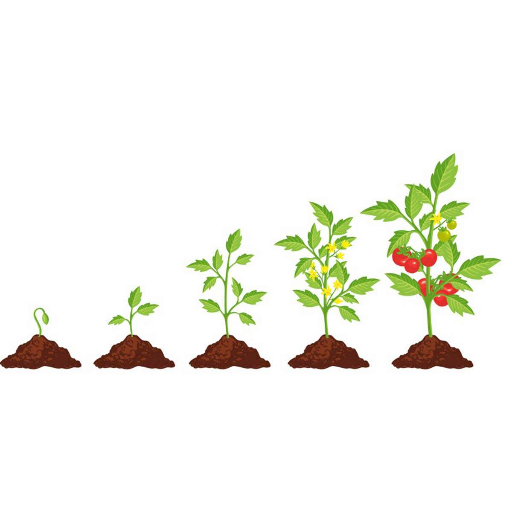
Look at this picture and see if you can tell what hormones are being released in each stage of the plant growth!
Chapter 3: Plant Growth Factors(External)
When plants are growing they are able to respond to their environment around them, these responses are known as Tropisms.
Some common types of tropisms are:
Gravitropism: Plant roots growing towards gravity and the stem away from it.
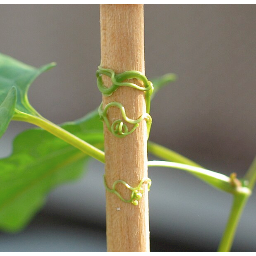
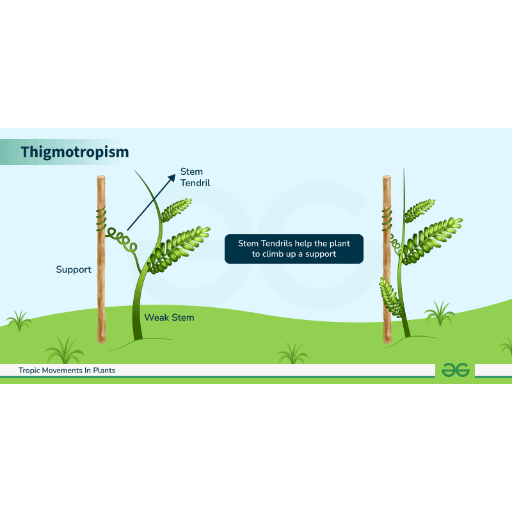
Thigmotropism: When a plant reacts to touch.
Did you know, tropism comes from the Greek word to turn or move.
Photoperiodism: Different from other tropisms and is when a plant changes how quick it's growing based on the time and amount of sunlight.
Positive tropism is when a plant moves towards what it's reacting to. Negative is the opposite.
Knowing these factors you could now use tropisms to your advantage when growing your plants. A way that this could be done is through thigmotropism where a plant with a weak stem leans on a piece of wood, as seen here:
Chapter 4: Plant Tissues
Now would be a good time to get teary eyed because we're going to be talking about tissues. So like many things mentioned plants are similar to humans in the way that they have multiple layers of 'skin'.
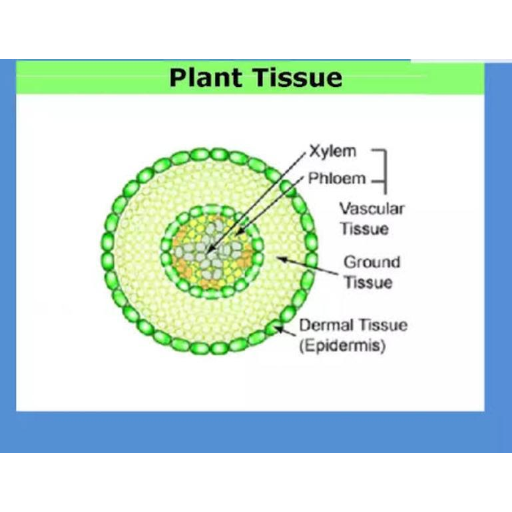
Meristematic: The tissue in a plant that allows it to divide and perform cell differentiation(Specializing cells).
Dermal Tissue: The outside layer which protects the plant, provides structure, and keeps water inside of the plant.
Vascular Tissue: The tissue that allows substances to transfer through the plant like humans use veins. There are two types: First there is Xylem, which moves water throughout the plant. Secondly there's Phloem which moves sugar throughout the plant(mainly the leaves).
Ground Tissue: A more vague type of plant tissue that includes anything that isn't dermal or vascular tissue. This tissue protects the plant, provides stability and allows movement.
Here you can see a visual of the exact formation of the inside of a plant:

Chapter 5: Leaf Tissues
Despite the simple looking nature of leaves they are actually just as complicated as the rest of the plant.
A leaf is made up of both a cuticle and an epidermis, these parts form the structure and allow the plant to be water proof, but still lets the stomata absorb air to let the oxygen transfer* occur.
The oxygen transfer is when CO2(Carbon Dioxide) is released and O2(Oxygen Gas) is 'breathed' into the plant. This allows the plant to breathe.
Speaking of the oxygen transfer, what other cells are needed for a plant to live? Well a plant needs a mesophyll cells which are included in three different cells:
The first is the palisade layer which contains most of the chloroplast(The cells that produce energy for the plant).
Secondly we have the spongy layer which is well ... spongy, this allows more oxygen to be brought into the plant.
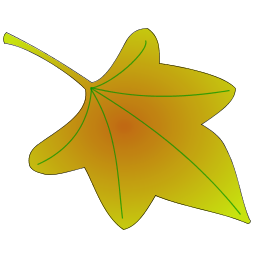
Lastly to complete the oxygen transfer you will need something to allow the gas in. This is where the aerenchyma comes in, these are openings located just where the arrows point, right on the underside of the leaf.

Chapter 6: Succession
One of the most important parts of being successful in botany* is understanding what processes that plants go through. So let's discuss succession.
Succession is when an area goes from a barren wasteland like the one you see in this picture. To the one that you can see when you flip the page!
Biodiversity is when there is many different plants, animals, and bugs all living in the same area.
- Full access to our public library
- Save favorite books
- Interact with authors
- < BEGINNING
- END >
-
DOWNLOAD
-
LIKE
-
COMMENT()
-
SHARE
-
SAVE
-
BUY THIS BOOK
(from $4.19+) -
BUY THIS BOOK
(from $4.19+) - DOWNLOAD
- LIKE
- COMMENT ()
- SHARE
- SAVE
- Report
-
BUY
-
LIKE
-
COMMENT()
-
SHARE
- Excessive Violence
- Harassment
- Offensive Pictures
- Spelling & Grammar Errors
- Unfinished
- Other Problem






COMMENTS
Click 'X' to report any negative comments. Thanks!