This book related to the concept of The story of Money is dedicated to the class of 11th std students

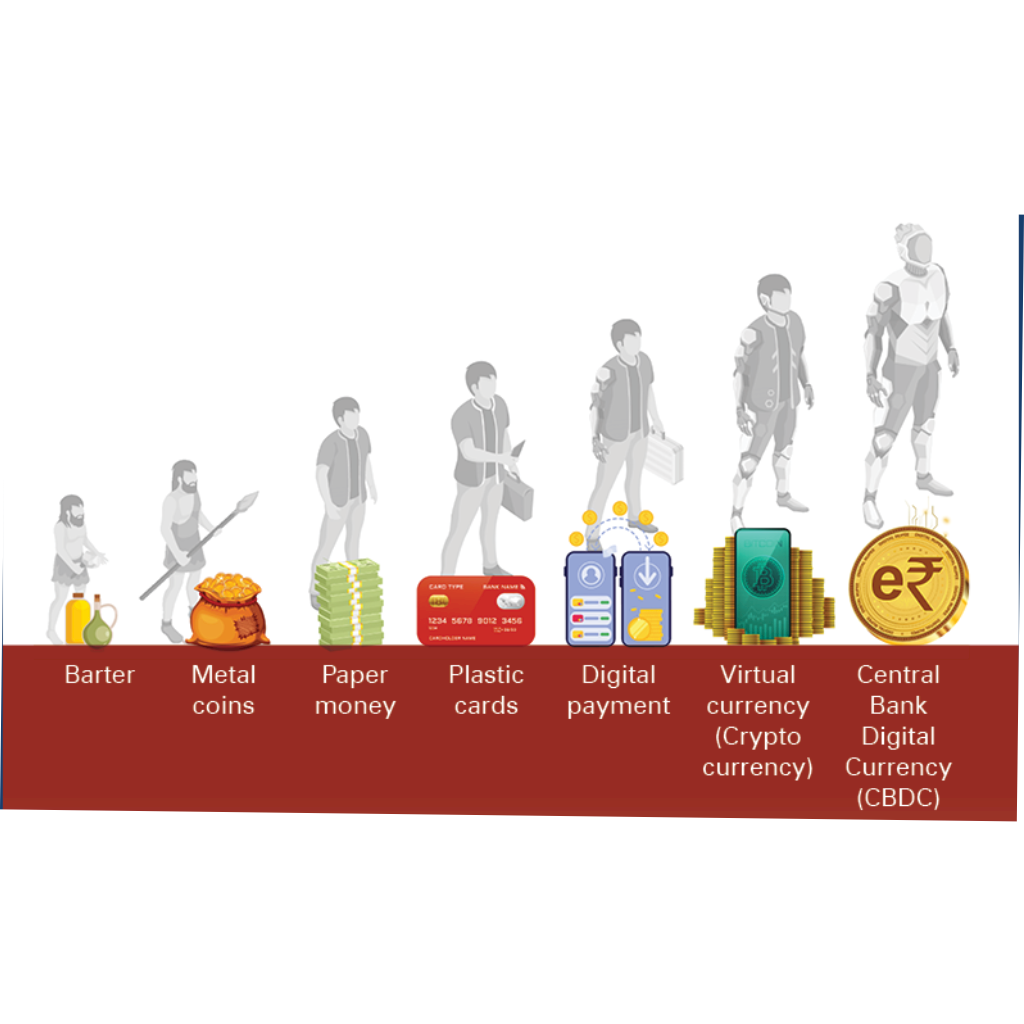

The Story of Money
Introduction: What is Money?
Man is an intellectual being, constantly innovating to make life easier. Among humanity’s greatest inventions, money stands out as a revolutionary force that transformed trade, commerce, and economic systems. Before money existed, people relied on the barter system—exchanging goods for goods—but this system had several limitations that made trade inefficient and complicated.
The evolution of money was a turning point in history. It simplified transactions, provided a common measure of value, acted as a reliable store of wealth, and enabled deferred payments. Over time, money has evolved from commodity-based exchange systems to metallic coins, paper currency, plastic cards, and now digital payments. Today, money is the backbone of modern economies, shaping global trade and financial systems.
Definition of Money
Prof. Crowther – "Money is anything that is generally acceptable as a means of exchange and at the same time acts as a measure and a store of value."
Money is anything that people widely accept for buying and selling goods and services. It is used to measure the value of things, store wealth for the future, and make payments easily. It can be in the form of coins, paper notes, bank deposits, or digital transactions.

The Barter System: Trade Before Money
Before the invention of money, people used the barter system, which involved the direct exchange of goods and services. If a farmer had wheat and needed milk, he would find a dairy farmer willing to trade wheat for milk. This system worked in simple economies but became difficult as trade expanded.
Difficulties of the Barter System
1. Double Coincidence of Wants
2. Lack of a Common Measure of Value
3. Indivisibility of Certain Goods
4.Difficulties in storage of goods
5. Problems with Deferred Payments
Despite being a simple system, barter had several major limitations that made trade difficult.
Why is this a problem?
Why is this a problem?
Definition: Some goods could not be divided into smaller parts for fair trade, creating another major difficulty.
Problem: If a cow is worth 10 sacks of grain, but the farmer only needs 5, how can he get only half a cow?
Example: If you want a small amount of salt but only have a large clay pot to trade, how can you divide the pot without breaking it?
Why is this a problem?
-It limits the ability to trade small quantities.
-People may be forced to trade more than necessary
3. Indivisibility of Certain Goods
Definition: Many goods used in the barter system were perishable, meaning they could not be stored for long periods without losing their value.
Problem: Unlike money, which can be saved for future use, goods like food, milk, or fruits could rot.
Example: If a farmer had a surplus of vegetables, he couldn’t store them for months to trade later.
Why is this a problem?
-It discourages long-term savings.
-People could lose wealth if their goods went bad
4.Difficulties in storage of goods
Definition: The barter system also had no way to handle deferred payments, which meant that transactions based on future promises were unreliable. If a person agreed to trade goods at a later date, there was no guarantee that the value of those goods would remain the same.
Problem: If a person agrees to deliver goods later, there’s no way to measure if the future exchange will be fair.
Example: A farmer promises to trade wheat for a tool in six months, but by then, the value of wheat may have dropped.
Why is this a problem?
-It makes credit transactions difficult.
-Leads to disputes over fairness.
5. Problems with Deferred Payments
Evolution of Money
Money has gone through various stages of development, transforming from simple barter exchanges to digital transactions. The need for a more convenient, standardized, and efficient medium of exchange has driven this evolution. Below are the key stages of money's transformation over time:
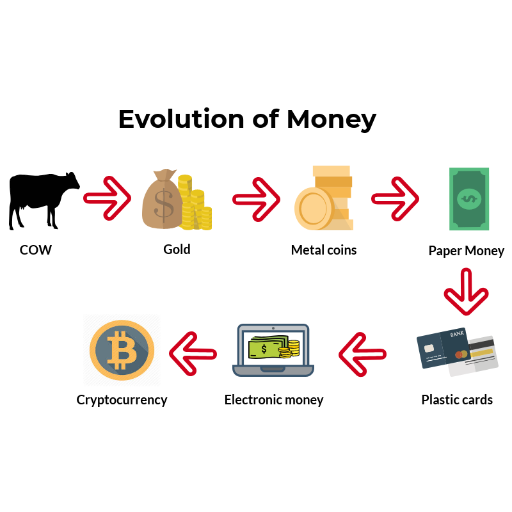

1. Animal Money
Before the use of physical money, people relied on livestock as a form of wealth and trade. Cattle, sheep, and other animals were used as a medium of exchange and store of value.
Why Animals?
Example: In many ancient civilizations, a person’s wealth was measured by the number of cows or sheep they owned. Even today, in some African and Asian cultures, cattle are still used in traditional trade and dowries.
2. Commodity Money
As societies grew, people began using natural commodities like grains, salt, shells, and stones as money. These commodities had intrinsic value, meaning they were useful beyond just being a medium of exchange.
Why Commodity Money?
Example: In ancient China, people used cowrie shells as money, while in Rome, soldiers were paid with salt (which led to the term "salary").
3. Metallic Money
As trade expanded, people started using metals like gold, silver, and copper as money because they were durable, valuable, and easy to carry.
Why Metals?
Example: In Mesopotamia, silver bars were used for trade, and in India, people used gold and silver for large transactions
4. Metallic Coins
To solve the problem of weighing metal for each transaction, rulers and governments minted coins with standard weights and values. This made trade easier and increased trust in money.
Why Coins?
Example: The Lydians (modern-day Turkey) were the first to introduce gold and silver coins around 600 BCE. Later, the Roman Empire widely used coins, making them a common currency across Europe.
5. Paper Money
Carrying heavy metal coins became inconvenient, especially for large transactions. To solve this problem, people started using paper money backed by gold or silver. These banknotes were first issued by governments and banks, allowing people to carry lightweight money instead of bulky metals.
Why Paper Money?
Example: China was the first country to introduce paper money in the 7th century CE during the Tang Dynasty. Later, European countries adopted it, with Sweden being the first to issue official banknotes in 1661.
- Full access to our public library
- Save favorite books
- Interact with authors
- < BEGINNING
- END >
-
DOWNLOAD
-
LIKE
-
COMMENT()
-
SHARE
-
SAVE
-
BUY THIS BOOK
(from $5.99+) -
BUY THIS BOOK
(from $5.99+) - DOWNLOAD
- LIKE
- COMMENT ()
- SHARE
- SAVE
- Report
-
BUY
-
LIKE
-
COMMENT()
-
SHARE
- Excessive Violence
- Harassment
- Offensive Pictures
- Spelling & Grammar Errors
- Unfinished
- Other Problem






COMMENTS
Click 'X' to report any negative comments. Thanks!