Alexander Hamilton, page 4
Betsy Rose, page 10
Claude Monet, page 14
Davy Crockett, page 18
Elton John, page 20
Fidel Castro, page 24
George Washington Carver, page 30
Hilary Clinton, page 32
Ida B. Wells, page 36
Jane Goodall, page 40
Kim Jong-un, page 42

Louis Armstrong, page 46
Michelangelo, page 50
Nikola Tesla, page 54
Oprah Winfrey, page 60
Pope Francis, page 70
Queen Elizabeth ll, page 74
Roald Dahl, page 82
Susan B. Anthony, page 90
Tony Hawk, page 94
Usain Bolt, page 96
Virgina Woolf, page 104
William Shakespear, page 114
Xavi, page 124
Yogi Berra, page 130
Zenobia, page 134
is for Alexander Hamilton

Alexander Hamilton (January 11, 1755 or 1757 – July 12, 1804) was an American military officer, statesman, and Founding Father who served as the first U.S. secretary of the treasury from 1789 to 1795 during the presidency of George Washington, the first president of the United States.
Born out of wedlock in Charlestown, Nevis, Hamilton was orphaned as a child and taken in by a prosperous merchant. He was given a scholarship and pursued his education in New York City where, despite his young age, he was an anonymous but prolific and widely read pamphleteer and advocate for the American Revolution. He then served as an artillery officer in the American Revolutionary War, where he saw military action against the British Army in the New York and New Jersey campaign, served for four years as aide-de-camp to Continental Army commander in chief George Washington, and fought under Washington's command in the war's climactic battle, the Siege of Yorktown, which secured American victory in the war and with it the independence of the United States.
After the Revolutionary War, Hamilton served as a delegate from New York to the Congress of the Confederation in Philadelphia. He resigned to practice law and founded the Bank of New York. In 1786, Hamilton led the Annapolis Convention, which sought to strengthen the power of the loose confederation of independent states under the limited authorities granted it by the Articles of Confederation. The
following year he was a delegate to the Philadelphia Convention, which drafted the U.S. Constitution creating a more centralized federal national government. He then authored 51 of the 85 installments of The Federalist Papers, which proved persuasive in securing its ratification by the states.
As a trusted member of President Washington's first cabinet, Hamilton served as the first U.S. secretary of the treasury. He envisioned a central government led by an energetic executive, a strong national defense, and a more diversified economy with significantly expanded industry. He successfully argued that the implied powers of the U.S. Constitution provided the legal basis to create the First Bank of the United States, and assume the states' war debts, which was funded by a tariff on imports and a whiskey tax. Hamilton opposed American entanglement with the succession of unstable French Revolutionary governments. In 1790, he persuaded the U.S. Congress to establish the U.S. Revenue Cutter service to protect American shipping. In 1793, he advocated in support of the Jay Treaty under which the U.S. resumed friendly trade relations with the British Empire. Hamilton's views became the basis for the Federalist Party, which was opposed by the Democratic-Republican Party, led by Thomas Jefferson. Hamilton and other Federalists supported the Haitian Revolution, and Hamilton helped draft Haiti's constitution in 1801.
After resigning as the nation's Secretary of the Treasury in 1795, Hamilton resumed
his legal and business activities and helped lead the abolition of the Atlantic slave trade. In the Quasi-War, fought at sea between 1798 and 1800, Hamilton called for mobilization against France, and President John Adams appointed him major general. The U.S. Army, however, did not see combat in the conflict. Outraged by Adams' response to the crisis, Hamilton opposed his 1800 presidential re-election. Jefferson and Aaron Burr tied for the presidency in the electoral college and, despite philosophical differences, Hamilton endorsed Jefferson over Burr, whom he found unprincipled. When Burr ran for Governor of New York in 1804, Hamilton again opposed his candidacy, arguing that he was unfit for the office. Taking offense, Burr challenged Hamilton to a pistol duel, which took place in Weehawken, New Jersey, on July 11, 1804. Hamilton was mortally wounded and immediately transported back across the Hudson River in a delirious state to the home of William Bayard Jr. in Greenwich Village, New York, for medical attention. The following day, on July 12, 1804, Hamilton succumbed to his wounds.
Scholars generally regard Hamilton as an astute and intellectually brilliant administrator, politician, and financier who was sometimes impetuous. His ideas are credited with influencing the founding principles of American finance and government. In 1997, historian Paul Johnson wrote that Hamilton was a "genius—the only one of the Founding Fathers fully entitled to that accolade—and he had the
elusive, indefinable characteristics of genius."
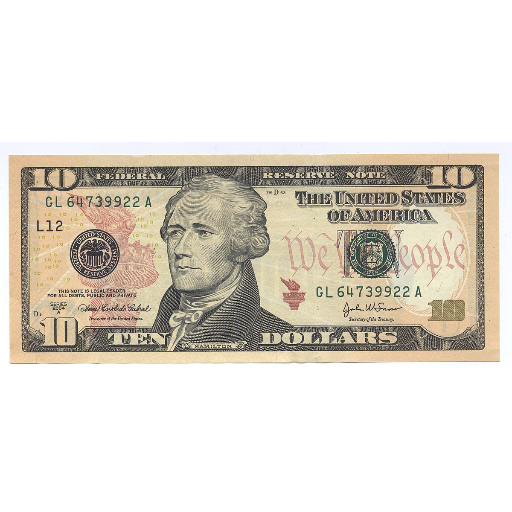
The $10 note features a portrait of Secretary Hamilton on the front of the note and a vignette of the United States Treasury Building on the back of the note.
is for Betsy Ross

Elizabeth Griscom Ross (née Griscom; January 1, 1752 – January 30, 1836), also known by her second and third married names, Ashburn and Claypoole, was an American upholsterer who was credited by her relatives in 1870 with making the second official U.S. flag, accordingly known as the Betsy Ross flag. Though most historians dismiss the story, Ross family tradition holds that General George Washington, commander-in-chief of the Continental Army and two members of a congressional committee—Robert Morris and George Ross—visited Mrs. Ross in 1776. Mrs. Ross convinced George Washington to change the shape of the stars in a sketch of a flag he showed her from six-pointed to five-pointed by demonstrating that it was easier and speedier to cut the latter. However, there is no archival evidence or other recorded verbal tradition to substantiate this story of the first U.S. flag. It appears that the story first surfaced in the writings of her grandson in the 1870s (a century after the fact), with no mention or documentation in earlier decades.
Ross made flags for the Pennsylvania Navy during the American Revolution. After the Revolution, she made U.S. flags for over 50 years, including 50 garrison flags for the U.S. Arsenal on the Schuylkill River during 1811. The flags of the Pennsylvania navy were overseen by the Pennsylvania Navy Board. The board reported to the Pennsylvania Provincial Assembly's Committee of Safety. In July 1775, the President of the Committee of Safety was Benjamin Franklin. Its members included Robert Morris
and George Ross. At that time, the committee ordered the construction of gunboats that would eventually need flags as part of their equipment. As late as October 1776, Captain William Richards was still writing to the Committee of Safety to request the design that he could use to order flags for the fleet.
Ross was one of those hired to make flags for the Pennsylvanian fleet. An entry dated May 29, 1777, in the records of the Pennsylvania Navy Board, includes an order to pay her for her work. It is worded as follows:
The Pennsylvania navy's ship color included (1) an ensign; (2) a long, narrow pennant; and (3) a short, narrow pennant. The ensign was a blue flag with 13 stripes—seven red stripes and six white stripes in the flag's canton (upper-left-hand corner). It was flown from a pole at the rear of the ship. The long pennant had 13 vertical, red-and-white stripes near the mast; the rest was solid red. It flew from the top of the ship's mainmast, the center pole holding the sails. The short pennant was solid red, and flew from the top of the ship's mizzenmast—the pole holding the ship's sails nearest the stern (rear of the ship).
The Betsy Ross flag is an early design for the flag of the United States, which is conformant to the Flag Act of 1777 and has red stripes outermost and stars arranged in a circle. These details elaborate on the 1777 act, passed early in the American Revolutionary War, which specified 13 alternating red and white horizontal stripes and 13 white stars in a blue canton. Its name stems from the story, once widely believed, that shortly after the 1777 act, upholsterer and flag maker Betsy Ross produced a flag of this design.
is for Claude Monet

Oscar-Claude Monet (UK: /ˈmɒneɪ/, US: /moʊˈneɪ, məˈ-/; French: [klod mɔnɛ]; 14 November 1840 – 5 December 1926) was a French painter and founder of Impressionism painting who is seen as a key precursor to modernism, especially in his attempts to paint nature as he perceived it. During his long career, he was the most consistent and prolific practitioner of Impressionism's philosophy of expressing one's perceptions of nature, especially as applied to plein air (outdoor) landscape painting. The term "Impressionism" is derived from the title of his painting Impression, soleil levant, which was first exhibited in the so-called "exhibition of rejects" of 1874–an exhibition initiated by Monet and like-minded artists as an alternative to the Salon.
Monet was raised in Le Havre, Normandy, and became interested in the outdoors and drawing from an early age. Although his mother, Louise-Justine Aubrée Monet, supported his ambitions to be a painter, his father, Claude-Adolphe, disapproved and wanted him to pursue a career in business. He was very close to his mother, but she died in January 1857 when he was sixteen years old, and he was sent to live with his childless, widowed but wealthy aunt, Marie-Jeanne Lecadre. He went on to study at the Académie Suisse, and under the academic history painter Charles Gleyre, where he was a classmate of Auguste Renoir. His early works include landscapes, seascapes, and portraits, but attracted little attention. A key early influence was Eugène Boudin, who introduced him to the concept of plein air painting. From 1883, Monet lived in Giverny, also in northern France, where he purchased a house and property and began a vast landscaping project, including a water-lily pond.
Monet's ambition to document the French countryside led to a method of painting the same scene many times so as to capture the changing of light and the passing of the seasons. Among the best-known examples are his series of haystacks (1890–1891), paintings of Rouen Cathedral (1892–1894), and the paintings of water lilies in his garden in Giverny, which occupied him for the last 20 years of his life. Frequently exhibited and successful during his lifetime, Monet's fame and popularity soared in the second half of the 20th century when he became one of the world's most famous
painters and a source of inspiration for a burgeoning group of artists.
is for Davy Crockett

Colonel David Crockett (August 17, 1786 – March 6, 1836) was an American politician, militia officer and frontiersman. Often referred to in popular culture as the "King of the Wild Frontier", he represented Tennessee in the United States House of Representatives and fought in the Texas Revolution.
Crockett grew up in East Tennessee, where he gained a reputation for hunting and storytelling. He was made a colonel in the militia of Lawrence County, Tennessee, and was elected to the Tennessee state legislature in 1821. In 1827, he was elected to the U.S. Congress where he vehemently opposed many of the policies of President Andrew Jackson, especially the Indian Removal Act. Crockett's opposition to Jackson's policies led to his defeat in the 1831 elections. He was re-elected in 1833, then narrowly lost in 1835, prompting his angry departure to Texas (then the Mexican state of Tejas) shortly thereafter. In early 1836, he took part in the Texas Revolution and died at the Battle of the Alamo. It is unclear whether he died in battle or was executed after being captured by the Mexican Army.
Crockett became famous during his lifetime for larger-than-life exploits popularized by stage plays and almanacs. After his death, he continued to be credited with acts of mythical proportion. These led in the 20th century to television and film portrayals, and he became one of the best-known American folk heroes.
is for Elton John

Sir Elton Hercules John (born Reginald Kenneth Dwight; 25 March 1947) is a British singer, songwriter and pianist. His music and showmanship have had a significant, lasting impact on the music industry, and his songwriting partnership with lyricist Bernie Taupin is one of the most successful in history. John was the 19th EGOT winner in history. He has sold over 300 million records worldwide, making him one of the best-selling music artists of all time.
John learned to play piano at an early age, winning a scholarship to the Royal Academy of Music. In the 1960s, he formed the blues band Bluesology, wrote songs for other artists alongside Taupin, and worked as a session musician, before releasing his debut album, Empty Sky (1969). Throughout the next six decades, John cemented his status as a cultural icon with 32 studio albums, including Honky Château (1972), Goodbye Yellow Brick Road (1973), Rock of the Westies (1975), Sleeping with the Past (1989), The One (1992), Songs from the West Coast (2001), The Diving Board (2013) and The Lockdown Sessions (2021). His catalog of hit singles includes "Your Song", "Tiny Dancer", "Rocket Man", "Crocodile Rock", "Bennie and the Jets", "Don't Go Breaking My Heart", "I'm Still Standing", "Sacrifice", "Can You Feel the Love Tonight" and "Cold Heart". He has also had success in musical films and theatre, composing music for The Lion King (1994), Aida (2000), and Billy Elliot the Musical (2005). John's final tour, Farewell Yellow Brick Road (2018–2023), became the highest-grossing tour
ever at the time. His life and career were dramatised in the 2019 biopic Rocketman.
John is an HIV/AIDS charity fundraiser and has been involved in the fight against AIDS since the late 1980s. He established the Elton John AIDS Foundation in 1992, which has raised over £300 million since its inception, and a year later he began hosting his annual AIDS Foundation Academy Awards Party, which has since become one of the biggest high-profile Oscar parties in the Hollywood film industry. John was the chairman and director of Watford Football Club from 1976 to 1987, and again from 1997 to 2002, and is an honorary life president of the club. From the late 1970s to the late 1980s, John developed a severe addiction to drugs and alcohol, but has been clean and sober since 1990. In 2005, he entered a civil partnership with his long-term partner, the Canadian filmmaker David Furnish. They married in 2014, when same-sex marriage was legalised in England and Wales.
John has had more than fifty top-40 hits on the UK singles chart and US Billboard Hot 100, including nine number ones in both countries, as well as seven consecutive number-one albums in the US. He is the most successful solo artist in the history of the US Billboard charts. His tribute single to Diana, Princess of Wales, "Candle in the Wind 1997", a rewritten version of his 1974 single, sold over 33 million copies worldwide and is the best-selling chart single of all time. In 2021, he became the first solo artist with UK top 10 singles across six decades. John's awards include
an Primetime Emmy Award, five Grammy Awards, two Academy Awards, a Tony Award, two Golden Globe Awards, a Laurence Olivier Award, and the Kennedy Center Honor. He was inducted into the Songwriters Hall of Fame in 1992 and the Rock and Roll Hall of Fame in 1994, and is a fellow of The Ivors Academy. He was appointed Knight Bachelor for services to music and charity in 1998 and was appointed a member of the Order of the Companions of Honour in 2020.
is for Fidel Castro

Fidel Alejandro Castro Ruz (/ˈkæstroʊ/ KASS-troh; Latin American Spanish: [fiˈðel aleˈxandɾo ˈkastɾo ˈrus]; 13 August 1926 – 25 November 2016) was a Cuban revolutionary and politician who was the leader of Cuba from 1959 to 2008, serving as the prime minister of Cuba from 1959 to 1976 and president from 1976 to 2008. Ideologically a Marxist–Leninist and Cuban nationalist, he also served as the first secretary of the Communist Party of Cuba from 1965 until 2011. Under his administration, Cuba became a one-party communist state; industry and business were nationalized, and socialist reforms were implemented throughout society.
Born in Birán, the son of a wealthy Spanish farmer, Castro adopted leftist and anti-imperialist ideas while studying law at the University of Havana. After participating in rebellions against right-wing governments in the Dominican Republic and Colombia, he planned the overthrow of Cuban president Fulgencio Batista, launching a failed attack on the Moncada Barracks in 1953. After a year's imprisonment, Castro travelled to Mexico where he formed a revolutionary group, the 26th of July Movement, with his brother, Raúl Castro, and Ernesto "Che" Guevara. Returning to Cuba, Castro took a key role in the Cuban Revolution by leading the Movement in a guerrilla war against Batista's forces from the Sierra Maestra. After Batista's overthrow in 1959, Castro assumed military and political power as Cuba's prime minister. The United States came to oppose Castro's government and unsuccessfully
attempted to remove him by assassination, economic embargo, and counter-revolution, including the Bay of Pigs Invasion of 1961. Countering these threats, Castro aligned with the Soviet Union and allowed the Soviets to place nuclear weapons in Cuba, resulting in the Cuban Missile Crisis—a defining incident of the Cold War—in 1962.
Adopting a Marxist–Leninist model of development, Castro converted Cuba into a one-party, socialist state under Communist Party rule, the first in the Western Hemisphere. Policies introducing central economic planning and expanding healthcare and education were accompanied by state control of the press and the suppression of internal dissent. Abroad, Castro supported anti-imperialist revolutionary groups, backing the establishment of Marxist governments in Chile, Nicaragua, and Grenada, as well as sending troops to aid allies in the Yom Kippur, Ogaden, and Angolan Civil War. These actions, coupled with Castro's leadership of the Non-Aligned Movement from 1979 to 1983 and Cuban medical internationalism, increased Cuba's profile on the world stage. Following the dissolution of the Soviet Union in 1991, Castro led Cuba through the economic downturn of the "Special Period", embracing environmentalist and anti-globalization ideas. In the 2000s, Castro forged alliances in the Latin American "pink tide"—namely with Hugo Chávez's Venezuela—and formed the Bolivarian Alliance for the Americas. In 2006, Castro transferred his responsibilities to Vice President Raúl Castro, who was elected to the presidency by the National Assembly in 2008.
The longest-serving non-royal head of state in the 20th and 21st centuries, Castro polarized world opinion. His supporters view him as a champion of socialism and anti-imperialism whose revolutionary government advanced economic and social justice
while securing Cuba's independence from American hegemony. His critics view him as a dictator whose administration oversaw human rights abuses, the exodus of many Cubans, and the impoverishment of the country's economy.
is for George Washington Carver

George Washington Carver ( 1864 – January 5, 1943) was an American agricultural scientist and inventor who promoted alternative crops to cotton and methods to prevent soil depletion. He was one of the most prominent black scientists of the early 20th century.
While a professor at Tuskegee Institute, Carver developed techniques to improve types of soils depleted by repeated plantings of cotton. He wanted poor farmers to grow other crops, such as peanuts and sweet potatoes, as a source of their own food and to improve their quality of life. Under his leadership, the Experiment Station at Tuskegee published over forty practical bulletins for farmers, many written by him, which included recipes; many of the bulletins contained advice for poor farmers, including combating soil depletion with limited financial means, producing bigger crops, and preserving food.
Apart from his work to improve the lives of farmers, Carver was also a leader in promoting environmentalism. He received numerous honors for his work, including the Spingarn Medal of the NAACP. In an era of high racial polarization, his fame reached beyond the black community. He was widely recognized and praised in the white community for his many achievements and talents. In 1941, Time magazine dubbed Carver a "Black Leonardo".
is for Hilary Clinton

Hillary Diane Rodham Clinton (née Rodham; born October 26, 1947) is an American politician, lawyer and diplomat. She was the 67th United States secretary of state in the administration of Barack Obama from 2009 to 2013, a U.S. senator representing New York from 2001 to 2009, and the first lady of the United States as the wife of Bill Clinton from 1993 to 2001. A member of the Democratic Party, she was the party's nominee in the 2016 presidential election, becoming the first woman to win a presidential nomination by a major U.S. political party and the only woman to win the popular vote for U.S. president. She is the only first lady of the United States to have run for elected office.
Rodham graduated from Wellesley College in 1969 and from Yale Law School in 1973. After serving as a congressional legal counsel, she moved to Arkansas and, in 1975, married Bill Clinton. In 1977, Clinton co-founded Arkansas Advocates for Children and Families, and in 1979 she became the first woman partner at Little Rock's Rose Law Firm. Clinton was the first lady of Arkansas from 1979 to 1981 and again from 1983 to 1992. As the first lady of the U.S., Clinton advocated for healthcare reform. In 1994, her health care plan failed to gain approval from Congress. In 1997 and 1999, Clinton played a leading role in promoting the creation of the State Children's Health Insurance Program, the Adoption and Safe Families Act, and the Foster Care Independence Act. In 1998, Clinton's marital relationship came under public scrutiny
during the Clinton–Lewinsky scandal, which led her to publicly reaffirm her commitment to the marriage.
Clinton was first elected to the U.S. Senate in 2000, becoming the first female senator from New York. As a senator, she chaired the Senate Democratic Steering and Outreach Committee from 2003 to 2007. Clinton ran for president in 2008, but lost to Barack Obama in the Democratic primaries. In 2009, she resigned from the Senate to become Obama's secretary of state. She responded to the Arab Spring by advocating the 2011 military intervention in Libya, but was harshly criticized by Republicans for the failure to prevent or adequately respond to the 2012 Benghazi attack. Clinton helped to organize a regime of international sanctions against Iran in an effort to force it to curtail its nuclear program, which eventually led to the multinational Joint Comprehensive Plan of Action in 2015. The strategic pivot to Asia was a central aspect of her tenure. Her use of a private email server as secretary was the subject of intense scrutiny; while no charges were filed, the controversy was the single-most-covered topic during her second presidential run in 2016. She won the Democratic nomination, but lost the general election to her Republican Party opponent, Donald Trump, in the Electoral College, while winning the popular vote.
Following her loss, she wrote multiple books and launched Onward Together, a political action organization dedicated to fundraising for progressive political
groups. In 2011, Clinton was appointed the Honorary Founding Chair of the Institute for Women, Peace and Security at Georgetown University, and the awards named in her name has been awarded annually at the university. Since 2020, she has served as Chancellor of Queen's University Belfast. In 2023, Clinton joined Columbia University as a Professor of Practice at the School of International and Public Affairs.
is for Ida B. Wells

Ida Bell Wells-Barnett (July 16, 1862 – March 25, 1931) was an American investigative journalist, sociologist, educator, and early leader in the civil rights movement. She was one of the founders of the National Association for the Advancement of Colored People (NAACP). Wells dedicated her career to combating prejudice and violence, and advocating for African-American equality—especially that of women.
Throughout the 1890s, Wells documented lynching of African-Americans in the United States in articles and through pamphlets such as Southern Horrors: Lynch Law in all its Phases and The Red Record, which debunked the fallacy frequently voiced by whites at the time that all Black lynching victims were guilty of crimes. Wells exposed the brutality of lynching, and analyzed its sociology, arguing that whites used lynching to terrorize African Americans in the South because they represented economic and political competition—and thus a threat of loss of power—for whites. She aimed to demonstrate the truth about this violence and advocate for measures to stop it.
Wells was born into slavery in Holly Springs, Mississippi. She was freed as an infant under the Emancipation Proclamation, when Union Army troops captured Holly Springs. At the age of 16, she lost both her parents and her infant brother in the 1878 yellow fever epidemic. She got a job teaching and kept the rest of the family together with the help of her grandmother. Later, moving with some of her siblings
to Memphis, Tennessee. Soon, Wells co-owned and wrote for the Memphis Free Speech and Headlight newspaper, where her reporting covered incidents of racial segregation and inequality. Eventually, her investigative journalism was carried nationally in Black-owned newspapers. Subjected to continued threats and criminal violence, including when a white mob destroyed her newspaper office and presses, Wells left Memphis for Chicago, Illinois. She married Ferdinand L. Barnett in 1895 and had a family while continuing her work writing, speaking, and organizing for civil rights and the women's movement for the rest of her life.
Wells was outspoken regarding her beliefs as a Black female activist and faced regular public disapproval, sometimes including from other leaders within the civil rights movement and the women's suffrage movement. She was active in women's rights and the women's suffrage movement, establishing several notable women's organizations. A skilled and persuasive speaker, Wells traveled nationally and internationally on lecture tours. Wells died on March 25, 1931, in Chicago, and in 2020 was posthumously honored with a Pulitzer Prize special citation "for her outstanding and courageous reporting on the horrific and vicious violence against African Americans during the era of lynching."
Having settled in Chicago, Wells continued her anti-lynching work while becoming more focused on the civil rights of African Americans. She worked with national civil rights leaders to protest a major exhibition, she was active in the national women's club movement, and she ultimately ran for a position in the Illinois State Senate. She also was passionate about women's rights and suffrage. She was a spokeswoman and an advocate for women being successful in the workplace, having equal opportunities, and creating a name for themselves.
Wells was an active member of the National Equal Rights League (NERL), founded in 1864, and was their representative calling on President Woodrow Wilson to end discrimination in government jobs. In 1914, she served as president of NERL's Chicago bureau.
In 1911, Wells attended the second annual Single Tax Conference. This meeting, which promoted the ideology of Land Value Tax, was moved from its original location to protest against the hotel's discrimination against African Americans at the conference banquet.
is for Jane Goodall

Dame Jane Morris Goodall DBE (/ˈɡʊdɔːl/; born Valerie Jane Morris-Goodall; 3 April 1934), formerly Baroness Jane van Lawick-Goodall, is an English zoologist, primatologist and anthropologist. She is considered the world's foremost expert on chimpanzees, after 60 years' studying the social and family interactions of wild chimpanzees. Goodall first went to Gombe Stream National Park in Tanzania to observe its chimpanzees in 1960.
She is the founder of the Jane Goodall Institute and the Roots & Shoots programme and has worked extensively on conservation and animal welfare issues. As of 2022, she is on the board of the Nonhuman Rights Project. In April 2002, she was named a United Nations Messenger of Peace. Goodall is an honorary member of the World Future Council.
is for Kim Jong-un

Kim Jong Un (born 8 January 1982, 1983 or 1984) is a North Korean politician who has been the third supreme leader of North Korea since 2011 (following the death of previous leader Kim Jong Il) and general secretary of the Workers' Party of Korea (WPK) since 2012. He is the third son of Kim Jong Il, who was the second supreme leader of North Korea, and a grandson of Kim Il Sung, the founder and first supreme leader of the country.
From late 2010, Kim was viewed as the successor to the North Korean leadership. Following his father's death in December 2011, state television announced Kim as the "great successor to the revolutionary cause". Kim holds the titles of General Secretary of the Workers' Party of Korea and President of the State Affairs. He is also a member of the Presidium of the WPK Politburo, the highest decision-making body in the country. In July 2012, Kim was promoted to the highest rank of marshal in the Korean People's Army, consolidating his positions as commander-in-chief of the Armed Forces and Chairman of the Central Military Commission. North Korean state media often refer to him as "Respected Comrade Kim Jong Un" or "Marshal Kim Jong Un". He has promoted the policy of byungjin, similar to Kim Il Sung's policy from the 1960s, referring to the simultaneous development of both the economy and the country's nuclear weapons program. He has also revived the structures of the WPK, expanding the party's power at the expense of the military leadership.
Kim Jong Un rules North Korea as a totalitarian dictatorship, and his leadership has followed the same cult of personality as his father and grandfather. In 2014, a United Nations Human Rights Council report suggested that Kim could be put on trial for crimes against humanity. According to reports, he has ordered the purge and execution of several North Korean officials including his uncle, Jang Song-thaek, in 2013. He is also widely believed to have ordered the assassination of his half-brother, Kim Jong-nam, in Malaysia in 2017. He has presided over an expansion of the consumer economy, construction projects and tourist attractions in North Korea.
Kim expanded the country's nuclear weapons program, which led to heightened tensions with the United States and South Korea, as well as China. In 2018 and 2019, Kim took part in summits with South Korean president Moon Jae-in and U.S. president Donald Trump, leading to a brief thaw between North Korea and the two countries, though the negotiations ultimately broke down without progress on reunification of Korea or nuclear disarmament. He has claimed success in combating the COVID-19 pandemic in North Korea, as the country did not report any confirmed cases until May 2022, although several independent observers have questioned this claim. Under his rule, North Korean soldiers have been deployed under Russian command in the Russian invasion of Ukraine.
Jubilee Medal "75 Years of Victory in the Great Patriotic War 1941–1945" (Russia, 2020) — awarded for his efforts at preserving the memory of Soviet soldiers who died during the Soviet–Japanese War (1945) and were buried in North Korea
is for Louis Armstrong

Louis Daniel Armstrong (August 4, 1901 – July 6, 1971), nicknamed "Satchmo", "Satch", and "Pops", was an American trumpeter and vocalist. He was among the most influential figures in jazz. His career spanned five decades and several eras in the history of jazz. Armstrong received numerous accolades including the Grammy Award for Best Male Vocal Performance for Hello, Dolly! in 1965, as well as a posthumous win for the Grammy Lifetime Achievement Award in 1972. His influence crossed musical genres, with inductions into the DownBeat Jazz Hall of Fame, the Rock and Roll Hall of Fame, and the National Rhythm & Blues Hall of Fame, among others.
Armstrong was born and raised in New Orleans. Coming to prominence in the 1920s as an inventive trumpet and cornet player, he was a foundational influence in jazz, shifting the focus of the music from collective improvisation to solo performance. Around 1922, Armstrong followed his mentor, Joe "King" Oliver, to Chicago to play in Oliver's Creole Jazz Band. Armstrong earned a reputation at "cutting contests", and his fame reached band leader Fletcher Henderson. Armstrong moved to New York City, where he became a featured and musically influential band soloist and recording artist. By the 1950s, Armstrong was an international musical icon, appearing regularly in radio and television broadcasts and on film. Apart from his music, he was also beloved as an entertainer, often joking with the audience and
keeping a joyful public image at all times.
Armstrong's best known songs include "What a Wonderful World", "La Vie en Rose", "Hello, Dolly!", "On the Sunny Side of the Street", "Dream a Little Dream of Me", "When You're Smiling" and "When the Saints Go Marching In". He collaborated with Ella Fitzgerald, producing three records together: Ella and Louis (1956), Ella and Louis Again (1957), and Porgy and Bess (1959). He also appeared in films such as A Rhapsody in Black and Blue (1932), Cabin in the Sky (1943), High Society (1956), Paris Blues (1961), A Man Called Adam (1966), and Hello, Dolly! (1969).
With his instantly recognizable, rich, gravelly voice, Armstrong was also an influential singer and skillful improviser. He was also skilled at scat singing. By the end of Armstrong's life, his influence had spread to popular music. He was one of the first popular African-American entertainers to "cross over" to wide popularity with white and international audiences. Armstrong rarely publicly discussed racial issues, to the dismay of fellow African Americans, but took a well-publicized stand for desegregation in the Little Rock crisis. He could access the upper echelons of American society at a time when this was difficult for Black men.
Armstrong was posthumously awarded the Grammy Lifetime Achievement Award in 1972 by the Academy of Recording Arts and Sciences. This Special Merit Award is presented by vote of the Recording Academy's National Trustees to performers who, during their lifetimes, have made creative contributions of outstanding artistic significance to the recording field.
is for Michelangelo

Michelangelo di Lodovico Buonarroti Simoni (6 March 1475 – 18 February 1564), known mononymously as Michelangelo, was an Italian sculptor, painter, architect, and poet of the High Renaissance. Born in the Republic of Florence, his work was inspired by models from classical antiquity and had a lasting influence on Western art. Michelangelo's creative abilities and mastery in a range of artistic arenas define him as an archetypal Renaissance man, along with his rival and elder contemporary, Leonardo da Vinci. Given the sheer volume of surviving correspondence, sketches, and reminiscences, Michelangelo is one of the best-documented artists of the 16th century. He was lauded by contemporary biographers as the most accomplished artist of his era.
Michelangelo achieved fame early. Two of his best-known works, the Pietà and David, were sculpted before the age of 30. Although he did not consider himself a painter, Michelangelo created two of the most influential frescoes in the history of Western art: the scenes from Genesis on the ceiling of the Sistine Chapel in Rome, and The Last Judgment on its altar wall. His design of the Laurentian Library pioneered Mannerist architecture. At the age of 71, he succeeded Antonio da Sangallo the Younger as the architect of St. Peter's Basilica. Michelangelo transformed the plan so that the Western end was finished to his design, as was the dome, with some modification, after his death.
Michelangelo was the first Western artist whose biography was published while he was alive. Three biographies were published during his lifetime. One of them, by Giorgio Vasari, proposed that Michelangelo's work transcended that of any artist living or dead, and was "supreme in not one art alone but in all three".
In his lifetime, Michelangelo was often called Il Divino ("the divine one"). His contemporaries admired his terribilità—his ability to instill a sense of awe in viewers of his art. Attempts by subsequent artists to imitate the expressive physicality of Michelangelo's style contributed to the rise of Mannerism, a short-lived movement in Western art between the High Renaissance and the Baroque.
While still working on the Last Judgment, Michelangelo received yet another commission for the Vatican. This was for the painting of two large frescos in the Cappella Paolina depicting significant events in the lives of the two most important saints of Rome, the Conversion of Saint Paul and the Crucifixion of Saint Peter. Like the Last Judgment, these two works are complex compositions containing a great number of figures. They were completed in 1550. In the same year, Giorgio Vasari published his Vita, including a biography of Michelangelo.
In 1546, Michelangelo was appointed architect of St. Peter's Basilica, Rome. The process of replacing the Constantinian basilica of the 4th century had been underway for fifty years and in 1506 foundations had been laid to the plans of Bramante. Successive architects had worked on it, but little progress had been made. Michelangelo was persuaded to take over the project. He returned to the concepts of Bramante, and developed his ideas for a centrally planned church, strengthening the structure both physically and visually. The dome, not completed until after his death, has been called by Banister Fletcher, "the greatest creation of the Renaissance".
As construction was progressing on St Peter's, there was concern that Michelangelo would die before the dome was finished. However, once building commenced on the lower part of the dome, the supporting ring, the completion of the design was inevitable.
is for Nikola Tesla

Nikola Tesla (/ˈnɪkələ ˈtɛslə/; Serbian Cyrillic: Никола Тесла [nǐkola têsla]; 10 July 1856 – 7 January 1943) was a Serbian-American engineer, futurist, and inventor. He is known for his contributions to the design of the modern alternating current (AC) electricity supply system.
Born and raised in the Austrian Empire, Tesla first studied engineering and physics in the 1870s without receiving a degree. He then gained practical experience in the early 1880s working in telephony and at Continental Edison in the new electric power industry. In 1884 he immigrated to the United States, where he became a naturalized citizen. He worked for a short time at the Edison Machine Works in New York City before he struck out on his own. With the help of partners to finance and market his ideas, Tesla set up laboratories and companies in New York to develop a range of electrical and mechanical devices. His AC induction motor and related polyphase AC patents, licensed by Westinghouse Electric in 1888, earned him a considerable amount of money and became the cornerstone of the polyphase system which that company eventually marketed.
Attempting to develop inventions he could patent and market, Tesla conducted a range of experiments with mechanical oscillators/generators, electrical discharge tubes, and early X-ray imaging. He also built a wirelessly controlled boat, one of the first ever exhibited. Tesla became well known as an inventor and demonstrated his
achievements to celebrities and wealthy patrons at his lab, and was noted for his showmanship at public lectures. Throughout the 1890s, Tesla pursued his ideas for wireless lighting and worldwide wireless electric power distribution in his high-voltage, high-frequency power experiments in New York and Colorado Springs. In 1893, he made pronouncements on the possibility of wireless communication with his devices. Tesla tried to put these ideas to practical use in his unfinished Wardenclyffe Tower project, an intercontinental wireless communication and power transmitter, but ran out of funding before he could complete it.
After Wardenclyffe, Tesla experimented with a series of inventions in the 1910s and 1920s with varying degrees of success. Having spent most of his money, Tesla lived in a series of New York hotels, leaving behind unpaid bills. He died in New York City in January 1943. Tesla's work fell into relative obscurity following his death, until 1960, when the General Conference on Weights and Measures named the International System of Units (SI) measurement of magnetic flux density the tesla in his honor. There has been a resurgence in popular interest in Tesla since the 1990s.
Tesla was a lifelong bachelor, who had once explained that his chastity was very helpful to his scientific abilities. In an interview with the Galveston Daily News on 10 August 1924 he stated, "Now the soft-voiced gentlewoman of my reverent worship has all but vanished. In her place has come the woman who thinks that her chief success in life lies in making herself as much as possible like man—in dress, voice and actions..." Although he told a reporter in later years that he sometimes felt that by not marrying, he had made too great a sacrifice to his work, Tesla chose to never pursue or engage in any known relationships, instead finding all the stimulation he needed in his work.
Tesla was asocial and prone to seclude himself with his work. However, when he did engage in social life, many people spoke very positively and admiringly of Tesla. Robert Underwood Johnson described him as attaining a "distinguished sweetness, sincerity, modesty, refinement, generosity, and force". His secretary, Dorothy Skerrit, wrote: "his genial smile and nobility of bearing always denoted the gentlemanly characteristics that were so ingrained in his soul". Tesla's friend Julian Hawthorne wrote, "seldom did one meet a scientist or engineer who was also a poet, a philosopher, an appreciator of fine music, a linguist, and a connoisseur of food and drink".
Tesla was a good friend of Francis Marion Crawford, Robert Underwood
Johnson, Stanford White, Fritz Lowenstein, George Scherff, and Kenneth Swezey. In middle age, Tesla became a close friend of Mark Twain; they spent a lot of time together in his lab and elsewhere. Twain notably described Tesla's induction motor invention as "the most valuable patent since the telephone". At a party thrown by actress Sarah Bernhardt in 1896, Tesla met Indian Hindu monk Swami Vivekananda. Vivekananda later wrote that Tesla said he could demonstrate mathematically the relationship between matter and energy, something Vivekananda hoped would give a scientific foundation to Vedantic cosmology. The meeting with Swami Vivekananda stimulated Tesla's interest in Eastern Science, which led to Tesla studying Hindu and Vedic philosophy for a number of years. Tesla later wrote an article titled "Man's Greatest Achievement" using Sanskrit terms akasha and prana to describe the relationship between matter and energy. In the late 1920s, Tesla befriended George Sylvester Viereck, a poet, writer, mystic, and later a Nazi propagandist. Tesla occasionally attended dinner parties held by Viereck and his wife.
Tesla could be harsh at times and openly expressed disgust for overweight people, such as when he fired a secretary because of her weight. He was quick to criticize clothing; on several occasions, Tesla directed a subordinate to go home and change her dress. When Thomas Edison died in 1931, Tesla contributed the only negative opinion to The New York Times, buried in an extensive coverage of Edison's life:
Tesla became a vegetarian in his later years, living on only milk, bread, honey, and vegetable juices.
is for Oprah Winfrey

Oprah Gail Winfrey (/ˈoʊprə/; born Orpah Gail Winfrey; January 29, 1954) is an American talk show host, television producer, actress, author, and media proprietor. She is best known for her talk show, The Oprah Winfrey Show, broadcast from Chicago, which ran in national syndication for 25 years, from 1986 to 2011. Dubbed the "Queen of All Media", she was the richest African-American of the 20th century and was once the world's only black billionaire. By 2007, she was often ranked as the most influential woman in the world.
Winfrey was born into poverty in rural Mississippi to a single teenage mother and later raised in inner-city Milwaukee. She has stated that she was molested during her childhood and early teenage years and became pregnant at 14; her son was born prematurely and died in infancy. Winfrey was then sent to live with the man she calls her father, Vernon Winfrey, a barber in Nashville, Tennessee, and landed a job in radio while still in high school. By 19, she was a co-anchor for the local evening news. Winfrey's often emotional, extemporaneous delivery eventually led to her transfer to the daytime talk show arena, and after boosting a third-rated local Chicago talk show to first place, she launched her own production company.
Credited with creating a more intimate, confessional form of media communication, Winfrey popularized and revolutionized the tabloid talk show genre pioneered by Phil Donahue. By the mid-1990s, Winfrey had reinvented her show with
a focus on literature, self-improvement, mindfulness, and spirituality. Though she has been criticized for unleashing a confession culture, promoting controversial self-help ideas, and having an emotion-centered approach, she has also been praised for overcoming adversity to become a benefactor to others. Winfrey also emerged as a political force in the 2008 presidential race, with her endorsement of Barack Obama estimated to have been worth about one million votes during the 2008 Democratic primaries. In the same year, she formed her own network, the Oprah Winfrey Network (OWN). In 2013, Winfrey was awarded the Presidential Medal of Freedom by President Barack Obama.
In 1994, she was inducted into the National Women's Hall of Fame. Then in October, she finished the Marine Corps Marathon in less than four and a half hours. She has received honorary doctorate degrees from multiple universities. Winfrey has won many awards throughout her career, including 19 Daytime Emmy Awards (including the Lifetime Achievement Award and the Chairman's Award), two Primetime Emmy Awards (including the Bob Hope Humanitarian Award), a Tony Award, a Peabody Award, and the Jean Hersholt Humanitarian Award awarded by the Academy Awards, in addition to two competitive Academy Award nominations. Winfrey was elected as a member of the American Academy of Arts and Sciences in 2021.
Working in local media, Winfrey was both the youngest news anchor and the first black female news anchor at Nashville's WLAC-TV (now WTVF-TV), where she often covered the same stories as John Tesh, who worked at a competing Nashville station. In 1976, she moved to Baltimore's WJZ-TV to co-anchor the six o'clock news. In 1977, she was removed as co-anchor and worked in lower profile positions at the station. She was then recruited to join Richard Sher as co-host of WJZ's local talk show People Are Talking, which premiered on August 14, 1978. She also hosted the local version of Dialing for Dollars.
In 1984, Winfrey relocated to Chicago to host WLS-TV's low-rated half-hour morning talk show, AM Chicago, after being hired by that station's general manager, Dennis Swanson. The first episode aired on January 2, 1984. Within months after Winfrey took over, the show went from last place in the ratings to overtaking Donahue as the highest-rated talk show in Chicago. The movie critic Roger Ebert persuaded her to sign a syndication deal with King World. Ebert predicted that she would generate 40 times as much revenue as his television show, At the Movies. It was then renamed The Oprah Winfrey Show and expanded to a full hour. The first episode was broadcast nationwide on September 8, 1986. Winfrey's syndicated show brought in double Donahue's national audience, displacing Donahue as the number-one daytime talk show in America. Their much-publicized contest was the subject of enormous
scrutiny. According to Time magazine in August 1988:
TV columnist Howard Rosenberg said: "She's a roundhouse, a full course meal, big, brassy, loud, aggressive, hyper, laughable, lovable, soulful, tender, low-down, earthy, and hungry. And she may know the way to Phil Donahue's jugular." Newsday's Les Payne observed, "Oprah Winfrey is sharper than Donahue, wittier, more genuine, and far better attuned to her audience, if not the world" and Martha Bayles of The Wall Street Journal wrote, "It's a relief to see a gab-monger with a fond but realistic assessment of her own cultural and religious roots."
In the early years of The Oprah Winfrey Show, the program was classified as a tabloid talk show. In the mid-1990s, Winfrey began to host shows on broader topics such as heart disease, geopolitics, spirituality, and meditation. She interviewed celebrities on social issues they were directly involved with, such as cancer, charity work, or substance abuse, and hosted televised giveaways. The later years of the show faced accusations that Winfrey was promoting junk science. This has manifested as criticisms of Winfrey for promoting particular guests whose medical commentaries (both on her show and in the wider media) frequently lack supporting science. Common targets of this criticism include Dr. Oz's promotion of various "miracle pills" (especially those aimed at weight loss), Dr. Phil, Jenny McCarthy's unfounded assertions about vaccines, and Suzanne Somers's promotion of bioidenticals. Multiple
publications have called on Oprah to denounce medical statements made by her former proteges long after her show ended. For example, there were calls for her to denounce Dr. Oz in 2020 reaction to his comments about coronavirus and his promotion of a poorly vetted drug as a cure.
In addition to her talk show, Winfrey also produced and co-starred in the drama miniseries The Women of Brewster Place (1989) and its short-lived spin-off, Brewster Place. As well as hosting and appearing on television shows, Winfrey co-founded the women's cable television network Oxygen, which was the initial network for her Oprah After the Show program from 2002 to 2006 before moving to Oprah.com when Winfrey sold her stake in the network. She is also the president of Harpo Productions (Oprah spelled backwards), a film and TV production company behind The Oprah Winfrey Show, Dr. Phil, Rachael Ray, The Dr. Oz Show and many others. She also moderated three ABC Afterschool Specials from 1992 to 1994.
On January 15, 2008, Winfrey and Discovery Communications announced plans to change Discovery Health Channel into a new channel called OWN: Oprah Winfrey Network. It was scheduled to launch in 2009 but was delayed, and actually launched on January 1, 2011.
The series finale of The Oprah Winfrey Show aired on May 25, 2011.
In January 2017, CBS announced that Winfrey would join 60 Minutes as a special
contributor on the Sunday evening news magazine program starting in September 2017. The National Museum of African American History and Culture in 2018 opened a special exhibit on Winfrey's cultural influence through television. Winfrey left 60 Minutes by the end of 2018.
In June 2018, Apple announced a multi-year content partnership with Winfrey, in which it was agreed that Winfrey would create new original programs exclusively for Apple's streaming service, Apple TV+. The first show under the deal, Oprah's Book Club, premiered on November 1, 2019. Oprah's Book Club is based on the segment of the same name from The Oprah Winfrey Show. The second show under the deal, Oprah Talks COVID-19, debuted on March 21, 2020, during the COVID-19 pandemic. A third show, The Oprah Conversation debuted on July 30, 2020, with Winfrey "[continuing] to explore impactful and relevant topics with fascinating thought leaders from all over the world".
In 1993, Winfrey hosted a rare prime-time interview called, Michael Jackson Talks ... to Oprah with Michael Jackson, which became the fourth most-watched event in American television history as well as the most watched interview ever, with an audience of 36.5 million. On December 1, 2005, Winfrey appeared on the Late Show with David Letterman for the first time in 16 years, to promote the new Broadway musical, The Color Purple, which she produced. The episode was hailed by some as the "television event of the decade" and helped Letterman attract his largest audience in more than 11 years: 13.45 million viewers. Although a much-rumored feud was said to have been the cause of the rift, both Winfrey and Letterman balked at such talk. "I want you to know, it's really over, whatever you thought was happening," said Winfrey. On September 10, 2007, Letterman made his first appearance on The Oprah Winfrey Show, as its season premiere was filmed in New York City.
In 2006, rappers Ludacris, 50 Cent, and Ice Cube criticized Winfrey for what they perceived as an anti-hip hop bias. In an interview with GQ magazine, Ludacris said that Winfrey gave him a "hard time" about his lyrics, and edited comments he made during an appearance on her show with the cast of the film Crash. He also said that he wasn't initially invited on the show with the rest of the cast. Winfrey responded by saying that she is opposed to rap lyrics that "marginalize women," but enjoys some artists, including Kanye West, who appeared on her show. She said she spoke with
Ludacris backstage after his appearance to explain her position and said she understood that his music was for entertainment purposes, but that some of his listeners might take it literally. In September 2008, Winfrey received criticism after Matt Drudge of the Drudge Report reported that Winfrey refused to have Sarah Palin on her show, allegedly because of Winfrey's support for Barack Obama. Winfrey denied the report, maintaining that there never was a discussion regarding Palin's appearing on her show. She said that after she made public her support for Obama, she decided that she would not let her show be used as a platform for any of the candidates. Although Obama appeared twice on her show, those appearances were prior to his declaration as a presidential candidate. Winfrey added that Palin would make a fantastic guest and that she would love to have her on the show after the election, which she did on November 18, 2009.
In 2009, Winfrey was criticized for allowing actress Suzanne Somers to appear on her show to discuss hormone treatments that are not accepted by mainstream medicine. Critics have also suggested that Winfrey is not tough enough when questioning celebrity guests or politicians whom she appears to like. Lisa de Moraes, a media columnist for The Washington Post, stated: "Oprah doesn't do follow-up questions unless you're an author who's embarrassed her by fabricating portions of a supposed memoir she's plugged for her book club", referring to the controversy
around James Frey's A Million Little Pieces.
In 2021, she conducted an interview with Meghan, Duchess of Sussex, and her husband Prince Harry, which was broadcast globally and received international media attention.
In 2024, ABC aired a new television special titled “AI and the Future of Us: An Oprah Winfrey Special”. The one-hour show aimed to delve into the impact of artificial intelligence (AI) on daily life. It featured interviews with prominent figures from the tech industry, including OpenAI CEO Sam Altman and Bill Gates.
is for Pope Francis

Pope Francis (born Jorge Mario Bergoglio; 17 December 1936 – 21 April 2025) was the head of the Catholic Church and sovereign of the Vatican City State from 2013 until his death in 2025. He was the first Jesuit pope, the first Latin American, the first from the Americas, the first from the Southern Hemisphere, and the first born or raised outside of Europe since the 8th-century Syrian pope Gregory III.
Born in Buenos Aires, Argentina, to a family of Italian origin, Bergoglio was inspired to join the Jesuits in 1958 after recovering from a severe illness. He was ordained a Catholic priest in 1969, and from 1973 to 1979 he was the Jesuit provincial superior in Argentina. He became the archbishop of Buenos Aires in 1998 and was created a cardinal in 2001 by Pope John Paul II.
Following the resignation of Pope Benedict XVI on 28 February 2013, a papal conclave elected Bergoglio as his successor on 13 March. He chose Francis as his papal name in honour of Saint Francis of Assisi. Throughout his public life, Francis was noted for his humility, emphasis on God's mercy, international visibility as pope, concern for the poor, and commitment to interreligious dialogue. He was known for having a less formal approach to the papacy than his predecessors by, for instance, choosing to reside in the Domus Sanctae Marthae guesthouse rather than in the papal apartments of the Apostolic Palace used by previous popes. In addition, due to both his Jesuit and Ignatian aesthetic, he was known for favoring simpler vestments void of
ornamentation, including refusing the traditional papal mozzetta cape upon his election, choosing silver instead of gold for his piscatory ring, and keeping the same pectoral cross he had as cardinal. Francis made women full members of dicasteries in the Roman Curia.
Francis believed that the Catholic Church should demonstrate more inclusivity to LGBTQ people, and stated that although blessings of same-sex unions are not permitted, the individuals in a same-sex relationship can be blessed as long as the blessing is not given in a liturgical context. Francis was a critic of trickle-down economics, consumerism, and overdevelopment; he made action on climate change a leading focus of his papacy. He viewed the death penalty as inadmissible in all cases, and committed the Catholic Church to its worldwide abolition. In international diplomacy, Francis criticized the rise of right-wing populism, called for the decriminalization of homosexuality, helped to restore full diplomatic relations between the United States and Cuba, negotiated a deal with the People's Republic of China to define Communist Party influence in appointing Chinese bishops, and supported the cause of refugees. He encouraged peace between Israel and Palestinians, signed the Vatican's first treaty with the State of Palestine and condemned Israel's military operations in Gaza, calling for investigations of war crimes. He called protection of migrants a "duty of civilization" and criticized anti-
immigration politics, including those of US president Donald Trump. In 2022, he apologized for the Church's role in the cultural genocide of Canadian Indigenous peoples in residential schools. Francis convened the Synod on Synodality, which was described as the culmination of his papacy and the most important event in the Catholic Church since the Second Vatican Council.
Francis died at the age of 88 in the early morning of 21 April 2025, on Easter Monday, after suffering a stroke, which led to a coma and cardiac arrest. He had made his last public appearance the day before, on Easter Sunday.
is for Queen Elizabeth ll

Elizabeth II (Elizabeth Alexandra Mary; 21 April 1926 – 8 September 2022) was Queen of the United Kingdom and other Commonwealth realms from 6 February 1952 until her death in 2022. She had been queen regnant of 32 sovereign states during her lifetime and was the monarch of 15 realms at her death. Her reign of 70 years and 214 days is the longest of any British monarch, the second-longest of any sovereign state, and the longest of any queen regnant in history.
Elizabeth was born in Mayfair, London, during the reign of her paternal grandfather, King George V. She was the first child of the Duke and Duchess of York (later King George VI and Queen Elizabeth The Queen Mother). Her father acceded to the throne in 1936 upon the abdication of his brother Edward VIII, making the ten-year-old Princess Elizabeth the heir presumptive. She was educated privately at home and began to undertake public duties during the Second World War, serving in the Auxiliary Territorial Service. In November 1947, she married Philip Mountbatten, a former prince of Greece and Denmark. Their marriage lasted 73 years until his death in 2021. They had four children: Charles, Anne, Andrew, and Edward.
When her father died in February 1952, Elizabeth, then 25 years old, became queen of seven independent Commonwealth countries: the United Kingdom, Canada, Australia, New Zealand, South Africa, Pakistan, and Ceylon, as well as head of the Commonwealth. Elizabeth reigned as a constitutional monarch through major
political changes such as the Troubles in Northern Ireland, devolution in the United Kingdom, the decolonisation of Africa, and the United Kingdom's accession to the European Communities as well as its subsequent withdrawal. The number of her realms varied over time as territories gained independence and some realms became republics. As queen, Elizabeth was served by more than 170 prime ministers across her realms. Her many historic visits and meetings included state visits to China in 1986, to Russia in 1994, and to the Republic of Ireland in 2011, and meetings with five popes and fourteen US presidents.
Significant events included Elizabeth's coronation in 1953 and the celebrations of her Silver, Golden, Diamond, and Platinum jubilees. Although there was occasional republican sentiment and media criticism of her family—particularly after the breakdowns of her children's marriages, her annus horribilis in 1992, and the death in 1997 of her former daughter-in-law Diana—support for the monarchy and her personal popularity in the United Kingdom remained consistently high. Elizabeth died aged 96 at Balmoral Castle, and was succeeded by her eldest son, Charles III.
Elizabeth rarely gave interviews, and little was known of her political opinions, which she did not express explicitly in public. It is against convention to ask or reveal the monarch's views. When Times journalist Paul Routledge asked her about the miners' strike of 1984–85 during a royal tour of the newspaper's offices, she replied that it was "all about one man" (a reference to Arthur Scargill), with which Routledge disagreed. Routledge was widely criticised in the media for asking the question and claimed that he was unaware of the protocols. After the 2014 Scottish independence referendum, Prime Minister David Cameron was overheard saying that Elizabeth was pleased with the outcome. She had arguably issued a public coded statement about the referendum by telling one woman outside Balmoral Kirk that she hoped people would think "very carefully" about the outcome. It emerged later that Cameron had specifically requested that she register her concern.
Elizabeth had a deep sense of religious and civic duty, and took her Coronation Oath seriously. Aside from her official religious role as supreme governor of the established Church of England, she worshipped with that church and with the national Church of Scotland. She demonstrated support for inter-faith relations and met with leaders of other churches and religions, including five popes: Pius XII, John XXIII, John Paul II, Benedict XVI and Francis. A personal note about her faith often featured in her annual Christmas Message broadcast to the Commonwealth. In 2000, she said:
Elizabeth was patron of more than 600 organisations and charities. The Charities Aid Foundation estimated that Elizabeth helped raise over £1.4 billion for her patronages during her reign. Her main leisure interests included equestrianism and dogs, especially her Pembroke Welsh Corgis. Her lifelong love of corgis began in 1933 with Dookie, the first of many royal corgis. Scenes of a relaxed, informal home life were occasionally witnessed; she and her family, from time to time, prepared a meal together and washed the dishes afterwards.
In the 1950s, as a young woman at the start of her reign, Elizabeth was depicted as a glamorous "fairytale Queen". After the trauma of the Second World War, it was a time of hope, a period of progress and achievement heralding a "new Elizabethan age". Lord Altrincham's accusation in 1957 that her speeches sounded like those of a "priggish schoolgirl" was an extremely rare criticism. In the late 1960s, attempts to portray a more modern image of the monarchy were made in the television documentary Royal Family and by televising Prince Charles's investiture as Prince of Wales. Elizabeth also instituted other new practices; her first royal walkabout, meeting ordinary members of the public, took place during a tour of Australia and New Zealand in 1970. Her wardrobe developed a recognisable, signature style driven more by function than fashion. In public, she took to wearing mostly solid-colour overcoats and decorative hats, allowing her to be seen easily in a crowd. By the end of her reign, nearly one third of Britons had seen or met Elizabeth in person.
At Elizabeth's Silver Jubilee in 1977, the crowds and celebrations were genuinely enthusiastic; but, in the 1980s, public criticism of the royal family increased, as the personal and working lives of Elizabeth's children came under media scrutiny. Her popularity sank to a low point in the 1990s. Under pressure from public opinion, she began to pay income tax for the first time, and Buckingham Palace was opened to the public. Although support for republicanism in Britain seemed higher than at any time
in living memory, republican ideology was still a minority viewpoint, and Elizabeth herself had high approval ratings. Criticism was focused on the institution of the monarchy itself, and the conduct of Elizabeth's wider family, rather than her own behaviour and actions. Discontent with the monarchy reached its peak on the death of Diana, Princess of Wales, although Elizabeth's personal popularity—as well as general support for the monarchy—rebounded after her live television broadcast to the world five days after Diana's death.
In November 1999, a referendum in Australia on the future of the Australian monarchy favoured its retention in preference to an indirectly elected head of state. Many republicans credited Elizabeth's personal popularity with the survival of the monarchy in Australia. In 2010, Prime Minister Julia Gillard noted that there was a "deep affection" for Elizabeth in Australia and that another referendum on the monarchy should wait until after her reign. Gillard's successor, Malcolm Turnbull, who led the republican campaign in 1999, similarly believed that Australians would not vote to become a republic in her lifetime. "She's been an extraordinary head of state", Turnbull said in 2021, "and I think frankly, in Australia, there are more Elizabethans than there are monarchists." Similarly, referendums in both Tuvalu in 2008 and Saint Vincent and the Grenadines in 2009 saw voters reject proposals to become republics.
Polls in Britain in 2006 and 2007 revealed strong support for the monarchy, and in
2012, Elizabeth's Diamond Jubilee year, her approval ratings hit 90 per cent. Her family came under scrutiny again in the last few years of her life due to her son Andrew's association with convicted sex offenders Jeffrey Epstein and Ghislaine Maxwell, his lawsuit with Virginia Giuffre amidst accusations of sexual impropriety, and her grandson Harry and his wife Meghan's exit from the working royal family and subsequent move to the United States. Polling in Great Britain during the Platinum Jubilee, however, showed support for maintaining the monarchy and Elizabeth's personal popularity remained strong. As of 2021 she remained the third most admired woman in the world according to the annual Gallup poll, her 52 appearances on the list meaning she had been in the top ten more than any other woman in the poll's history.
Elizabeth was portrayed in a variety of media by many notable artists, including painters Pietro Annigoni, Peter Blake, Chinwe Chukwuogo-Roy, Terence Cuneo, Lucian Freud, Rolf Harris, Damien Hirst, Juliet Pannett and Tai-Shan Schierenberg. Notable photographers of Elizabeth included Cecil Beaton, Yousuf Karsh, Anwar Hussein, Annie Leibovitz, Lord Lichfield, Terry O'Neill, John Swannell and Dorothy Wilding. The first official portrait photograph of Elizabeth was taken by Marcus Adams in 1926.
is for Roald Dahl

Roald Dahl (13 September 1916 – 23 November 1990) was a British author of popular children's literature and short stories, a poet, screenwriter and a wartime fighter ace. His books have sold more than 300 million copies worldwide. He has been called "one of the greatest storytellers for children of the 20th century".
Dahl was born in Wales to affluent Norwegian immigrant parents, and lived for most of his life in England. He served in the Royal Air Force (RAF) during the Second World War. He became a fighter pilot and, subsequently, an intelligence officer, rising to the rank of acting wing commander. He rose to prominence as a writer in the 1940s with works for children and for adults, and he became one of the world's best-selling authors. His awards for contribution to literature include the 1983 World Fantasy Award for Life Achievement and the British Book Awards' Children's Author of the Year in 1990. In 2008, The Times placed Dahl 16th on its list of "The 50 Greatest British Writers Since 1945". In 2021, Forbes ranked him the top-earning dead celebrity.
Dahl's short stories are known for their unexpected endings, and his children's books for their unsentimental, macabre, often darkly comic mood, featuring villainous adult enemies of the child characters. His children's books champion the kindhearted and feature an underlying warm sentiment. His works for children include James and the Giant Peach, Charlie and the Chocolate Factory, Matilda, The Witches, Fantastic Mr Fox, The BFG, The Twits, George's Marvellous Medicine and Danny, the Champion of
the World. His works for older audiences include the short story collections Tales of the Unexpected and The Wonderful Story of Henry Sugar and Six More.
Dahl married American actress Patricia Neal on 2 July 1953 at Trinity Church in New York City. Their marriage lasted for 30 years and they had five children:
On 5 December 1960, four-month-old Theo was severely injured when his baby carriage was struck by a taxicab in New York City. For a time, he suffered from hydrocephalus. As a result, Dahl became involved in the development of what became known as the "Wade-Dahl-Till" (or WDT) valve, a device to improve the shunt used to alleviate the condition. The valve was a collaboration between Dahl, hydraulic engineer Stanley Wade, and London's Great Ormond Street Hospital neurosurgeon Kenneth Till, and was used successfully on almost 3,000 children around the world.
In November 1962, Dahl's daughter Olivia died of measles encephalitis, age seven. Her death left Dahl "limp with despair", and feeling guilty about not having been able
to do anything for her. Dahl subsequently became a proponent of immunisation—writing "Measles: A Dangerous Illness" in 1988 in response to measles cases in the UK—and dedicated his 1982 book The BFG to his daughter. After Olivia's death and a meeting with a Church official, Dahl came to view Christianity as a sham. In mourning he had sought spiritual guidance from Geoffrey Fisher, the former Archbishop of Canterbury, and was dismayed being told that, although Olivia was in Paradise, her beloved dog Rowley would never join her there. Dahl recalled years later:
In 1965, Dahl's wife Patricia Neal suffered three burst cerebral aneurysms while pregnant with their fifth child, Lucy. Dahl took control of her rehabilitation over the next months; Neal had to re-learn to talk and walk, but she managed to return to her acting career. This period of their lives was dramatised in the film The Patricia Neal Story (1981), in which the couple were played by Glenda Jackson and Dirk Bogarde.
In 1972, Roald Dahl met Felicity d'Abreu Crosland, niece of Lt.-Col. Francis D'Abreu who was married to Margaret Bowes Lyon, the first cousin of the Queen Mother, while Felicity was working as a set designer on an advert for Maxim coffee with the author's then wife, Patricia Neal. Soon after the pair were introduced, they began an 11-year affair. In 1983 Neal and Dahl divorced and Dahl married Felicity, at Brixton Town Hall, South London. Felicity (known as Liccy) gave up her job and moved into Gipsy
House, Great Missenden in Buckinghamshire, which had been Dahl's home since 1954.
In August 1983, Dahl reviewed Australian author Tony Clifton's God Cried, a picture book about the siege of West Beirut by the Israeli army during the 1982 Lebanon War. The article, in which Dahl stated the Jews had never "switched so rapidly from much-pitied victims to barbarous murderers", appeared in the Literary Review and was the subject of media comment and criticism at the time. Dahl wrote that Clifton's book would make readers "violently anti-Israeli", saying, "I am not anti-Semitic. I am anti-Israel." In 1990, Dahl spoke again on the Lebanon invasion, stating "they killed 22,000 civilians when they bombed Beirut. It was very much hushed up in the newspapers because they are primarily Jewish-owned. I'm certainly anti-Israeli and I've become antisemitic in as much as that you get a Jewish person in another country like England strongly supporting Zionism. I think they should see both sides. It's the same old thing: we all know about Jews and the rest of it. There aren't any non-Jewish publishers anywhere, they control the media—jolly clever thing to do". His comments invoked responses from Jewish colleagues and friends, with the philosopher Sir Isaiah Berlin, stating, "I thought he might say anything. Could have been pro-Arab or pro-Jew. There was no consistent line. He was a man who followed whims, which meant he would blow up in one direction, so to speak", while Amelia Foster, Jewish director of
the Roald Dahl Museum in Great Missenden, said, "He had a childish reaction to what was going on in Israel. Dahl wanted to provoke, as he always provoked at dinner." As a consequence of his comments, in 2014, the Royal Mint decided not to produce a coin to commemorate the centenary of Dahl's birth. In 2020, Dahl's family published a statement on the official Roald Dahl website apologising for his antisemitism.
In the 1986 New Years Honours List, Dahl was offered an appointment to Officer of the Order of the British Empire (OBE), but turned it down. He reportedly wanted a knighthood so that his wife would be Lady Dahl. Dahl's last significant involvement in medical charities during his lifetime was with dyslexia. In 1990, the year which saw the UN launch International Literacy Year, Dahl assisted with the British Dyslexia Association's Awareness Campaign. That year saw Dahl write one of his last children's books, The Vicar of Nibbleswicke, which features a vicar who has a fictitious form of dyslexia that causes him to pronounce words backwards. Called "a comic tale in the best Dahl tradition of craziness" by Waterstones, Dahl donated the rights of the book to the Dyslexia Institute in London.
In 2012, Dahl was featured in the list of The New Elizabethans to mark the diamond Jubilee of Queen Elizabeth II. A panel of seven academics, journalists and historians named Dahl among the group of people in Britain "whose actions during the reign of Elizabeth II have had a significant impact on lives in these islands and given the age
its character". In September 2016, Dahl's daughter Lucy received the BBC's Blue Peter Gold badge in his honour, the first time it had ever been awarded posthumously.
is for Susan B. Anthony

Susan B. Anthony (born Susan Anthony; February 15, 1820 – March 13, 1906) was an American social reformer and women's rights activist who played a pivotal role in the women's suffrage movement. Born into a Quaker family committed to social equality, she collected anti-slavery petitions at the age of 17. In 1856, she became the New York state agent for the American Anti-Slavery Society.
In 1851, she met Elizabeth Cady Stanton, who became her lifelong friend and co-worker in social reform activities, primarily in the field of women's rights. Together they founded the New York Women's State Temperance Society after Anthony was prevented from speaking at a temperance conference because she was female. During the Civil War they founded the Women's Loyal National League, which conducted the largest petition drive in United States history up to that time, collecting nearly 400,000 signatures in support of the abolition of slavery. After the war, they initiated the American Equal Rights Association, which campaigned for equal rights for both women and African Americans. They began publishing a women's rights newspaper in 1868 called The Revolution. A year later, they founded the National Woman Suffrage Association as part of a split in the women's movement. The split was formally healed in 1890 when their organization merged with the rival American Woman Suffrage Association to form the National American Woman Suffrage Association, with Anthony as its key force. Anthony and Stanton began working
with Matilda Joslyn Gage in 1876 on what eventually grew into the six-volume History of Woman Suffrage. The interests of Anthony and Stanton diverged somewhat in later years, but the two remained close friends.
In 1872, Anthony was arrested in her hometown of Rochester, New York, for voting in violation of laws that allowed only men to vote. She was convicted in a widely publicized trial. Although she refused to pay the fine, the authorities declined to take further action. In 1878, Anthony and Stanton arranged for Congress to be presented with an amendment giving women the right to vote. Introduced by Sen. Aaron A. Sargent (), it later became known colloquially as the Susan B. Anthony Amendment. It was eventually ratified as the Nineteenth Amendment to the U.S. Constitution in 1920.
Anthony traveled extensively in support of women's suffrage, giving as many as 75 to 100 speeches per year and working on many state campaigns. She worked internationally for women's rights, playing a key role in creating the International Council of Women, which is still active. She also helped to bring about the World's Congress of Representative Women at the World's Columbian Exposition in Chicago in 1893.
When she first began campaigning for women's rights, Anthony was harshly ridiculed and accused of trying to destroy the institution of marriage. Public perception of her changed radically during her lifetime, however. Her 80th birthday was celebrated in
the White House at the invitation of President William McKinley. She became the first female citizen to be depicted on U.S. coinage when her portrait appeared on the 1979 dollar coin.
is for Tony Hawk

Anthony Frank Hawk (born May 12, 1968), nicknamed Birdman, is an American professional skateboarder, entrepreneur, and the owner of the skateboard company Birdhouse. A pioneer of modern vertical skateboarding, Hawk completed the first documented "900" skateboarding trick in 1999. He also licensed a skateboarding video game series named after him, published by Activision that same year. Hawk retired from competing professionally in 2003 and is widely regarded as one of the greatest and most influential skateboarders of all time.
Hawk has been involved in various philanthropic activities throughout his career. He founded the Skatepark Project, which helps to build skateparks in underprivileged areas around the world.
is for Usain Bolt

Usain St. Leo Bolt (/ˈjuːseɪn/; born 21 August 1986) is a Jamaican retired sprinter who is widely considered to be the greatest sprinter of all time. He is an eight-time Olympic gold medalist and the world record holder in the 100 metres, 200 metres, and 4 × 100 metres relay.
Bolt is the only sprinter to win Olympic 100 m and 200 m titles at three consecutive Olympics (2008, 2012, and 2016). He also won two 4 × 100 relay gold medals. He gained worldwide fame for his double sprint victory in world record times at the 2008 Beijing Olympics, which made him the first person to hold both records since fully automatic time became mandatory.
An eleven-time World Champion, he won consecutive World Championship 100 m, 200 m and 4 × 100 metres relay gold medals from 2009 to 2015, with the exception of a 100 m false start in 2011. He is the most successful male athlete of the World Championships. Bolt is the first athlete to win four World Championship titles in the 200 m and is one of the most successful in the 100 m with three titles, being the first person to run sub-9.7s and sub-9.6s races.
Bolt improved upon his second 100 m world record of 9.69 with 9.58 seconds in 2009 – the biggest improvement since the start of electronic timing. He has twice broken the 200 metres world record, setting 19.30 in 2008 and 19.19 in 2009. He has helped Jamaica to three 4 × 100 metres relay world records, with the current record being
36.84 seconds set in 2012. Bolt's most successful event is the 200 m, with three Olympic and four World titles. The 2008 Olympics was his international debut over 100 m; he had earlier won numerous 200 m medals (including 2007 World Championship silver) and held the world under-20 and world under-18 records for the event until being surpassed by Erriyon Knighton in 2021.
His achievements as a sprinter have earned him the media nickname "Lightning Bolt", and his awards include the IAAF World Athlete of the Year, Track & Field Athlete of the Year, BBC Overseas Sports Personality of the Year (three times), and Laureus World Sportsman of the Year (four times). Bolt was included in Time magazine's 100 Most Influential People of 2016. Bolt retired after the 2017 World Championships, when he finished third in his last solo 100 m race, opted out of the 200 m, and pulled up injured in the 4 × 100 m relay final.
Usain Bolt co-founded electric scooter company Bolt Mobility in 2018, created in his namesake. Bolt founded the micromobility company, which provides electric scooters and other yet-to-be released mobility devices, such as the company's upcoming Bolt Nano. Bolt appeared in Bolt Mobility's debut commercial, released through YouTube and his official Facebook account. Bolt appeared in a number of interviews for the company, alongside CEO Sarah Pishevar Haynes. Bolt made his first public appearance for the company in March 2019, during the company's New York City launch and in CNBC interviews on the NYSE. In May 2019, the company expanded its services to Europe, introducing the product first in Paris.
In May 2019, Bolt spoke in Paris at the Viva Technology conference, where he introduced the company's future release of the Nano minicar. He also met with French president Emmanuel Macron while at the conference. While in France, Bolt participated in a CNN interview where he revealed his reasons for founding the company.
Bolt argues that his scooter is different, which allows storage for riders' bags, shopping, and mobile phones. The scooters have capabilities to reach up to 30 mph, but are typically capped at 15 mph depending on city regulation. The company has begun operations in a number of U.S. cities, and plans to expand throughout Europe
and Asia.
In 2021, Usain Bolt partnered with SprintRay Inc, a company specializing in dental 3D printing, to launch "Bolt Labs powered by SprintRay" in Jamaica. This initiative aims to increase access to dental care across Jamaica and the Caribbean through the use of advanced 3D printing technology. Bolt Labs focuses on creating high-quality dental prosthetics quickly and cost-effectively, serving both urban and remote communities. Bolt's collaboration with SprintRay also includes outreach efforts via mobile dental clinics equipped with 3D printers, enabling accessible, on-site dental treatments for underserved populations. Through this partnership, Bolt has expanded his role in social impact, promoting innovations in healthcare in his home country.
In early July 2022, Bolt Mobility abruptly ceased operations, leaving bike-sharing programs up in the air, including in Burlington, Vermont; Portland, Oregon; Richmond, California; and Richmond, Virginia.
After winning the 200 m title in the 2002 World Junior Championships in Kingston, Bolt signed a sponsorship deal with Puma. To promote Bolt's chase for Olympic glory in the 2008 Summer Olympics in Beijing, China, Puma released a series of videos including Bolt's then-world-record-setting run in Icahn Stadium and his Olympic preparations. After his record-breaking run in New York City, which was preceded by a lightning storm, the press frequently made puns on the Jamaican's name, nicknaming him "Lightning Bolt" and the "Bolt from the blue". During the 2008 Beijing 100 m final, Bolt wore golden Puma Complete Theseus spikes that had "Beijing 100 m Gold" emblazoned across them. Writing of Bolt's performance at the Olympics, The Associated Press said:
In September 2010, Bolt travelled to Australia where his sponsor Gatorade was holding an event called the "Gatorade Bolt" to find Australia's fastest footballer. The event was held at the Sydney International Athletic Centre and featured football players from rugby league, rugby union, Australian rules football, and association football. Prior to the race Bolt gave the runners some private coaching and also participated in the 10th anniversary celebrations for the 2000 Summer Olympic Games.
In January 2012, Bolt impersonated Richard Branson in an advertising campaign for Virgin Media. The campaign was directed by Seth Gordon and features the Virgin founder Branson to promote its broadband service. In March 2012, Bolt starred in an advert for Visa and the 2012 Summer Olympics. In July 2012, Bolt and RockLive launched Bolt!, an Apple iOS game based on his exploits. Bolt! quickly became the No. 1 app in Jamaica and climbed the UK iTunes charts to reach No. 2 on the list of Top Free Apps.
In 2012, Bolt collaborated with headphone maker Soul Electronics to design his own line of headphones. Bolt designed both an in-ear bud and over-ear model with the Jamaican color scheme and his signature "To Di World" pose.
Bolt's autobiography, My Story: 9.58: Being the World's Fastest Man, was released in 2010. Bolt had previously said that the book "...should be exciting, it's my life, and I'm a cool and exciting guy." His athletics agent is PACE Sports Management.
As part of his sponsorship deal with Puma, the manufacturer sends sporting equipment to his alma mater, William Knibb Memorial High School, every year. At Bolt's insistence, advertisements featuring him are filmed in Jamaica, by a Jamaican production crew, in an attempt to boost local enterprise and gain exposure for the country. In 2017, Bolt had the third highest earning social media income for sponsors among sportspeople (behind Cristiano Ronaldo and Neymar), and he was the only
non-footballer in the top seven.
Bolt is the highest paid athlete in the history of the sport. In 2016, Bolt earned about $33 million in one year putting him at No. 32 on Forbes list of The World's Highest-paid Athletes making him the only track and field athlete on the list.
is for Virgina Woolf

Adeline Virginia Woolf (/wʊlf/; née Stephen; 25 January 1882 – 28 March 1941) was an English writer and one of the most influential 20th century modernist authors. She helped to pioneer the use of stream of consciousness narration as a literary device.
Woolf was born into an affluent household in South Kensington, London as the seventh child of Julia Prinsep Jackson and Leslie Stephen. She grew up in a blended family of eight that included her sister, modernist painter Vanessa Bell. From a young age, she was home-schooled in English classics and Victorian literature. Between 1897 to 1901, she attended the Ladies' Department of King's College London, where she studied classics and history. There, she encountered early reformers advocating for women's higher education and the women's rights movement.
After her father's death in 1904, the Stephen family moved from Kensington to Bloomsbury, a more bohemian neighbourhood. There, alongside her brothers' intellectual friends, she helped form the artistic and literary Bloomsbury Group. In 1912, she married Leonard Woolf, and in 1917, the couple founded the Hogarth Press, which went on to publish much of her work. They rented a home in Sussex and permanently settled there in 1940.
Woolf began writing professionally in 1900. During the inter-war period, Woolf became an important part of London's literary and artistic society, and its anti-war position. In 1915, she published her first novel, The Voyage Out, through her half-
brother's publishing house, Gerald Duckworth and Company. Her best-known works include the novels Mrs Dalloway (1925), To the Lighthouse (1927) and Orlando (1928). She is also known for her essays, such as A Room of One's Own (1929).
Woolf became one of the central subjects of the 1970s movement of feminist criticism. Her works, translated into more than 50 languages, have attracted attention and widespread commentary for inspiring feminism. A large body of writing is dedicated to her life and work. She has been the subject of plays, novels, and films. Woolf is commemorated by statues, societies dedicated to her work, and a building at the University of London.
Much examination has been made of Woolf's mental health. From the age of 13, following the death of her mother, Woolf suffered periodic mood swings. However, Hermione Lee asserts that Woolf was not "mad"; she was merely a woman who suffered from and struggled with illness for much of her life, a woman of "exceptional courage, intelligence and stoicism", who made the best use, and achieved the best understanding she could, of that illness.
Her mother's death in 1895, "the greatest disaster that could happen", precipitated a crisis for which their family doctor, Dr Seton, prescribed rest, stopping lessons and writing, and regular walks supervised by Stella. Yet just two years later, Stella too was dead, bringing on Virginia's first expressed wish for death at the age of fifteen. This was a scenario she would later recreate in "Time Passes" (To the Lighthouse, 1927).
The death of her father in 1904 provoked her most alarming collapse, on 10 May, when she threw herself out of a window and she was briefly institutionalised under the care of her father's friend, the eminent psychiatrist George Savage. She spent time recovering at the house of Stella's friend Violet Dickinson, and at her aunt Caroline Stephen's house in Cambridge, and by January 1905, Savage considered her cured.
Her brother Thoby's death in 1906 marked a "decade of deaths" that ended her childhood and adolescence.
On Savage's recommendation, Virginia spent three short periods in 1910, 1912, and 1913 at Burley House at 15 Cambridge Park, Twickenham, described as "a private nursing home for women with nervous disorder" run by Miss Jean Thomas. By the end of February 1910, she was becoming increasingly restless, and Savage suggested being away from London. Vanessa rented Moat House, outside Canterbury, in June, but there was no improvement, so Savage sent her to Burley for a "rest cure". This involved partial isolation, deprivation of literature, and force-feeding, and after six weeks she was able to convalesce in Cornwall and Dorset during the autumn.
She loathed the experience; writing to her sister on 28 July, she described how she found the religious atmosphere stifling and the institution ugly, and informed Vanessa that to escape "I shall soon have to jump out of a window". The threat of being sent back would later lead to her contemplating suicide. Despite her protests, Savage would refer her back in 1912 for insomnia and in 1913 for depression.
On emerging from Burley House in September 1913, she sought further opinions from two other physicians on the 13th: Maurice Wright, and Henry Head, who had been Henry James's physician. Both recommended she return to Burley House. Distraught, she returned home and attempted suicide by taking an overdose of 100 grains of veronal (a barbiturate) and nearly dying.
On recovery, she went to Dalingridge Hall, George Duckworth's home in East
Grinstead, Sussex, to convalesce on 30 September, returning to Asham on 18 November. She remained unstable over the next two years, with another incident involving veronal that she claimed was an 'accident', and consulted another psychiatrist in April 1914, Maurice Craig, who explained that she was not sufficiently psychotic to be certified or committed to an institution.
The rest of the summer of 1914 went better for her, and they moved to Richmond, but in February 1915, just as The Voyage Out was due to be published, she relapsed once more, and remained in poor health for most of that year. Then she began to recover, following 20 years of ill health. Nevertheless, there was a feeling among those around her that she was now permanently changed, and not for the better.
Over the rest of her life, she suffered recurrent bouts of depression. In 1940, a number of factors appeared to overwhelm her. Her biography of Roger Fry had been published in July, and she had been disappointed in its reception. The horrors of war depressed her, and their London homes had been destroyed in the Blitz in September and October. Woolf had completed Between the Acts (published posthumously in 1941) in November, and completing a novel was frequently accompanied by exhaustion. Her health became increasingly a matter of concern, culminating in her decision to end her life on 28 March 1941.
She also suffered many physical ailments such as headaches, backache, fevers and
faints, which related closely to her psychological stress. These often lasted for weeks or even months, and impeded her work: "What a gap! ... for 60 days; & those days spent in wearisome headache, jumping pulse, aching back, frets, fidgets, lying awake, sleeping draughts, sedatives, digitalis, going for a little walk, & plunging back into bed again."
Though this instability would frequently affect her social life, she was able to continue her literary productivity with few interruptions throughout her life. Woolf herself provides not only a vivid picture of her symptoms in her diaries and letters but also her response to the demons that haunted her and at times made her long for death: "But it is always a question whether I wish to avoid these glooms... These 9 weeks give one a plunge into deep waters... One goes down into the well & nothing protects one from the assault of truth."
Psychiatry had little to offer Woolf, but she recognised that writing was one of the behaviours that enabled her to cope with her illness: "The only way I keep afloat... is by working... Directly I stop working I feel that I am sinking down, down. And as usual, I feel that if I sink further I shall reach the truth." Sinking underwater was Woolf's metaphor for both the effects of depression and psychosis— but also for finding the truth, and ultimately was her choice of death.
Throughout her life, Woolf struggled, without success, to find meaning in her illness:
on the one hand, an impediment, on the other, something she visualised as an essential part of who she was, and a necessary condition of her art. Her experiences informed her work, such as the character of Septimus Warren Smith in Mrs Dalloway (1925), who, like Woolf, was haunted by the dead, and ultimately takes his own life rather than be admitted to a sanitorium.
Leonard Woolf relates how during the 30 years they were married, they consulted many doctors in the Harley Street area, and although they were given a diagnosis of neurasthenia, he felt they had little understanding of the causes or nature. The proposed solution was simple—as long as she lived a quiet life without any physical or mental exertion, she was well. In contrast, any mental, emotional, or physical strain resulted in a reappearance of her symptoms, beginning with a headache, followed by insomnia and thoughts that started to race. Her remedy was simple: to retire to bed in a darkened room, following which the symptoms slowly subsided.
Modern scholars, including her nephew and biographer, Quentin Bell, have suggested her breakdowns and subsequent recurring depressive periods were influenced by the sexual abuse to which she and her sister Vanessa were subjected by their half-brothers George and Gerald Duckworth (which Woolf recalls in her autobiographical essays "A Sketch of the Past" and "22 Hyde Park Gate"). Biographers point out that when Stella died in 1897, there was no counterbalance to control George's predation,
and his nighttime prowling. "22 Hyde Park Gate" ends with the sentence "The old ladies of Kensington and Belgravia never knew that George Duckworth was not only father and mother, brother and sister to those poor Stephen girls; he was their lover also."
It is likely that other factors also played a part. It has been suggested that they include genetic predisposition. Virginia's father, Leslie Stephen, suffered from depression, and her half-sister Laura was institutionalised. Many of Virginia's symptoms, including persistent headache, insomnia, irritability, and anxiety, resembled those of her father's. Another factor is the pressure she placed upon herself in her work; for instance, her breakdown of 1913 was at least partly triggered by the need to finish The Voyage Out.
Virginia herself hinted that her illness was related to how she saw the repressed position of women in society when she wrote A Room of One's Own. in a 1930 letter to Ethel Smyth:
Thomas Caramagno and others, in discussing her illness, oppose the "neurotic-genius" way of looking at mental illness, where creativity and mental illness are conceptualised as linked rather than antithetical. Stephen Trombley describes Woolf as having a confrontational relationship with her doctors, and possibly being a woman who is a "victim of male medicine", referring to the lack of understanding,
particularly at the time, about mental illness.
is for William Shakespeare

William Shakespeare ( 23 April 1564 – 23 April 1616) was an English playwright, poet and actor. He is widely regarded as the greatest writer in the English language and the world's pre-eminent dramatist. He is often called England's national poet and the "Bard of Avon" or simply "the Bard". His extant works, including collaborations, consist of some 39 plays, 154 sonnets, three long narrative poems and a few other verses, some of uncertain authorship. His plays have been translated into every major living language and are performed more often than those of any other playwright. Shakespeare remains arguably the most influential writer in the English language, and his works continue to be studied and reinterpreted.
Shakespeare was born and raised in Stratford-upon-Avon, Warwickshire. At the age of 18, he married Anne Hathaway, with whom he had three children: Susanna, and twins Hamnet and Judith. Sometime between 1585 and 1592, he began a successful career in London as an actor, writer, and part-owner ("sharer") of a playing company called the Lord Chamberlain's Men, later known as the King's Men after the ascension of King James VI of Scotland to the English throne. At age 49 (around 1613), he appears to have retired to Stratford, where he died three years later. Few records of Shakespeare's private life survive; this has stimulated considerable speculation about such matters as his physical appearance, his sexuality, his religious beliefs and even certain fringe theories as to whether the works attributed to him were written by
- Full access to our public library
- Save favorite books
- Interact with authors
- < BEGINNING
- END >
-
DOWNLOAD
-
LIKE
-
SHARE
-
SAVE
-
BUY THIS BOOK
(from $34.99+) -
BUY THIS BOOK
(from $34.99+) - DOWNLOAD
- LIKE
- SHARE
- SAVE
- Report
-
BUY
-
LIKE
-
SHARE
- Excessive Violence
- Harassment
- Offensive Pictures
- Spelling & Grammar Errors
- Unfinished
- Other Problem





COMMENTS