Beatrix Potter, page 10
Chuck Jones, page 16
David Hookes, page 26
E. B. White, page 34
Franklin D. Roosevelt, page 36
Grimm brothers, page 42
Harry Houdini, page 58
Ian Botham, page 60
José Asunción Silva, page 104
Karl Ferdinand von Graefe, page 106

Lewis Caroll, page 108
Milton Hershey, page 110
Ned Kelly, page 112
O. Henry, page 116
Paul Alexander, page 122
Qi Baishi, page 124
Richard Nixon, page 126
Salvador Dalí, page 130
Tutankhamun, page 136
Uri Geller, page 140
Virginia Gutierrez, page 142
Walt Disney, page 144
Xie Na, page 148
Yahya Sinwar, page 150
Zhao Ziyang, page 154
is for Andrew Jackson

Andrew Jackson (March 15, 1767 – June 8, 1845) was the seventh president of the United States from 1829 to 1837. Before his presidency, he rose to fame as a general in the U.S. Army and served in both houses of the U.S. Congress. His political philosophy became the basis for the Democratic Party. Jackson's legacy is controversial. He has been praised as an advocate for working Americans and preserving the union of states, and criticized for his racist policies, particularly towards Native Americans.
Jackson was born in the colonial Carolinas before the American Revolutionary War. He became a frontier lawyer and married Rachel Donelson Robards. He briefly served in the U.S. House of Representatives and the U.S. Senate, representing Tennessee. After resigning, he served as a justice on the Tennessee Superior Court from 1798 until 1804. Jackson purchased a plantation later known as the Hermitage, becoming a wealthy planter who profited off the forced labor of hundreds of enslaved African Americans during his lifetime. In 1801, he was appointed colonel of the Tennessee militia and was elected its commander. He led troops during the Creek War of 1813–1814, winning the Battle of Horseshoe Bend and negotiating the Treaty of Fort Jackson that required the indigenous Creek population to surrender vast tracts of present-day Alabama and Georgia. In the concurrent war against the British, Jackson's victory at the Battle of New Orleans in 1815 made him a national hero. He later
commanded U.S. forces in the First Seminole War, which led to the annexation of Florida from Spain. Jackson briefly served as Florida's first territorial governor before returning to the Senate. He ran for president in 1824. He won a plurality of the popular and electoral vote, but no candidate won the electoral majority. With the help of Henry Clay, the House of Representatives elected John Quincy Adams as president. Jackson's supporters alleged that there was a "corrupt bargain" between Adams and Clay and began creating a new political coalition that became the Democratic Party in the 1830s.
Jackson ran again in 1828, defeating Adams in a landslide despite issues such as his slave trading and his "irregular" marriage. In 1830, he signed the Indian Removal Act. This act, which has been described as ethnic cleansing, displaced tens of thousands of Native Americans from their ancestral homelands east of the Mississippi and resulted in thousands of deaths, in what has become known as the Trail of Tears. Jackson faced a challenge to the integrity of the federal union when South Carolina threatened to nullify a high protective tariff set by the federal government. He threatened the use of military force to enforce the tariff, but the crisis was defused when it was amended. In 1832, he vetoed a bill by Congress to reauthorize the Second Bank of the United States, arguing that it was a corrupt institution. After a lengthy struggle, the Bank was dismantled. In 1835, Jackson became the only president to pay off the national debt. After leaving office, Jackson supported the presidencies of Martin Van Buren and James K. Polk, as well as the annexation of Texas.
Contemporary opinions about Jackson are often polarized. Supporters characterize him as a defender of democracy and the U.S. Constitution, while critics point to his reputation as a demagogue who ignored the law when it suited him. Scholarly rankings of U.S. presidents historically rated Jackson's presidency as above average. Since the late 20th century, his reputation declined, and in the 21st century his placement in rankings of presidents fell.
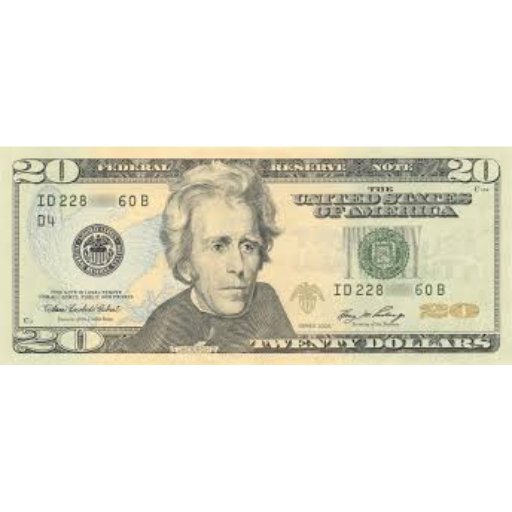
The United States twenty-dollar bill (US$20) is a denomination of U.S. currency. A portrait of Andrew Jackson, the seventh U.S. president (1829–1837), has been featured on the obverse of the bill since 1928; the White House is featured on the reverse. Jackson's portrait on the twenty-dollar bill has been noted as ironic, given his well-known opposition to the Second Bank of the United States and his broader resistance to central banking.
As of December 2018, the average life of a $20 bill in circulation is 7.8 years before it is replaced due to wear. Twenty-dollar bills are delivered by Federal Reserve Banks in violet straps.
is for Beatrix Potter

Helen Beatrix Heelis (née Potter; 28 July 1866 – 22 December 1943), usually known as Beatrix Potter (/ˈbiːətrɪks/ BEE-ə-triks), was an English writer, illustrator, natural scientist, and conservationist. She is best known for her children's books featuring animals, such as The Tale of Peter Rabbit, which was her first commercially published work in 1902. Her books, including The Tale of Jemima Puddle Duck and The Tale of Tom Kitten, have sold more than 250 million copies. An entrepreneur, Potter was a pioneer of character merchandising. In 1903, Peter Rabbit was the first fictional character to be made into a patented stuffed toy, making him the oldest licensed character.
Born into an upper-middle-class household, Potter was educated by governesses and grew up isolated from other children. She had numerous pets and spent holidays in the Lake District, developing a love of landscape, flora and fauna, all of which she closely observed and painted. Potter's study and watercolours of fungi led to her being widely respected in the field of mycology. In her thirties, Potter self-published the highly successful children's book The Tale of Peter Rabbit. Following this, Potter began writing and illustrating children's books full-time.
Potter wrote over sixty books, with the best known being her twenty-three children's tales. In 1905, using the proceeds from her books and a legacy from an aunt, Potter bought Hill Top Farm in Near Sawrey, a village in the Lake District. Over the following
decades, she purchased additional farms to preserve the unique hill country landscape. In 1913, at the age of 47, she married William Heelis (1871–1945), a respected local solicitor with an office in Hawkshead. Potter was also a prize-winning breeder of Herdwick sheep and a prosperous farmer keenly interested in land preservation. She continued to write, illustrate, and design merchandise based on her children's books for British publisher Warne until the duties of land management and her diminishing eyesight made it difficult to continue.
Potter died of pneumonia and heart disease on 22 December 1943 at her home in Near Sawrey, England at the age of 77, leaving almost all her property to the National Trust. She is credited with preserving much of the land that now constitutes the Lake District National Park. Potter's books continue to sell throughout the world in many languages with her stories being retold in songs, films, ballet, and animations, and her life is depicted in two films – The Tales of Beatrix Potter (1983) and Miss Potter (2006).
Potter had been a disciple of the land conservation and preservation ideals of her long-time friend and mentor, Canon Hardwicke Rawnsley, the first secretary and founding member of the National Trust. According to the National Trust, "she supported the efforts of the National Trust to preserve not just the places of extraordinary beauty but also those heads of valleys and low grazing lands that would be irreparably ruined by development." Potter was also an authority on the traditional Lakeland crafts and period furniture, as well as local stonework. She restored and preserved the farms that she bought or managed, making sure that each farm house had in it a piece of antique Lakeland furniture. Potter was interested in preserving not only the Herdwick sheep but also the way of life of fell farming. In 1930 the Heelises became partners with the National Trust in buying and managing the fell farms included in the large Monk Coniston Estate.
The estate was composed of many farms spread over a wide area of north-western Lancashire, including the Tarn Hows. Potter was the de facto estate manager for the Trust for seven years until the National Trust could afford to repurchase most of the property from her. Potter's stewardship of these farms earned her full regard, but she was not without her critics, not the least of which were her contemporaries who felt she used her wealth and the position of her husband to acquire properties in advance of their being made public. She was notable in observing the problems
of afforestation, preserving the intact grazing lands, and husbanding the quarries and timber on these farms. All her farms were stocked with Herdwick sheep and frequently with Galloway cattle.
In 1971, a ballet film was released, The Tales of Beatrix Potter, directed by Reginald Mills, set to music by John Lanchbery with choreography by Frederick Ashton, and performed in character costume by members of the Royal Ballet and the Royal Opera House orchestra. The ballet of the same name has been performed by other dance companies around the world.
In 1992, Potter's children's book The Tale of Benjamin Bunny was featured in the film Lorenzo's Oil.
Potter is also featured in Susan Wittig Albert's series of light mysteries called The Cottage Tales of Beatrix Potter. The first of the eight-book series is Tale of Hill Top Farm (2004), which deals with Potter's life in the Lake District and the village of Near Sawrey between 1905 and 1913.
is for Chuck Jones

Charles Martin Jones (September 21, 1912 – February 22, 2002) was an American animator, painter, voice actor and filmmaker, best known for his work with Warner Bros. Cartoons on the Looney Tunes and Merrie Melodies series of shorts. He wrote, produced, and/or directed many classic animated cartoon shorts starring Bugs Bunny, Daffy Duck, Wile E. Coyote and the Road Runner, Pepé Le Pew, Marvin the Martian, and Porky Pig, among others.
Jones started his career in 1933 alongside Tex Avery, Friz Freleng, Bob Clampett, and Robert McKimson at the Leon Schlesinger Production's Termite Terrace studio, the studio that made Warner Brothers cartoons, where they created and developed the Looney Tunes characters. During the Second World War, Jones directed many of the Private Snafu (1943–1946) shorts which were shown to members of the United States military. After his career at Warner Bros. ended in 1962, Jones started Sib Tower 12 Productions and began producing cartoons for Metro-Goldwyn-Mayer, including a new series of Tom and Jerry shorts (1963–1967) as well as the television adaptations of Dr. Seuss's How the Grinch Stole Christmas! (1966) and Horton Hears a Who! (1970). He later started his own studio, Chuck Jones Enterprises, where he directed and produced the film adaptation of Norton Juster's The Phantom Tollbooth (1970).
Jones's work along with the other animators was showcased in the documentary Bugs Bunny: Superstar (1975). Jones directed the first feature-length animated Looney
Tunes compilation film, The Bugs Bunny/Road Runner Movie (1979). In 1990 he wrote his memoir, Chuck Amuck: The Life and Times of an Animated Cartoonist, which was made into a documentary film, Chuck Amuck (1991). He was also profiled in the American Masters documentary Chuck Jones: Extremes & Inbetweens – A Life in Animation (2000) which aired on PBS.
Two Warner Brothers cartoons that Jones directed, For Scent-imental Reasons and So Much for So Little, won Academy Awards for Best Animated Short Film, though at this time it was customary for the statuette to be given to a cartoon's producer, not the director. Jones did not receive a Best Animated Short Film Oscar of his own until winning for the The Dot and the Line in 1966. Robin Williams later presented Jones with an Honorary Academy Award in 1996 for his work in the animation industry. Film historian Leonard Maltin has praised Jones's work at Warner Bros., MGM and Chuck Jones Enterprises. In Jerry Beck's 1994 book The 50 Greatest Cartoons, a group of animation professionals ranked What's Opera, Doc? (1957) as the greatest cartoon of all time, with ten of the entries being directed by Jones including Duck Amuck (1953), Duck Dodgers in the 24½th Century (1953), One Froggy Evening (1955), Rabbit of Seville (1950), and Rabbit Seasoning (1952).
Jones joined Leon Schlesinger Productions, the independent studio that produced Looney Tunes and Merrie Melodies for Warner Bros., in 1933 as an assistant animator. In 1935 he was promoted to animator and assigned to work with a new Schlesinger director, Tex Avery. There was no room for the new Avery unit in Schlesinger's small studio, so Avery, Jones, and fellow animators Bob Clampett, Virgil Ross, and Sid Sutherland were moved into a small adjacent building they dubbed "Termite Terrace". In 1937, Jones' old boss Ub Iwerks was subcontracted to produce several Looney Tunes shorts for Schleshinger, with Clampett and Jones brought in to assist him. Iwerks completed only two shorts before he left, with Clampett taking his position soon after. Jones worked alongside Clampett as an animator and an uncredited co-director (or "supervisor", the original title for an animation director in the studio) before becoming a main director himself in 1938 when Frank Tashlin left the studio, a position that was initially offered to animator Robert McKimson. The following year, Jones created his first major character, Sniffles, a cute Disney-style mouse, who went on to star in twelve Warner Bros. cartoons.
Jones initially struggled in with his directorial style in his formative years. Unlike the other directors in the studio, Jones wanted to make cartoons that would rival the quality and tone to that of ones made by Walt Disney Productions. However, his cartoons suffered from sluggish pacing and confusing gags, with Jones himself later
describing his early conception of timing and dialog to have been "formed by watching the action in the La Brea Tar Pits". Schlesinger and the studio heads were unsatisfied with his Disney-esque style and demanded him make cartoons that were more funny. Jones began to change of directorial style starting with the 1942 short The Draft Horse, but the cartoon that was generally considered his true turning point was The Dover Boys later that year. The short became highly-regarded in recent years for its quick-timed gags and extensive use of limited animation. Despite this, Schlesinger and the studios heads were still dissatisfied and begun the process to fire him, but they were unable to find a replacement due to a labor shortage stemming from World War II, so Jones kept his position.
He was actively involved in efforts to unionize the staff of Leon Schlesinger Studios. He was responsible for recruiting animators, layout men, and background people. Almost all animators joined, in reaction to salary cuts imposed by Leon Schlesinger. The Metro-Goldwyn-Mayer cartoon studio had already signed a union contract, encouraging their counterparts under Schlesinger. In a meeting with his staff, Schlesinger talked for a few minutes, then turned over the meeting to his attorney. His insulting manner had a unifying effect on the staff. Jones gave a pep talk at the union headquarters. As negotiations broke down, the staff decided to go on strike. Schlesinger locked them out of the studio for a few days, before agreeing to sign the
contract. A Labor-Management Committee was formed and Jones served as a moderator. Because of his role as a supervisor in the studio, he could not himself join the union.
During World War II, Jones worked closely with Theodor Geisel, better known as Dr. Seuss, to create the Private Snafu series of Army educational cartoons (the character was created by director Frank Capra). Jones later collaborated with Seuss on animated adaptations of Seuss' books, including How the Grinch Stole Christmas! in 1966. Jones directed such shorts as The Weakly Reporter, a 1944 short that related to shortages and rationing on the home front. During the same year, he directed UPA's second short subject Hell-Bent for Election, a propaganda campaign film for Franklin D. Roosevelt.
Jones created characters from the late 1930s to the 1950s, which include his collaborative help in co-developing Bugs Bunny and also included creating Inki, Hubie and Bertie, The Three Bears, Claude Cat, Marc Antony and Pussyfoot, Charlie Dog, Michigan J. Frog, Gossamer, and his four most popular creations, Marvin the Martian, Pepé Le Pew, Wile E. Coyote and the Road Runner. Jones and writer Michael Maltese collaborated on the Road Runner cartoons, Duck Amuck, One Froggy Evening, and What's Opera, Doc?. Other staff at Unit A whom Jones collaborated with include layout artist, background designer, and co-director Maurice Noble; animator
and co-director Abe Levitow; and animators Ken Harris and Ben Washam.
Jones remained at Warner Bros. throughout the 1950s, except for a brief period in 1953 when Warner closed the animation studio. During this interim, Jones found employment at Walt Disney Productions, where he teamed with Ward Kimball for a four-month period. According to Kimball, Jones expected to work at Disney at a higher salary rate then at Warner Bros., but was instead employed at the same salary despite numerous negotiations with Walt Disney. Furthermore, Jones was not given any directorial assignments but was instead assigned to assists Kimball on the film Sleeping Beauty (1959), which at the time was going through production delays. Upon Warner Bros. Cartoons reopening, Jones was rehired and reunited with most of his unit. Despite the unsatisfying tenure, Jones still holds the Disney studio to high regard, but later joked that the only job he wanted from Disney's was the position held by Walt.
In the early 1960s, Jones and his wife Dorothy wrote the screenplay for the animated feature Gay Purr-ee. The finished film featured the voices of Judy Garland, Robert Goulet and Red Buttons as cats in Paris, France. The feature was produced by UPA and directed by his former Warner Bros. collaborator, Abe Levitow. Jones moonlighted to work on the film since he had an exclusive contract with Warner Bros. UPA completed the film and made it available for distribution in 1962; it was picked up by
Warner Bros. When Warner Bros. discovered that Jones had violated his exclusive contract with them, they terminated him. Jones's former animation unit was laid off after completing the final cartoon in their pipeline, The Iceman Ducketh, and the rest of the Warner Bros. Cartoons studio was closed in early 1963.
With business partner Les Goldman, Jones started an independent animation studio, Sib Tower 12 Productions, and brought on most of his unit from Warner Bros., including Maurice Noble and Michael Maltese. In 1963, Metro-Goldwyn-Mayer contracted with Sib Tower 12 to have Jones and his staff produce new Tom and Jerry cartoons as well as a television adaptation of all Tom and Jerry theatricals produced to that date. This included major editing, including writing out the African-American maid, Mammy Two-Shoes, and replacing her with one of Irish descent voiced by June Foray. In 1964, Sib Tower 12 was absorbed by MGM and was renamed MGM Animation/Visual Arts. His animated short film, The Dot and the Line: A Romance in Lower Mathematics, won the 1965 Academy Award for Best Animated Short Film. Jones directed the classic animated short The Bear That Wasn't.
As the Tom and Jerry series wound down (it was discontinued in 1967), Jones produced more for television. In 1966, he produced and directed the TV special How the Grinch Stole Christmas!, featuring narration by Boris Karloff.
Jones continued to work on other TV specials such as Horton Hears a Who! (1970), but his main focus during this time was producing the feature film The Phantom Tollbooth, which did lukewarm business when MGM released it in 1970. Jones co-directed 1969's The Pogo Special Birthday Special, based on the Walt Kelly comic strip, and voiced the characters of Porky Pine and Bun Rab. It was at this point that he decided to start ST Incorporated.
MGM closed the animation division in 1970, and Jones once again started his own studio, Chuck Jones Enterprises. He produced a Saturday morning children's TV series for the American Broadcasting Company called The Curiosity Shop in 1971. In 1973, he produced an animated version of the George Selden book The Cricket in Times Square and subsequently produced two sequels.
Three of his works during this period were animated TV adaptations of short stories from Rudyard Kipling's The Jungle Book: Mowgli's Brothers, The White Seal and Rikki-Tikki-Tavi. During this period, Jones began to experiment with more realistically
designed characters, most of which had larger eyes, leaner bodies, and altered proportions, such as those of the Looney Tunes characters.
Jones resumed working with Warner Bros. in 1976 with the animated TV adaptation of The Carnival of the Animals with Bugs Bunny and Daffy Duck. Jones also produced The Bugs Bunny/Road Runner Movie (1979), which was a compilation of Jones's best theatrical shorts, new Road Runner shorts for The Electric Company series and Bugs Bunny's Looney Christmas Tales (1979). New shorts were made for Bugs Bunny's Bustin' Out All Over (1980).
From 1977 to 1978, Jones wrote and drew the newspaper comic strip Crawford (also known as Crawford & Morgan) for the Chicago Tribune-NY News Syndicate. In 2011 IDW Publishing collected Jones's strip as part of their Library of American Comic Strips.
In 1978, Jones's wife Dorothy died. He married Marian Dern, the writer of the comic strip Rick O'Shay in 1981.
is for David Hookes

David William Hookes (3 May 1955 – 19 January 2004) was an Australian cricket player and coach. He played for the Australia national cricket team and domestic cricket for South Australia, later coaching Victoria. An aggressive left-handed batsman, Hookes usually batted in the middle order. His international career got off to a sensational start in the Centenary Test at Melbourne in 1977 when he hit England captain Tony Greig for five consecutive boundaries, but a combination of circumstances ensured that he never became a regular in the Australian team. He wrote in his autobiography, "I suspect history will judge me harshly as a batsman because of my modest record in 23 Tests and I can't complain about that".
For many years, he was a leading figure in Australian domestic cricket, most notably in his role as captain of South Australia (SA). Wisden called him "a first-class destroyer of second-rate bowling". Angered by Victorian captain Graham Yallop's late declaration in a Sheffield Shield match at the Adelaide Oval in October 1982, Hookes, who normally batted at number 3 or 4, promoted himself to opening batsman and proceeded to score a century from 34 balls in just 43 minutes (including 18 fours and two sixes), at the time the fastest century scored in first-class cricket. He finished his career as the highest run-scorer in Sheffield Shield history.
An outspoken man who had several brushes with the game's officials, Hookes retired at the end of the 1991–92 season and pursued his media career. He moved to
Melbourne in 1995 and broadcast on Radio 3AW. His popularity among players and his reputation for strong leadership led to his appointment as coach of the Victorian team in 2002. The team enjoyed success under his tutelage. He died after being punched by a hotel bouncer outside a pub where he had been drinking with Victorian players following their victory in a match earlier in the day.
Hookes grew up in Torrensville, South Australia. He played for the West Torrens Cricket Club and made his A-Grade debut at the age of just 15. When he came in to bat he faced Adelaide Cricket Club bowler and local Australian rules football and media personality Ken "KG" Cunningham. KG said later in a Channel 9 tribute to Hookes that after the first two balls went past the edge of the bat, he walked down the wicket and attempted to upset the youngster in his first game and "gave him a huge spray". Hookes then sent the next four balls to the fence and after the over walked up to Cunningham and said: "Listen old man, if you continue to bowl those wobbly little inswingers the next four will go over the fence and not into the fence." In later years KG became one of Hookes's close friends and on Adelaide television and radio one of his strongest supporters even after his move to Melbourne to become coach of the Victorian state side.
David Hookes made his first-class debut in 1975–76 for South Australia. A rush of form in February 1977, when he scored five centuries from six innings in 17 days, led to his selection for the Centenary Test in March, 1977, at the age of 21.
During Australia's second innings of the match, Hookes made 56, and hit Tony Greig for five consecutive boundaries. Soon after, he signed a contract with World Series Cricket (WSC) and then toured England. Playing all five Tests, Hookes compiled 283 runs at 31.44, with scores of 85 at The Oval and 50 at Lord's.
Australian Captain Ian Chappell described World Series Cricket (WSC) as the toughest cricket he ever played (with all the best players in the world involved)
Hookes was one of the key personalities marketed by the breakaway WSC organisation. In a Supertest at the Sydney Showground in 1977, a bouncer from Andy Roberts broke his jaw, and his confidence never fully recovered from the injury. Nevertheless, he was the third-best performed Australian batsman behind Ian and Greg Chappell with 770 runs (at 38.5 average) across the Supertests played during the 1977–78 / 78-79 and was in fact the best performed Australian batsmen across the 1978–79 Supertests with 392 runs (at 56 average). His future in the Australian team following the rapprochement between WSC and official cricket seemed assured.
However, Hookes managed just one Test and two ODIs when injury curtailed his 1979–80 season. Returned to fitness, he toured Pakistan in 1980, but made a pair in
the first Test at Karachi, dismissed twice by spin bowler Iqbal Qasim. His play against slow bowling had not developed and he was vulnerable to the well-flighted delivery as his footwork was non-existent. Dropped from the Australian team, his form failed to improve in the following Australian season, and he lost his place in the South Australia team as well.
The SACA took a gamble by appointing Hookes as South Australia captain at the start of the 1981–82 season. He responded to the challenge and led the state to the Sheffield Shield. Improved confidence and form led to his reinstatement in the Australian team for the 1982–83 Ashes series, and he batted consistently for 344 runs at 49.14 average with a best score of 68 in the fourth Test at Melbourne. Continuing his good form on the following tour of Sri Lanka, Hookes scored 143 off 152 balls in the first Test between the nations.
Hookes's performances were more subdued during the 1983 World Cup in England. Australia played poorly in the tournament. When the team returned home, Hookes criticised the team's captain, Kim Hughes. This earned him a fine and he was dropped from the 1983–84 Test series against Pakistan. He returned for five Tests in the West Indies during the 1984 tour and passed 20 in seven of his ten innings, yet made only
one half-century, 51 at Antigua in the fourth Test.
Frustrated by Hookes's failure to turn regular starts into big scores, the Australian selectors ignored him for the next 18 months. He was not selected for the 1985 tour of England, although there had been an exodus of Australian players on a rebel tour of South Africa. His last international appearances were in 1985–86, when he played two Tests against both New Zealand and India, and two ODIs in the World Series Cup. Thereafter, Australia pursued a selection policy of giving prolonged opportunities to younger players and passing over older players with inconsistent records.
Despite his failure to live up to expectations at the highest level, Hookes continued to captain South Australia until 1990, when he was sensationally sacked. In October 1982, Hookes thrashed a 43-minute, 34-ball century, which in some respects is the fastest hundred in first-class history. On 7–8 March 1987, Hookes and Wayne Phillips shared an unbroken fourth wicket stand of 462 for South Australia against Tasmania, with Hookes making his highest ever score of 306 not out coming in just 385 minutes from only 314 balls faced (Phillips scored 213 not out). Hookes' innings also included 40 fours and 2 sixes. Hookes and Wicket-keeper Phillips, both left-handed batsmen, broke the previous first-class partnership record of 456 set by Victorian pair Bill
Ponsford and Edgar Mayne in the 1923–24 season against Queensland at the MCG.
Hookes also formed a devastating partnership with fellow South Australian left-hander Darren Lehmann, the pair often entertaining spectators at the Adelaide Oval in Shield matches with their attacking play. In all first-class cricket, Hookes scored 12,671 runs in 178 matches at an average of 43.99.
Hookes was an aggressive strokeplayer against fast bowling, and was known to play the hook shot effectively. However he had problems playing spin. He was known as an "eye" player – or one who relied more on his eye than on sound batting technique.
is for E. B. White

Elwyn Brooks White (July 11, 1899 – October 1, 1985) was an American writer. He was the author of several highly popular books for children, including Stuart Little (1945), Charlotte's Web (1952), and The Trumpet of the Swan (1970).
In a 2012 survey of School Library Journal readers, Charlotte's Web was ranked first in their poll of the top one hundred children's novels. White also was a contributing editor to The New Yorker magazine and co-author of The Elements of Style, an English language style guide. Kurt Vonnegut called White "one of the most admirable prose stylists our country has so far produced."
is for Franklin D. Roosevelt

Franklin Delano Roosevelt (January 30, 1882 – April 12, 1945), also known as FDR, was the 32nd president of the United States, serving from 1933 until his death in 1945. He is the longest-serving U.S. president, and the only one to have served more than two terms. His initial two terms were centered on combating the Great Depression, while his third and fourth saw him shift his focus to America's involvement in World War II.
A member of the prominent Delano and Roosevelt families, Roosevelt was elected to the New York State Senate from 1911 to 1913 and was then the assistant Secretary of the Navy under President Woodrow Wilson during World War I. Roosevelt was James M. Cox's running mate on the Democratic Party's ticket in the 1920 U.S. presidential election, but Cox lost to Republican nominee Warren G. Harding. In 1921, Roosevelt contracted a paralytic illness that permanently paralyzed his legs. Partly through the encouragement of his wife, Eleanor Roosevelt, he returned to public office as governor of New York from 1929 to 1933, during which he promoted programs to combat the Great Depression. In the 1932 presidential election, Roosevelt defeated president Herbert Hoover in a landslide victory.
During his first 100 days as president, Roosevelt spearheaded unprecedented federal legislation and directed the federal government during most of the Great Depression, implementing the New Deal, building the New Deal coalition, and realigning
American politics into the Fifth Party System. He created numerous programs to provide relief to the unemployed and farmers while seeking economic recovery with the National Recovery Administration and other programs. He also instituted major regulatory reforms related to finance, communications, and labor, and presided over the end of Prohibition. In 1936, Roosevelt won a landslide reelection. He was unable to expand the Supreme Court in 1937, the same year the conservative coalition was formed to block the implementation of further New Deal programs and reforms. Major surviving programs and legislation implemented under Roosevelt include the Securities and Exchange Commission, the National Labor Relations Act, the Federal Deposit Insurance Corporation, and Social Security. In 1940, he ran successfully for reelection, before the official implementation of term limits.
Following the Japanese attack on Pearl Harbor on December 7, 1941, Roosevelt obtained a declaration of war on Japan. When in turn, Japan's Axis partners, Nazi Germany and Italy, declared war on the U.S. on December 11, 1941, he secured additional declarations of war from the United States Congress. He worked closely with other national leaders in leading the Allies against the Axis powers. Roosevelt supervised the mobilization of the American economy to support the war effort and implemented a Europe first strategy. He also initiated the development of the first atomic bomb and worked with the other Allied leaders to lay the groundwork for
the United Nations and other post-war institutions, even coining the term "United Nations". Roosevelt won reelection in 1944 but died in 1945 after his physical health seriously and steadily declined during the war years. Since then, several of his actions have come under criticism, such as his ordering of the internment of Japanese Americans. Nonetheless, historical rankings consistently place him among the three greatest American presidents, and he is often considered an icon of American liberalism.
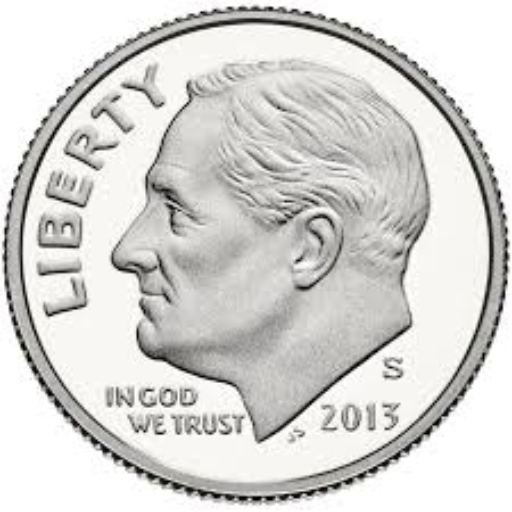
Roosevelt dime. The Roosevelt dime is the current dime, or ten-cent piece, of the United States. Struck by the United States Mint continuously since 1946, it displays President Franklin D. Roosevelt on the obverse and was authorized soon after his death in 1945.
is for Grimm brothers

The Brothers Grimm (German: die Brüder Grimm or die Gebrüder Grimm), Jacob (1785–1863) and Wilhelm (1786–1859), were German academics who together collected and published folklore. The brothers are among the best-known storytellers of folktales, popularizing stories such as "Cinderella" ("Aschenputtel"), "The Frog Prince" ("Der Froschkönig"), "Hansel and Gretel" ("Hänsel und Gretel"), "Town Musicians of Bremen" ("Die Bremer Stadtmusikanten"), "Little Red Riding Hood" ("Rotkäppchen"), "Rapunzel", "Rumpelstiltskin" ("Rumpelstilzchen"), "Sleeping Beauty" ("Dornröschen"), and "Snow White" ("Schneewittchen"). Their first collection of folktales, Children's and Household Tales (Kinder- und Hausmärchen), was first published in 1812.
The Brothers Grimm spent their formative years in the town of Hanau in the Landgraviate of Hesse-Kassel. Their father's death in 1796 (when Jacob was 11 and Wilhelm 10) caused great poverty for the family and affected the brothers many years after. Both brothers attended the University of Marburg, where they developed a curiosity about German folklore, which grew into a lifelong dedication to collecting German folktales.
The rise of Romanticism in 19th-century Europe revived interest in traditional folk stories, which to the Brothers Grimm represented a pure form of national literature and culture. With the goal of researching a scholarly treatise on folktales, they
established a methodology for collecting and recording folk stories that became the basis for folklore studies. Between 1812 and 1857 their first collection was revised and republished many times, growing from 86 stories to more than 200. In addition to writing and modifying folktales, the brothers wrote collections of well-respected Germanic and Scandinavian mythologies, and in 1838 they began writing a definitive German dictionary (Deutsches Wörterbuch), which they were unable to finish.
The popularity of the Grimms' collected folktales has endured. They are available in more than 100 translations and have been adapted by renowned filmmakers, including Lotte Reiniger and Walt Disney, in films such as Snow White and the Seven Dwarfs. In the mid-20th century, Nazi Germany weaponized the tales for propaganda; later in the 20th century, psychologists such as Bruno Bettelheim reaffirmed the work's value despite the sexuality, cruelty, and violence in some of the tales' original versions, which were eventually censored by the Grimms themselves.
The rise of romanticism, romantic nationalism, and trends in valuing popular culture in the early 19th century revived interest in fairy tales, which had declined since their late 17th-century peak. Johann Karl August Musäus published a popular collection of tales called Volksmärchen der Deutschen between 1782 and 1787; the Grimms aided the revival with their folklore collection, built on the conviction that a national identity could be found in popular culture and with the common folk (Volk). They collected and published their tales as a reflection of German cultural identity. In the first collection, though, they included Charles Perrault's tales, published in Paris in 1697 and written for the literary salons of an aristocratic French audience. Scholar Lydie Jean says that Perrault created a myth that his tales came from the common people and reflected existing folklore to justify including them—even though many of them were original.
The brothers were directly influenced by Brentano and von Arnim, who edited and adapted the folk songs of Des Knaben Wunderhorn (The Boy's Magic Horn or cornucopia). They began the collection with the purpose of creating a scholarly treatise of traditional stories, and of preserving the stories as they had been handed from generation to generation—a practice threatened by increased industrialization. Maria Tatar, professor of German studies at Harvard University, argues that it is precisely the handing from generation to generation and the genesis
in the oral tradition that gives folk tales important mutability. Versions of tales differ from region to region, "picking up bits and pieces of local culture and lore, drawing a turn of phrase from a song or another story, and fleshing out characters with features taken from the audience witnessing their performance."
But Tatar argues that the Grimms appropriated as uniquely German stories, such as "Little Red Riding Hood", that had existed in many versions and regions throughout Europe, because they believed that such stories reflected Germanic culture. Furthermore, the brothers saw fragments of old religions and faiths reflected in the stories, which they thought continued to exist and survive through the telling of stories.
When Jacob returned to Marburg from Paris in 1806, their friend Brentano sought the brothers' help in adding to his collection of folk tales, at which time the brothers began to gather tales in an organized fashion. By 1810 they had produced a manuscript collection of several dozen tales, written after inviting storytellers to their home and transcribing what they heard. These tales were heavily modified in transcription; many had roots in previously written sources. At Brentano's request, they printed and sent him copies of the 53 tales that they collected for inclusion in his
third volume of Des Knaben Wunderhorn. Brentano either ignored or forgot about the tales, leaving the copies in a church in Alsace where they were found in 1920 and became known as the Ölenberg manuscript. It is the earliest extant version of the Grimms' collection and has become a valuable source to scholars studying the development of the Grimms' collection from the time of its inception. The manuscript was published in 1927 and again in 1975.
The brothers gained a reputation for collecting tales from peasants, although many tales came from middle-class or aristocratic acquaintances. Wilhelm's wife, Henriette Dorothea (Dortchen) Wild, and her family, with their nursery maid, told the brothers some of the more well-known tales, such as "Hansel and Gretel" and "Sleeping Beauty". Wilhelm collected some tales after befriending August von Haxthausen, whom he visited in 1811 in Westphalia where he heard stories from von Haxthausen's circle of friends. Several of the storytellers were of Huguenot ancestry, telling tales of French origin such as those told to the Grimms by Marie Hassenpflug, an educated woman of French Huguenot ancestry, and it is probable that these informants were familiar with Perrault's Histoires ou contes du temps passé (Stories from Past Times). Other tales were collected from Dorothea Viehmann, the wife of a middle-class tailor and also of French descent. Despite her middle-class background, in the first English translation she was characterized as a peasant and given the
name Gammer Gretel. At least one tale, Gevatter Tod (Grim Reaper), was provided by composer Wilhelmine Schwertzell, with whom Wilhelm had a long correspondence.
According to scholars such as Tatar and Ruth Bottigheimer, some of the tales probably originated in written form during the medieval period with writers such as Straparola and Boccaccio, but were modified in the 17th century and again rewritten by the Grimms. Moreover, Tatar writes that the brothers' goal of preserving and shaping the tales as something uniquely German at a time of French occupation was a form of "intellectual resistance", and in so doing they established a methodology for collecting and preserving folklore that set the model followed later by writers throughout Europe during periods of occupation.
From 1807 onward, the brothers added to the collection. Jacob established the framework, maintained through many iterations; from 1815 until his death, Wilhelm assumed sole responsibility for editing and rewriting the tales. He made the tales stylistically similar, added dialogue, removed pieces "that might detract from a rustic tone", improved the plots, and incorporated psychological motifs. Ronald Murphy writes in The Owl, the Raven, and the Dove that the brothers, particularly Wilhelm, also added religious and spiritual motifs to the tales. He believes that Wilhelm
"gleaned" bits from old Germanic faiths, Norse mythology, Roman and Greek mythology, and biblical stories that he reshaped.
Over the years, Wilhelm worked extensively on the prose; he expanded and added detail to the stories to the point that many of them grew to twice the length they had in the earliest published editions. In the later editions Wilhelm polished the language to make it more enticing to a bourgeois audience, eliminated sexual elements, and added Christian elements. After 1819 he began writing original tales for children (children were not initially considered the primary audience) and adding didactic elements to existing tales.
Some changes were made in light of unfavorable reviews, particularly from those who objected that not all the tales were suitable for children because of scenes of violence and sexuality. He worked to modify plots for many of the stories; for example, "Rapunzel" in the first edition of Kinder- und Hausmärchen clearly shows a sexual relationship between the prince and the girl in the tower, which he edited out in subsequent editions. Tatar writes that morals were added (in the second edition a king's regret was added to the scene in which his wife is to be burned at the stake) and often the characters in the tale were amended to appear more German: "every fairy (Fee), prince (Prinz) and princess (Prinzessin)—all words of French origin—was transformed into a more Teutonic-sounding enchantress (Zauberin) or wise
woman (weise Frau), king's son (Königssohn), king's daughter (Königstochter)."
The Grimms' legacy contains legends, novellas, and folk stories, the vast majority of which were not intended as children's tales. Von Arnim was concerned about the content of some of the tales—such as those that showed children being eaten—and suggested adding a subtitle to warn parents of the content. Instead the brothers added an introduction with cautionary advice that parents steer children toward age-appropriate stories. Despite von Arnim's unease, none of the tales were eliminated from the collection; the brothers believed that all the tales were of value and reflected inherent cultural qualities. Furthermore, the stories were didactic in nature at a time when discipline relied on fear, according to scholar Linda Dégh, who explains that tales such as "Little Red Riding Hood" and "Hansel and Gretel" were written as "warning tales" for children.
The stories in Kinder- und Hausmärchen include scenes of violence that have since been sanitized. For example, in the Grimms' original version of "Snow White", the Queen is Little Snow White's mother, not her stepmother, but still orders her Huntsman to kill Snow White (her biological daughter) and bring home the child's lungs and liver so that she can eat them; the story ends with the Queen dancing at
Snow White's wedding, wearing a pair of red-hot iron shoes that kill her. Another story, "The Goose Girl", has a servant stripped naked and pushed into a barrel "studded with sharp nails" pointing inward and then rolled down the street. The Grimms' version of "The Frog Prince" describes the princess throwing the frog against a wall instead of kissing him. To some extent the cruelty and violence may reflected the medieval culture from which the tales originated, such as scenes of witches burning, as described in "The Six Swans".
Tales with a spinning motif are broadly represented in the collection. In her essay "Tale Spinners: Submerged Voices in Grimms' Fairy Tales", Bottigheimer argues that these stories reflect the degree to which spinning was crucial in the life of women in the 19th century and earlier. Spinning, particularly of flax, was commonly performed in the home by women. Many stories begin by describing the occupation of their main character, as in "There once was a miller", yet spinning is never mentioned as an occupation; this appears to be because the brothers did not consider it an occupation. Instead, spinning was a communal activity, frequently performed in a Spinnstube (spinning room), a place where women most likely kept the oral traditions alive by telling stories while engaged in tedious work. In the stories, a woman's personality is often represented by her attitude toward spinning; a wise woman might be a spinster and Bottigheimer writes that the spindle was the symbol
of a "diligent, well-ordered womanhood". In some stories, such as "Rumpelstiltskin", spinning is associated with a threat; in others, spinning might be avoided by a character who is either too lazy or not accustomed to spinning because of her high social status.
The Grimms' work have been subjected to feminist critique. For example, Emma Tennant writes:
The tales were also criticized for being insufficiently German, which influenced the tales that the brothers included and their use of language. But scholars such as Heinz Rölleke say that the stories are an accurate depiction of German culture, showing "rustic simplicity [and] sexual modesty". German culture is deeply rooted in the forest (wald), a dark dangerous place to be avoided, most particularly the old forests with large oak trees, and yet a place where Little Red Riding Hood's mother sent her daughter to deliver food to her grandmother's house.
Some critics, such as Alistair Hauke, use Jungian analysis to say that the deaths of the brothers' father and grandfather are the reason for the Grimms' tendency to idealize and excuse fathers, as well as the predominance of female villains in the tales, such as the wicked stepmother and stepsisters in "Cinderella". However, this disregards the fact that they were collectors, not authors of the tales. Another possible influence is found in stories such as "The Twelve Brothers", which mirrors the brothers' family
structure of several brothers facing and overcoming opposition. Some of the tales have autobiographical elements, and according to Zipes the work may have been a "quest" to replace the family life lost after their father died. The collection includes 41 tales about siblings, which Zipes says are representative of Jacob and Wilhelm. Many of the sibling stories follow a simple plot where the characters lose a home, work industriously at a specific task, and in the end find a new home.
Between 1812 and 1864, Kinder- und Hausmärchen was published 17 times: seven of the "Large edition" (Große Ausgabe) and ten of the "Small edition" (Kleine Ausgabe). The Large editions contained all the tales collected to date, extensive annotations, and scholarly notes written by the brothers; the Small editions had only 50 tales and were intended for children. Emil Grimm, Jacob and Wilhelm's younger brother, illustrated the Small editions, adding Christian symbolism to the drawings, such as depicting Cinderella's mother as an angel and adding a Bible to the bedside table of Little Red Riding Hood's grandmother.
The first volume was published in 1812 with 86 folk tales, and a second volume with 70 additional tales was published late in 1814 (dated 1815 on the title page); together the two volumes and their 156 tales are considered the first of the (annotated) Large
editions. A second expanded edition with 170 tales was published in 1819, followed in 1822 by a volume of scholarly commentary and annotations. Five more Large editions were published in 1837, 1840, 1843, 1850, and 1857. The seventh and final edition of 1857 contained 211 tales—200 numbered folk tales and 11 legends.
In Germany Kinder- und Hausmärchen, commonly Grimms' Fairy Tales in English, was also released in a "popular poster-sized Bilderbogen (broadsides)" format and in single-story formats for the more popular tales such as "Hansel and Gretel". The stories were often added to collections by other authors without respect to copyright as the tales became a focus of interest for children's book illustrators, with well-known artists such as Arthur Rackham, Walter Crane, and Edmund Dulac illustrating. Another popular edition released in the mid-19th century included elaborate etchings by George Cruikshank. Upon the brothers' deaths, the copyright went to Wilhelm's son Hermann Grimm, who continued the practice of printing the volumes in expensive and complete editions, but after 1893, when copyright lapsed, various publishers began to print the stories in many formats and editions. In the 21st century, Kinder- und Hausmärchen is a universally recognized text. Jacob's and Wilhelm's collection of stories has been translated to more than 160 languages; 120 different editions of the text are available for sale in the US alone.
While at the University of Marburg, the brothers came to see culture as tied to language and regarded the purest cultural expression in the grammar of a language. They moved away from Brentano's practice—and that of the other romanticists—who frequently changed original oral styles of folk tale to a more literary style, which the brothers considered artificial. They thought that the style of the people (the volk) reflected a natural and divinely inspired poetry (naturpoesie)—as opposed to the kunstpoesie (art poetry), which they saw as artificially constructed. As literary historians and scholars they delved into the origins of stories and attempted to retrieve them from the oral tradition without loss of the original traits of oral language.
The brothers strongly believed that the dream of national unity and independence relied on a full knowledge of the cultural past that was reflected in folklore. They worked to discover and crystallize a kind of Germanness in the stories they collected in the belief that folklore contained kernels of mythologies and legends crucial to understanding the essence of German culture. In examining culture from a philological point of view they sought to establish connections between German law, culture, and local beliefs.
The Grimms considered the tales to have origins in traditional Germanic folklore, which they thought had been "contaminated" by later literary tradition. In the shift
from the oral tradition to the printed book, tales were translated from regional dialects to Standard German (Hochdeutsch or High German). But over the course of the many modifications and revisions, the Grimms sought to reintroduce regionalisms, dialects, and Low German to the tales—to reintroduce the language of the original form of the oral tale.
As early as 1812 they published Die beiden ältesten deutschen Gedichte aus dem achten Jahrhundert: Das Lied von Hildebrand und Hadubrand und das Weißenbrunner Gebet (The Two Oldest German Poems of the Eighth Century: The Song of Hildebrand and Hadubrand and the Wessobrunn Prayer); the Wessobrunn Prayer is a ninth-century German prayer, while the Song of Hildebrand and Hadubrand is the earliest-known German heroic song.
Between 1816 and 1818 the brothers published a two-volume work, Deutsche Sagen (German Legends), consisting of 585 German legends. Jacob undertook most of the work of collecting and editing the legends, which he organized according to region and historical (ancient) legends and were about real people or events. The brothers meant it as a scholarly work, but the historical legends were often taken from secondary sources, interpreted, modified, and rewritten—resulting in works "that were regarded as trademarks". Some scholars criticized the Grimms' methodology in collecting and rewriting the legends, yet conceptually they set an example for legend
collections that was followed by others throughout Europe. Unlike the collection of folk tales, Deutsche Sagen sold poorly, but Zipes says that the collection, translated to French and Danish in the 19th century but not to English until 1981, is a "vital source for folklorists and critics alike".
Less well known in the English-speaking world is the Grimms' pioneering scholarly work on a German dictionary, the Deutsches Wörterbuch, which they began in 1838. Not until 1852 did they begin publishing the dictionary in installments. The work on the dictionary was not finished in their lifetimes, because in it they gave a history and analysis of each word.
is for Harry Houdini

Erik Weisz (March 24, 1874 – October 31, 1926), known professionally as Harry Houdini (/huːˈdiːni/ hoo-DEE-nee), was a Hungarian-American escapologist, illusionist, and stunt performer noted for his escape acts.
Houdini first attracted notice in vaudeville in the United States and then as Harry "Handcuff" Houdini on a tour of Europe, where he challenged police forces to keep him locked up. Soon he extended his repertoire to include chains, ropes slung from skyscrapers, straitjackets under water, and having to escape from and hold his breath inside a sealed milk can with water in it.
In 1904, thousands watched as Houdini tried to escape from special handcuffs commissioned by London's Daily Mirror, keeping them in suspense for an hour. Another stunt saw him buried alive and only just able to claw himself to the surface, emerging in a state of near-breakdown. While many suspected that these escapes were faked, Houdini presented himself as the scourge of fake spiritualists, pursuing a personal crusade to expose their fraudulent methods. As president of the Society of American Magicians, he was keen to uphold professional standards and expose fraudulent artists. He was also quick to sue anyone who imitated his escape stunts.
Houdini made several movies but quit acting when it failed to bring in money. He was also a keen aviator and became the first man to fly a powered aircraft in Australia.
is for Ian Botham

Ian Terence Botham, Baron Botham (born 24 November 1955) is an English cricket commentator, member of the House of Lords, a former cricketer who has been chairman of Durham County Cricket Club since 2017 and charity fundraiser. Hailed as one of the greatest all-rounders in the history of the game, Botham represented England in both Test and One-Day International cricket. He was a part of the English squads which finished as runners-up at the 1979 Cricket World Cup and as runners-up at the 1992 Cricket World Cup.
He played most of his first-class cricket for Somerset, at other times competing for Worcestershire, Durham and Queensland. He was an aggressive right-handed batsman and, as a right-arm fast-medium bowler, was noted for his swing bowling. He generally fielded close to the wicket, predominantly in the slips. In Test cricket, Botham scored 14 centuries with a highest score of 208, and from 1986 to 1988 held the world record for the most Test wickets until overtaken by fellow all-rounder Sir Richard Hadlee. He took five wickets in an innings 27 times, and 10 wickets in a match four times. In 1980, he became the second player in Test history to complete the "match double" of scoring 100 runs and taking 10 wickets in the same match. On the occasion of England's 1000th Test in August 2018, he was named in the country's greatest Test XI by the ECB.
Botham has at times been involved in controversies, including a highly publicised
court case involving rival all-rounder Imran Khan and an ongoing dispute with the Royal Society for the Protection of Birds (RSPB). These incidents, allied to his on-field success, have attracted media attention, especially from the tabloid press. Botham has used his fame to raise money for research into childhood leukaemia. These efforts have realised millions of pounds for Bloodwise, of which he became president. On 8 August 2009, he was inducted into the ICC Cricket Hall of Fame. In July 2020, it was announced that Botham would be elevated to the House of Lords and that he would sit as a crossbench peer.
Botham has a wide range of sporting interests outside cricket. He was a talented footballer at school and had to choose between cricket and football as a career. He chose cricket but, even so, he played professional football for a few seasons and made eleven appearances in the Football League for Scunthorpe United, becoming the club's president in 2017. He is a keen golfer, and his other pastimes include angling and shooting. He has been awarded both a knighthood and a life peerage.
Botham had done well for the Second XI and he later acknowledged the help and advice he received from Somerset players Peter Robinson, Graham Burgess and Ken Palmer. Botham made his senior debut, aged 17, for Somerset on Sunday, 2 September 1973 when he played in a List A John Player League (JPL) match (38 overs each) against Sussex at the County Ground, Hove. The match was in the same week that his time on the Lord's ground staff was completed. Somerset batted first, and Botham, number seven in the batting order, scored two runs before he was dismissed leg before wicket (lbw) by Mike Buss. Somerset totalled 139 for 9. Sussex won comfortably by six wickets, reaching 141 for four with fifteen deliveries remaining. Botham bowled three overs without success, conceding 22 runs. He did impress, however, by taking a diving catch to dismiss his future England colleague Tony Greig off the bowling of his captain Brian Close.
A week later, Botham made a second appearance in the JPL against Surrey at The Oval in the final match of the season. Somerset were well beaten by 68 runs. Botham had his first bowling success when he dismissed Geoff Howarth lbw. He bowled four overs and took one for 14. As in his first match, he scored two batting at number seven, this time being caught and bowled by Intikhab Alam. These were his only two senior appearances in 1973, Somerset finishing 11th in the JPL. In summary, Botham scored four runs, took one wicket for 14 and held one catch.
Aged 18, Botham was a regular in the Somerset team from the beginning of the 1974 season and made his first-class début 8–10 May in a County Championship match against Lancashire at the County Ground, Taunton. Viv Richards, from Antigua and Barbuda, made his County Championship début for Somerset in the same match and Lancashire's team included Clive Lloyd, two players who would loom large in Botham's future Test career. Brian Close won the toss and decided to bat first. On day one, Somerset were all out for 285 and Lancashire reached 41 for none. Botham batted at number seven and scored 13 before being caught. Day two was rain-affected and Lancashire advanced to 200 for none. Their innings closed on the final day at 381 for eight. Botham bowled only three overs and his figures were none for 15; he held one catch to dismiss Jack Simmons. Somerset played for the draw and were 104 for two at the end. Botham did not bat again.
On 12 June 1974, he played against Hampshire at Taunton in a Benson & Hedges Cup (B&H Cup) quarter-final. Hampshire won the toss and decided to bat. They scored 182 all out with Botham taking two for 33 including the prize wicket of Barry Richards, bowled for 13. Botham was number nine in Somerset's batting order and came in with his team struggling at 113 for 7. Almost immediately, that became 113 for 8 and he had only the tailenders Hallam Moseley and Bob Clapp to support him. He was facing the West Indian fast bowler Andy Roberts who delivered a bouncer which hit
him in the mouth. Despite heavy bleeding and the eventual loss of four teeth, Botham refused to leave the field and carried on batting. He hit two sixes and made 45*, enabling Somerset to win by one wicket. He won the Gold Award. Later, he said he should have left the field but was full of praise for Moseley and Clapp.
In a County Championship match on 13 July 1974, Botham scored his first half-century in first-class cricket. He made 59 in Somerset's first innings against Middlesex at Taunton, the highest individual score in a low-scoring match which Somerset won by 73 runs. Middlesex's captain was Mike Brearley, who would become a very influential figure in Botham's career. A month later, in a match against Leicestershire at Clarence Park, Weston-super-Mare, Botham achieved his first-ever five wickets in an innings (5wI) with five for 59. He took seven in the match which Somerset won by 179 runs, largely thanks to Close who scored 59 and 114*.
Botham showed great promise in 1974, his first full season in which Somerset finished fifth in the County Championship and a close second to Leicestershire in the JPL. They also reached the semi-finals in both the Gillette Cup and the B&H Cup. In 18 first-class appearances, Botham scored 441 runs with a highest of 59, took 30 first-class wickets with a best of five for 59 and held 15 catches. He played in 18 List A matches too, scoring 222 runs with a highest of 45* (his Gold Award innings against Hampshire), took 12 wickets with a best of two for 16 and held four catches.
Botham continued to make progress in 1975. Somerset struggled in the County Championship, winning only four of their twenty matches and finished joint 12th. In the JPL, they slumped badly from second to 14th. They reached the quarter-final of the B&H Cup but only the second round of the Gillette Cup. Botham played in 22 first-class and 23 List A matches so it was a busy season for him. In first-class, he scored 584 runs with a highest of 65, one of two half-centuries, and held 18 catches. He took 62 wickets, doubling his 1974 tally, with a best of five for 69, his only 5wI that season. In List A, he scored 232 runs with a highest of 38* and held seven catches. He took 32 wickets with a best of three for 34.
1976 was a significant season for Botham as he scored over 1,000 runs for the first time, completed his first century and earned international selection by England in two Limited Overs Internationals. Somerset improved in the County Championship to finish seventh, winning seven matches. They were one of five teams tied for first place in the JPL but their run rate was less than that of Kent, who were declared the champions. Somerset lost their opening match in the Gillette Cup and were eliminated at the group stage of the B&H Cup. Botham, though, came on in leaps and bounds. He totalled 1,022 first-class runs in 20 matches with a highest of 167*, his
first-ever century and he also scored six half-centuries. With the ball, he took 66 wickets with a best of six for 16. He had four 5wI and, for the first time, ten wickets in a match (10wM). He played in a total of 22 List A matches, including the two for England, scoring 395 runs with a highest of 46. He took 33 wickets with a best of four for 41.
In the County Championship match against Sussex at Hove in May, Botham came very close to his maiden century but was dismissed for 97, his highest score to date. The match was drawn. At the end of the month, Somerset played Gloucestershire in a remarkable match at Taunton. Batting first, Somerset scored 333 for seven (innings closed) and then, thanks to six for 25 by Botham, bowled out Gloucestershire for only 79. The follow-on was enforced but Gloucestershire proved a much tougher nut to crack second time around. With Zaheer Abbas scoring 141, they made 372 and left Somerset needing 118 to win. Botham took five for 125 in the second innings for a match analysis of 11 for 150, his maiden 10wM. This match ended the same way as the famous Test at Headingley in 1981 but the boot was on the other foot for Botham here because he was on the team that enforced the follow-on – and lost. Mike Procter and Tony Brown did the damage and bowled Somerset out for 110 in 42 overs, Gloucestershire winning by just eight runs.
Botham scored his maiden first-class century at Trent Bridge on Tuesday 3 August
1976 in the County Championship game against Nottinghamshire (Notts) who won the toss and decided to bat first. Derek Randall scored 204* and the Notts innings closed at 364 for 4 (Botham one for 59). Somerset were 52 for one at close of play. On day two, Somerset scored 304 for 8 (innings closed) and Botham, batting at number six, scored 80. At close of play, Notts in their second innings were 107 for four, thus extending their lead to 167 with six wickets standing. On day three, Notts advanced to 240 for nine declared (Botham one for 16), leaving Somerset with a difficult target of 301. At 40 for two and with both their openers gone, Brian Close changed his batting order and summoned Botham to come in at number four. Close himself had gone in at three but he was out soon afterwards for 35. With support from Graham Burgess (78), Botham laid into the Notts bowling and scored an impressive 167 not out. Somerset reached 302 for four in only 65 overs and won by six wickets.
Botham's international début for England was on 26 August 1976 in a Limited Overs International (LOI) against the West Indies at the North Marine Road Ground, Scarborough. The series was called the Prudential Trophy and the teams had 55 overs each per innings. Botham, still only 20, was the youngest player. At Scarborough, England captain Alan Knott lost the toss and Clive Lloyd, captaining the West Indies, elected to field first. Botham was number seven in the batting order and came in at 136 for five to join Graham Barlow. He scored only one before he was caught by Roy Fredericks off the bowling of his future Sky Sports colleague Michael Holding. England's innings closed at 202 for eight with Barlow 80 not out. West Indies lost Fredericks almost immediately but that brought Viv Richards to the crease and he hit 119 not out, winning the man of the match award, and leading West Indies to victory in only 41 overs by six wickets. Botham had the consolation of taking his first international wicket when he had Lawrence Rowe caught by Mike Hendrick for 10. He bowled only three overs and took some punishment from Richards, his return being one for 26.
In the second match at Lord's, Botham was replaced by returning England captain Tony Greig. England lost by 36 runs as Richards, this time with 97, was again the difference between the teams. Having lost the series, England recalled Botham for the final match at Edgbaston on 30–31 August. The match was extended to two days
and overs reduced to 32 per side. Tony Greig won the toss and decided to field. England began well and dismissed Fredericks and Richards, for a duck, in only the second over. West Indies were then seven for one but a powerful innings by Clive Lloyd pulled them out of trouble and they reached 223 for nine, innings closed. Botham bowled three very expensive overs, conceding 31 runs, but he did manage to bowl out Michael Holding for his second international wicket. England were never in the hunt and were bowled out for 173, West Indies winning by 50 runs and claiming the series 3–0. Botham again batted at number seven and made a good start, scoring 20 at a run a ball, but he was then caught by Bernard Julien off Fredericks and England were 151 for seven with only Knott and the tailenders left.
In the winter of 1976–77, after he had made his first two international appearances, Botham played District Cricket in Melbourne, Australia for the University of Melbourne Cricket Club. He was joined by Yorkshire's Graham Stevenson. They were signed for the second half of the season on a sponsorship arranged through the Test and County Cricket Board (TCCB) by Whitbread's Brewery. Five of the competition's 15 rounds were abandoned because of adverse weather. It was apparently on this trip that Botham originally fell out with the former Australian captain Ian Chappell. The
cause seems to have been a cricket-related argument in a bar, which may have resulted in Chappell being pushed off his stool (the story is widely sourced but accounts differ). This became a long-running feud and, as late as the 2010–11 Ashes series, there was an altercation between Botham and Chappell in a car park at the Adelaide Oval.
Botham produced a number of good batting and bowling performances for Somerset in 1977 and these impressed the Test selectors who included him in the team for the third Test against Australia at Trent Bridge, starting on 28 July. Having captured 36 first-class wickets through May and June, Botham had something of a purple patch in July which earned him his Test call-up. In the match against Sussex at Hove, which Somerset won by an innings and 37 runs, he took four for 111 and six for 50 for his second 10wM. In Somerset's innings of 448 for eight, he shared a 4th wicket partnership of 174 with Viv Richards. Botham scored 62, Richards 204. He took 22 more wickets, including two 5wI, in the next three County Championship games before his Test debut. In the whole season, playing 17 first-class matches, he took 88 wickets with six 5wI and one 10wM, his second innings return at Hove being his best. His batting was not quite as good as in 1976 as his average was down but he
scored 738 runs with a highest of 114, which was his sole century, and five half-centuries. He scored the century in July against Hampshire at Taunton, 114 in Somerset's first innings of 284, and followed it with bowling returns of four for 69 and four for 43, another impressive all-round effort which earned Somerset a win by 152 runs. Somerset had a good season in the County Championship, finishing fourth. They reached the semi-final of the Gillette Cup but, without the injured Botham, were well beaten by eventual winners Middlesex. They were a poor tenth in the JPL and were eliminated from the B&H Cup at the group stage.
Botham made his Test début at Trent Bridge on 28 July 1977 in the third Test against Australia. His début was somewhat overshadowed by the return from self-imposed Test exile of Geoffrey Boycott. England went into the match with a 1–0 series lead having won the second Test after the first had been drawn. The series was played against the background of the so-called "Packer Affair" which resulted in the establishment of World Series Cricket in the next Australian season. Because of Tony Greig's involvement, he had been stripped of the England captaincy but remained in the team under new captain Mike Brearley. England had three all-rounders at Trent Bridge with Greig, Geoff Miller and Botham all playing. Australian captain Greg Chappell won the toss and decided to bat first. Australia scored 243 and were all out shortly before the close on day one. Botham, aged 21, made an immediate impact
and took five for 74, the highlight being the wicket of Chappell, bowled for just 19. England batted all through day two and into day three as Boycott, in his first Test innings since 1974, and Knott both made centuries. Botham came in at number eight on day three and scored 25 before he was bowled by Max Walker. England were all out not long afterwards for 364, a first innings lead of 121. Botham had no joy in Australia's second innings with none for 60. A century by Rick McCosker enabled Australia to score 309 before they were all out in the evening session on day four. Bob Willis took five for 88. England needed 189 to win and completed the job, by seven wickets, well into the final day with Brearley scoring 81 and Boycott, who batted on all five days, 80 not out. Botham didn't get a second innings.
Botham's impressive bowling at Trent Bridge meant he was an automatic choice for the fourth Test at Headingley two weeks later. England won the toss, decided to bat first and went on to win by an innings and 85 runs to secure a winning 3–0 lead in the series and regain The Ashes, which they had lost in 1974–75. The match is famous for Boycott's one hundredth career century, scored on his home county ground and in his second Test since his return to the England fold. Botham was bowled third ball by Ray Bright without scoring. He made amends with the ball by taking five for 21 in only eleven overs, Australia being bowled out for only 103. The follow-on was enforced and Australia this time made 248, but Botham (none for 47) did not take a wicket. He was
injured during the second innings when he accidentally trod on the ball and broke a bone in his foot. He was unable to play again in the 1977 season.
His promising start as Test player resulted in two awards. He was named Young Cricketer of the Year for 1977 by the Cricket Writers' Club; and was selected as one of the Wisden Cricketers of the Year (i.e., for 1977 but announced in the 1978 edition). Wisden commented that his 1977 season "was marred only by a week's cricket idleness carrying the drinks at the Prudential matches, and a foot injury which ruined for him the end of the season and probably robbed him of a rare double. He finished with 88 wickets and 738 runs". Importantly, the foot injury was a broken toe sustained when he trod on the ball at Headingley and Botham subsequently needed treatment for it at his local hospital in Taunton. It was while going to one of his appointments that he took a wrong turn and ended up on a children's ward where he learned that some of the children were dying of leukaemia. This incident sparked his charitable crusade on behalf of leukaemia research.
England were in Pakistan from November 1977 to January 1978, playing three Tests and three LOIs. Botham was almost fully recovered from his foot injury but did not play in any of the Tests. He took part in all three LOIs and in some of the first-class
matches against club teams. From January to March, England were in New Zealand for a three-match Test series under the captaincy of Geoff Boycott. Botham impressed in a first-class match against Canterbury at Lancaster Park, scoring 126 not out in the second innings against an attack including Richard Hadlee and was selected for the first Test at Basin Reserve. Botham had an indifferent game there and England, twice bowled out by Hadlee, lost by 72 runs. In the next match at Carisbrook against Otago, Botham achieved a 10wM with seven for 58 (his career best return to date) in the second innings, enabling the England XI to win by six wickets.
England won the second Test at Lancaster Park by 174 runs after an outstanding all-round performance by Botham who scored 103 and 30 not out and took five for 73 and three for 38. He also held three catches. In the second innings, promoted up the order to get quick runs before an overnight declaration, he was responsible for calling for a risky run that led to the run-out dismissal of acting-captain Geoff Boycott: Botham's own published autobiography alleges that this was deliberately done, on the orders of acting vice-captain Bob Willis, because Boycott was scoring too slowly. The final Test was played at Eden Park and was drawn, the series ending 1–1. New Zealand batted first and totalled 315 with Geoff Howarth scoring 122. Botham took five for 109 in 34 overs. England replied with 429 all out (Clive Radley 158, Botham 53). New Zealand then chose to bat out time and Howarth scored his second
century of the match (Botham none for 51). Botham's form in New Zealand cemented his place in the England team.
In the 1978 English season, Pakistan and New Zealand both visited to play three Tests each and Botham featured in all six matches. Having scored exactly 100 in the first Test against Pakistan at Edgbaston, England winning by an innings and 57 runs, Botham in the second at Lord's scored 108 and then, after none for 17 in the first innings, achieved his Test and first-class career best return of eight for 34 in the second, England winning by an innings and 120 runs. The third Test was ruined by the weather and England won the series 2–0. Against New Zealand, Botham did little with the bat but his bowling was outstanding. In the second Test he took nine wickets in the match as England won by an innings and then a 10wM in the final match at Lord's with six for 101 and five for 39. England won the series 3–0.
Due to his England commitments, Botham appeared infrequently for Somerset in 1978. His best performances for them were a return of seven for 61 against Glamorgan and an innings of 80 against Sussex in the Gillette Cup final at Lord's. This was Somerset's first limited overs final and they lost by five wickets despite Botham's effort. They were involved in a tight contest for the JPL title and were placed second on run rate after tying with Hampshire and Leicestershire on 48 points each. Somerset did quite well in the County Championship, finishing fifth after winning nine
matches, and reached the semi-final of the B&H Cup.
Botham's first tour of Australia was in 1978–79. England, defending the Ashes they had regained in 1977, played six Tests under Mike Brearley's leadership. Australia had what was effectively "a reserve team" because their leading players were contracted to World Series Cricket for the season. The difference in standard was evident on the first day of the first Test at the Gabba as Botham, Chris Old and Bob Willis bowled them out for only 116 in just 38 overs, England going on to win easily enough by seven wickets. Apart from a surprise defeat in the third Test, England were never troubled and won the series 5–1. Botham's performance in the series was satisfactory but there were no headlines and only modest averages. He took 23 wickets at 24.65 with a best return of four for 42. He scored 291 runs with a highest of 74 at 29.10. He held 11 catches.
Botham played for England in the 1979 Cricket World Cup and was a member of their losing team in the final. He was again an infrequent member of the Somerset team because of the World Cup and the Test series against India. It became a memorable season for Somerset as they built on their form in 1978 to win both the Gillette Cup and the JPL, their first-ever senior trophies. Botham played in the Gillette Cup final at Lord's, in which they defeated Northamptonshire by 45 runs, thanks to a century by Viv Richards. They slipped to eighth in the County Championship. In the B&H Cup,
however, they were expelled from the competition for bringing the game into disrepute after an unsporting declaration, designed to protect the team's run rate, by team captain Brian Rose.
The England v India series in 1979 took place after the World Cup ended and four Tests were played. England won the first at Edgbaston by an innings and 83 runs after opening with a massive total of 633 for five declared. Botham scored 33 and then took two for 86 and five for 70. On the first day of the second Test at Lord's, Botham swept through the Indian batting with five for 35 and a catch off Mike Hendrick to dismiss them for only 96 in 56 overs. Surprisingly, however, India recovered to salvage a draw. In the third Test at Headingley, it was Botham the batsman who did the business, scoring 137 from 152 balls in England's first innings total of 270 (the next highest innings was 31 by Geoff Boycott). The match was ruined by the weather and was drawn. In the final Test at The Oval, England opened with 305 (Botham 38); India replied with 202 (Botham four for 65); and England with 334 for eight declared (Botham run out for a duck) extended their lead to 437 with four sessions remaining. Thanks to a brilliant 221 by Sunil Gavaskar, India came agonisingly close to pulling off a remarkable last day victory but ran out of time on 429 for eight (Botham three for 97), just nine runs short, and so England won the series 1–0 with three draws.
The shambolic state of international cricket at the end of the 1970s was illustrated by
the panic resulting from a hastily convened settlement between World Series Cricket and the Australian Board of Control. Although they had visited Australia only twelve months earlier to play for the Ashes, England were persuaded to go there again and play another three Tests, but with the Ashes not at stake. As Wisden put it, the programme did not have the best interests of cricket at heart, particularly Australian cricket below Test level, which had been "swamped by the accent on Test and one-day internationals, neatly parcelled to present a cricketing package suitable for maximum exploitation on television".
The matches were widely perceived to be semi-official only and received "a definite thumbs down". Botham was a member of the England team and played in all three matches which nevertheless count towards his Test statistics. England were largely faithful to the players who had toured Australia the previous winter and Derek Underwood was the only World Series player they recalled; they did not recall Alan Knott, for example, while Tony Greig was beyond the pale. Australia recalled Greg Chappell, Dennis Lillee, Rod Marsh and Jeff Thomson, fielding a team that was a mixture of old and new. In the first match, played at the WACA Ground, Botham had match figures of eleven for 176 but to no avail as Australia won by 138 runs. Having excelled with the ball in that match, Botham did so with his bat in the third one, scoring an unbeaten 119 in the second innings of the third. Australia won all three
matches of a series best forgotten for all its attendant politics, but Botham had enhanced his reputation as a world-class all-rounder.
Botham's third overseas tour was to India in February 1980. It was the fiftieth anniversary of India's entry into Test cricket and so England played a single commemorative Test at the Wankhede Stadium in Bombay. It turned into a personal triumph for Botham who became the first player in Test history to score a century and take ten wickets in the same match. England's wicketkeeper Bob Taylor held ten catches in the match, eight of them off Botham's bowling.
India won the toss and decided to bat first but, with Botham taking six for 58, they were all out on day one for 242. England replied with 296, the highlight being Botham's 114 from just 144 balls; he began his innings with England in trouble at 57 for four. This quickly became 58 for five and Botham was joined by England's other match hero Taylor. England's first five batsmen had contributed just 51 to the total. Botham was often unfairly labelled a "big hitter" but in fact his style was very orthodox (i.e., he "played straight") and in this innings he scored 17 fours but, significantly, no sixes. Taylor provided dogged support and their sixth wicket partnership realised 171 runs. When Botham was out near the end of day two, the
score was 229 for six and England reached 232 for six at close of play, still ten runs behind. On the third morning, Taylor led England past India's total and, with useful batting performances by the specialist bowlers, England totalled 296 to gain a first innings lead of 54.
India's second innings was a disaster, and they lost eight wickets by the close of play on the third day with only Kapil Dev offering any resistance. They were all out early on the fourth day for 149. Botham was the outstanding performer again, taking seven for 48 which gave him match figures of thirteen for 106. Geoffrey Boycott and Graham Gooch scored the necessary runs for England to win by ten wickets with a day to spare.
Mike Brearley announced his retirement from Test cricket after the Jubilee Test in Bombay and, somewhat surprisingly given his lack of captaincy experience, Botham was appointed to replace him as England's captain for the forthcoming home series against West Indies, who were at the time the world's outstanding team. Botham led England in twelve Tests in 1980 and 1981 but he was unsuccessful, the team achieving no wins, eight draws and four defeats under his leadership. In addition, his form suffered and was eventually dismissed from the post, although he did actually resign
just before the selectors were about to fire him. In Botham's defence, nine of his matches as captain were against West Indies, who afterwards won twelve of their next thirteen Tests against England. The other three were all against Australia.
In 1980, which was a wet summer, West Indies arguably had the better of all five Test matches, although, with the rain constantly intervening, they were able to win only one of them. West Indies won the first Test by only two wickets, and being at one stage 180/7 chasing a tricky 208. Rain saved England from a probable heavy defeat in the 2nd and 5th Tests: they fared better in between. In the 3rd, England conceded a first-innings lead of 110, but replied strongly in the second innings with a painstakingly slow and defensive 391/7, which would have resulted in a difficult target for the Windies had there been another day to chase it – but the third day had been rained off, and time ran out. In the Fourth Test, England picked up their only first-innings lead of the series – of 105 runs – but collapsed catastrophically in the second, before being saved by a century partnership for the last wicket between Willey (100*) and Willis (24*) to reach a total 201/9, and again the loss of a day and a half to rain left no time for the Windies to chase a potentially tough target above 300.
Botham had a poor season as a bowler and, in all first-class cricket, took just 40 wickets at the high average of 34.67 with a best return of only four for 38. He did better as a batsman, scoring 1,149 runs (the second time, after 1976, that he topped a
thousand in a season) at 42.55: but this did not translate to form in the Tests. He completed two centuries and six other half-centuries for his county. His highest score in the season was ultimately the highest of his career: 228 for Somerset against Gloucestershire at Taunton in May. He batted for just over three hours, hitting 27 fours and ten sixes. With Gloucestershire batting out time for a draw on the final day, Somerset used all eleven players as bowlers. Apart from an innings of 57 in the first Test, Botham contributed little to England in the series and that innings was the only time he reached 50 in all his twelve Tests as England captain.
Somerset came close to retaining their JPL title in 1980 but had to be content with second place, only two points behind Warwickshire. They finished a credible fifth in the County Championship but were eliminated from both the Gillette and B&H Cups in the opening phase.
Botham led England on the controversial tour of the West Indies from January to April 1981. The second Test, scheduled to be played at Bourda, was cancelled after the Guyanese government revoking the visa of Robin Jackman because of his playing and coaching links with South Africa. The other four Tests were played and West Indies won the series 2–0 but England were helped by rain in the two drawn matches. Botham took the most wickets for England, but Wisden said "his bowling never recovered the full rhythm of a year before". His batting, however, apart from one
good LOI performance in the first one-day international "was found wanting in technique, concentration and eventually in confidence". In Wisden's view, Botham's loss of form "could be cited as eloquent evidence of the undesirability of saddling a fast bowler and vital all-rounder with the extra burden of captaincy". The closest England came to a victory was in the first ODI, in which England bowled the West Indies out for 127 but, thanks to six wickets from Colin Croft, failed by two runs in the chase which was anchored by Botham's 60: this was, at the time, the lowest ODI total batting first to be successfully defended.
The England captaincy had affected Botham's form as a player and in his last Test as captain, against Australia at Lord's in 1981, he was dismissed for a pair. According to Wisden editor Matthew Engel, writing in ESPNcricinfo, Botham "resigned (a minute before being sacked), his form shot to pieces" after that match. Australia were then leading the series 1–0 after two Tests with four more to be played. Botham was replaced by the returning Mike Brearley, who had been his predecessor until retiring from Test cricket in 1980.
Botham continued to play for England under Brearley and achieved the highpoint of his career in the next three Tests as England recovered to win The Ashes. In the third
Test at Headingley, Australia opened with 401 for 9 declared, despite good bowling by Botham who took 6 for 95. England responded poorly and were dismissed for 174. Botham was the only batsman to perform at all well and scored 50, which was his first Test half-century since he had been awarded the captaincy thirteen Tests earlier. Having been forced to follow-on, England collapsed again and at 135 for 7 on the afternoon of the fourth day, an innings defeat looked certain. Bookmakers had reportedly been offering odds of 500/1 against an England win after the follow-on was enforced. Botham, himself not long at the wicket, was the sole remaining recognised batsman as he was joined by the fast bowler Graham Dilley, number nine in the batting order, with only Chris Old and Bob Willis to come. With able support from Dilley (56) and Old (29), Botham hit out and by the close of play was 145 not out with Willis hanging on at the other end on 1 not out. England's lead was just 124 but there remained a glimmer of hope. On the final day's play, Botham reached 149 not out before Willis's wicket fell. Australia, with plenty of time remaining, needed 130 to win and were generally expected to get them; but after Botham took the first wicket, Willis took 8 for 43 to dismiss Australia for only 111. England had won by 18 runs; it was only the second time in history that a team following on had won a Test match.
Botham's outstanding form continued through the next two Tests. In the fourth at Edgbaston, a low-scoring match left Australia batting last and needing 151 to win.
They reached 105 for 5 and were still favourites at that point but, in an inspired spell of bowling, Botham then took five wickets for only one run in 28 balls to give England victory by 29 runs. In the fifth Test at Old Trafford, Botham scored 118 in a partnership of 149 with Chris Tavaré before he was dismissed. He hit six sixes in that innings. England won that match to take a winning 3–1 series lead. The last Test at The Oval was drawn, Botham achieving a 10wM by taking six for 125 and four for 128. He was named Man of the Series after scoring 399 runs, taking 34 wickets and holding 12 catches.
Somerset won the Benson & Hedges Cup for the first time in 1981 and did well in the County Championship too, finishing third. They were again runners-up in the JPL, but a long way behind the winners Essex. In the renamed NatWest Trophy (formerly Gillette Cup), Somerset were knocked out in the second round. Botham played in the B&H final at Lord's, in which Somerset defeated Surrey by seven wickets. He took no wickets but provided Viv Richards (132 not out) with good support in the run chase. Botham ended the season with 67 wickets at 25.55, a best return of six for 90 (for Somerset v Sussex) and one 10wM (sixth Test). He scored 925 runs with a highest of 149* (third Test) at 42.04; and held 19 catches.
During this period, Botham played in 25 Tests. There were home series against both India and Pakistan in 1982; and New Zealand in 1983. His overseas tours were to India and Sri Lanka in 1981–82 (he took part in the inaugural Test played by Sri Lanka); to Australia in 1982–83; and to New Zealand and Pakistan in 1983–84. He played for England in the 1983 Cricket World Cup and was a member of their losing team in the semi-final.
Botham's return to India was less than triumphant and Wisden took him to task for his "ineffectiveness with the ball". Having achieved a match analysis of nine for 133 at Bombay, where England were beaten on a poor pitch, Botham took only eight more wickets, at 65 each, in the last five Tests and Wisden said this "was a telling blow to England's chance of levelling the series".
1982 was a good all-round season for Botham, especially as Somerset retained the Benson & Hedges Cup. In 17 first-class matches, he scored 1,241 runs with a highest of 208 against India (this was ultimately his career highest in Test cricket) at a good average of 44.32. He took 66 wickets at the low average of 22.98 with a best return of five for 46. England won their Test series against Pakistan by 2–1 and the one against India 1–0. Botham scored two centuries against India: 128 at Old Trafford and his career high 208 at The Oval. Somerset finished sixth and ninth in the County Championship and the JPL respectively. They reached the quarter-final of the NatWest
Trophy and their season highlight was retaining the B&H Cup they won in 1981. In the final at Lord's, Somerset dismissed Nottinghamshire for only 130 (Botham two for 19) and won easily by nine wickets.
Botham toured Australia again in 1982–83 with England seeking to retain the Ashes, but Australia won the series 2–1 despite England winning, at the Melbourne Cricket Ground (MCG), a Test described by Wisden as "one of the most exciting Test matches ever played". Botham had a poor series and tour. He played in nine first-class matches and scored only 434 runs at the low average of 24.11 with a highest of 65. He was no better with the ball, taking just 29 wickets for a too-high 35.62 with a best return of four for 43. He did, however, field well and held 17 catches, nearly two a match.
Incidentally, it was during the subsequent ODI tournament - the annual Australian Tri-Series, at the time called the "World Series" - that Botham opened the batting for the first time in one-day cricket. Thanks to the fielding restrictions in force in that tournament (and for ODIs in Australia generally since 1980), only two fielders were permitted outside the 30 yard circle during the first ten overs (now called a Powerplay): and it was in the 9th match of the tournament, against Australia, that Botham opened the batting for the first time, with the idea that he was the batsman best equipped to hit the ball over the top. However, the tactic did not go as planned, Botham only scoring 19 and England losing the match. The tactic was more
successful, two matches later against New Zealand with Botham scoring 65, but he was expensive with the ball as NZ chased the target successfully for the highest successful run-chase in ODIs at the time. England finished the tournament in third and last place and did not qualify for the finals.
In the 1983 English season, Somerset won the NatWest Trophy for the first time, defeating Kent in the Lord's final by 24 runs with Botham as their captain. They were very close to taking the JPL title too but, having tied with Yorkshire on 46 points, they were placed second on run rate. In the County Championship, they won only three matches and finished tenth. They were knocked out of the B&H Cup early. Botham had a good season with the bat, scoring 852 runs in his 14 first-class matches at 40.57 with a highest score of 152 among three centuries. He did less well with the ball: only 22 wickets at the high average of 33.09. New Zealand played a four-match Test series against England after the World Cup and, at the 29th attempt, finally defeated England for the first time in a Test match in England. England won the other three matches convincingly, however, to take the series 3–1. Botham did little with the ball, the same story as in his whole season, but he did score a century (103) in the final Test at Trent Bridge (see photo).
In the winter of 1983–84, England toured New Zealand from January to February and Pakistan in March. Apart from one innings at Basin Reserve in the first Test against
New Zealand, Botham was a disappointment on this tour, especially as a bowler. He scored 138 in the first Test, sharing in a sixth wicket partnership of 232 with Derek Randall (164), but the match was drawn. It was a poor tour for England, all told, and described by Wisden as "ranking among the unhappiest they have ever undertaken". England lost both series 1–0. Botham left Pakistan after the first Test there, the one England lost, to have a knee problem investigated at home.
After ten seasons as a first-team regular, Botham was appointed Somerset club captain in 1984 and 1985. In the County Championship, they finished seventh in 1984 and then dropped to 17th (bottom of the table) in 1985. In the JPL, they were 15th in 1984 and eleventh in 1985. They made little impression in either of the B&H Cup or the NatWest Trophy so, all in all, Botham's captaincy period was a lean time for the club who had enjoyed its most successful period ever in the preceding seasons.
Botham played in 18 Tests from 1984 to 1986, ten of them (five home, five away) against West Indies. Throughout Botham's Test career, the highest international standards were set by West Indies and Botham was generally unsuccessful against them. In both of these series, 1984 and 1985–86, West Indies beat England 5–0 in whitewashes that were dubbed "blackwash".
His highest score and both his best and worst bowling performances against West Indies occurred in the same match at Lord's in 1984. Clive Lloyd won the toss and, perhaps mistakenly, elected to field. The first day was rain-affected and England, 167 for two overnight, scored 286 thanks to a century by Graeme Fowler; Botham scored a useful 30. West Indies lost three quick wickets, all of them to Botham who was a "reminder of his old self" in the words of Wisden, but recovered to reach 119 for three at the close of play on day two.
In the third morning, Viv Richards was dismissed by Botham under dubious circumstances but Botham was inspired by the capture of his great friend's wicket and went on to take eight for 103, dismissing West Indies for 245 and for once giving England a chance of victory against the world's best team, with a first innings lead of 41. This was Botham's best-ever bowling performance against West Indies by some distance. England began their second innings and had been reduced to 88 for four when Botham joined Allan Lamb. They reached 114 for four at day three close. There was no Sunday play and England resumed on the Monday 155 runs ahead with six wickets standing. Botham and Lamb added 128 for the fifth wicket before Botham was out for 81, including nine fours and one six, easily his highest score and best innings against West Indies. Lamb made a century and England were all out on the Tuesday morning (final day) for exactly 300. West Indies needed 342 to win in five and
a half hours. They lost Desmond Haynes to a run out at 57 for 0, whereupon Larry Gomes (92 not out) joined Gordon Greenidge (214 not out) and West Indies went on to win by nine wickets with 11.5 of the last twenty overs to spare.
Although Wisden does not name Botham except as an "inattentive" fielder who dropped a catch, it describes the England bowlers "looking second-rate and nobody but Willis bowling the right line or setting the right field to the powerful and phlegmatic Greenidge". Botham bowled the most overs, 20, and with nought for 117 he conceded almost a run a ball (Willis had nought for 48 from 15 overs). In mitigation, Wisden conceded that Greenidge played "the innings of his life, and his ruthless batting probably made the bowling look worse that it was".
Botham also played in the one-off Test against Sri Lanka: not bowling particularly well in the first innings although he took the first wicket (1/114 out of 491), and being dismissed for 6 as England batted (370). Toward the end of Sri Lanka's second innings as the match meandered to a draw, in absolutely ferocious heat Botham dispensed with his usual fast bowler's long run-up and switched to bowling off-spin off a few paces, surprising everybody (himself included) by taking several wickets with it, out of an analysis of 6/90. He decided to take a rest over the winter, and sit out of the 1984–85 tour of India.
In 1985, Botham played in all six Tests against a poor Australian team as England,
themselves a second-rate team based on their recent performances, comfortably regained the Ashes and he was the leading wicket-taker, but the series was dominated by England's specialist batsmen, especially Mike Gatting and David Gower. Botham, who by this time had adopted a dyed blonde mullet haircut as a trademark, contributed relatively little with the bat, compared with the massive totals amassed by Gower, Gatting, Graham Gooch and Tim Robinson. He scored 250 runs at 31.25 with a highest of 85. He did take the most wickets (31 at 27.58 with a best of five for 109) but he was rarely impressive and he was bowling to a weak batting side, Allan Border apart. England's best bowler was Richard Ellison who played only twice and took 17 wickets at only 10.88 with a best of six for 77 and one 10wM.
Botham was suspended for 63 days by the Test and County Cricket Board in 1986 after he admitted in an interview that he had smoked cannabis. Due to the ban, Botham played in only one Test which was the final one of the series against New Zealand. He made his mark on that Test though: beginning it by taking the wicket of Bruce Edgar with his very first delivery, to go level with Dennis Lillee on 355 as holder of the world record for Test wickets. The next delivery was edged through the slip cordon by Jeff Crowe. Botham went past the mark in his second over to hold the record outright, by trapping Crowe leg-before. Then on the fourth day of the match, coming in after centuries from Gatting and Gower, he bashed a quickfire half-century
in just 32 balls, including 24 off one over from Derek Stirling – equalling the record at the time, for most runs off an over in Tests... a record which he was responsible for, but from the other side, having conceded 24 runs to Andy Roberts back in the 1980/81 tour of the West Indies. England declared with a massive first-innings lead, but rain came after lunch on the fourth day and only one further over was bowled.
Botham was succeeded by Peter Roebuck as Somerset captain for 1986 but, during the season, tensions arose in the Somerset dressing room which eventually exploded into a full-scale row and resulted in the sacking by the club of Botham's friends Viv Richards and Joel Garner. Botham, who supported Richards and Garner, decided to resign at the end of the season. 1986 was not a season for Botham to remember except for one brilliant List A innings when he made his career highest score in the limited overs form of 175 not out for Somerset against Northamptonshire in a 39-over JPL match at the Wellingborough School ground. It was to no avail, however, as the weather intervened and the game ended in no result. His innings remains a ground record.
Botham's final tour of Australia was in 1986/87 under Mike Gatting's captaincy. He played in four Tests and England won the Ashes for the last time until 2005. In many ways, the series was also Botham's last hurrah because he scored his final Test century (138 in the first Test at Brisbane which England won by seven wickets) and
took his final Test 5wI (five for 41 in the fourth Test at the MCG which England won by an innings and 14 runs). Wisden pointed out that although Botham had a modest series statistically, "he was an asset to the side" because of his enthusiasm and "going out of his way to encourage younger players, especially Phil DeFreitas".
Botham suffered a severe rib injury in the Second Test in Perth, which kept him out of the 3rd Test entirely and reduced the pace of his bowling for the remainder of the tour as he tried to manage it: as a result, with reasonable success, he changed his bowling style to a defensive, miserly military-medium pace. England also won the two one-day tournaments, the one-off Benson & Hedges Perth Challenge (against Australia, West Indies and Pakistan) and the World Series (against Australia and Windies): Botham produced several match-winning performances with both bat and ball despite being not fully fit, and was Man of the Match in both matches of the best-of-three final of the World Series – with the bat in the first, opening the batting for 71 (scored out of 91 while he was at the crease), and with the ball in the second, for a particularly miserly spell which also took three wickets as England defended a low total by nine runs, to win the finals 2–0. Once again, thanks to the fielding restrictions in place for the World Series tournament, Botham opened the batting - a tactic that had been trialled in the 1982-3 tour: the tactic met with mixed success in the group stages, but it came good in the final.
After his resignation from Somerset, Botham joined Worcestershire for the 1987 season and spent five seasons with them. In 1987, he scored 126* against his old county but otherwise he was more successful as a limited overs batsman, scoring two centuries and averaging 40.94. His bowling too was much better in the shorter form, wherein he averaged 21.29 against 42.04 in first-class. His limited overs efforts helped Worcestershire to win the Sunday League. They finished ninth in the County Championship and were unsuccessful in the two knockout trophies. Worcestershire, taking a leaf from England's winter tactic, sometimes used Botham to open the batting in one-day matches, in partnership with regular opener Tim Curtis.
Botham played in the five 1987 Tests against Pakistan, the last time he represented England in a full series. He scored 232 runs in the series with one half-century (51*) at 33.14; and took only seven wickets which were enormously expensive. Pakistan won by an innings at Headingley with the other four Tests drawn, although England were in superior positions in the First and Fourth tests which lost much time to rain, and only narrowly failed to level the series in the Fourth, running out of overs chasing a small target. When Pakistan totalled 708 at The Oval, the 217 runs conceded by Botham, from 52 overs, were the most by an England bowler, passing the 204 by Ian Peebles, from 71 overs, against Australia at The Oval in 1930, although he took three wickets and also ran out Imran Khan. The half-century, his final and by far his slowest Test fifty, was a dogged, defensive effort occupying most of the last day in a drawn match, in an unbroken partnership with Gatting (150*) to save the 5th test and keep England's margin of defeat at 1–0. He declined to go on tour with England the following winter, either for the 1987 World Cup in India and Pakistan (in which England reached the final) or for the subsequent tours of Pakistan (lost 1–0) and New Zealand (a rain-ruined 0–0 drawn series).
Botham spent the 1987–88 Australian season with Queensland, playing for them in the Sheffield Shield. Queensland were one of the better state teams in the 1980s and were always in the Shield's top three from the 1983–84 season through to the 1990–
91 season, but didn't win it. In Botham's season there, his teammates including Allan Border (captain), wicketkeeper Ian Healy and pace bowler Craig McDermott, they finished second to Western Australia. Botham scored several half-centuries and took a reasonable number of wickets and helped Queensland make the Sheffield Shield final. Botham and Dennis Lillee were fined for damaging the Queensland dressing room in Launceston, Tasmania during a one-day match. When the Queensland team flew to Perth for the Shield final, Botham was involved in an altercation where he allegedly assaulted a fellow airline passenger who had intervened in an argument between the Queensland players. Queensland lost the final. Botham was fined $800 by a magistrate and $5,000 by the Australian Cricket Board. He was consequently sacked by Queensland.
Botham was unfit for most of the 1988 season and played in only four first-class and seven limited overs matches during April and May. He did not play for England. Nevertheless, Worcestershire won both the County Championship and the Sunday League. Botham was out of action for eleven months, having had an operation to fuse vertebrae in his spine in response to a long-standing back problem.
He returned in May 1989 and, bowling well in the County Championship, helped Worcestershire to a second successive title. With England struggling against Allan Border's rebuilt Australian team which featured the likes of Healy, McDermott, Steve
Waugh, Merv Hughes and Mark Taylor, Botham was recalled for the third, fourth and fifth Tests of the pivotal Ashes 1989 series. He could do little to stem a tide which had now turned completely in Australia's favour and looked completely out of his depth. He scored only 62 runs at the very low average of 15.50 – two-thirds of them in one innings – and took just three wickets at an enormously expensive 80.33. The summer of 1989 saw more controversy for England with the organisation of a rebel tour to South Africa, all participants being banned for three years: Botham declined the rebel tour, hoping to be selected for the winter tour of the West Indies, only to be dropped for his poor form.
Another two-year absence from international cricket ensued until he was recalled again to play against West Indies in 1991, on the strength of belting 161* for Worcestershire against them in their early-season tour match against the county – it was to be his only century ever against the West Indies. He was selected for the early-season ODI series at first: he took a wicket in his first over, and four in his ten-over spell, but later tore a hamstring, going for a quick single while batting. He could have retired hurt, but opted to continue with a runner, only to be dismissed by the next delivery. The injury put him out of the remaining ODIs (both won by England) and the first couple of Tests (which England won and drew to lead 1–0): then, on his comeback in a county match, another injury caused him to be unavailable for the 3rd and 4th
Tests (both lost by England).
He was recalled for the 5th Test with England needing a victory to tie the series: batting in the first innings, he scored a respectable 31 before attempting to hook Curtly Ambrose and being dismissed "hit wicket", in circumstances which caused an infamous giggling fit in the BBC Test Match Special radio commentary box. Used sparingly with the ball, he took 1/27 and 2/40 as West Indies were bowled out, forced to follow on and bowled out again, by Tufnell (6/25) and Lawrence (5/106) in the first and second innings respectively. His only Test victory against the Windies was completed when he himself hit the winning runs – a boundary off his first delivery – as England chased a target of 143 with five wickets to spare, and tied the series. Two weeks later, he played against Sri Lanka at Lord's, achieving little of note. He helped Worcestershire to win the B&H Cup for the only time in 1991.
Botham's final tour was to Australia and New Zealand in 1991–92. In the tour of NZ, he played in only the last Test, and the one-day series: his most notable contribution was his highest ODI score of 79, opening the batting, in which he seemed to be set fair to finally reach a century in an ODI, but NZ managed to keep him away from the strike for several overs, he ran out of patience, slogged a delivery straight up in the
air and was caught. After this came the World Cup in Australia. Botham had not previously won any man of the match awards in the World Cup, but in this competition he won two. Against India at the WACA Ground, he bowled tightly and restricted India, needing 237, to only 27 runs from his ten overs, an economy rate of 2.70 which was significantly lower than anyone else's. He captured two wickets and one of them was Sachin Tendulkar. England won by nine runs.
Against Australia at Sydney Cricket Ground later in the competition, Botham won the award for the sort of all-round performance which had made his reputation. Australia won the toss and decided to bat first. They scored 171 all out in 49 overs and Botham took four for 31 in his ten. He then opened the England innings with Graham Gooch – the tactic England had trialled in Australia five years before, and again in the ODIs against NZ at the end of the tour before the World Cup – and scored 53 from only 77 balls in a partnership with Gooch of 107. England went on to win by eight wickets with nine overs to spare. He was less successful in the final, where previously economical bowling figures were ruined by a late assault from the Pakistani batting line-up, and then he was given out caught-behind for a duck (perhaps unfortunately, since he appeared not to have touched the ball according to the camera replays) in Wasim Akram's first over, England losing the match.
In 1992, Botham joined County Championship newcomers Durham, scoring a century
in the second innings in their inaugural first-class match against Leicestershire: and he played in the first two Tests against Pakistan, the second one at Lord's being his final Test appearance. Botham scored 2 and 6, cheaply dismissed each time by the pace of Waqar Younis. As a bowler, he was used for only five overs in the first innings, his final Test return being none for nine: he did not bowl in Pakistan's second innings, due to a foot injury sustained while batting, although he fielded at slip. England lost the match by two wickets and Pakistan went on to win the series 2–1.
Botham did however play in the ODI series, in all five matches, which England won 4–1: these were his last international matches. England's batting was so dominant in all but one of the matches, that Botham only came in right at the end of the innings, or not at all, reverting to his old place in the middle order, and he had little to do: except in the 4th match, where he opened the batting again (in Gooch's absence) and scored a respectable and workmanlike 40, but saw England lose their last four wickets for ten runs and the match by three runs. His bowling was similarly unremarkable, usually capturing one or two wickets at about four an over: he neither scored a run (did not bat) nor took a wicket (0–43) in his final match.
In 1992 Botham was appointed an Officer of the Order of the British Empire (OBE) for services to cricket and for his charity work in the Queen's Birthday Honours.
Botham retired from cricket midway through the 1993 season, his last match being
for Durham against the visiting Australians at The Racecourse 17–19 July 1993. Durham batted first and scored 385 for eight declared (Wayne Larkins 151). In his final first-class innings, Botham scored 32. In reply, Australia could only make 221, due to Simon Brown who took seven for 70 (Botham none for 21). Being 164 behind, Australia had to follow on and a victory for Durham was possible but centuries by Matthew Hayden and David Boon saved Australia and the match was drawn. Botham's final bowling return was none for 45 from eleven overs. In the final over of the game, Botham also kept wicket, without wearing gloves or pads.
- Full access to our public library
- Save favorite books
- Interact with authors
- < BEGINNING
- END >
-
DOWNLOAD
-
LIKE
-
SHARE
-
SAVE
-
BUY THIS BOOK
(from $31.39+) -
BUY THIS BOOK
(from $31.39+) - DOWNLOAD
- LIKE
- SHARE
- SAVE
- Report
-
BUY
-
LIKE
-
SHARE
- Excessive Violence
- Harassment
- Offensive Pictures
- Spelling & Grammar Errors
- Unfinished
- Other Problem





COMMENTS