This is dedicated to Mr Leslie 703 Social Studies Class

Page 3: Welcome to the World of pottery
Page 4 Getting to know your clay
Page 5: Tools of the Trade
Page 6: Hand-Building Basics
Page 7: Using the Pottery Wheel
Page 8: Adding Texture and Design
Page 9: Glazing and Painting
Page 10: Creative Projects to
Page 11: Pottery around the world
Page 12: Caring For Your Creations
Pottery is a activity, skill , hobby and more that is made by hand . you can make pottery out of clay and oil clay . The history behind pottery is between 6,00 and 4,00 BC the first ever potter wheel was invented in Mesopotamia this is a revolution in the way ancient people could make items out clay.Pottery is awesome because you can get very creative and design anything you want.
Welcome to the world of pottery
Getting To Know Your Clay
To make pottery, there are certain tools that are crucial to its success, as in a wooden modeling tool; which can be helpful o fine details and sculpting, a wire cutter; used for cutting clay and separating pieces from the wheel and lastly creating level rims . Another tool that is needed as well as cruciually useful is the the needle tool. The needle tool is a sharp metal needle set in a handle. It is used for cutting, piercing, measuring the depth of the clay, creating patterns, scoring, and finishing fine details. It is a very useful and versatile tool, and will be found in any beginners potter set.
Tools of the trade
Hand - building Basics
Pinch Pot: Press a thumb into the center of a ball of clay to begin.
The walls of the clay are then gradually thinned and enlarged to form a bowl, cup, or circular shape by lightly pinching and spinning it between the thumb and fingers. It's the most straightforward approach and ideal for beginners. Coil Building: Clay is rolled into long, generally thick coils that resemble snakes.After that, these coils are layered one on top of the other, frequently on a flat base, and are firmly joined by scoring and slipping. In order to construct containers of different heights and forms, the coils are then blended and smoothed together on the inside as well as the outside to form a continuous surface.
The pottery wheel, a significant invention, emerged in Mesopotamia around 3500 BC. This tool allowed potters to create more uniform and symmetrical clay vessels with increased efficiency, replacing slower hand-shaping methods. Its development was crucial for ancient societies, enabling the faster production of containers for storage and trade, and contributing to the growth of civilization.
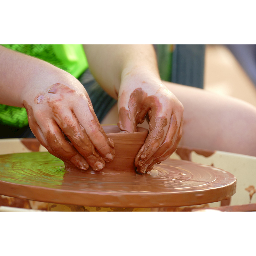
Introducing to the Wheel
Adding Texture and Design
Adding texture and design to pottery is all about making it unique. You can make pottery bumpy or rough by pressing items into the clay, like leaves or stamps. You can also carve designs into the surface. For design, slip trailing involves squeezing liquid clay onto the pottery to create raised lines for decoration. These methods alter how pottery feels and looks, giving each piece a distinct appearance.
Glazing and Painting
Painting pottery uses special colors (underglazes) for decoration; you brush them onto bisque-fired clay. Glazing adds a clear, glass-like coating that makes pottery shiny, waterproof, and food-safe; you dip or pour glaze onto bisque-fired pieces, avoiding the bottom. Both are applied before the final, hot firing in a kiln.
- Full access to our public library
- Save favorite books
- Interact with authors
- < BEGINNING
- END >
-
DOWNLOAD
-
LIKE
-
COMMENT()
-
SHARE
-
SAVE
-
BUY THIS BOOK
(from $2.99+) -
BUY THIS BOOK
(from $2.99+) - DOWNLOAD
- LIKE
- COMMENT ()
- SHARE
- SAVE
- Report
-
BUY
-
LIKE
-
COMMENT()
-
SHARE
- Excessive Violence
- Harassment
- Offensive Pictures
- Spelling & Grammar Errors
- Unfinished
- Other Problem





COMMENTS
Click 'X' to report any negative comments. Thanks!