At the end of the project we collected in this e-magazine new ideas of our students regardind useful future AI tools, oppinions about AI and about the information found out during the project.
We, all the teachers and students in the project, hope you will find it interesting and like it.

Students involved in the project were divided into 5 teams and got the same workload, to imagine an AI useful tool and to establish, through discussions during the on-line meetings, characteristics of their tool:
1) Title and Name of the AI Tool
(A short, creative, and meaningful name)
2) Introduction
(Explains what problem the tool solves and why it is important.)
3) Tool Description
(How the tool works, what technologies it uses. If possible, it can be supported with drawings, infographics, or digital images.)


4) Usage Scenario
(A story/scenario illustrating how the tool is used in real life.)
5) Innovative Aspects
(What sets it apart from similar tools? How can it be improved in the future?)
6) Ethical and Social Impact
(What will be its contribution to society? Have issues such as privacy, security, and dependency been considered?)
7) Student Feedback
(Short personal reflections on what team members learned and felt during this process.)

TEAM 1 - NeuroMentor AI
Team members - 15 students: Tamara.Buzila.4, Alexandra Tololoi, Enes.Nfk.2, Andrei Cerneaga.1, Octavian. Smatoc.1, Rahad22.1, Reem33, Maria.Maier, Aiana.Sas, Ionela.Vîlcu.1, Yaman Nfk, Bogdan.Lupu.1, Furkan Nfk.2, Mark.Natalenko, Yasin.Nfk.4
Team leaders: Angela Iepure & Cosmina Stalidi (România)
1) Title and Name of the AI Tool: NeuroMentorAI
2) Introduction (Explains what problem the tool solves and why it is important)
Millions of individuals face cognitive decline, neurological disorders, or challenges in maintaining mental fitness as they age or recover from brain-related conditions. Current solutions are either too generic or require heavy human involvment
Why it's important:
As Europe’s population ages and neurological conditions rise, there's a growing need for scalable, intelligent, and ethical tools that support brain health.
NeuroMentorAI bridges the gap between cutting-edge neuroscience and AI,
delivering personalized mental training and monitoring that adapts in real time
This problem is critical because timely and tailored interventions are crucial for maximizing recovery potential, managing symptoms, and improving the quality of life for those with neurological conditions. Without adequate support, individuals may experience slower progress, increased frustration, and a reduced ability to participate fully in daily life. NeuroMentorAI aims to democratize access to high-quality, personalized neurological support, making effective cognitive training and adaptive strategies available to a wider audience and empowering individuals to take a more active role in their own neurological health.
3) Tool Description
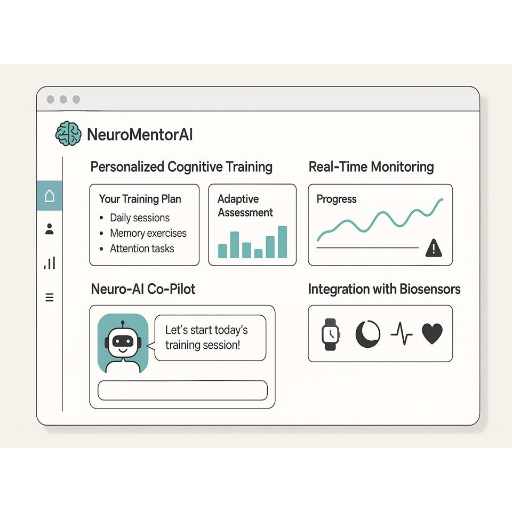
How it works: NeuroMentorAI is a digital platform powered by AI and neuroscience research that provides:
Personalized Cognitive Training Plans: Based on user profile, clinical input, and cognitive baseline.
Real-Time Monitoring and Feedback: Using machine learning to adapt difficulty, suggest interventions, or alert caregivers.
Neuro-AI Co-Pilot: A conversational AI agent that acts as a coach, motivator, and observer, available on desktop and mobile apps.
Integration with Biosensors: Optionally connects with wearables to monitor sleep, stress, heart rate variability, and more.
Technologies used:
Al/ML (personalization algorithms, NLP)
Federated Learning for data privacy
Brain-inspired modeling (Neuro-Symbolic Al from NITRO)
Human-Al interaction design
(from AIAS methodologies)
GDPR-compliant cloud architecture
Optional visual support (describable infographic):
(How the tool works, what technologies it uses. If possible, it can be supported with drawings, infographics, or digital images.)
4) Usage Scenario (A story/scenario illustrating how the tool is used in real life.)
Scenario: Elena, a 62-year-old retired teacher, recently noticed she forgets small things more often. Her doctor recommends she engage in brain training. Elena installs NeuroMentorAI.
On day 1, she completes a 30-minute adaptive assessment.
Over the weeks, she interacts with her AI coach daily, performing memory and attention tasks designed for her specific profile.
After 3 months, the AI detects significant improvements and a more stable mood.
Her neurologist accesses a summary report, adjusting her overall health plan.
Elena feels empowered and connected, not burdened.
5) Innovative Aspects (What sets it apart from similar tools? How can it be improved in the future?)
Truly Personalized
Neuro-Coaching using a hybrid of neuroscience and adaptive Al.
Al Partnership:
Clinician +
Ensures human oversight.
Federated Learning protects user data, allowing decentralized model training.
Neuro-Symbolic Reasoning for explainability - users understand why a task is suggested.
Scalable for all ages, not just seniors or clinical users.
Future Improvements:
VR support for immersive cognitive therapy
Multilingual emotional Al for broader reach
Deeper integration with EMR systems.
6) Ethical and Social Impact (What will be its contribution to society? Have issues such as privacy, security, and dependency been considered?)
Positive contributions:
Enhances mental health and early detection of neurodegenerative conditions.
Empowers users with autonomy over their cognitive well-being.
Democratizes access to cognitive support, especially in rural areas.
Considerations Addressed:
Privacy: All data remains local unless the user consents.
Security: End-to-end encryption and federated model training.
Dependency: Encourages healthy detachment-users "graduate" to fewer check-ins as they improve.
7) Student Feedback
(Short personal reflections on what team members learned and felt during this process.)
"I never realized how AI can be tailored for cognitive health. Working on
NeuroMentorAI made me think not only about code, but how people live and age."
"The ethical discussions opened my eyes. Building tech for vulnerable populations means being extra careful."
"We learned from the AIAS and ANTIDOTE projects that technology isn’t about replacing humans—it’s about enhancing the support systems we already have."
Team 2 - EduBot
Team members - 15 students: Iraida.Borzin, Amalia.Maria, Fatma.Hemkonya, Alexandra. Andreica, Stefan. Knieling, Ahmet. Nfk. 2, Beatrice. Pantea, Maria. Ștefana, Katherine. Diaconu, Abdullah Mohammad, Grigore.Chilici.1, Bianca. Neagu.5, Darius. Cezar, Alexia. Moraru, Maria.Staci.3
Team leaders: Olena Naumenko, Lidmila Erdman (Ukraine) & Adnan Guler (Turkiye)
1) Title and Name of the AI Tool (A short, creative, and meaningful name):
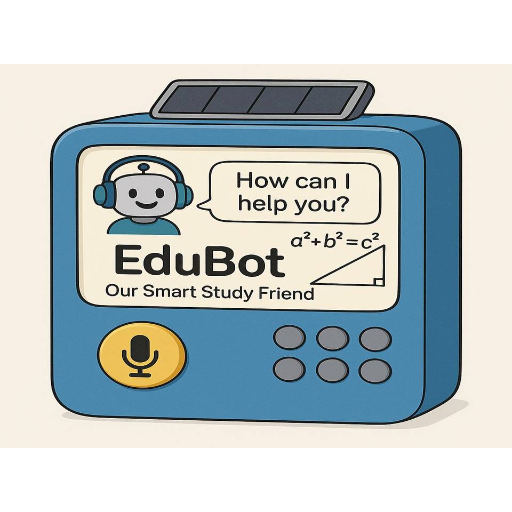
EduBot – Our Smart Study Friend
2) Introduction (Explains what problem the tool solves and why it is important.)
Sometimes we struggle when studying at home. There are topics we don't understand, but we can't ask our teachers right away. We search the internet, but either the explanations are too complicated or the information is incorrect. That's why EduBot will be very useful. We ask it any question we
want, and it answers us immediately and simply. In other words, it both helps us and enables us to understand the subject better. Thanks to EduBot, studying is now easier and more fun.
3) Tool Description (How the tool works, what technologies it uses. If possible, it can be supported with drawings, infographics or digital images.)
EduBot can be thought of as a small device. It has a screen and buttons. We can write to it or ask questions by speaking. It can respond to us either in writing, by voice, or with images. Sometimes it narrates with music, which is very appealing. It knows many languages: English, Turkish, even other languages.The best part is that you don't need to plug it in when the battery runs out, because it can run on solar energy.
4) Usage Scenario (A story / scenario illustrating how the tool is used in real life.)
One day, while doing my math homework, I couldn't understand a problem. I couldn't find the answer in the book or on the internet. Then I asked EduBot. It explained the problem to me in simple steps and with examples. It even showed me with a small drawing. There was also an audio narration, and because it was accompanied by music, I didn't get bored at all. I understood the topic right away.
Then he asked me, “Would you like a similar question?” and gave me another question. That helped me reinforce my understanding.
I was very happy that day because I was able to do my homework on my own, without any help.
5) Innovative Aspects (What sets it apart from similar tools? How can it be improved in the future?)
EduBot is different from other artificial intelligence tools because:
It explains things to us in everyday, simple language.
It does not provide incorrect information and responds carefully.
It makes lessons enjoyable with images, music, and videos.
Portable, small, and easy to use.
It runs on solar energy, which is also good for the environment.
In the future, we may be able to wear EduBot like glasses, and it will display topics right in front of our eyes. Perhaps it will be able to explain things like a teacher in the room using augmented reality (AR). We want it to reach more people.
6) Ethical and Social Impact
(What will be its contribution to society? Have issues such as privacy, security, and dependency been considered?)
EduBot also has benefits for society. It is a great help for students who do not have a teacher at home or cannot attend private lessons. It helps everyone learn equally. It also protects our information, meaning it doesn't tell anyone what we ask or what we do. Of course, we shouldn't expect everything from EduBot. It's just there to help us. We understand that learning is something we have to do ourselves. Sometimes it's important to try things on our own.
7) Student Feedback
(Short personal reflections on what team members learned and felt during this process.)
Working on this project was very exciting. It was a little difficult at first, but once we put our ideas together, we came up with some great things. We used our imagination, worked together, and designed a vehicle.
Here are some comments from our friends:
This project developed my creativity. I felt great.
This idea could really work. I can't wait.
TEAM 3 - LangBuddy AI, EcoMind Al, FocusFlow Al, MindMate AI
Team members - 15 students: Yaanal.Abdullah, Mihai.Sargu.3, Luka.Tyshchenko, Omar. Awwad, Daniela.Bagrin.2, Pavlo.Kulyk, Lavinia.Balta.2, Abdulelah.Mohammad, Nichita.Grecu.1, Dumitru.Oborocean.2, David.Cristian, Maria.Bianca, Vlad.Bilyi, Yevhenii. Biedariev, Robert.Buzenchi
Team leaders: Mutasem Ghozlan ( Jordan), Maia Porombrica
( Republic of Moldova)
Title and Name of the AI Tools ( Short, creative, and meaningful names):
a) LangBuddy AI; b) EcoMind Al; c) FocusFlow Al;d) MindMate AI
2) Introduction (Explains what problem the tools solve and why they are important)
a) Many students struggle with learning new languages due to lack of practice, fear of making mistakes, and limited access to native speakers.
LangBuddy AI solves this by offering a friendly, always-available AI conversation partner that helps students practice speaking, listening, reading, and writing in real-life contexts.
b) Climate change and environmental awareness are pressing global issues, yet many students lack practical tools to understand and reduce their environmental footprint. EcoMind AI empowrs students to make eco-friendly choices by analyzing their daily habits and providing actionable, personalized sustainability suggestions.
c) In today’s digital world, many students struggle with distractions, procrastination, and poor time management. FocusFlow AI is designed to help students build strong focus habits, manage their study time effectively, and boost productivity through personalized AI coaching.
d)Many students face stress, anxiety, and lack of focus during their academic journey. MindMate AI is designed to support students' mentalwell-being through personalizede motional check-ins, mindfulness exercises, and intelligent suggestions, creating a healthier and more focused learning environ.
3) Tools Description:
a) LangBuddy AI uses advanced Natural Language Processing (NLP), speech recognition, and real-time translation technologies. It allows students to:
Chat and speak with an AI tutor in over 20 languages
Receive instant grammar and vocabulary feedback
Practice through the meddia logues (e.g., orderingfood, traveling, job interviews)
Track progress and weak areas over time
Play mini-gamestore in force vocabulary and grammar
It is available via a mobile app, web interface, and even as a plugin forschool platforms.
b) EcoMind AI uses machine learning and behavior tracking (via self-input or integration with wearable / smartphone data) toassess users’ environmental impact in areas like wateruse, energy consumption, transportation, and food waste. Key features include:
Daily eco-check quizzes toassess habits
AI-generated green alternatives and tips
Personalized eco-goals and progress tracker
Gamification system with badges and community challenges
It uses AI to adaptts suggestions .
c) FocusFlow AI uses machine learning, behavioral pattern recognition, and cognitive science principles to:
Create smart study schedules based on each student’s routine and energy levels
Detect distraction patterns (like switching apps or longin activity)
Offer real-time focus reminders and calming background sounds
Suggest focus techniques (Pomodoro, deepwork, breaks) tailored to the user
Provide end-of-day reports and motivational feedback
The tool is accessible through a browser extension and a mobile app that sync with calendars and study platforms.
d) MindMate AI is a chatbot-based virtual companion that uses Natural Language Processing (NLP), sentiment analysis, and AI-generated personalized routines to monitor students’ mood sand offer real-time mental wellness support. It includes features such as:
Daily mood tracking with emoji scale and short text input
Guided breathing and meditation sessions
Study break reminders and motivational tips
AI-generated wellness journals based on user interactions
It can be accessed via a mobile app or web platform and syncs with the student’s calendar or learning platforms.
4) Usage Scenario (A story / scenario illustrating how the tools are used in real life):
b) Ali, a middleschool student, logs into EcoMind AI. He answers a short quiz about his week—how often he used single-use plastic, transportation choices, and electricity habits. The AI generates a personalized dashboard showing his carbonfootprint and suggests three small changes: using a reusable bottle, unplugging devices overnight, and walking to school twice a week. Over time,
c) Omar often finds himself wasting time scrolling on social media during study hours. After installing FocusFlow AI, the tool analyzes his screen activity and sets a smart Pomodoro schedule with short breaks. When he tries to open distracting apps, the AI gently reminds him of his goals. At the end of the day, it shows him how much focused time he achieved and offers a motivational quote. Within a week, Omar’s productivity has noticeably improved.
d) Sarah, a highschool student, feels overwhelmed before her final exams. She opens the MindMate AI app, selects "Stressed" as her current mood, and writes a short note explaining how she feels. The AI responds with a calming message, offers her a 5-minute breathing exercise, and schedules a short break into her study planner. It then suggests a motivational quote and creates a short reflection journal for the day, helping Sarah regain focus and calm.
5) Innovative Aspects (What set them apart from similar tools? How could they be improved in the future?)
a) Lang Buddy AI uses real conversation simulations, not just flash cards or exercises. It adapts to the user’space and preferred learning style (visual, auditory, etc.). In the future, it could support accent training using voice cloning and connect students across countries for peer exchange.
b) EcoMind AI stands out by focusing on environmental education through personalization and gamification. It turns complex data into simple, actionable tasks for youth. Future versions could integrate with smarthomesystems or offer AR experiences for virtual eco-tours and simulations.
c) Unlike standard focus apps, FocusFlow AI learns from the student’s real behavior and adapts dynamically. It combines AI nudges, habittracking, and emotional check-ins. Future improvements may include integration with brainwave-reading head bands or virtual focus groups with classmates.
d) Unlike general wellness apps, MindMate AI is education-focused and adapts to the academic rhythm of the student. It uses AI to personalize interactions based on learning stress patterns and performance schedules. Future
improvements could include integration with schoolplatforms, real-time teacher
alerts for students at risk, and emotional analytics dashboards for counselors.
6) Ethical and Social Impact (What will be their contribution to society? Have issues such as privacy, security, and dependency been considered?)
a) This tool increases access to language learning for students regardless of location or economic status. It supports inclusivity by offering multilingual support, and privacy is protected as no user voice or text is stored without permission. LangBuddy AI promotes global citizenship and cross cultural understanding.
b) FocusFlow AI promotes digital well-being and healthier study habits. It avoids shame-based motivation and supports privacy—data is processed locally or with full consent. It helps reduce screen addiction and supports academic success
in a balanced way.
c) The tool builds environmental responsibility in the next generation. It respects user privacy by storing no GPS orbiometric data and avoids guilt-tripping by using positive reinforcement. EcoMind AI contributes to a culture of sustainability and civic responsibility among students.
d) MindMate AI promotes positive mental health in schools and reduces stigma around seeking help. It respects user privacy by storing data securely and anonymously, offers data control settings, and avoids excessive emotional dependency by encouraging human interactions when needed. It contributes to building emotionally intelligent, resilient students.
- Full access to our public library
- Save favorite books
- Interact with authors
- < BEGINNING
- END >
-
DOWNLOAD
-
LIKE
-
COMMENT()
-
SHARE
-
SAVE
-
BUY THIS BOOK
(from $6.99+) -
BUY THIS BOOK
(from $6.99+) - DOWNLOAD
- LIKE
- COMMENT ()
- SHARE
- SAVE
- Report
-
BUY
-
LIKE
-
COMMENT()
-
SHARE
- Excessive Violence
- Harassment
- Offensive Pictures
- Spelling & Grammar Errors
- Unfinished
- Other Problem





COMMENTS
Click 'X' to report any negative comments. Thanks!