











So that everyone, especially students, can expand their knowledge of research methodology, taking into account each of the topics covered.

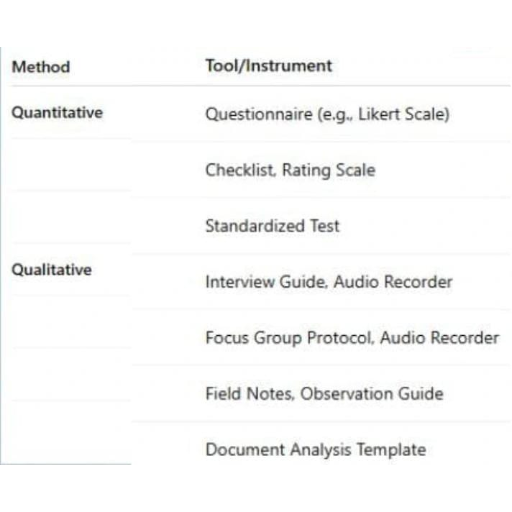
Data collection methods, techniques and instruments/tools
Methods

Seeks to gather descriptive data that explore experiences, behaviors or concepts.
This flexible and subjective approach often involves thematic analysis, allowing for deeper insights into participants' perspectives and motivations.
Quantitative Research
Focuses on collecting numerical data to quantify variables and measure patterns. This structured, objective approach often involves statistical analysis, making it suitable for large-scale studies that require generalizable results.

echniques

Techniques are the methods, skills or procedures used to achieve a specific result in various areas of life.
QUANTITATIVE:
Structured Survey: A method using closed-ended questions.
Structured Observation: Systematically recording specific, predefined behaviors to objectively quantify and compare actions.
Testing: Using standardized assessments to quantitatively measure and compare knowledge, skills, or abilities against a benchmark.


QUALITATIVE:
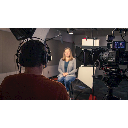
Interview: A direct conversation with a participant.
Focus Group: A moderated group discussion designed to generate rich data.
Unstructured Observation: Flexibly observing subjects in their natural environment to capture spontaneous behaviors and unexpected insights.
Document Analysis: Examining existing documents to extract data and understand context.


Instruments/tools
Techniques are the methods or strategies you use to gather information, while instruments (or tools) are the specific things you use to carry out those techniques.


Surveys, interviews, focus groups, observation, document analysis
Surveys
Is a systematic process of gathering data from a sample of individuals through questionnaires or interviews, aiming to understand the characteristics, opinions, or behaviors of a larger group.
Tool: Questionnaire (includes questions, scales, response options).

Interviews are a direct data collection technique that allows researchers to obtain sensitive and detailed information, facilitating a deep understanding of the perspectives and nuances in participants' responses.
Interviews

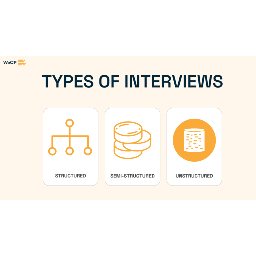
Types of interviews
A standardized interview using closed-ended questions to collect quantitative data.
A flexible interview combining fixed and open-ended questions to gather both qualitative and quantitative insights.
An informal, open-ended interview focused on exploring deep qualitative insights without a set format.

Observation
Observation is one way to collect primary data. Observation is a purposeful, systematic and selective way of watching and listening to an interaction or phenomenon as it takes place.
Participant Observation
Researchers actively participate in the activity or group they are observing, gaining an insider's perspective.
Non-participant observation
Involves researchers observing a group or situation without directly interacting or participating in its activities.
T
Y
P
E
S

Recording observations
*Narrative recording:This involves detailed descriptive accounts of events or behaviors, often using everyday language and short sentences.
*Using scales:Measurement involves rating scales, where behaviors or characteristics
*Categorical recording: This involves grouping observations into categories, often using nominal or ordinal scales
*Recording on electronic devices: Audio or video recording of observations.
Situations in which observations can be made
Natural observation involves no interference; controlled observation introduces a stimulus to observe reactions.
- Full access to our public library
- Save favorite books
- Interact with authors

- < BEGINNING
- END >
-
DOWNLOAD
-
LIKE
-
COMMENT()
-
SHARE
-
SAVE
-
BUY THIS BOOK
(from $3.39+) -
BUY THIS BOOK
(from $3.39+) - DOWNLOAD
- LIKE
- COMMENT ()
- SHARE
- SAVE
- Report
-
BUY
-
LIKE
-
COMMENT()
-
SHARE
- Excessive Violence
- Harassment
- Offensive Pictures
- Spelling & Grammar Errors
- Unfinished
- Other Problem

COMMENTS
Click 'X' to report any negative comments. Thanks!