Dedicated To Everyone who wants to learn more about fairy-tale creatures.

Chapter 1: Habitat
If you walk deep enough into a forest—deep enough that your boots squish moss instead of mud, and the air smells like cedar and mushrooms—then you are in Tijapurtun territory.
They live not in trees, but under them, in cozy burrows that look like this:
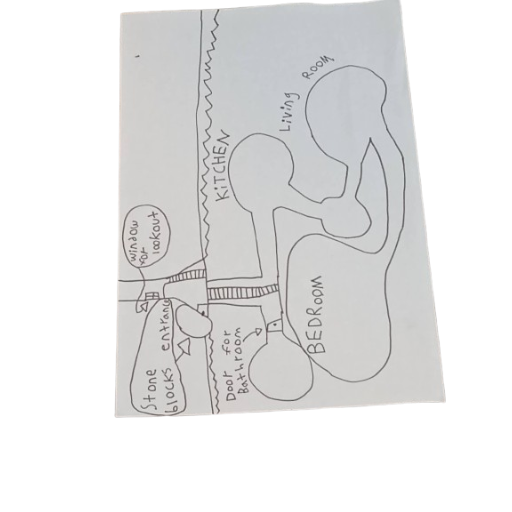
It is required by the King and Queen of Tijapurtuns that you have all of the rooms that were listed in the picture, even the one without the label. They hollow out the bottom of the tree for a window, then they build burrows under the tree. A stone blocks the entrance to the burrow in-case of emergency, like a troll is in the area or a hunter is out. A family of Tijapurtuns all sleep in one room. They believe that if they all had separate rooms, then it would be easier for a predator to find them, because the others wouldn't be alerted yet.
Chapter 2: The Basics
Tijapurtuns are about 11 inches tall. They wear turtle shells on their backs for protection. Elder Tijapurtuns get a hat made of thorny plants and a shell for protection. Because they
believe the elders know the answer to all their problems. Male Tijapurtun will start to grow mustaches by the age of 7. And at the age of 11, their long, orange, mustache will be complete.
Tijapurtuns villages are called Shellholds, They also have court-like places, they are built around a Grand Tree, often hollowed at the base to serve as the Council Chamber. There, the Shellsages—the oldest and most mustachioed elders—sit and debate things like squirrel treaties, owl attacks, or if birds should be kept as pets.
The Tijapurtun with the longest mustache is the mayor of the Tijapurtun village. Tijapurtuns call their mayors "Shellholders" Every 5 months, the King and Queen
will hold a meeting with every tijapurtun mayor in existence. Tijapurtun mayors from all over the world make a huge journey to it. And at the meeting, the king and queen will discuss if their villagers are healthy and if they've been attacked by a former ally. After the meeting, the king and queen will assign a family of butterflies to send the Tijapurtun mayors back to their villages. After the butterfly sends the mayor back, they are rewarded with all the sweet nectar they want, but if they died while bringing the mayor back, then a grand funeral is held for it. Lady Tijapurtuns don't grow mustaches, but instead, are judged by their hair. It was said by Sir Watershell The Second that if a male
tijapurtun doesn't grow a mustache, then that is a sign of bad luck for the tijapurtun boy, and that he should be protected at all times. But there have only been 14 male tijapurtuns who were known not to have mustaches. There are different types of Tijapurtun, and they all live far apart from each-other.
The Maplewhisks of Minnesota are peaceful leaf-painters. The Mosshollows of Canada are serious and strong. The Shellgleams of Wisconsin love shiny things and pranking. And in the warm, tangled heart of the Rainforest, the Rootcurls dance with tree frogs and weave vines into jewelry. All of them live near lakes, so they don't need to travel far to get their turtle shell.
But no matter the forest, all Tijapurtun know one thing: They are not born with their shells.
And one day, when they come of age—around the time their mustaches reach their chin—they must go on a journey known as The Shellfinding.
That is when the real stories begin...
Chapter 3: The Shellfinding and the Way of the Shell
When a young Tijapurtun turns 12, they are summoned before the Shellsage Council. There, beneath the Grand Tree, the Shellsages place a moss-woven satchel around the child’s shoulders and whisper the ancient blessing:
"Let the shell that suits you find you before fear does."
the Shellfinding is not a race. It is not a hunt. It is a journey into the wild woods where the young ones must discover a turtle in need—not for its shell, but for its friendship. For the shell must be given, not taken.
Tijapurtuns believe that every turtle has a story, and only the turtle who shares your heart will allow you their shell after their passing. But turtles can live for decades, so the Tijapurtuns believe that when Shellfinding, you should find a really old turtle
Some Shellfindings last a day. Others, a season. No one is allowed to return to the Shellhold until they carry their shell on their back. Some return with scars.
Others return with new songs.
Once a shell is earned, the community gathers for a night of dancing and storytelling around the Mossfire Pit. The new shellbearer is draped in ferns and painted with symbols of their journey. Males have their mustaches braided for the first time into a spiral curl—a mark of adulthood. Same with the females, except their hair is braided because they do not have mustaches.
From that day on, the shell is never removed. It becomes part of their body, part of their story.
The shell is used in battle, in ceremonies, and even in games of tumble-stone. It is polished before dates, dusted before debates, and sometimes engraved with runes or ancestral names. Chapter 4: Culture and religion
Each type of tijaputun has their own shell customs. The Shellgleams polish theirs with lake-sap and gems. The Rootcurls decorate theirs with vines and beetle shells. The Mosshollows carve their stories in quiet, sacred spirals.
To break a shell, even by accident, is a sorrowful thing. To steal one is unforgivable.
Thus the shell is more than armor. It is identity, history, and heart.
And so, the Shellfinding is remembered in song, story, and curl.
It is where every Tijapurtun begins their true life.
To the Tijapurtuns, the world is alive with ancient memory. They follow a spiritual belief known as the Spiral Path, a religion based on harmony with the forest, reverence for turtles, and the sacred journey each soul must travel.
They believe the Great Turtle, Old Shellfather, dreamt the world into being by singing to the stars from inside his shell. The forests grew from the hum of his voice, and the lakes from the tears he shed when the world was too beautiful to bear.
Every Tijapurtun carries a tiny clay spiral tied to their belt. This spiral charm represents their life’s path—ever growing, ever circling toward deeper wisdom. Children
carve their first spiral themselves using sharpened squirrel bone and soft bark at the age of 10.
The Shellsong is their most sacred ritual, sung beneath full moons. The song is part lullaby, part prayer, and part map—it tells of migrations, warnings, blessings, and dreams.
Their sacred texts aren’t books, but carved shells passed down generations. These ancient shells are stored in the Grand Tree’s Chamber of Echoes. Each one contains stories etched in a language of notches and swirls.
The Mossday Festival is their holy day—once every moon cycle, they gather to share stories, paint each other's shells, and braid new moss into the temple
burrows. The rituals involve lighting glowmoss lanterns and reciting the Ten Whispers:
"Grow silently"
"Speak gently"
"Carry shelter"
"Honor the quiet"
"Help the small"
"Hide from thunder"
"Laugh with frogs"
"Breathe with leaves"
"Listen to stone"
"Never break a gift"
Elders teach that when a Tijapurtun dies, their soul travels inward on the spiral, resting in the heart of the Old Shellfather’s back, where it hums forever with the forest.
This belief in unity, silence, and steady wisdom shapes every part of their life—from how they greet squirrels to how they resolve disputes (with mustache duels, of course).
To be a Tijapurtun is to be a guardian of stillness, a friend to turtles, and a student of the spiral.
Chapter 5: Enemies Of Tijapurtun
As peaceful as they are, the Tijapurtuns are not without foes. The forests, while full of friends, also echo with whispers of danger—creatures who sneer at stillness and scoff at spirals.
Foremost among these are the wretched, mucus-mouthed creatures known as Snotgurgles. Even though there are only 2-3 left, these bog-dwelling brutes love nothing more than trampling mushroom circles, stealing shell-chimes, and slinging mudballs at the edge of Shellholds. Snotgurgles are feared not for their strength, but for their chaos—they break what they cannot understand and laugh as they do it. Tijapurtun children are warned with the old rhyme: “Sniff thrice and see if a
Gurgle's near thee.”
Next are the Gnashfang Goblins, cave-born mischief-makers who grind their teeth on roots and chew glowing stones. While not evil by nature, goblins and Tijapurtuns have clashed for generations—mostly over territory, but also over shell envy. Goblins cannot grow mustaches, and this has caused much resentment. Some rogue goblins have been known to wear fake whiskers and steal shells, an act considered a deep insult.
More dangerous still are the Hollowhowl Trolls. Towering beasts with mossy backs and hollow bellies, they move only at dusk and dawn, stomping paths through forest and fen. They are slow, but nearly
indestructible, and can smell fear—or a turtle shell—from a hundred paces. The Tijapurtuns deal with trolls using decoy shells, distraction drums, and elaborate burrow mazes.
Then there are the Roughners, Creatures that like wind and shadow. These humanoid creatures are born buff and love to destroy things—they destroy anything they can find. They have light-brown skin and are 1 foot tall. They hate the Spiral Path, for it defies their hunger for confusion and fear. Only Shellsingers and moss-charmers are trained to repel them. For all Roughners are allergic to charms, no one knows why, but it's helpful.
Even some corrupted forest animals, tainted by bad
magic or foul fungus, have turned against gnomes, fairies, pixies, elves, and Tijapurtuns. Rabid squirrels with glowing eyes. Frogs that croak curses. Birds that steal dreams instead of worms.
But perhaps the most feared enemy of all is the Duendren, a dark cousin of the gnome folk. These twisted tricksters live in warped tree hollows and feed on regret and forgotten promises. They whisper lies into ears at night and twist dreams into nightmares. A duendren once tricked an entire Shellhold into giving up its shells—an event still mourned in the “Night of Naked Backs.” duendren are born with mustaches instead of having to grow one, and tijapurtuns take that as a mock.
Though these enemies are many, the Tijapurtun do not live in fear. They prepare. They train. They remember the Ten Whispers.
For they know that even the smallest mustache, when curled with courage, can face down shadow.
Chapter 6: Allies Of Tijapurtun
Though they are secretive and soft-spoken, the Tijapurtun are not alone in the wild world. Over centuries, they’ve woven quiet threads of friendship with other creatures—many just as strange and magical as themselves. Their oldest and most cherished allies are the Pixies of the Fernmist Glades.
These tiny winged beings share the Tijapurtun love of harmony and laughter, and the two races often exchange gifts during the Moonmoss Season. Pixies bring glowing nectar and dew-crystals, while the Tijapurtun offer carved whistles, dream-pollen, and shell-painted charms. The pixies’ glowing trails often help young ones find their way during Shellfinding journeys.
Another steadfast friend is the Fungling Tribes—mushroom-folk who live in damp groves and dance beneath storms. Though the Funglings rarely speak (and when they do, it sounds like bubbling compost), they communicate through glowing color changes and spore dances. Tijapurtun elders can read these signs fluently
and often visit the Funglings for wisdom, medicine, and tea that smells like earth after rain.
The Gnomes, (read Wil Huygen's "Gnomes" book to find out where they live) are allies in crafting and engineering. Tijapurtun shellsmiths often trade river pearls and beetle-shell enamel for gnome tools, while gnomes receive mossglass and slow-growing vinewood in return. They have an annual crafting contest called the Quiet Build, where the only sound allowed is the hum of concentration.
Then there are the Silver Antler Elves of the northern pines—aloof, tall, and graceful. Though rarely seen, these reclusive beings honor the Tijapurtun with signs of
respect: a ring of pinecones left at a shellhold gate, or a trail cleared after a storm. The Tijapurtun, in turn, leave poems scratched on bark and gifts of lake-thistle wine.
Among animals, the Painted Turtles, of course, are honored as sacred kin. But other forest beasts have proven friends as well. Owls offer messages (for a price), foxes sometimes help guide lost shellbearers, and even frogs have been known to guard burrow entrances during the rainy season.
These alliances are maintained with trust, tradition, and the ancient practice of giftspeech—a way of offering items that tell a story or feeling. The Tijapurtun believe that if you give something crafted with care, it carries a
piece of your spirit. This is why no deal, treaty, or promise is made without an exchange of handmade tokens.
Despite their love of solitude, the Tijapurtun know that a forest is not made of one tree, and a life is not lived in one shell alone.
Their allies are not just protection—they are pieces of the spiral itself.
Chapter 6: Pixie Pacts and Fungling Feasts
Among the Tijapurtun, traditions aren’t just celebrated—they’re sung, danced, and carved into the spiral of every shell. Of all their rituals and festivities, none are more beloved than the Pixie Pacts and the grand Fungling
Feasts.
Each spring, when the dew glows and pollen hangs like golden fog in the air, the Pixie Pacts are renewed. It is a delicate ritual of mutual respect between the Tijapurtun and the Pixies of the Fernmist Glades. Under the first full moon of Sprouthollow, both races gather at the Spiral Glade, where ancient stones rise like moss-covered teeth and the air hums with old magic.
The ritual begins with the Opening Flutter—a dazzling aerial display performed by the pixies, who paint symbols in the air with their glowing trails. In response, the youngest Shellsinger of the Tijapurtun performs the Spiral Chant, a haunting tune played on a double-
fluted acorn pipe. Then, in silence, the pacts are offered: carved beads from the Tijapurtun, woven silkgold threads from the Pixies. These are exchanged and buried beneath the oldest stone of the glade.
The Pacts ensure a year of protection, warning songs, and shared knowledge of shifting trails and weather signs. They also grant the Tijapurtun permission to gather rare pixie-moss and glowdew, ingredients used in their healing salves and truth teas.
Later in the summer comes the Fungling Feast, a wild, root-deep celebration of growth, rot, and rebirth. Hosted by the mushroom folk in the damp heart of the Toadcap Thickets, the feast is a surreal and sensory wonder.
Massive mushrooms are hollowed and lit with glowspores. Sporelights dance above the clearing like stars learning to fly.
The menu? Strange and spectacular. Clay-baked beetles glazed in sugar sap, wormroot pies with crunchy crusts, and the sacred Slumber Soup—a broth that gives gentle dreams to those who sip it. Funglings communicate through colored light, and during the feast, they perform luminous plays on wide mossy stages, telling ancient tales of forest life and fungal wisdom.
The Tijapurtun contribute music, riddles, and the Shell Parade—a proud, prancing display of their finest backwear, decorated with carvings, moss embroidery,
and even tiny living gardens.
No arguments are allowed during the Fungling Feast. It is a time of peace, respect, and the joyful weirdness of being alive. At midnight, everyone lies down on mushroom mats and listens to the Driftsong—a layered hum of frog-throats, windpipes, and deep-earth Fungling growls that lull the entire forest into quietude.
These events are not just parties. They are promises. They remind the Tijapurtun of who they are—not just wanderers or watchers, but vital strands in the web of the wild.
For every pact made, and every feast shared, makes the spiral stronger.
Chapter 7: Evil Tijapurtuns
There are also Evil Tijapurtuns, They only roam in the mountains of Canada and have crooked shells, they were all once normal, kind Tijapurtuns, but each one has a different reason why they turned evil, some of them will say because of the shell finding, and others will say because they had the Big Ban (which only happens if a Tijapurtun does evil things and shows signs of doing of it) If you joined the tribe of the Evil Tijapurtuns, first, you have to twist your turtle shell and make it crooked with your bare hands. Second, you have to find a creature and do an evil thing to it in front of the Evil Tijapurtuns, then they will find you worthy. Tijapurtuns tell other
creatures and animals about the evil Tijapurtuns, and how they can tell the difference between normal Tijapurtuns and Evil Tijapurtuns. Evil Tijapurtuns follow their leader, The Echo King he was the first Evil Tijapurtun in the world, he is 1,826 years old, and that isn't even close to how old the oldest Tijapurtun was! Evil Tijapurtuns have a fear of frogs and love the cold. They tend to stab creatures with sharp pieces of Ice so they can stock up on food. The Echo King is the only Tijapurtun mayor who can't come to the royal meetings that the king and queen of Tijapurtuns have with all their Tijapurtun mayors. The Echo King has a long, orange beard that he like to store snowballs in, he has dark blue
eyes with black pupils, he wears blue, gray, and white clothing, his turtle shell is more crooked than any other shell of the Evil Tijapurtun, he has a staff made from an ancient willow tree, and he wears a crown made from emeralds and tanzanite. He has far different clothing from what the Evil Tijapurtuns are supposed to wear. The Evil Tijapurtuns can only wear white clothing, and are forced to paint their shells white so they can blend in, but they do keep their orange hair and mustaches.
Chapter 8: A Hundred Small Facts About The Tijapurtuns
Think you know everything about the Tijapurtun? Think again. Here are 100 more strange, sweet, suspicious, and sensational facts from burrows, glades, and spiral paths across the land:
Some Tijapurtun can whistle with their mustaches.
They believe sneezes attract butterflies.
Every Shellhold has one “Wiggly Day” a year where rules are gently ignored.
A mushroom called “Snorecap” is used as a sleeping pillow.
Spiralkeepers use pinecones to vote in village decisions.
A carved acorn is the traditional way to propose friendship.
- Full access to our public library
- Save favorite books
- Interact with authors

- < BEGINNING
- END >
-
DOWNLOAD
-
LIKE(2)
-
COMMENT()
-
SHARE
-
SAVE
-
BUY THIS BOOK
(from $9.59+) -
BUY THIS BOOK
(from $9.59+) - DOWNLOAD
- LIKE (2)
- COMMENT ()
- SHARE
- SAVE
- Report
-
BUY
-
LIKE(2)
-
COMMENT()
-
SHARE
- Excessive Violence
- Harassment
- Offensive Pictures
- Spelling & Grammar Errors
- Unfinished
- Other Problem





COMMENTS
Click 'X' to report any negative comments. Thanks!