May your questions always lead to discovery,
your ideas shape a better world,
and your learning never lose its wonder.
This story is for you—
the future thinkers, dreamers, and doers of tomorrow.


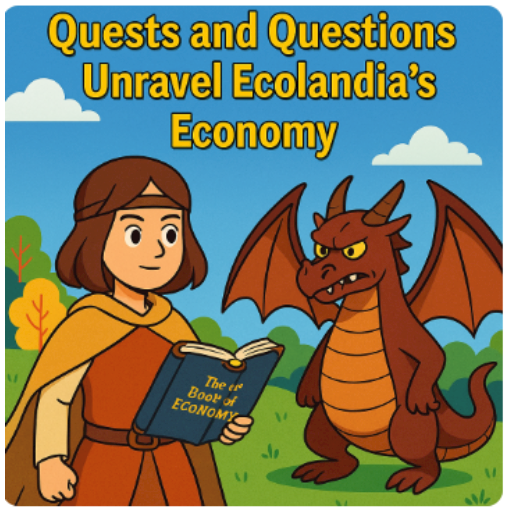
Once upon a time in a colorful land called EcoLandia, everything ran smoothly because of a magical book called "The Book of Economy." It had four golden rules that helped the kingdom thrive. One day, the book was stolen by a mischievous dragon named Greedon.
Without the book, people didn’t know what to make, who would get what, or how to use their resources. The land began to fall into confusion.
A young hero named Arya (or you can use the name of a student) sets out to bring back the lost knowledge.

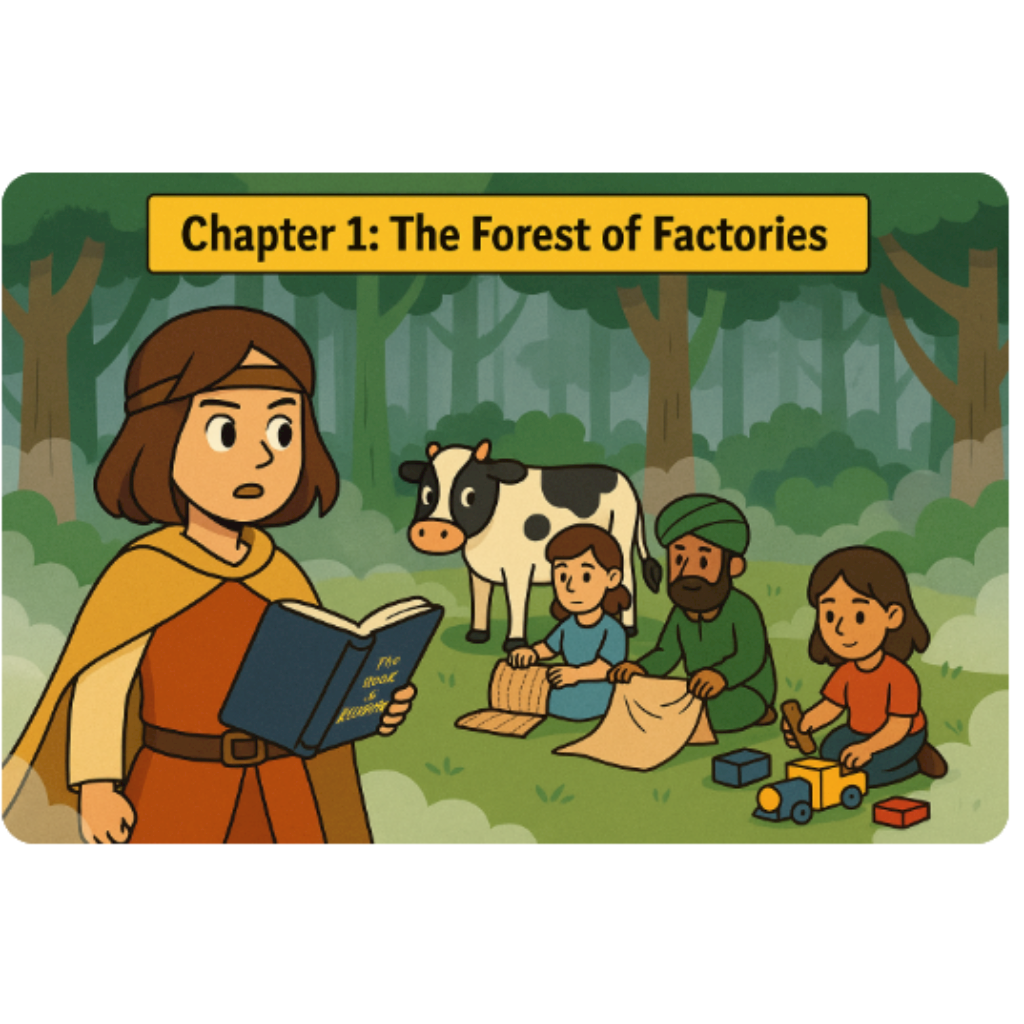
Arya enters a foggy forest where trees grow strange things—some give milk, others produce cloth! Confused villagers are randomly picking fruits and making toys with no plan.
A wise owl says:
“The first function of an economy is Production — what to produce, how to produce, and for whom!”
Examples of Production Confusion
Villagers are arguing: some want more milk, some want more cloth, others waste wood making hundreds of toy swords no one needs.
This shows the problem of what to produce clearly.
How to Produce
Arya notices that some villagers cut trees roughly and waste resources, while others use careful tools and make better products.
The owl explains: “If we waste resources, there will be nothing left. We must choose wisely how to produce!”
For Whom to Produce
Some children are hungry with no milk, while one rich villager hoards many jars.
Arya feels sad and asks the owl how to decide who should get what.
The owl hints: “That’s part of the puzzle you will discover in the next lands.”
End of Chapter 1 – Transition
Arya leaves the forest with a small glowing seed given by the owl, symbolizing the knowledge of “Production.”
The owl says: “Carry this wisdom forward. Without balance in production, no economy can grow.”

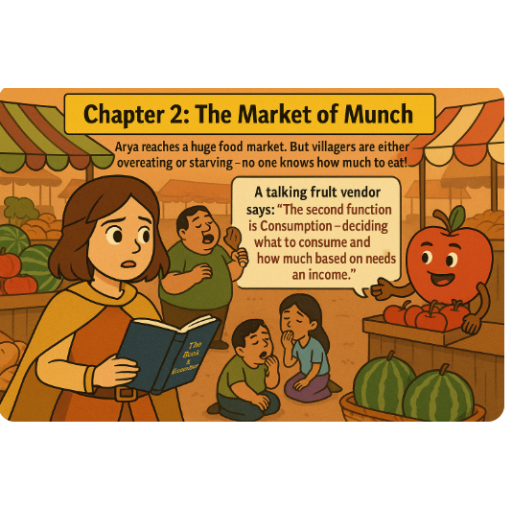
Arya reaches a huge food market. But villagers are either overeating or starving—no one knows how much to eat!
A talking fruit vendor says:
“The second function is Consumption – deciding what to consume and how much based on needs and income.”
Scenes of Confusion
Some villagers buy baskets of sweets and waste them.
Others can’t afford even one fruit.
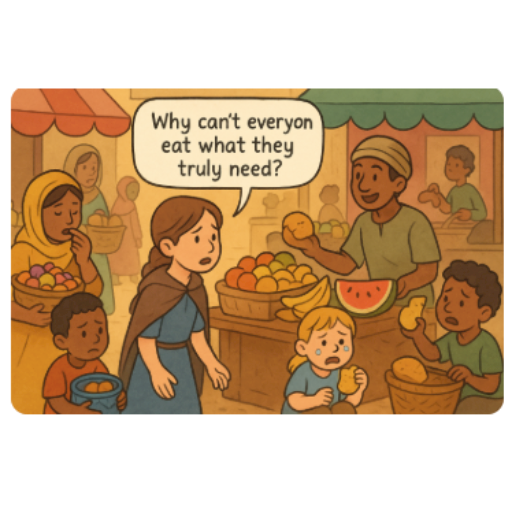
A child is crying with hunger while another throws away half-eaten bread.
Arya’s Question
Arya asks the fruit vendor:
“Why can’t everyone eat what they truly need?”


Vendor’s Explanation
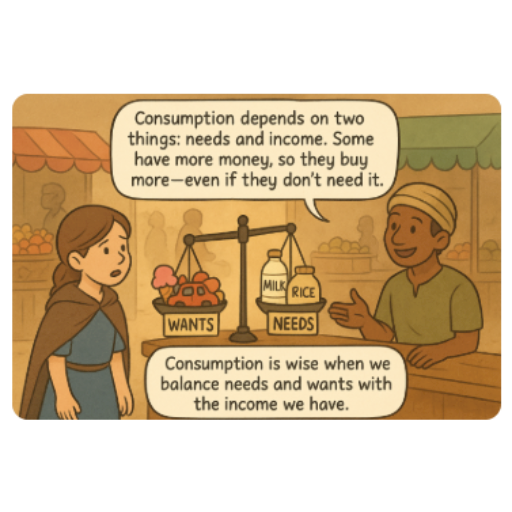
“Consumption depends on two things: needs and income. Some have more money, so they buy more—even if they don’t need it. Others have little and struggle to survive.”
A Mini Lesson
Arya sees a weighing scale. The fruit vendor uses it to show balance:
One side = “Wants” (ice creams, toys, luxury).
Other side = “Needs” (rice, milk, medicine).
“Consumption is wise when we balance needs and wants with the income we have.”
- Full access to our public library
- Save favorite books
- Interact with authors

- < BEGINNING
- END >
-
DOWNLOAD
-
LIKE
-
COMMENT()
-
SHARE
-
SAVE
-
BUY THIS BOOK
(from $3.99+) -
BUY THIS BOOK
(from $3.99+) - DOWNLOAD
- LIKE
- COMMENT ()
- SHARE
- SAVE
- Report
-
BUY
-
LIKE
-
COMMENT()
-
SHARE
- Excessive Violence
- Harassment
- Offensive Pictures
- Spelling & Grammar Errors
- Unfinished
- Other Problem

COMMENTS
Click 'X' to report any negative comments. Thanks!