Turkey
Romania
Italy

BERRAK ÜLKÜ ARSLAN
ŞEHİT MUAMMER NACAKOĞLU İMAM HATİP ORTAOKULU YERKÖY/YOZGAT
Mangala Paper Game – Box Description and Game Explanation for Story Jumper Book
Mangala is a traditional strategy-based board game that has been played for centuries. In our eTwinning project, students played Mangala as a paper-based game created with simple and accessible materials. The game was designed for two players and aimed to develop strategic thinking, problem-solving skills, patience, and decision-making abilities.
The game box includes a paper Mangala board with small pits and stones. Each player starts the game with an equal number of stones placed in their pits. Players take turns distributing the stones one by one into the next pits in a counterclockwise direction. The main goal of the game is to collect as many stones as possible in the player’s own store by making thoughtful and strategic moves. The player who collects the most stones at the end of the game wins.
During the game process, students learned that every move affects the next step. At first, some students focused only on winning, but as they continued playing, they realized the importance of planning ahead, being patient, and learning from mistakes. Losing a game encouraged them to think differently and try new strategies in the next round.
This gaming experience inspired students to transform the Mangala game into a story for the Story Jumper book. The story focuses on characters who face challenges while playing the game, make mistakes, rethink their strategies, and gradually improve their skills. Through the story, students reflected on values such as perseverance, fairness, cooperation, and respect for others.
Students actively participated in all stages of the activity. They played the game, discussed strategies with their classmates, shared their ideas, and contributed to the creation of the story content. Some students also designed characters and imagined scenes based on their game experiences.
Through this activity, students improved their strategic thinking, creativity, collaboration, and communication skills. At the same time, they became familiar with a traditional game and learned how games can be transformed into meaningful learning stories. This work represents an effective example of game-based learning and interdisciplinary collaboration within our eTwinning project.
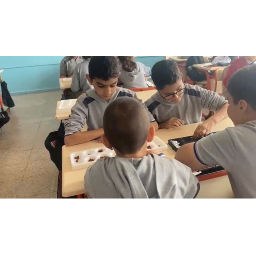
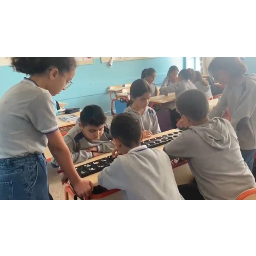
Multiplication Board Game – Paper Game Description and Explanation for Story Jumper Book
The Multiplication Board Game is a paper-based educational game designed to help students practice multiplication skills in a fun and motivating way. This game was created and played within our eTwinning project and shared with Gelsomina’s students to promote collaborative learning through games.
The game board starts with a “Start” point and ends with a “Finish” point. The path includes multiplication questions, such as basic and advanced multiplication facts, as well as special action squares like “Move ahead spaces,” “Go back spaces,” and short physical or thinking tasks. Players move along the path by rolling a dice and answering the multiplication questions on the square they land on.
If a student answers the multiplication correctly, they stay on the square and continue the game. If the answer is incorrect, they miss a turn or follow a simple rule decided by the group. Special squares make the game more dynamic and exciting, encouraging students to stay focused and motivated throughout the game.
While playing the game, students realized that multiplication is not only about memorizing numbers but also about concentration, quick thinking, and strategy. The game environment helped students feel more confident, reduced fear of making mistakes, and encouraged learning through trial and error.
This board game experience was transformed into a story for the Story Jumper book. The story is based on characters who move along a colorful path, face multiplication challenges, sometimes move forward, sometimes go back, but never give up. Through the game, the characters learn that mistakes are part of learning and that persistence leads to success.
Students actively took part in all stages of the activity. They played the game, discussed answers and strategies, supported each other, and shared their experiences with partner school students. Their ideas and reflections inspired the storyline and characters of the book.
Through this activity, students developed their multiplication skills, problem-solving abilities, cooperation, and self-confidence. The Multiplication Board Game became not only a mathematics practice tool but also a meaningful story that reflects learning through play and international collaboration in our eTwinning project.
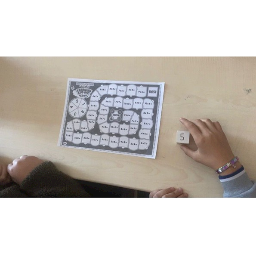
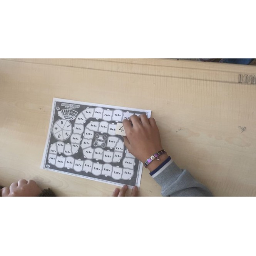
Gelsomina Melone, Italy
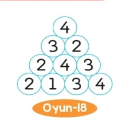
Introduction to the Magic Pyramid paper game
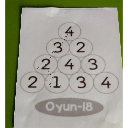
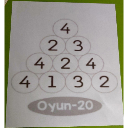
The Magic Pyramid game is an enjoyable activity where you can establish relationships between numbers and create a path based on possibilities.
In this game, the difficulty level is determined by the number of steps, and as the number of steps increases, the questions become more challenging.
Starting from the top number — the peak of the pyramid — we aim to reach the bottom number by using the numbers only once.
When we reach the bottom of the pyramid, we must have used as many digits as the number of steps, without repeating any of them.
Violeta Cristina Irimia, Lunca Priporului, Romania
Patika – Strategy Path Game
Patika is a traditional Turkish logic and strategy game played on a grid made of alternating black and white squares. The goal of the game is to create a continuous path from one side of the board to the other by stepping only on your color — either black or white squares.
Each player starts at opposite ends of the board. Players take turns moving one step at a time in any direction (up, down, left, right), but only on squares of their designated color. The challenge is to block your opponent while finding the best route to reach the opposite side first.
The game develops spatial awareness, strategic thinking, and concentration. It’s fun, fast, and great for players of all ages — especially in educational settings.
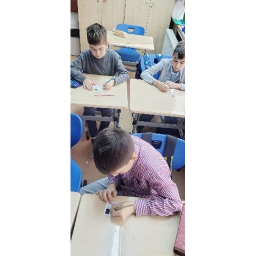
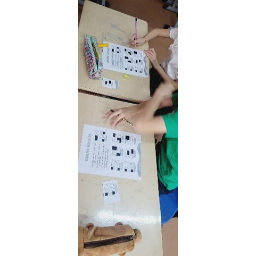
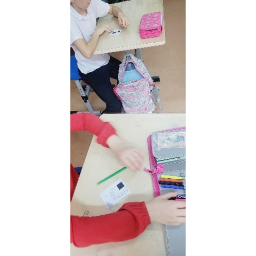
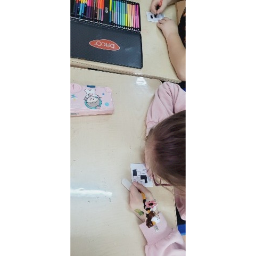
Children play Patika on a board made of black and white squares. Each child chooses one color (black or white) and starts from one side of the board. The goal is to reach the opposite side by stepping only on squares of their color. They take turns and move one step at a time – up, down, or sideways. The game becomes exciting as they try to find the best path and block each other.
Benefits for children:
- Improves logical thinking – they must plan their moves carefully.
- Builds concentration – they focus on the path and the opponent.
- Encourages strategy – they learn to think ahead.
- Fun and friendly competition – they enjoy playing while learning.
Patika is a simple game with big benefits!
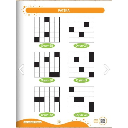
How to Play
Look at the grid!
You get a picture made of small squares:
White squares* → your path must pass through them
Black squares* → your path must not touch them
Think of black squares as *rocks* you must walk around
Draw the path
You draw lines on the edges of the squares:
* You may go ,,up, down, left, or right"
* You may ,,no" draw diagonal lines
* The line must always stay on the grid lines
Make one big loop
Your path should:
* Connect back to itself
* Have ,,no beginning and no end"
* Be ,,smooth" without branches *Every point of the path should connect to exactly 2 other points.*
If you ever make a T-shape or a dead end, it is not allowed.
Cover all white squares
Your loop must go through *every white square*.
You cannot skip one.
If a white square stays empty at the end, the puzzle is not solved.
Avoid black squares
You are not allowed to touch or cross black squares.
Imagine they are *holes* in the ground — stay away from them!
Helpful Tips for Kids
* Start with the *corners*, because the path has fewer choices there.
* If a space is very *narrow*, your path almost always must pass through it.
* Try to imagine the loop like a *race track* — it can’t suddenly stop.
* Every time you add a line, check:

Violeta Cristina Irimia, Lunca Priporului, Romania
PATH
Goal:
Connect all pairs of matching numbers with continuous paths.
Rules:
Each pair of identical numbers must be connected by one continuous path.
Paths can move only up, down, left, or right (no diagonals).
Every cell in the grid must be filled by exactly one path.
Each number belongs to only one path.
Puzzle (4×4 grid
1 . . 2
. . . .
. . . .
1 . . 2
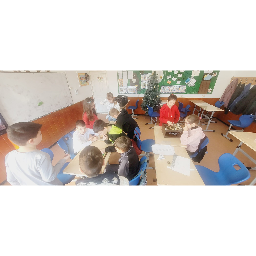
One possible solution (illustrated with lines)
Paths cannot cross or overlap.
1 ─ ─ 2
│ │
│ │
1 ─ ─ 2
Explanation:
The two 1s are connected on the left side.
The two 2s are connected on the right side.
All cells are filled.
No paths cross.

Nevzat Dokur-ERDEMLİ BİLİM SANAT MERKEZİ
STAR BATTLE GAME
Star Battle is a puzzle game with simple rules but challenging to solve. You can
play with pen and paper, or online.
The rules of Star Wars are simple. You must place the stars on the grid according to
the rules:
TOWERS OF HANOI GAME
The Towers of Hanoi is a mathematical puzzle game. It consists of three poles and 7 or 8 discs of varying sizes. You can move these discs to any pole you wish. The puzzle begins with the discs arranged on a pole, from smallest to largest, with the smallest disc at the top, forming a conical shape. The goal of the game is to move all the discs to another pole according to the following rules:
• Only one disc can be moved per move.
• Each move consists of removing the top disc from a pole and moving it to another pole.
• Discs may already be on the next pole.
• No disc can be placed on top of a smaller disc.
NEVZAT DOKUR/Erdemli Science and Art School
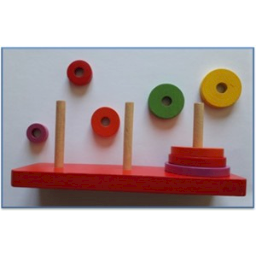
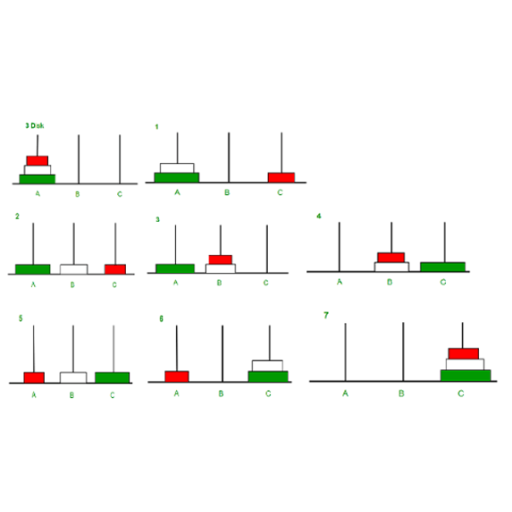
The minimum number of moves in the Towers of Hanoi game is calculated using the formula 2n-1. For example, for 3 discs, the game can be completed in at least 7 moves: 2³ - 1 = 2 x 2 x 2 – 1=7.
NEVZAT DOKUR/Erdemli Science and Art School
Aydan Soner
Özel Toros Koleji, Mersin
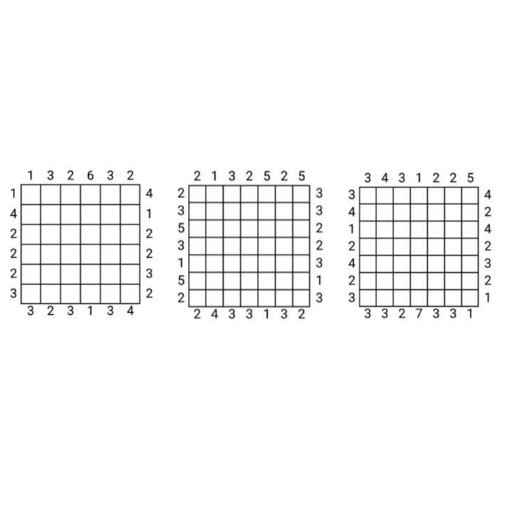
In the Apartments mind game,
The numbers you place inside the diagram indicate the height of the apartment,
The numbers given outside the diagram indicate the number of apartments that are visible from that direction and not hidden behind taller apartments.
The aim of the game is to fill the diagram with the numbers (1-4) in the given range,
once in each row and each column
Aydan Soner Uncular
REVERSİ
Reversi is played with special pieces, one side of which is black and the other is white.
At the beginning, four pieces are placed in the four squares in the center of the game board, alternating between white and black.
If a player wants to make a move, they must place a piece so that it faces their own piece color.
The player cannot place their piece anywhere. In each move, they must capture one or more of the opponent's pieces. To do this, their own pieces must be in the same row diagonally, vertically, or horizontally.
If there are opponent's pieces between the area where one player places their piece and another of their own pieces,
those pieces also change color and take on the color of the player's piece. Captured pieces are flipped over (their colors change) and become the player's own pieces. If the player cannot capture any of the opponent's pieces in the current situation, the turn passes to the opponent. • The game ends when all squares are filled or when no valid move can be made.
Akdeniz İmam Hatip Secondary School, Mersin
Futoshiki
Futoshiki is a logic puzzle game that comes from Japan.
The word *Futoshiki* means **“inequality”** in Japanese.
The game challenges players to think carefully, use logic, and compare numbers.
Game Objective
The main goal of Futoshiki is to **fill the grid with numbers correctly by following two simple rules:
1. Each number can be used only once** in every row and column.
2. All inequality signs (>, <)between the boxes must be true.
Game Board
The board is usually a square grid such as 4×4, 5×5, or 6×6.
Some numbers are already placed to help you start.
Inequality symbols ( > or < ) appear between certain boxes and show which number must be bigger or smaller.
Example:
3 > 1 means 3 must be placed in the box on the left and 1 in the box on the right.
2 < 4 means 2 must be smaller than 4.
How to Play
1. Look at the numbers already given on the grid.
2. Check the inequality signs between boxes.
3. Fill in the empty boxes with numbers (for example, 1 to 4 in a 4×4 grid).
4. Make sure:
* No number repeats in the same row.
* No number repeats in the same column.
* All inequality signs are correct.
5. Use logical thinking, not guessing.
Rules Summary
Numbers do not repeat in a row
Numbers do not repeat in a column
Inequality signs must be respected
Only logical reasoning is used
Why Play Futoshiki?
Playing Futoshiki helps to:
* Improve logical thinking
* Develop problem-solving skills
* Strengthen attention and concentration
- Full access to our public library
- Save favorite books
- Interact with authors
- < BEGINNING
- END >
-
DOWNLOAD
-
LIKE
-
COMMENT()
-
SHARE
-
SAVE
-
BUY THIS BOOK
(from $5.19+) -
BUY THIS BOOK
(from $5.19+) - DOWNLOAD
- LIKE
- COMMENT ()
- SHARE
- SAVE
- Report
-
BUY
-
LIKE
-
COMMENT()
-
SHARE
- Excessive Violence
- Harassment
- Offensive Pictures
- Spelling & Grammar Errors
- Unfinished
- Other Problem





COMMENTS
Click 'X' to report any negative comments. Thanks!