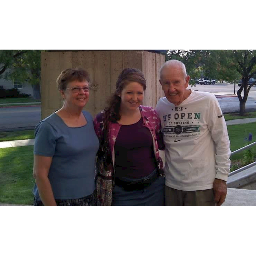
I dedicate this book to my paternal grandparents, Kathy and Fred Sheldon. Their involvement in my life from infancy to now, their dedication to living and teaching the gospel of Jesus Christ, their service in the Church, and their character qualities and love have influenced me in more ways than I can count. I love you both. Thank you for all you have done for our family. Love, Megan
Note: All information in this book was found in FamilySearch.org, via interview, or in the public domain. ChatGPT was used to generate some written content, as well as the cover art.
Published 2026


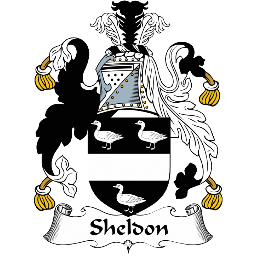
Sheldon Name Etymology
An English surname meaning "steep-sided valley" or "shelf hill," from Old English elements scylf (shelf/ ledge) and dūn (hill/ valley). It originated from various English place names, such as those in Derbyshire, Devon, and Warwickshire. The Sheldon coat of arms varies by family line but often features sheldrakes (ducks), symbolizing resourcefulness, and as a pun on the name.
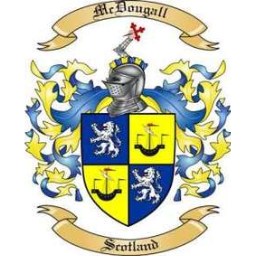
The MacDougall Clan
Clan MacDougall descends from Dougal, the son of a powerful figure who ruled the Isles and Argyll (modern day coastal areas west of Glasgow). The MacDougalls were Lords of Lorn and one of the most powerful clans in the Western Highlands. They built impressive castle strongholds that still stand today. Their motto is "Buaidh no Bas" (Victory or Death). The MacDougall tartan often features a prominent red base with interwoven shades of green, blue, and white, symbolizing the clan's loyalty, valor, and lands by the sea.

"What is a 3rd cousin, 4 times removed?"
When we talk about 2nd, 3rd, or 4th cousins, we are describing how closely two people are related based on their most recent shared ancestors. First cousins share grandparents. Second cousins share great-grandparents. Third cousins share great-great-grandparents, and fourth cousins share great-great-great-grandparents. The higher the cousin number, the farther back the shared ancestor is, which usually means the relatives are less closely related.
The phrase “removed” refers to a difference in generations, not distance in the family tree. If two people are from different generations, one is “removed” from the other. For example, your first cousin once removed could be either your cousin’s child or your parent’s cousin. Twice removed means a two-generation difference, and so on. So a third cousin twice removed means you share the same great-great-grandparents, but one person is two generations older or younger than the other.

Francis and Hester Cooke (1583- 1663) . . . . . . pg.5
Priscilla and John Alden (1602- 1685) . . . . . . . . pg.7
William Perry Sellers (1861- 1953) . . . . . . . . . . pg.10
Lulu Brown (1881- 1974) . . . . . . . . . . . . . . . . . . pg.12
Mary Catherine Wheeler (1907- 1981) . . . . . . . pg.14
Fred Eugene Sheldon, Jr. (1923- 2019) . . . . . . . pg.16
James Madison (1751- 1836) . . . . . . . . . . . . . . pg.20
James Garfield (1831- 1881) . . . . . . . . . . . . . . . pg.22
George Washington (1732- 1799 . . . . . . . . . . pg.24
John E. Page (1799- 1867) . . . . . . . . . . . . . . . . . pg.26
Brigham Young (1801- 1877) . . . . . . . . . . . . . . pg.28
Francis M. Lyman (1840- 1916) . . . . . . . . . . . . pg.30
Joseph Smith, Jr. (1805- 1844) . . . . . . . . . . . . . . pg.32
Heber C. Kimball (1801- 1868) . . . . . . . . . . . . . pg.34

Francis and Hester Cooke
(12th Great- Grand Uncle and Aunt)
Francis FamilySearch ID: LZ2F-MM7
Hester FamilySearch ID: LHVB-P72
Francis Cooke was born around 1583, likely in England, possibly near Canterbury or Norwich. As a teenager, he immigrated to Holland around age 14, where he became part of the Walloon Church, a French-speaking Protestant congregation in Leiden, Holland, whose beliefs closely matched those of the English Separatists. In Holland, Cooke worked as a wool-comber and married Hester le Mahieu on July 20, 1603. Hester came from a Walloon family that had fled religious persecution. Francis remained faithful to his religious beliefs throughout his life, even when facing pressure and persecution from other religious groups. Despite a brief return to England around 1606, he and Hester settled again in Holland, where their first son, John, was baptized in 1607.
In 1620, Francis Cooke and his son John joined the Pilgrims’ journey to America. After the ship Speedwell was forced to turn back, they continued aboard the Mayflower, leaving England in September and arriving near present-day Cape Cod in November 1620. Cooke was one of the signers of the Mayflower Compact, showing his commitment to self-government in the new colony. He survived the extremely difficult first year in Plymouth and attended the first Thanksgiving, where he brought his son John to a feast hosted by the Wampanoag chief and about 90 members of thed tribe to celebrate with the surviving Pilgrims.
Once the colony became more stable, Francis sent for his family. His wife Hester and their children Jacob, Jane, Elizabeth, and Hester arrived in Plymouth aboard the ship Anne in 1623. Francis lived the rest of his life in the Plymouth Colony, serving the community in modest but important ways, including working on committees, surveying land, and serving as a juror in an murder case. Francis Cooke died on April 7, 1663, at about 80 years old, having remained steady in his faith and respected as a quiet but faithful member of the Pilgrim community. His wife, Hester, followed him in death at least three years later.
Priscilla and John Alden
(11th Great Grandparents)
Priscilla FamilySearch ID: MZB7-D1B
John FamilySearch ID: LQR9-JCJ
American poet laureate Henry Wadsworth Longfellow wrote a poem about the young John Alden and Priscilla Mullins, who were his ancestors, and also ours. The Courtship of Miles Standish tells the story of a love triangle in the early Plymouth Colony. Miles Standish, a brave but blunt soldier, loves Priscilla Mullins but feels uncomfortable speaking about love, so he asks his friend John Alden to propose to her for him. Alden agrees, even though he secretly loves Priscilla himself. When Alden delivers the message, Priscilla responds with the famous line, “Why don’t you speak for yourself, John?” revealing her feelings for Alden instead. This creates tension between the two men, and Standish becomes angry, feeling betrayed. Before the conflict can be resolved, Standish leaves on a military mission. Alden considers leaving the colony out of guilt and heartbreak, but ultimately stays and admits his love to Priscilla. The two marry, and when Standish returns, he forgives them and gives his blessing, restoring friendship and peace in the community. Find the full poem here: https://www.excellence-in-literature.com/courtship-of-miles-standish/
John Alden was born in England around 1599 and came to North America in 1620 as a cooper (barrel-maker) aboard the Mayflower. He was one of the younger adult men on the ship and became a signer of the Mayflower Compact, the first governing document of the Plymouth Colony, shortly after the ship arrived. Alden persevered through the extremely harsh first winter in Plymouth, during which about half the colonists died. Around 1622–1623 he married Priscilla Mullins, a fellow Mayflower passenger whose entire immediate family had died that first winter, and together they began a family that eventually included eleven children.
After the first years at Plymouth, Alden became an important civic leader. He helped settle land divisions as the colony grew and was among the founders of Duxbury, Massachusetts, where he and Priscilla established a homestead and farm. Alden served Plymouth Colony in many official roles over decades, including as assistant to the governor, deputy to the General Court, treasurer, and member of the council of war. He was repeatedly elected to positions of trust and responsibility, demonstrating both his commitment to the community and his leadership among the Pilgrims.
In his later life, Alden continued to be active in public affairs and remained a respected figure in Duxbury. He lived long enough to be remembered as one of the last surviving signers of the Mayflower Compact and as a witness to much of the colony’s early history. John Alden died on September 12, 1687 in Duxbury, leaving a lasting legacy through his descendants and his role in establishing one of America’s earliest English settlements.
Priscilla Mullins was born in England around 1601, most likely in Dorking, Surrey, and
she came to North America in 1620 aboard the Mayflower with her parents and brother Joseph. She was a young teenager during this voyage, and she survived the notoriously harsh first winter in the Plymouth Colony that claimed the lives of her father William, her mother Alice, and her brother Joseph—leaving her the sole survivor of her immediate family in the New World.
After the first difficult years at Plymouth, Priscilla married fellow Mayflower colonist John Alden around 1623, likely making them one of the earliest couples married in the colony. Together they initially lived in Plymouth before helping establish the nearby settlement of Duxbury, Massachusetts. Priscilla and John had a large family, with at least ten children, and their descendants became numerous in New England and beyond.
She became a well-known figure in American cultural memory thanks to Henry Wadsworth Longfellow’s 1858 poem The Courtship of Miles Standish. In the romanticized tale, she is courted by both Captain Miles Standish and John Alden, and her witty response—“Why don’t you speak for yourself, John?”—helped make her one of the most famous women associated with the Pilgrim story.
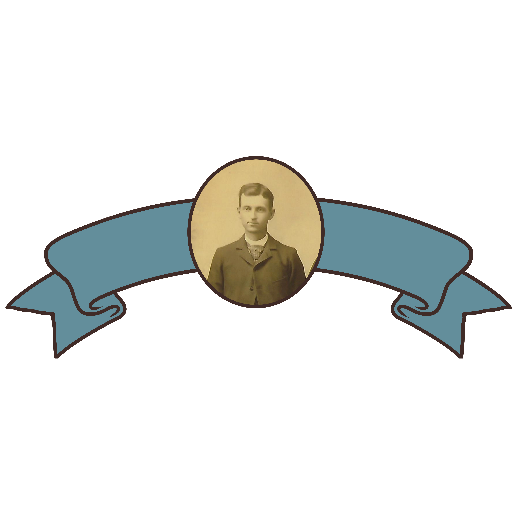
William Perry Sellers
(3rd Great- Grand Uncle)
FamilySearch ID: MCD8-SYN
William Perry Sellers was born in Kokomo, Indiana on May 24, 1861, as one of nine children and grew up learning the value of hard work and family. He became a carpenter and cabinet maker. His skill and care showed not only in his work but also in what he left behind—most notably a four-poster bed he built himself, which is still used today by his grand-niece, Kathleen McDougall Sheldon. William married Jane “Jennie” Brown in 1886 in Rochester, Indiana, and the two built a life together, raising at least one son along the way.
Over the years, William and Jennie lived in several places, including Michigan and later California, where they spent about a decade in Alhambra, Los Angeles. They were active members of the Main Street Christian Church while they lived in LA. William and Jennie were married for 66 years. When Jennie passed away in December 1952, William followed just a month later in January 1953 and was buried in Alhambra, Los Angeles.
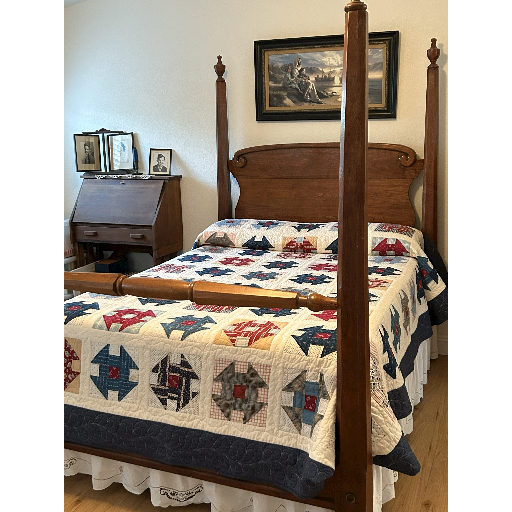
This is the four-poster bed made by William Sellers, and inherited by his grand niece Kathleen McDougall Sheldon when she was about 9 years old. She used this bed until she got married, and since the passing of her husband, Fred, is using this bed again.
The quilt squares on this bed were hand stitched by Lulu Brown, William's adopted daughter. The squares were passed down two generations to Kathleen Sheldon, and later made into a full quilt.
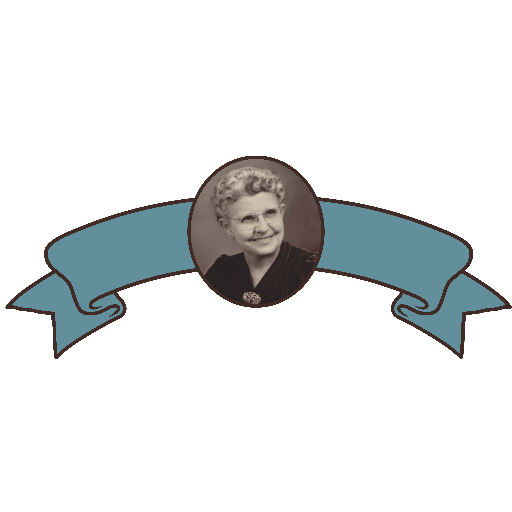
Lulu Brown
(Great Great Grandmother)
FamilySearch ID: KVV8-Z1W
Lulu Brown was born in 1881 to Joseph and Mary Brown in Kokomo, Indiana, but her mother died while Lulu was very young. As the youngest child, she was taken in by another family—Isaac and Ada Keller—who either were relatives or very close family friends, and who had recently lost a daughter of the same age. Though this adoption shaped her life, Lulu rarely spoke of her early years. What is known is remarkable for her time: at the turn of the twentieth century, when few women pursued higher education, Lulu attended college, joined the Pi Beta Phi sorority, graduated, and became a teacher.
Lulu was a formal woman and always impeccably dressed. She wore gloves and a hat to church, kept her hair perfectly coiffed, and carried herself with grace and good manners throughout her life. She was a deeply devoted lifelong Baptist, attending church faithfully wherever she lived. When she was 25, she married Courtney Arthur Wheeler, and they had a daughter and two sons.
After being widowed at age 60, she later remarried Smith “Smitty” Gray, a kind and capable man who was legally blind yet worked selling musical instruments and navigated San Francisco independently by memorizing trolley and bus routes. Together they lived on Ashbury Street near Eighth, in a narrow San Francisco apartment building before moving to Salt Lake City and then to Los Angeles, CA.
Lulu is remembered to give books to her grandchildren for birthdays and Christmases—Bible stories and classic literature. She proudly worked as a clerk for the U.S. Army during World War II. Cherished memories include when her granddaughter Kathleen visited Lulu at the Presidio, as well as riding cable cars, going to Fisherman’s Wharf, and attending church together in San Francisco. She is remembered to never complain about her trials in life. She passed away in 1974 at age 92 in Los Angeles, CA.

Mary Catherine Wheeler
(Great Grandmother)
FamilySearch ID: LH8V-X62
Mary Catherine “Kitty” Wheeler was born in Kokomo, Indiana, in 1907 as the first child of Courtney Wheeler and Lulu Brown. The family soon moved to Caldwell, Idaho, and later lived for a time in Salt Lake City, Salt Lake County, Utah. In high school, she participated in sports, including basketball and track, and remained physically active throughout her life.
At age 20, Kitty married her first husband, Lester Bixenman, in Bountiful, Utah. They had two daughters: Pat, and Mary Lou, and later divorced. By 1935, Kitty and her girls were living in Los Angeles, California. Around age 28, she met and married her second husband, Stuart McDougall, and eight years later had their only child Kathleen.
Kitty trained as a registered nurse, beginning her nursing education in Salt Lake City, Utah, and later completing her training in Orange County, California. She worked for many years as a nurse, including doing private-duty night nursing before modern intensive care units existed. Later, she worked at Good Samaritan Hospital in Los Angeles, California. Nursing remained a central part of her adult life, and she took particular pride when her daughter later worked at the same hospital as a nurse.
Kitty regularly attended church, including Baptist, Methodist, and Christian Church denominations. She often participated in service in the community including communion preparation for her church, groups of Camp Fire Girls, and remained involved with Job’s Daughters for many years. She lived near her grandchildren and her son in law, Fred, often visited her on his way home from work in Whittier, CA. She is remembered for her free spiritedness, work ethic, and lifelong commitment to caring for others through both family and profession. Everyone she worked for or with loved her, and she valued those work and family relationships throughout her life. She passed away in 1981 at age 74 in Whittier, California.
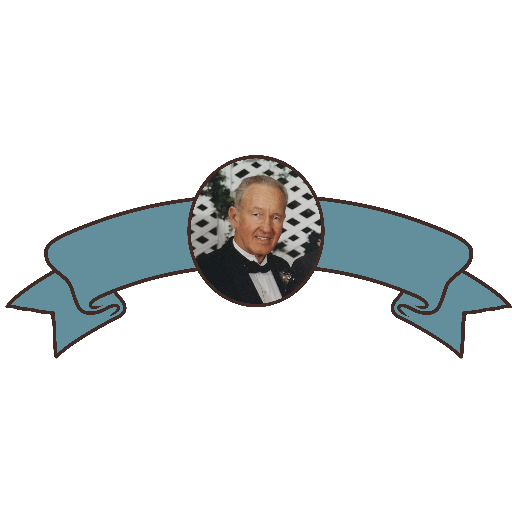
Fred Eugene Sheldon, Jr.
(Grandfather)
FamilySearch ID: LNBT-7K2
Fred Eugene Sheldon was born in February 1923 in Mexia, Texas, to Fred Sheldon Sr. and Maud Fine. He was the youngest of 3 boys, with a sister who passed away as a child before he was born. As a teenager, he became an accomplished athlete, playing on a championship football team at Garfield High School and later continuing his football career at Pasadena City College.
World War II broke out when he was 19 years old, so Fred made the courageous and patriotic decision to enlist in the Army Air Corps. After the war, Fred returned to his education. He graduated from Whittier College before earning his administrative credential from the University of Southern California, then committed himself to a career in education. He also married Hazel Jensen in 1943 at age 20, and they went on to have three wonderful children together before they divorced.
Fred spent more than 45 years as a coach, teacher, and administrator at Montebello High School, where “Mr. Sheldon” was well loved by athletes, students, and co-workers.
During these years, Fred met Kathleen McDougall, a student at the high school, and they fell in love in spite of some initial opposition from Kathleen’s family. In 1962 they were married, went on to raise 6 children, and later delighted in 29 grandchildren. He showed unique interest in each of his children and grandchildren, and blessed them with his cheerful hope and optimism. He always whistled while he worked, and he won many awards for his homemade lemon meringue pie.
Fred had a deep faith in God, prayed often, faithfully attended church, and showed love and kindness toward everyone. During the early years of their marriage, Fred and Kathy were introduced to the Church of Jesus Christ of Latter-day Saints by some friends and were later baptized. After retiring, Fred and Kathy chose to continue serving the Lord together through full-time church missions. This included a year of humanitarian service on the Navajo Indian Reservation in Arizona as well as a year serving at church historical sites in Wyoming. Fred and Kathy often described these mission years as some of the best of their lives. Fred passed away on March 26, 2019, at the age of 96, in his home in San Juan Capistrano, CA. He is remembered by his family as a man of strong faith, amazing health, and a loving and wise father, husband, and grandfather.
The Sheldon- McDougall family lines have many relations to ancestors who were or have become famous. Here is a list that includes some of those people up, although it is not exhaustive. Stories were included in the following pages only for relatives up to fourth cousins, as meaningful family connections become more distant beyond that point.
United States Presidents
James Madison (US President)- 3rd cousin 10 times removed
James Garfield (US President)- 4th cousin 6 times removed
George Washington (US President)- 4th cousin 10 times removed
Rutherford B. Hayes (US President)- 5th cousin, 5 times removed
Calvin Coolidge (US President)- 5th cousin, 5 times removed
Millard Fillmore (US President)- 5th cousin, 6 times removed
Abraham Lincoln (US President)- 5th cousin, 6 times removed
Franklin Pierce (US President)- 5th cousin, 7 times removed
Andrew Jackson (US President)- 5th cousin, 9 times removed
Innovators and Influencers
Eli Whitney (inventor of cotton gin)- 5th cousin, 7 times removed
Thomas Edison (inventor)- 6th cousin, 4 times removed
Orville and Wilbur Wright (invented the first airplane)- 6th cousins, 6 times removed
Amelia Earhart (aviation pioneer)- 7th cousin, 3 times removed
Buffalo Bill (showman)- 5th cousin, 5 times removed
Marilyn Monroe (actress and model)- 6th cousin, 3 times removed
Nathaniel Hawthorne (author)- 6th cousin, 6 times removed
Leaders of the Church of Jesus Christ of Latter-day Saints
John E. Page (Apostle)- 3rd cousin, 6 times removed
Brigham Young (Prophet)- 3rd cousin, 7 times removed
Francis M. Lyman (Apostle)- 4th cousin, 5 times removed
Joseph Smith (Prophet)- 4th cousin, 5 times removed
Heber C. Kimball (Apostle)- 4th cousin, 7 times removed
Joseph F. Smith (Prophet)- 5th cousin, 4 times removed
Emma Smith (Relief Society president)- 5th cousin, 5 times removed
Eliza R. Snow (Relief Society president)- 5th cousin, 5 times removed
Lorenzo Snow (Prophet)- 5th cousin, 5 times removed
Heber J. Grant (Prophet) - 5th cousin, 5 times removed
Wilford Woodruff (Prophet) - 5th cousin, 5 times removed
Willard Richards (Apostle)- 5th cousin, 7 times removed
Lyman Wight (Apostle)- 5th cousin, 7 times removed
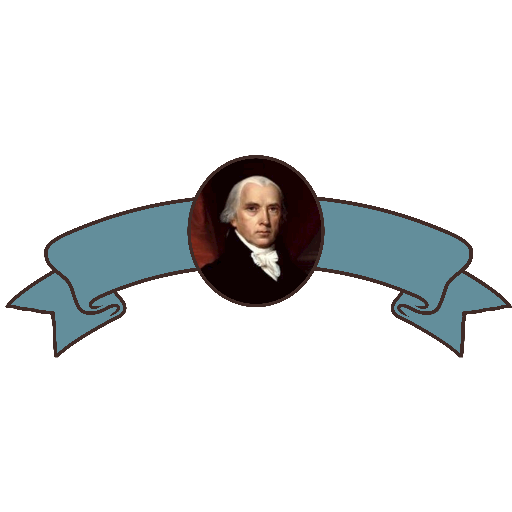
James Madison
(3rd cousin, 10 times removed)
FamilySearchID: LZTD-MFS
James Madison was born on March 16, 1751, in Port Conway, Virginia, and grew up on his family’s plantation at Montpelier. He was small, often sickly, and more comfortable with books than physical labor, but he developed a powerful love of learning. Madison studied history, philosophy, and government, believing knowledge was the key to protecting freedom. In 1794, he married Dolley Payne Todd, a lively and intelligent widow. Although they had no children, Dolley became one of the most influential First Ladies in American history and was a steady support to Madison throughout his life.
Madison’s greatest contribution came before he was ever president. He played a leading role in writing the U.S. Constitution and is often called the “Father of the Constitution.” He believed deeply in balancing power so no one branch of government could dominate the others. Along with Alexander Hamilton and John Jay, he wrote the Federalist Papers, essays that helped convince Americans to support the new Constitution. Later, Madison insisted on adding the Bill of Rights, even when
others thought it unnecessary, because he believed personal freedoms must be clearly protected. Throughout these years, Dolley’s ability to host gatherings and ease tensions among political leaders quietly supported Madison’s work behind the scenes.
One powerful story from Madison’s life comes during the burning of Washington, D.C. in the War of 1812. As British troops approached the capital, Dolley Madison famously saved important national treasures, including a portrait of George Washington. Her courage and quick thinking preserved symbols of the young nation’s identity. Madison returned to a city in ruins but did not give up. Instead, he made the hard
decision to continue the war effort, believing the nation’s independence was worth defending even in the face of embarrassment and loss.
Madison served two terms as president and then retired quietly to Montpelier, where he continued to study and reflect on government. Dolley remained an important partner in his later years, managing their household and maintaining his legacy through her continued connections and influence in Washington society. He died on June 28, 1836, in Virginia. Madison is remembered not for dramatic speeches or military victories, but for his steady belief that freedom depends on thoughtful laws, compromise, and respect for differing views—and for the partnership he shared with Dolley, whose influence helped shape both his personal life and his public success.

James Abraham Garfield
(4th cousin, 6 times removed)
FamilySearchID: LZ6W-F3Y
James Abram Garfield was born on November 19, 1831, in Orange Township, Ohio, into deep poverty. His father died when James was very young, and he worked hard to help support his family. As a teenager, Garfield labored on canals and farms but dreamed of an education. Through determination and self-discipline, he became a teacher, preacher, and scholar. In 1858, he married Lucretia Garfield, a former student who shared his deep love of learning and strong moral values. Their marriage was built on intellectual partnership and mutual respect. Lucretia encouraged Garfield’s academic pursuits, challenged his thinking, and remained a steady influence during times of illness, doubt, and long separations. Together they raised seven children, and her strength and independence helped keep their family stable while Garfield pursued his demanding career.
Garfield served as a Union general during the American Civil War, then spent many years in Congress.
- Full access to our public library
- Save favorite books
- Interact with authors
- < BEGINNING
- END >
-
DOWNLOAD
-
LIKE
-
COMMENT()
-
SHARE
-
SAVE
-
BUY THIS BOOK
(from $6.79+) -
BUY THIS BOOK
(from $6.79+) - DOWNLOAD
- LIKE
- COMMENT ()
- SHARE
- SAVE
- Report
-
BUY
-
LIKE
-
COMMENT()
-
SHARE
- Excessive Violence
- Harassment
- Offensive Pictures
- Spelling & Grammar Errors
- Unfinished
- Other Problem






COMMENTS
Click 'X' to report any negative comments. Thanks!