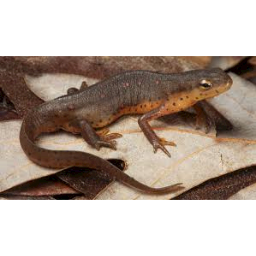
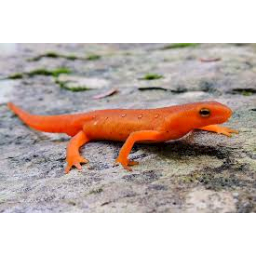
Habitat - The eastern newt inhabits a diverse, semi-aquatic environment across eastern North America, requiring
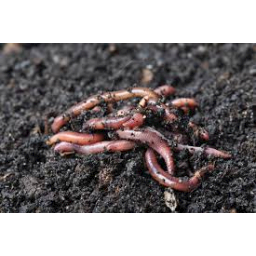
Diet - Eastern newts are carnivorous at all life stages, eating small invertebrates, worms, snails, insect larvae, and small crustaceans
Life expectancy - Eastern newts typically live for 12 to 15 years in the wild
Number of offspring at one time - An eastern newt female lays in a single breeding season

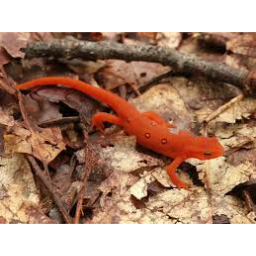
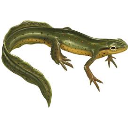
Variations and adaptations - they can secrete toxic substances from their skin to deter predators, and a distinctive, bright orange coloration as juveniles that serves as a warning, while returning to green for camouflage as adults, While adults are primarily aquatic and have a flattened tail for swimming, they can return to land and enter a semi-terrestrial state if their pond dries up, enabling them to survive temporary environmental changes. It helps them reproduce because they have the ability to defend off enimies and change thier habitat witch makes them love longer and be able to survive to reproduce.

Homologous structures - The eastern newt shares a common ancestor with humans, which is why we share similar bone structures. The best examples are their forelimbs and hindlimbs, which follow the same one bone, two bones, many bones pattern as our arms and legs. For instance, their front legs have a humerus (upper arm), radius and ulna (forearm), and carpals (wrist bones) just like us. The main difference is how they use them; while humans use our limbs for walking upright or grabbing things, newts use theirs for swimming and crawling through mud. Also, newts are a bit different because they only have four fingers on their front legs, while humans have five. Even though they look different on the outside, the skeletal map is almost identical.

Vestigial structures - The Eastern Newt has vestigial gill slits as an adult that are pretty much useless. When they are babies (larvae), they use big, feathery gills to breathe underwater, but after they grow up and develop lungs, these gills mostly disappear. Scientists believe these were once essential for breathing underwater full-time, but they became vestigial because the newt evolved a life cycle where it spends a lot of time on land as a "red eft." Since they have lungs and can breathe through their skin now, they don't need the old gills anymore, so they just turned into small, leftover marks on their bodies.

Evolutionary relationships -
Works cited - https://nationalzoo.si.edu/animals/eastern-newt
https://biokids.umich.edu/critters/Notophthalmus_viridescens/
https://www.chesapeakebay.net/news/blog/exploring-the-unique-triple-life-of-an-eastern-newt
https://rochesterecologypartners.org/2025/03/17/eastern-newt-species-spotlight/
Taxonomy -

- Full access to our public library
- Save favorite books
- Interact with authors

- < BEGINNING
- END >
-
DOWNLOAD
-
LIKE
-
COMMENT()
-
SHARE
-
SAVE
-
BUY THIS BOOK
(from $2.99+) -
BUY THIS BOOK
(from $2.99+) - DOWNLOAD
- LIKE
- COMMENT ()
- SHARE
- SAVE
- Report
-
BUY
-
LIKE
-
COMMENT()
-
SHARE
- Excessive Violence
- Harassment
- Offensive Pictures
- Spelling & Grammar Errors
- Unfinished
- Other Problem

COMMENTS
Click 'X' to report any negative comments. Thanks!