 In dedication to Mrs. Moore's science class
This book was created and published on StoryJumper™
©2015 StoryJumper, Inc. All rights reserved.
Publish your own children's book:
www.storyjumper.com

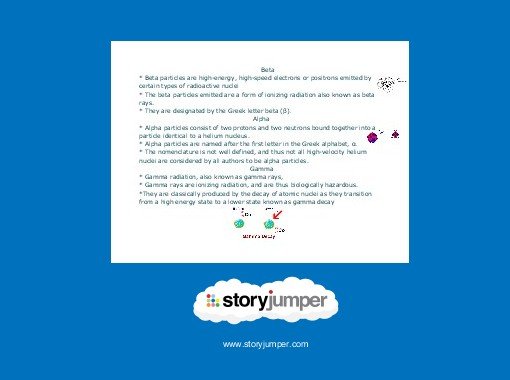
Beta
* Beta particles are high-energy, high-speed electrons or positrons emitted by
certain types of radioactive nuclei
* The beta particles emitted are a form of ionizing radiation also known as beta
rays.
* They are designated by the Greek letter beta (β).
Alpha
* Alpha particles consist of two protons and two neutrons bound together into a
particle identical to a helium nucleus.
* Alpha particles are named after the first letter in the Greek alphabet, α.
* The nomenclature is not well defined, and thus not all high-velocity helium nuclei
are considered by all authors to be alpha particles.
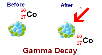
Gamma
* Gamma radiation, also known as gamma rays,
* Gamma rays are ionizing radiation, and are thus biologically hazardous.
*They are classically produced by the decay of atomic nuclei as they transition from
a high energy state to a lower state known as gamma decay


* Half life- A fixed time required for half the
radioactive nuclei in a substance to decay.
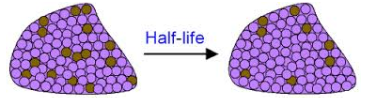
* Imagine we have an undiscovered element, Parentium, that
has a radioactive isotope, Parentium-123, which decays to
stable Daughterium-123. This is the only way Parentium-123
decays, and there is no other source of Daughterium-123.
Furthermore, Parentium and Daughterium are so different in
chemical properties that they don't otherwise occur together.
* In other words there was originally 4 parts per million
Parentium-123 and 0 parts per million Daughterium-123.
Since there is now only 1/4 of the original amount of
Parentium-123, we know that two half-lives of Parentium-123
have elapsed.
*If there were such a pair of isotopes, radiometric dating would be
very simple. We could be sure that a mineral containing parentium
originally had no daughterium.

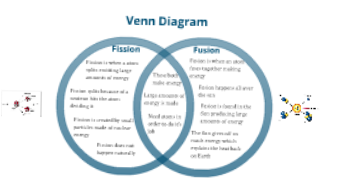
Fission- is either a nuclear reaction or a radioactive decay process in
which the nucleus of an atom splits into smaller parts (lighter nuclei).
*Nuclear bombs work by fission. A core of $_{92}^{235}\text{U}$ is
forced to undergo fission when a uranium bullet fires into the core on
detonation, forcing the core to critical mass.
*Nuclear power plants generate power by fission reactions. Fuel rods
enriched with $_{92}^{235}\text{U}$, an isotope of uranium that
can undergo fission, are used to heat water or steam. The water or
steam goes on to power a steam turbine. A containment vessel
surrounds the reactor so no radiation escapes. In 2008, around 8.5%
of U.S. electrical energy was produced by nuclear power plants.
Fusion- the process or result of joining two or more things together to
form a single entity.
*Because of their slow movement in relation to one another, solid
particles exert strong attractions; yet as slowly as they move, solid
particles do move—as is the case with all forms of matter at the
atomic level. Whereas the particles in a liquid or gas move fast
enough to be in relative motion with regard to one another, however,
solid particles merely vibrate from a fixed position.
*the motion and attraction of particles in matter has a direct effect on
thermal energy, and thus on heat and temperature. The cooler the
solid, the slower and weaker the vibrations, and the closer the
particles are to one another. Thus, most types of matter contract
when freezing, and their density increases. Absolute zero, or 0K on
the Kelvin scale of temperature—equal to −459.67°F (−273°C)—is
the point at which vibration virtually ceases.

1945 Hiroshima
1945 Nagasaki
Techa River
* Bomb dropped by US during WWII and spread chemicals.
* Dropped a bomb and spread to two cities.
*From 1949 to 1956 the Mayak complex[1] dumped an estimated 76 million
cubic metres (2.7×10⁹ cu ft) of radioactive waste water into the Techa River, a
cumulative dispersal of 2.75 MCi (102 PBq) of radioactivity.


Glossary
Beta Particle- a fast-moving electron emitted by radioactive decay of
substances.
Alpha Particle- a helium nucleus emitted by some radioactive substances,
originally regarded as a ray.
Gamma Particle- are ionizing radiation, and are thus biologically
hazardous.
Half life- A fixed time required for half the radioactive nuclei in a substance to decay.
Fission- is either a nuclear reaction or a radioactive decay process in which the nucleus of an atom
splits into smaller parts (lighter nuclei).
Fusion- the process or result of joining two or more things together to form a single
entity.
Speed- the rate at which someone or something is able to move or operate.
Average speed- as the distance traveled divided by the time elapsed.
Velocity- the speed of something in a given direction.
Acceleration- increase in the rate or speed of something.
You've previewed 9 of 15 pages.
To read more:
Click Sign Up (Free)- Full access to our public library
- Save favorite books
- Interact with authors

- < BEGINNING
- END >
-
DOWNLOAD
-
LIKE
-
COMMENT()
-
SHARE
-
SAVE
-
BUY THIS BOOK
(from $2.99+) -
BUY THIS BOOK
(from $2.99+) - DOWNLOAD
- LIKE
- COMMENT ()
- SHARE
- SAVE
- Report
-
BUY
-
LIKE
-
COMMENT()
-
SHARE
- Excessive Violence
- Harassment
- Offensive Pictures
- Spelling & Grammar Errors
- Unfinished
- Other Problem





COMMENTS
Click 'X' to report any negative comments. Thanks!