 I dedicate this book to Julián and the people of Venezuela
- LAR
This book was created and published on StoryJumper™
©2010 StoryJumper, Inc. All rights reserved.
Publish your own children's book:
www.storyjumper.com

enter text here
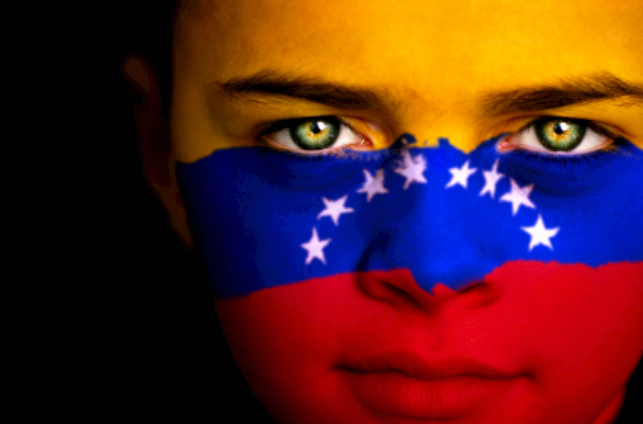
Julián was a young boy who lived in Venezuela. He was very ignorant about
his culture and history. His grandpa, Pablo, kept trying to show him, but he
was too caught up in his video games. Whenever his grandpa tried to tell
him something about Venezuela, he wouldn't look up from his video game,
so he grew more ignorant.
One evening when the family was eating and Julián was forced to turn off
his video game, his grandpa was telling him a story from when he was a kid.
Pablo realized that he wasn't paying much attention to his story so he
decided to take Julián for a ride around Caracas after dinner to show him
the culture.
To convince Julián to go with him he told him that he was going to buy him
a new video game. Julián got in the car very excited. When Julián realized
they were not going the right way, he asked his grandfather, "Where are we
going?'' Pablo responded, "We're taking a shortcut.''
As he drove through the streets of Caracas, Pablo started
telling Julián about its history.
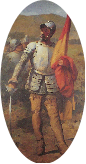
"Our capital city was founded in 1567 by Diego de Losada and
its full name is Santiago de León de Caracas:
-- Santiago for the apostle James, who is the patron saint of
Spain
-- de León for Don Pedro Ponce de León, the governor,
-- and Caracas for the Caracas Indians, who inhabited the
region."
Diego de Losada
Then, Pablo suddenly stopped the car and asked Julián to get out and
walk with him. "Grandpa, where are we?" asked Julián. Pablo told him,
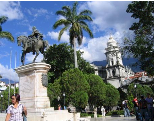
"We are at the heart of the city -- Plaza Bolívar." Julián looked around,
and saw many beautiful trees and statues, and many Venezuelans
walking through the plaza.
"Wow, there are lots of people here," he said. Pablo explained to him
that Bolívar Plaza was the center of social, political, and tourist activity.
"People pass through here every day, on their way to work or to mass or
to visit the the mayor's office." Pablo first showed him the Cathedral of
Caracas. "Most people in Venezuela -- about 96% --are Roman Catholic,
like our Spanish founders."
Catedral de Caracas

Julián suddenly pointed to a statue of a man on a horse. "Who's that,
Grandpa?" "That is Bolívar himself!"
Simón Bolívar Bolívar Fuerte
Plaza Bolivar, Caracas
"Bolivar?", asked Julián. "Isn't that the name of our money?" "Yes, our
money is called the Bolívar Fuerte or Strong Bolívar after Simón Bolívar,
the most famous Venezuelan ever."



Julián had heard the name of Simón Bolívar all his life, but he
realized he knew very little about him. "Why is he so
famous?", he asked.
His grandpa told him about the history of Venezuela.
"This land was originally inhabited by Indian people, such as
the Mariches and the Caciques. Then, the Spanish explorers
came, starting with Christopher Columbus in 1498 and Alonso
de Ojeda, in 1499, who gave it the name of Venezuela, which
means "little Venice", because of its many rivers.
Venezuela was a colony of Spain during the 16th, 17th and
18th century. Then, the people grew tired of the Spanish Rule,
and they began a fight for their independence.
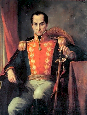
"Simón Bolívar was born in Caracas on July 24th, 1783. His parents
died was he was young and he inherited a fortune. When he was 14,
he was sent to military school. He loved learning about arms and
military strategies."
"He became one of South Americas greatest generals. In 1821, he
led the victory over the Spaniards and won independence not only for
Venezuela, but also for Bolivia, Panama, Colombia, Ecuador and Peru.
For that reason, he is called El Liberator and the George Washington
of South America. There are statues in his honor all over the world,
in places like Argentina, Colombia, Bolivia, Paris and Washington,
DC."
Julián thought for a moment. "So, even though we wanted to be free
of Spain, we still kept many things from them, like our religion and
our language?" "That's right," said Pablo. "Because we were ruled by
the Spanish for over 300 years, those things had already become a
part of our culture."
Julián was becoming more curious now. "What other things did we get
from the Spanish?"
"The Spanish have influenced many things in our culture -- our art,
our architecture, our music. But we also have been influenced from
the original American Indians, as well as by the Africans, who arrived
in Venezuela after the Spanish were defeated. Then, in the 20th
century, we had many new immigrants to Venezuela, such as Italians,
Germans, and Arabs."
"Wow, so many different kinds of people have made Venezuela
their home," said Julián. "Is that why we all look so
different?"
"Yes," said Pablo. "Most people here are what we call mestizo
or mixed race. They are almost two-thirds of the population.
We also have Europeans, which are about one-fifth of our
people. About 10% are black, and only 2% are the original
American Indians."
Julián had never thought so much about the people living
around him. "How many people are there, grandpa?" "Almost
30 million," Pablo told him.
Then Julián grew a bit sad. "But Grandpa, many of the people
who live here are very poor, aren't they?"
"Yes, Julián, I'm afraid they are. Many people here are not as
lucky as you and I. One-third of the people here live in
poverty. Almost 15% of our people live on less than $2 a day."
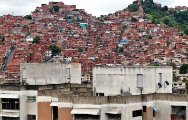
Julián thought about the poor neighborhoods he had seen in
his country, and he felt bad that he hadn't paid more
attention.
You've previewed 11 of 18 pages.
To read more:
Click Sign Up (Free)- Full access to our public library
- Save favorite books
- Interact with authors


- < BEGINNING
- END >
-
DOWNLOAD
-
LIKE(6)
-
COMMENT()
-
SHARE
-
SAVE
-
BUY THIS BOOK
(from $3.59+) -
BUY THIS BOOK
(from $3.59+) - DOWNLOAD
- LIKE (6)
- COMMENT ()
- SHARE
- SAVE
- Report
-
BUY
-
LIKE(6)
-
COMMENT()
-
SHARE
- Excessive Violence
- Harassment
- Offensive Pictures
- Spelling & Grammar Errors
- Unfinished
- Other Problem





COMMENTS
Click 'X' to report any negative comments. Thanks!