
Augmented reality is an interactive environment that blends virtual reality and real world elements (Hamilton, 2010).

Augmented Reality (AR):
Augmented Reality Brings the Abstract to Life
In the interactive AR environment, virtual objects can be manipulated or stationary.
These objects can be used for entertainment, advertisement, education, and more.
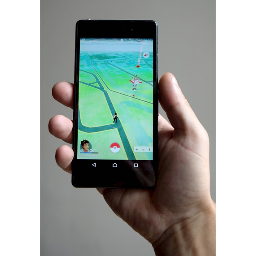
In the Classroom, "AR"...
-Allows students to collaborate with peers, parents, and the community using digital tools and resources to support student learning and innovation (ISTE-T 3.b).
-Models collaborative knowledge construction by engaging in learning with students, colleagues, and others in face-to-face and virtual environments (ISTE-T 1.d.).
Augmented Reality Resources for the Classroom:
Aurasma allows its users to create unique AR experiences. One way I would utilize this is to have students

create a word wall with triggers that pop up a peer providing an image, definition, and example of the word (Nesloney, 2013).

FETCH! Lunch Rush is an Augmented Reality App that overlays 3-dimensional graphics on the camera to assist
elementary aged children with addition and subtraction. One pro is that the app is available for free but unfortunately it can only be downloaded through the Apple App Store.
Math Alive is another resource geared towards elementary aged students. Math alive incorporates
seeing, hearing, and doing to engage students in activities ranging from number sense, computation, data and probability, patterns, Geometry, and measurement. A big pro is the 400+ page lesson guide aligned to the common core. A big con is the introductory price of $795.

I want to shift my focus away from math for these next two pages to discuss some of the coolest apps I have ever seen. Elements 4D by
Daqri has blocks which depict varying chemical elements from the periodic table. When combined with "AR" the blocks come to life displaying the element and its properties. Amazingly, when two blocks are placed together the app shows you how the elements would react in real life.
Google Sky Map displays the stars, planets,
and constellations that would be visible in the direction your smart phone is facing.

This would be a powerful tool for any astronomy class to better visualize the stars and constellations in person rather than reading descriptions of them from a textbook.
- Full access to our public library
- Save favorite books
- Interact with authors
- < BEGINNING
- END >
-
DOWNLOAD
-
LIKE
-
COMMENT()
-
SHARE
-
SAVE
-
BUY THIS BOOK
(from $2.99+) -
BUY THIS BOOK
(from $2.99+) - DOWNLOAD
- LIKE
- COMMENT ()
- SHARE
- SAVE
- Report
-
BUY
-
LIKE
-
COMMENT()
-
SHARE
- Excessive Violence
- Harassment
- Offensive Pictures
- Spelling & Grammar Errors
- Unfinished
- Other Problem





COMMENTS
Click 'X' to report any negative comments. Thanks!