
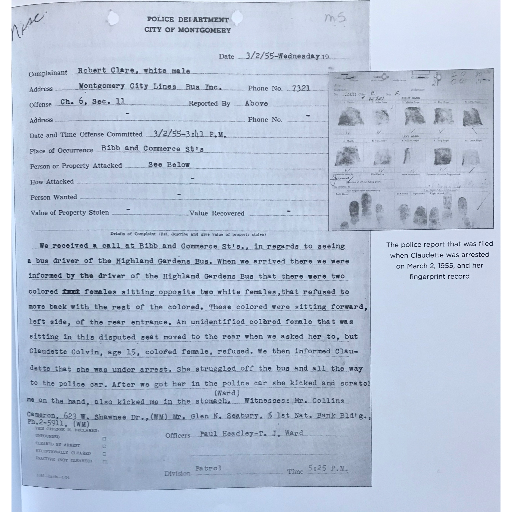
Claudette Colvin was born in 1938, a time where Blacks and Whites were not seen as equal. When she was a child, she saw how badly people of color were treated in her city of Montgomery, Alabama. There were big, new movie theaters for White people and then smaller, older movie theaters for the colored people. There were nicer clothing stores, schools, and restaurants for the White people, just because their skin was not dark. There were so many places you could not go, and things you could not do, if you were black. Things were not fair.
The Montgomery city bus was really terrible for the people of color. They had to enter from the very back of the bus after they paid to get on. They were not allowed to sit in the first ten seats on the bus, those seats were for the White people only. The Black people were supposed to sit in the very back. If the White section filled up, they were expected to give up their seats for the White people, unless there was not another empty seat open for them to move to. Things were not fair.
In 1954, a new law passed that said all schools had to mix students. Claudette loved school, she learned from some great teachers that Black people had a rich history too. She was excited for Whites and Blacks to go to school together because she wanted to read the books that the White schools had. Claudette babysat for a White family and she got to see what the textbooks were like from the White schools. They were much nicer, and they had stories and information that her textbooks did not. Things were not fair.
Claudette was a smart, young girl who wanted to learn. She knew too many adults who stopped going to school in the sixth grade. Learning made her feel like she mattered, and she knew a good change was coming. She said, “When my moment came I was ready.” Claudette was just a teenage girl, but she knew that things were not fair, and that should change.

Her moment came soon after. One day, she went on the bus with her friends, and she chose a spot by the window in the back. Before she knew it, the bus became crowded and a white woman was standing over her. The bus driver yelled at her to give her seat to the white woman. Claudette knew her rights, she did not have to give her seat away if she was in the Black section and there were no other seats open. Claudette sat still while her friends gave up their seats. Still, the white woman would not sit because that meant she would have to be next to Claudette. To the white woman, Black people were supposed to sit behind white people on the bus. This was a way to tell the Blacks that they were worth less. Things were not fair.

Even though people, White and Black, were telling her to move, Claudette stayed seated and quiet. Things were not fair, and she was finally going to do something about it. The bus driver called the police to get her off the bus. They shouted at her in an angry voice until she cried. She told them that it was her constitutional right to be sitting there. The cops pulled her off the bus, one cop kicked her. Before she knew it, she was in jail.
- Full access to our public library
- Save favorite books
- Interact with authors

- < BEGINNING
- END >
-
DOWNLOAD
-
LIKE(4)
-
COMMENT()
-
SHARE
-
SAVE
-
BUY THIS BOOK
(from $3.99+) -
BUY THIS BOOK
(from $3.99+) - DOWNLOAD
- LIKE (4)
- COMMENT ()
- SHARE
- SAVE
- Report
-
BUY
-
LIKE(4)
-
COMMENT()
-
SHARE
- Excessive Violence
- Harassment
- Offensive Pictures
- Spelling & Grammar Errors
- Unfinished
- Other Problem

COMMENTS
Click 'X' to report any negative comments. Thanks!