
Life Sciences 11
May 3rd, 2019

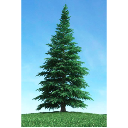
FIR TREES ARE GYMNOSPERMS!
- This means that their seeds are unprotected by an ovary or fruit!
- Fir trees are conifers, and are vascular plants.
What does vascular mean?
Pertaining to, composed of, or provided with vessels or
ducts that convey fluids, such as blood, lymph, or sap


Nutrition!
Fir trees do photosynthesis in order to obtain their nutrients. The chlorophyll in the leaves of the tree make photosynthesis possible. Fir trees use the energy they produce in a specific order. First, they make sure all parts of the tree receive nutrients, then the tree produces new hair-like roots, leaves and reproductive structures. Branches and the main root system are extended; wood is added to the trunk, branches and the root system; and, finally, some firs make a chemical for protection. These trees are still able to do photosynthesis in winter because the cells in the needles are protected by self-made antifreeze that is carried in the tree sap. This is what gives fir trees their distinctive smell. Conifers do lose some needles during the winter, so photosynthesis is not as efficient as during the summer.


reproduction
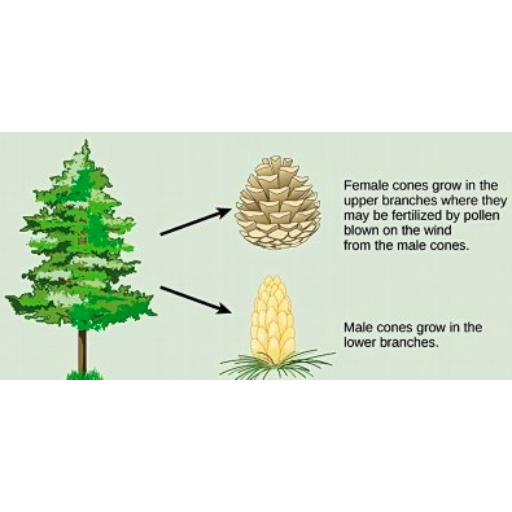
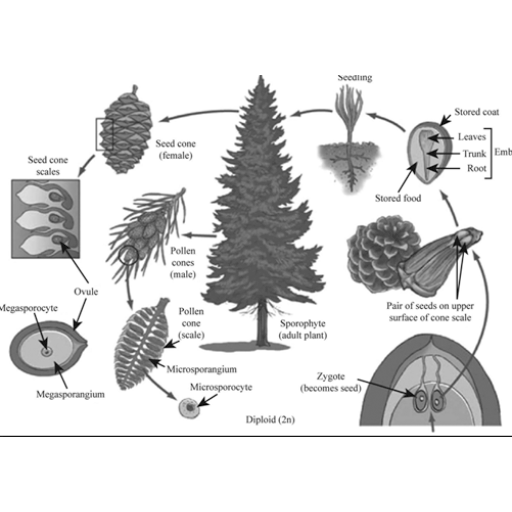
Douglas-fir reproduces by seeds which form on cones. Trees start to bear seed at about age 20. Both Pine and Fir trees reproduce by producing seeds. Unlike deciduous trees, which produce seeds that are surrounded by fruit, pine seeds are located on scales of structures called cones (pine cones). ... Both male and female cones are on the same tree. They use sexual reproduction. Pollen is produced by the male cone, The grain of pollen then finds its way to a receptive female cone, which appears to be solid and hard. Once the pollen lands on the cone, it grows a long thin tube into the center of the cone where the egg is located.

There, in the female cone, the genetic information in the pollen grain is combined with the genetic information in the egg, and a fertilized embryo results.
As time passes (usually about two years), the embryo grows into a seed and the cone becomes brown and develops scales. It is at this time the pine cone resembles the familiar cones you can often see littering the forest floor. If one of the pine cone's scales is pulled off, a mature seed can be seen at the base. If planted, this seed will grow into a pine tree!


LIFE CYCLE
Fir trees are found throughout much of Northand Central America, Europe, Asia, and North Africa, occurring in mountains over most of the range.
They are found in sub alpine forests and tolerate a variety of soils. They are shade tolerant when young, but prefer sun when fully mature. Fir trees are found alone or standing with Western Red Cedar, Western Hemlock, Western White Pine, the Douglas fir or Sitka Spruce trees.
HABITAT & LOCATION
USE BY HUMANS
FIR TREES ARE MOST COMMONLY USED BY HUMANS AS CHRISTMAS TREES IN THE HOLIDAY SEASON!
YOU CAN ALSO SURIVE OFF FIR TREE BARK WHEN LOST IN THE WILDERNESS.
THEY'RE ALSO USED FOR INTERIOR WOOD PANELLING, AND LIGHT FRAME CONSTRUCTION.

- Full access to our public library
- Save favorite books
- Interact with authors

- < BEGINNING
- END >
-
DOWNLOAD
-
LIKE
-
COMMENT()
-
SHARE
-
SAVE
-
BUY THIS BOOK
(from $2.99+) -
BUY THIS BOOK
(from $2.99+) - DOWNLOAD
- LIKE
- COMMENT ()
- SHARE
- SAVE
- Report
-
BUY
-
LIKE
-
COMMENT()
-
SHARE
- Excessive Violence
- Harassment
- Offensive Pictures
- Spelling & Grammar Errors
- Unfinished
- Other Problem

COMMENTS
Click 'X' to report any negative comments. Thanks!