 How to use this ebook:
- Move through this ebook, like you would a paper book.
- Any words in orange, are defined in the glossary on the last page.
- The computer icon found at the bottom of some pages will
suggest web pages, You Tube videos or an activity for you
to try.
At the end of this book, you should be able to: 1. Recognize that all
stars produce a unique spectral pattern; 2. Identify the three types
of spectra and the conditions that produce each one; and 3. Identify
a red shift or blue shift in spectral patterns to determine if a star is
moving towards or away from the viewer.
This book was created and published on StoryJumper™
©2010 StoryJumper, Inc. All rights reserved.
Publish your own children's book:
www.storyjumper.com

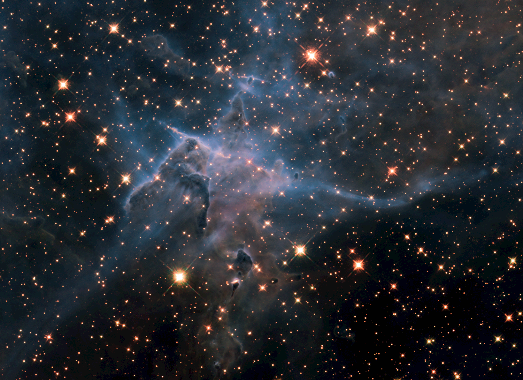
Have you ever seen stars through a telescope or
images of stars on the internet? Have you ever
wondered what stars are made of or if they are
moving?
Telescopes are not the only way we can learn about celestial bodies.
Scientists and astronomers use spectroscopy to learn more about
objects in the sky.
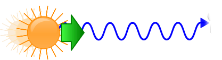
Light from the Sun or another star, passes through a spectroscope or
diffraction grating, which splits the light and produces a spectrum.
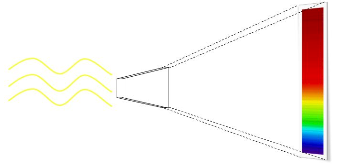
 spectroscope
Insert text here.
There are three types of spectra that can be produced when light is
passed through a spectroscope or diffraction grating.
A continuous spectrum is a complete, non-stop flow of colour.
An emission spectrum is a continuous spectrum with only precise bright
bands, or emitted sections of light.
An absorption spectrum is a continuous spectrum, with dark lines, or
areas of the spectrum that are absorbed.




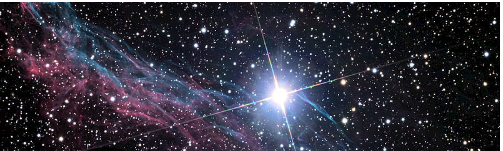
All starlight will produce a spectrum, but each spectrum is unique, both
in the type of spectrum produced, and the pattern of lines seen in the
spectrum.

 To reinforce what you have just learned. Use an app such as Interactive
 White Board, Draw Free for iPad, Scribbler, or Sketch to draw each of the
spectra listed. Be sure to label each type of spectra.
The three different spectra are produced, depending on the conditions
in which the light is produced, or viewed.
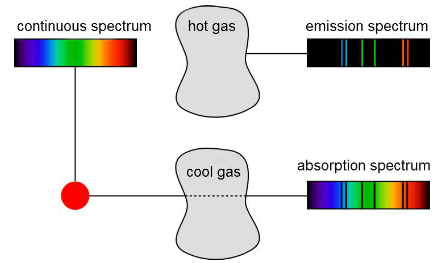 hot source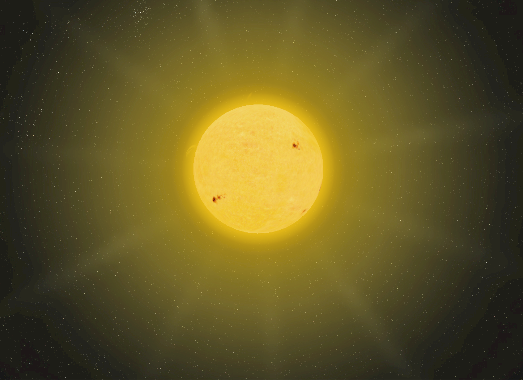
What type of spectrum do you think our Sun emits?
When viewing a hot object directly, a continuous spectrum is
produced.
When an object is heated to glowing, or viewed through a hot
gas, an emission spectrum is produced.
When the source is viewed through a cool gas, an absorption
spectrum is produced.


 hotcool


enter text here
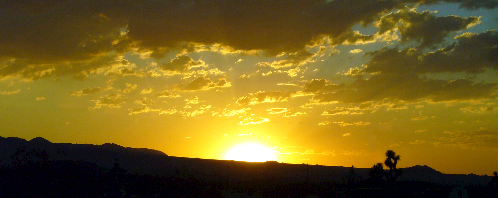
Because we view our
Sun through the
atmosphere, which
is much cooler than
the Sun, we see its
spectrum as an
absorption
spectrum. In fact
most stars will have
an absorption
spectrum when
viewed on Earth.

 To see a video of the three types of spectra and how they are
produced, watch "Spectrum of the Stars" on You Tube. Type
the following into the URL:
http://www.youtube.com/watch?v=I4yg4HTm3uk
But it is not only stars that produce spectral patterns.
Any object heated to glowing and viewed through a
spectroscope will produce a spectrum.
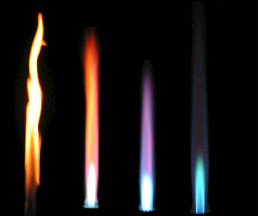
Chemists discovered that if they heated elements to glowing,
or caused them to burn, each one would produce its own
unique spectral pattern.


 element
 View the video "Spectroscopy of Stars - Wonders of the Universe:
 Stardust - BBC Two" on You Tube by typing in the following URL:
http://www.youtube.com/watch?v=n_KyYFYNvpI
to see the different coloured flames of different elements and their
spectral patterns.
These are simplified spectral patterns for a few elements.
hydrogen
helium
calcium
sodium




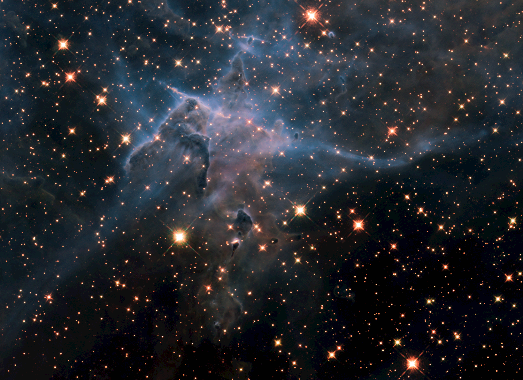

We can use the spectral patterns of stars to determine their
composition. By studying the unique lines of a star's absorption
spectrum, and comparing it to known elements, we can tell what the
star is made of.
Can you identify the two elements from the spectra on the previous
page that are present in the spectrum of this mystery star?
If you identified hydrogen and sodium, you are correct.
In these diagrams, hydrogen has three distinct lines: one in the red, one
in the blue and one in the purple end of the spectrum. Sodium has a
very distinct pair of lines in the green-yellow area of the spectrum.



By lining up the spectra for hydrogen, sodium and the
mystery star, we can see the patterns are the same.
hydrogen
sodium
mystery star

We can also use spectral patterns to figure out if a star is
moving towards us or away from us.
We can identify this movement by applying the principles of
the Doppler Effect.
The Doppler Effect is when a wave, like a wave of light,
appears to be shorter or longer because it is moving towards
or away from the viewer.
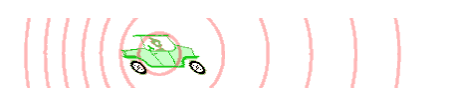
When a wave moves away
from the viewer, it appears
to stretch out or get longer.
This is called a red shift.
When a wave moves
towards the viewer, it
appears to get pushed
together, or shorter.
This is called a blue shift.


You've previewed 17 of 26 pages.
To read more:
Click Sign Up (Free)- Full access to our public library
- Save favorite books
- Interact with authors
- < BEGINNING
- END >
-
DOWNLOAD
-
LIKE(6)
-
COMMENT()
-
SHARE
-
SAVE
-
BUY THIS BOOK
(from $5.19+) -
BUY THIS BOOK
(from $5.19+) - DOWNLOAD
- LIKE (6)
- COMMENT ()
- SHARE
- SAVE
- Report
-
BUY
-
LIKE(6)
-
COMMENT()
-
SHARE
- Excessive Violence
- Harassment
- Offensive Pictures
- Spelling & Grammar Errors
- Unfinished
- Other Problem
"The Science of Stars:"
After reading and interacting with this eBook, students should be able to:
• recognize that all stars produce a unique spectral pattern when viewed through a spectroscope;
• identify the three types of spectra;
• describe the conditions that produce each type of spectrum; and
• identify a red shift or a blue shift in the spectral pattern and conclude from that information if a star is moving towards or away from the viewer.





COMMENTS
Click 'X' to report any negative comments. Thanks!