Dedicated to my bestie... Mr. P!

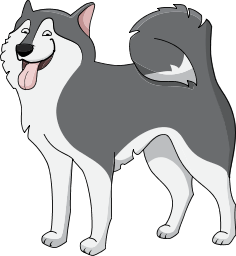
This is Charlie! Charlie is a husky who has been in the animal adoption center for a while.
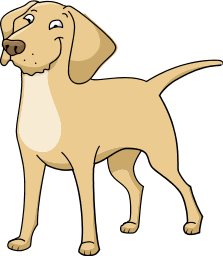
Meanwhile he has made some friends, like Bud. Bud is a yellow labrador who has not been in the adoption center for quite as long as Charlie, but he has been there long enough to see people pass by Charlie and move on to another dog. Charlie and Bud are best friends and crate mates.
Finally, one day when yet another family looked at charlie and passed him up, he wanted to know why this kept happening.
"Hey Bud, why do these people not want to adopt me?" asked Charlie.
"Well it's nothing wrong with who you are Charlie!
It might be because of your mutation that causes you to have two different colored eyes, although I personally think it's pretty cool," said Bud.
"What's a mutation?" asked Charlie, who was very curious to learn more about this condition that he had.
"Charlie, you have a mutation called heterochromia iridis, which causes you to have two different colored eyes.
A mutation is a permanent change in the DNA sequence that makes up a gene," Bud informed.
"Wait what do you mean by 'DNA sequence' and what is a gene?" Charlie got confused.

"Okay let's get into what DNA is first.
DNA is our genetic information, it basically tells our bodies what to do and what to make. It is found in the nucleus of our cells. Half of our DNA is directly from our parents and was passed down to us. The other half of it is ours. Our DNA looks like a twisted ladder, which is called a double helix structure.
This structure is made out of things called nucleotides, which are made out of three groups. These three groups are called a deoxyribose, a phosphate group, and a nitrogenous base. The nucleotides join together into long chains of DNA by really strong bonds known as phosphodiester bonds.
Our DNA looks like a twisted ladder because the nitrogenous bases from one chain bond to another chain with weak bonds known as hydrogen bonds. However, there are five different nitrogenous bases. Their names are adenine, guanine, cytosine, thymine, and uracil. Uracil is only in RNA, which I will get to later.
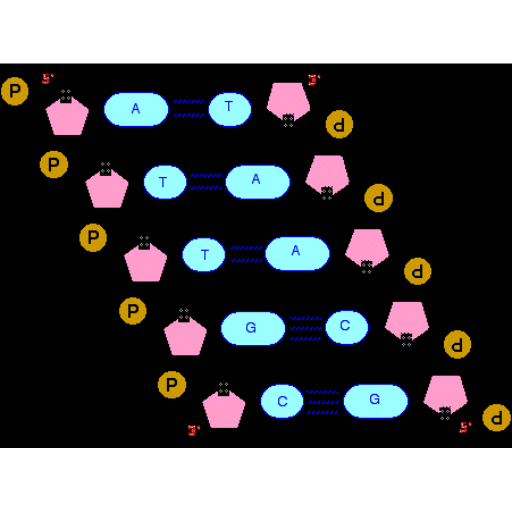
Just remember that there are four nitrogenous bases in DNA. Each individual nitrogenous base has specifically one other nitrogenous base that it pairs to.
Guanine pairs with cytosine and adenine pairs with thymine and vice versa. A guanine on one strand will bond to cytosine on the other strand. A gene is a specific series of the DNA that codes for a protein," Bud had begun to explain.
"Huh? This makes absolutely no sense! I don't understand Bud," Charlie said.
"Let's try an example and if that helps. Imagine DNA as the time when we line up for food and the nucleus would be the room we are in.
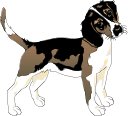
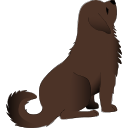
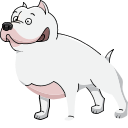
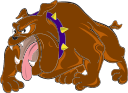


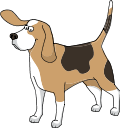
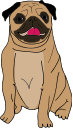
We line up in two lines, right, and each dog has his or her other dog that they line up next to, just like we always do!We represent the nitrogenous bases in DNA that pair up with each other.

For example, if you were adenine, I would be thymine. However, we aren't attached so it wouldn't be that hard to break us up, which is just like the hydrogen bonds in DNA that connect the bases.

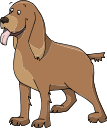

The very strong phosphodiester bonds would be like if we were in our crates when we go to sleep and the people lock the doors. It's not easy to get out of the crate because the lock is pretty strong.


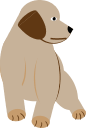
A gene would be like a certain number of paired dogs in the lines. Let's say from Maggie and Daisy to you and me. That could be one gene because all the dogs make up the DNA and only a certain number of dog pairs are used to make the gene," Bud tried to explain. He had hoped Charlie understood.
"Ohhhh okay! I'm pretty sure I get DNA now. So what happens to make a mutation?" asked Charlie.

"As I said before, you know that a mutation is a permanent change in the DNA sequence that makes up a gene. You also understand what DNA is and that a gene is a sub unit of DNA that codes for one protein. It is a certain segment in the DNA.
You can get mutations passed down from your parents or you can develop one during your life due to multiple reasons. An example of a mutation would be if in one part of the DNA, in one gene, there was supposed to be a cytosine paired with a guanine but instead, there was adenine and thymine.

Or, using everyone in the line, if Maggie and Daisy were supposed to be five spots behind us but instead, Doug and Blaze were there," Bud explained.
"Okay, that makes sense! So because of a mutation, I have two different colored eyes while everyone who doesn't have the same mutation has two of the same colored eyes," Charlie understood.
"Yes!" Bud exclaimed. He was very happy that Charlie started grasping this concept.
"That's cool to know! Now I want to find out what mutation happened to me that caused me to have these eyes instead of what everyone else has," Charlie said intrigued.
He was very eager to know what went wrong in his DNA that gave him two different colored eyes. No other dog had this mutation in the adoption center but it didn't seem to affect his sight at all or any other time other than when people and families passed him up.
"Okay, well first I'll talk to you about how a gene makes a protein, or protein synthesis. There are two processes within protein synthesis called transcription and translation. These take place in what is known as the ribosome. DNA cannot travel from the nucleus to the ribosome because the cytoplasm will dissolve it, thinking it is a foreign invader.
This is why RNA is used. RNA is different enough from DNA that the cytoplasm will not dissolve it but similar enough that RNA is like a blueprint of DNA, the 'master plan.' RNA is single stranded, unlike DNA which is double stranded in the double helix I told you about. It kind of looks like DNA that is missing the other strand.
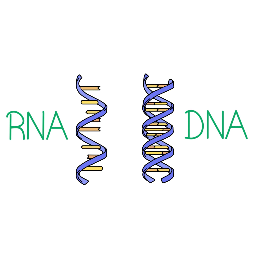
Instead of bonding to thymine, adenine bonds to uracil in RNA. Also, in RNA, there is a ribose group instead of a deoxyribose which is in DNA. In transcription, an enzyme called helicase comes in to unwind the DNA in the nucleus, which is a specific gene.
Helicase breaks the hydrogen bonds between the nitrogenous bases. Then, another enzyme named RNA polymerase, adds RNA nucleotides to the DNA nucleotides, which make a strand of RNA which we call mRNA.
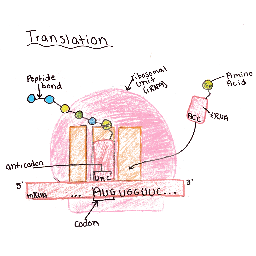
This strand of mRNA copies the instructions of the gene on what protein to make. The mRNA then goes to the ribosome to do translation.
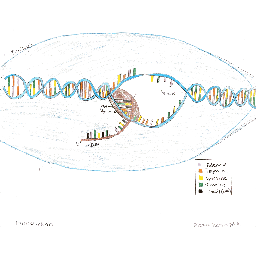
In translation, the mRNA is read by nucleotides, called codons. One codon is three nucleotides. rRNA is a type of RNA in the ribosome that translates the message of the mRNA and tells tRNA what anticodons to get, which have the amino acids needed to make the protein.
- Full access to our public library
- Save favorite books
- Interact with authors
- < BEGINNING
- END >
-
DOWNLOAD
-
LIKE(1)
-
COMMENT()
-
SHARE
-
SAVE
-
BUY THIS BOOK
(from $11.39+) -
BUY THIS BOOK
(from $11.39+) - DOWNLOAD
- LIKE (1)
- COMMENT ()
- SHARE
- SAVE
- Report
-
BUY
-
LIKE(1)
-
COMMENT()
-
SHARE
- Excessive Violence
- Harassment
- Offensive Pictures
- Spelling & Grammar Errors
- Unfinished
- Other Problem






COMMENTS
Click 'X' to report any negative comments. Thanks!