In this book, we will learn about the solar system and its respective components. This book is dedicated for children between the ages of 6-11 years.

INTRODUCTION.
In this book, we will learn about the Solar System and the planets involved in the Solar System. We will learn more about these planets individually, their properties and any other basic information you should know at your age. We will also learn a bit more about the dwarf planet(s) which the Solar System does not support which is in the Kuiper Belt, a belt beyond the Solar System.
THE SOLAR SYSTEM.
The Solar System is believed to have formed 4.6 billion years ago from a gravitational collapse of a giant interstellar molecular cloud. The vast majority of the system's mass is in the Sun, with the majority of the remaining mass contained in Jupiter. It also contains smaller objects like the asteroid belt which lies between the orbits of Mars and Jupiter. Now let us go on to explore the planets involved in the Solar System and the Kuiper Belt.
THE SUN.
It is the largest of all planets and the oldest with an age of 4.6 billion years. It is at the center of the Solar System. It formed when a cloud of dust and a gas called nebula collapsed under its own gravity. It is a huge, glowing sphere of hot gas made up of hydrogen(70%), helium(28%), and the 2% is distributed among many different gases like carbon, nitrogen, oxygen, iron, silicon, and neon. It is currently halfway through the most stable part of its life. If hydrogen fusion stops in its core it will undergo changes.


MERCURY.
It is the smallest and innermost planet in the Solar System. Its orbit around the sun takes 88 days, the shortest of all the planets in the Solar System. Its distance from the sun is 35.98 million miles. The length of day in mercury is 58days 15hours and 30minutes on earth. It has a rocky body like earth, and it consists of 70% metallic and 30% silicate materials. It has a radius of 1,516miles and its density is the second-highest after earth.

VENUS.
It is the second planet from the Sun. It is 67.24 million miles away from the sun. A year in Venus consists of 225 days and a day's length is 116days 18hours. It is sometimes called the"Earth's sister planet" because of their similarity in size, mass, closeness to the Sun, and their bulk composition. Venus is the hottest planet in the Solar System, with a mean surface temperature of 863 degrees fahrenheit.
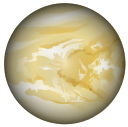

EARTH.
It is the planet which the human species is occupying. This is where we are. It is the third planet from the Sun. Earth was formed over 4.5 billion years ago. It is 92.96 million miles away from the sun. It is the densest planet in the Solar System and the largest, and most massive of the four rocky planets. 29% of the earth's surface is land in form of continents and islands, and 71% is covered by water. Its radius is about 3,958 miles and its currently supporting more than 7 billion people.

EARTH'S MOON.
It is an astronomical body orbiting Earth as its only satellite. It is the fifth-largest satellite in the Solar System. It is 238 900 miles away from earth and it is about 4.5 billion years old. It is the second-densest satellite in the Solar System after Jupiter. After the sun, it is the second-brightest celestial object regularly visible in the Earth's sky. The moon's size in the sky is almost the same as that of the sun and before it covers the sun precisely during a total solar eclipse.


MARS.
It is the fourth planet from the Sun and the second-smallest planet in the Solar System after Mercury. Mars is a terrestrial planet with a thin atmosphere, having surface features reminiscent both of the impact craters of the Moon and the valleys, deserts, and polar ice caps of Earth. Mars has two moons namely Phobos and Deimos. Mars is half the diameter of Earth, with a surface area only slightly less than the total area of Earth's dry land.

JUPITER.
It is the 5th planet from the sun and the largest in the solar system. It is 483 million miles away from the sun. Its orbital period is 12 years and a length of a day is 9 hours 56 minutes. It is the third brightest natural object in the night sky after the Moon and Venus. It is primarily composed of gaseous and liquid matter, and its diameter is 88, 846 miles. The air in Jupiter is about 88% hydrogen and 12% helium by percent volume of gas molecules.

- Full access to our public library
- Save favorite books
- Interact with authors

- < BEGINNING
- END >
-
DOWNLOAD
-
LIKE
-
COMMENT()
-
SHARE
-
SAVE
-
BUY THIS BOOK
(from $3.19+) -
BUY THIS BOOK
(from $3.19+) - DOWNLOAD
- LIKE
- COMMENT ()
- SHARE
- SAVE
- Report
-
BUY
-
LIKE
-
COMMENT()
-
SHARE
- Excessive Violence
- Harassment
- Offensive Pictures
- Spelling & Grammar Errors
- Unfinished
- Other Problem






COMMENTS
Click 'X' to report any negative comments. Thanks!