For all of those younglings out there (yes, I mean you, sophomores) who want to grasp a basic understanding of physics before next year. . .
This one is for you.

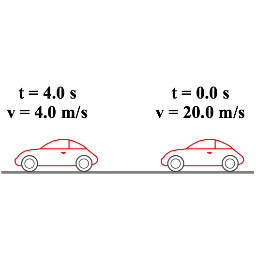
is for Acceleration
Acceleration, to put it simply, is the rate of change of velocity. In relation to motion, typically when acceleration is applied, it means the speed of an object is changing. However, that is not always the case. When the same object is traveling in a circular path at a constant speed, the object is still accelerating due to the direction of the velocity changing.


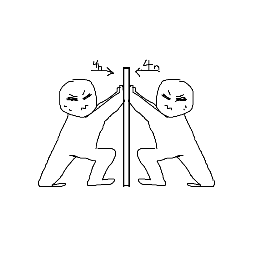
is for Balanced Forces
Balanced forces refer to two forces that are equal in size and act in opposite directions on an object. When balanced forces are present on an object, the object will remain stationary or continues to move in the same direction at the same speed.


is for Compression

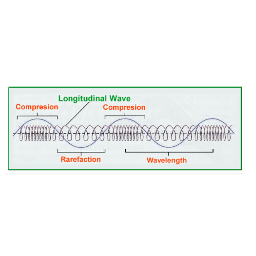
A compression is a region in a longitudinal wave where the particles are closest together. Therefore, this where particles are forced or pressed together. As these molecules are pressed together, they pass kinetic energy to one another. In doing so, sound travels outward from the source.


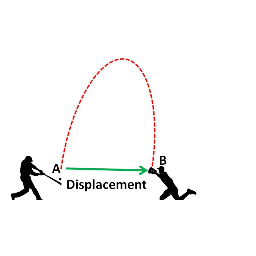
is for Displacement

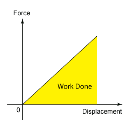
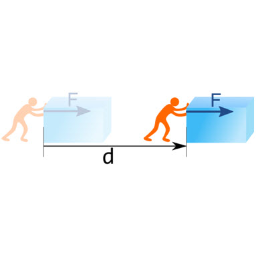
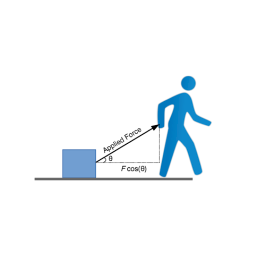
Displacement refers to a change in an object's position, but only measuring from the object's initial position to its final position. In physics, work is the product of displacement and force. A force has done work if there is a displacement of the point of application in the same direction of the force (when acting).
is for Electromagnetism

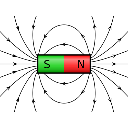
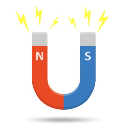
Electromagnetism is a branch of physics that studies the interactions of electric currents and magnetic fields. Thus, electricity and magnetism are two aspects of electromagnetism. When a wire is manipulated and moved within a magnetic field (which is produced by a moving electric charge), the magnetic field produces a current in the wire.
is for Friction

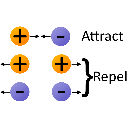
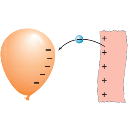
Friction, by definition, is the resistance to motion of one object as a result of its contact with another object. Friction plays a role in the presence of static electricity. When certain objects are rubbed together (friction), they may become either positively or negatively charged as a result of electrons transferring between the objects. If an object has more protons than electrons, it is positively charged. The opposite is also true.
is for Gamma Rays

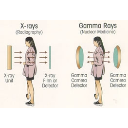
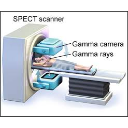
Gamma rays are ranked on the latter half of the electromagnetic spectrum. Gamma rays have short wavelengths and harbor a great deal of energy. They are generated by radioactive atoms and in nuclear explosions. Gamma rays play an essential role in nuclear medicine. In nuclear medicine, a radioactive material is administered into the patient and detected by a gamma camera. The radiation given off by the body during nuclear medicine imaging are gamma rays. They are similar to x-rays, but have shorter wavelengths.
is for Height

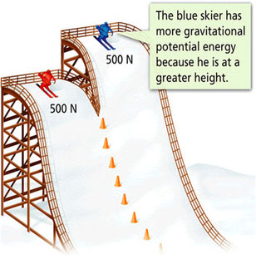
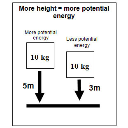
Height, when related to a physics concept such as potential energy, is the vertical distance from the top of an object or figure to its base. Gravitational potential energy is the stored energy within an object as a result of its height. Thus, there is a direct relation between gravitational potential energy and the height of an object. The higher an object is elevated, the greater the gravitational potential energy.
is for Interference

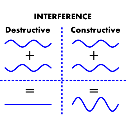
Interference of waves occurs when two or more waves come together. There are two main forms of interference with waves: constructive and destructive. Constructive interference of waves occurs whenever waves come together so that they are in phase with one another. All of this meaning that the oscillations of the waves at a specific point are in the same direction. Destructive interference occurs when the waves come together in a way that completely cancels one another out. This means that the waves have the same amplitude in opposite directions.
is for Joules

A joule is the amount of energy exerted when a force of one newton is applied over a displacement of one meter. However, joules is the unit used for both work and energy. After all, energy is defined as the ability of a body to do work. Therefore, they are interrelated. One joule is equivalent to one watt of power radiated for one second.
is for Kilowatt-hour

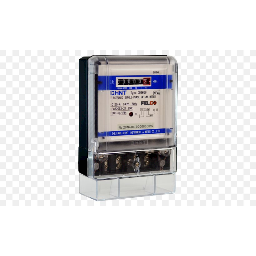
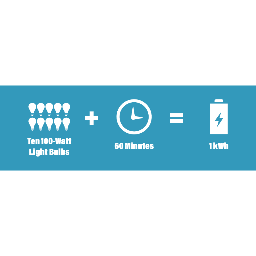
The kilowatt-hour is a unit of energy equivalent to one kilowatt (1,000 watts) of power exerted over a one hour time period. Though the kilowatt-hour is not a standard unit, it is commonly used in electrical appliances.
is for Longitudinal

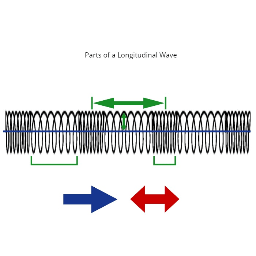
A longitudinal wave is a wave that oscillates back and forth on an axis and in which the disturbance moves in the same direction as the wave. A longitudinal wave can also portray sound. As sound waves propagate through a medium, the molecules within collide with one another in the very same direction in which the sound is moving.
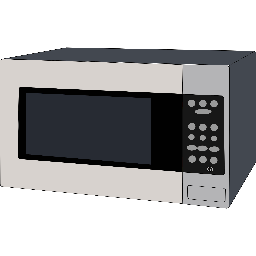
is for Microwave

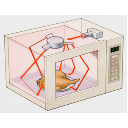
Microwaves, residing on the higher half of the electromagnetic spectrum because of their longer wavelengths, are used to carry information from one point on earth to a satellite and back. Microwaves enable water and fat molecules to vibrate so that they may be used to cook food in microwave ovens.
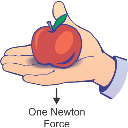
is for Newton

A newton, named after the english scientist Isaac Newton, is the SI unit of force. One newton is the force required to accelerate an object with a mass of one kilogram one meter per second squared when no other force is present or acting on it.
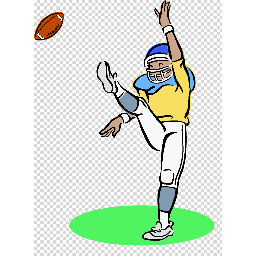
is for Ohm's Law

Ohm's Law is a predictor of current electricity and states that the voltage across a resistor is directly proportional to the current flowing through the resistance. Thus, Ohm's Law shows the relationship between current, voltage, and resistance. The formula for Ohm's Law is V=IR where "V" represents voltage, "I" represents current, and "R" represents resistance.

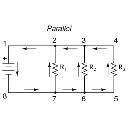
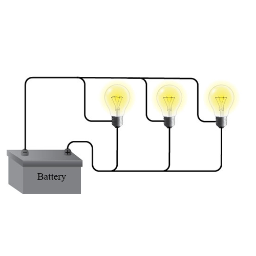
is for Parallel Circuit

A parallel circuit is a circuit that provides more than one path for current to travel through. In parallel circuits, lights are not dependent on one another and current is not the same in all parts of the circuit. However, voltage is the same in all parts of the circuit. Current goes from positive to negative, and the current in each branch adds up to the total current of the circuit.
- Full access to our public library
- Save favorite books
- Interact with authors
- < BEGINNING
- END >
-
DOWNLOAD
-
LIKE
-
COMMENT()
-
SHARE
-
SAVE
-
BUY THIS BOOK
(from $5.19+) -
BUY THIS BOOK
(from $5.19+) - DOWNLOAD
- LIKE
- COMMENT ()
- SHARE
- SAVE
- Report
-
BUY
-
LIKE
-
COMMENT()
-
SHARE
- Excessive Violence
- Harassment
- Offensive Pictures
- Spelling & Grammar Errors
- Unfinished
- Other Problem






COMMENTS
Click 'X' to report any negative comments. Thanks!