
WHO IS A KANGAROO RAT?
Kangaroo rats, small mostly nocturnal rodents of genus Dipodomys, are native to arid areas of western North America. The common name derives from their bipedal form. They hop in a manner similar to the much larger kangaroo, but developed this mode of locomotion independently, like several other clades of rodents (e.g. dipodids and hopping mice).
Description of this amazing animal
Kangaroo rats are four-toed heteromyid rodents with big hind legs, small front legs and relatively large heads. Adults typically weigh between 70 and 170 grams (2.5 and 6.0 oz) The tails of kangaroo rats are longer than both their bodies and their heads. Another notable feature of kangaroo rats are their fur-lined cheek pouches, which are used for storing food. The coloration of kangaroo rats varies from cinnamon buff to dark gray, depending on the species. There is also some variation in length with one of the largest species, the banner-tailed kangaroo rat being six inches in body length and a tail length of eight inches. Sexual dimorphism exists in all species, with males being larger than females.
What a Kangaroo Rat eats?
Kangaroo rats are primarily seed eaters. They will, however, eat vegetation occasionally, and at some times of the year, possibly insects as well. They have been seen storing the seeds of mesquite, creosote bush, purslane, ocotillo and grama grass in their cheek pouches. Kangaroo rats will store extra seeds in seed caches. This caching behavior affects the range-land and croplands where the animals live. Kangaroo rats must harvest as much seed as possible in as little time as possible. To conserve energy and water, they minimize their time away from their cool, dry burrows. In addition, maximizing time in their burrows minimizes their exposure to predators.
When on foraging trips, kangaroo rats hoard the seeds that they find. It is important for a kangaroo rat to encounter more food items than are consumed, at least at one point in the year, as well as defend or rediscover food caches and remain within the same areas long enough to utilize food resources. Different species of kangaroo rat may have different seed caching strategies to coexist with each other, as is the case for the banner-tailed kangaroo rat and Merriam's kangaroo rat which have overlapping ranges. Merriam's kangaroo rats scatterhoard small caches of seeds in numerous small, shallow holes they dig. This is initially done close to the food source, maximizing harvest rates and reducing travel costs, but later redistributed more widely, minimizing theft by other rodents. Banner-tailed kangaroo rats larderhoard a sizable cache of seeds within the large mounds they occupy.
Life of our guest
Kangaroo rats inhabit overlapping home ranges. These home ranges tend to be small with most activities within 200–300 ft and rarely 600 ft. Home range size can vary within species with Merriam's kangaroo rats having larger home ranges than banner-tailed kangaroo rats. Recently weaned kangaroo rats move into new areas not occupied by adults. Within its home range, a kangaroo rat has a defended territory consisting of its burrowing system.
More pictures of Kangaroo Rat
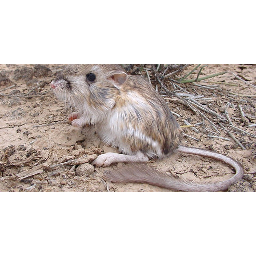
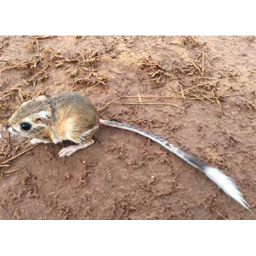
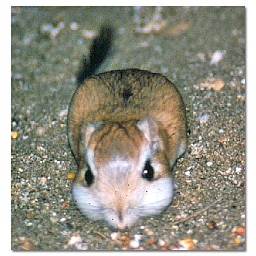
IT's Locomotion
Kangaroo rats move bipedally. Kangaroo rats often leap a distance of 6 feet, and reportedly up to 9 feet (2.75 m) at speeds up to almost 10 feet/sec, or 10 km/h (6 mph). They can quickly change direction between jumps. The rapid locomotion of the banner-tailed kangaroo rat may minimize energy cost and predation risk. Its use of a "move-freeze" mode may also make it less conspicuous to nocturnal predators.
Thank you for your attention)
- Full access to our public library
- Save favorite books
- Interact with authors
- < BEGINNING
- END >
-
DOWNLOAD
-
LIKE(4)
-
COMMENT()
-
SHARE
-
SAVE
-
BUY THIS BOOK
(from $2.99+) -
BUY THIS BOOK
(from $2.99+) - DOWNLOAD
- LIKE (4)
- COMMENT ()
- SHARE
- SAVE
- Report
-
BUY
-
LIKE(4)
-
COMMENT()
-
SHARE
- Excessive Violence
- Harassment
- Offensive Pictures
- Spelling & Grammar Errors
- Unfinished
- Other Problem






COMMENTS
Click 'X' to report any negative comments. Thanks!