 I'd like to dedicate this book to my family.
This book was created and published on StoryJumper™
©2010 StoryJumper, Inc. All rights reserved.
Publish your own children's book:
www.storyjumper.com

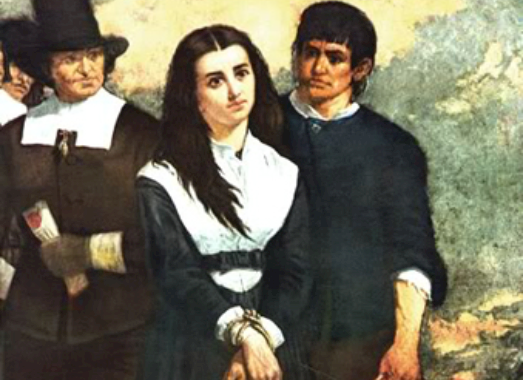
Nineteen people were executed by hanging after being
accused of witchcraft in Salem, Massachusetts, in 1692. Even
though witchcraft was practiced in states from Maine to New
York, the majority of trials took place in Salem.
Life in Salem Village revolved around the church. People
of many different religions lived in Massachusetts in 1692 -
Presbyterians, Baptists, Quakers, Huguenots, Roman Catholics,
and Anglicans. Most of the people involved in the Salem
witchcraft trials were Congregational. Each congregation took
care of its own business and was not governed by a board of
bishops. Yet, all of the congregations shared the same
Christian ideas, as well as their opinions about witchcraft.
Dancing and music were strictly forbidden because of their
Pagan roots, the exception being hymns sung in church. Toys
were also forbidden and any schooling except that which
involved religious teachings was frowned upon. Life centered
around the meeting house and services lasted most of the day
on Sundays. Puritan life was very rigid, consisting of all
work and no play. Girls were expected to help their mother
with household chores while boys worked as crafters' helpers,
in addition to hunting and fishing for food. Showing any sort
of emotion was frowned upon, considered to be rude, and was
severely punished.

It's no wonder that winters in Salem were extremely depressing
for the young people, especially when forced to stay indoors
because of the severe weather.
Several young girls started to meet at Rev. Parris' home to
pass their boredom. Rev. Parris' slave, Tituba, captivated the
girls interest with stories about demons and witchcraft. The
girls also practiced fortune telling by cracking eggs into a
glass container and interpreting the various shapes that were
formed. Marriage was one of the most important subjects in the
life of the young girls in Salem, and they practiced fortune
telling to find out who they would marry. This was done by
looking into a cup filled with milk and an egg. The girls became
horror-struck when they saw the shape of a coffin since a coffin
symbolized death. They became even more upset because this was a
practice in which they had been forbidden to participate.
Fortune telling was to be considered one of Devil's tools.
They were told that the Devil was always waiting and watching to
catch those who broke the rules they were supposed to follow.
People surrounded their house with laurel springs to keep evil
away. They also hung a horseshoe over the front door to protect
it and a rock with a hole in it in the stable to keep evil from
the livestock.
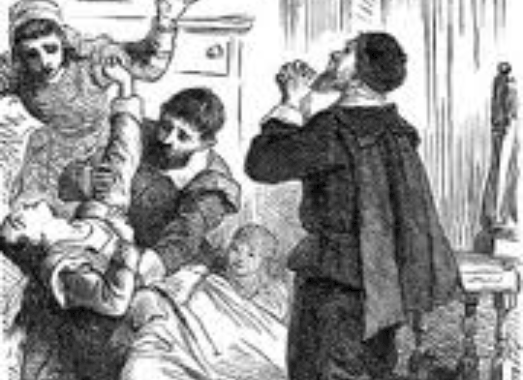
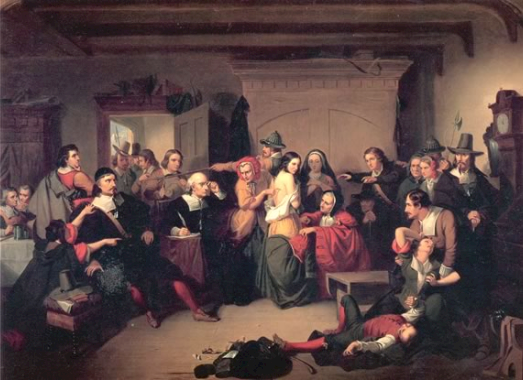
Witch hysteria became widespread by the middle of January when
Betty Parris and her cousin, Abigail Williams, began to develop
strange behavior. They made odd noises, cried, twitched, threw
things across the room, crawled under furniture and twisted
their bodies into positions that were both unique and peculiar.
They also stated that they were being picked by large pins and
pinched so severely that their arms and legs were covered with
large red bruises.
William Griggs, the village doctor examined the girls and
could not find any medical evidence that would explain the
girls' weird behavior. Therefore, his opinion was that the
girls had come under the spells of a witch.
Betty and Abigail had friends in the neighborhood who became
very curious about their strange ailments. Ann Putham, Mercy
Lewis, Elizabeth Hubbard, Mary Walcoff, and Mary Warren formed a
close bond with the two girls and shared conversations and
confidences. They felt comfortable with one another in this
friendship while their imagination and storytelling enveloped
them.
The Parris' slaves, Tituba and John Indian were instructed by
neighbor Mary Sibley to create a spell in order to find out
who was responsible for the girls' strange behavior. This was
to be accomplished by baking a witch cake. The cake was made
by using rye and the urine from two girls. The cake would
then be fed to a dog. If the dog began to have the same
symptoms as the affected person, it would be proof that the
cause of their behavior was witchcraft.
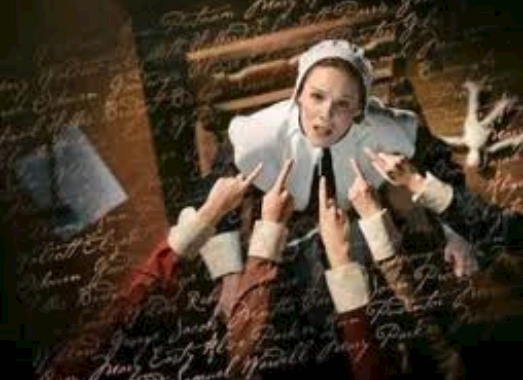
After it was established that the girls were "possessed" they
were questioned by their family who influenced the girls by
suggesting some names of those who might be responsible for
their ailments. The girls then identified three local women -
Sarah Good, Sarah Osborne, and the slave Tituba. The three
were arrested on February 29 and questioned on March 1.
All three women had a low position in the community and
were looked down upon by the villagers. Sarah Good had a life
of poverty and often had to beg for food. Sarah Osborne's lack
of attending church meetings and attempt to control her son's
inheritance from a previous marriage was very distasteful to
the other Puritans. She also married an indentured servant
which the villagers believed she did just to help serve her own
interests. Tituba was a slave who was known to influence and
fascinate the girls with her stories about witchcraft.
When the authorities questioned the three women,
Tituba was the only one to confess. She claimed
that the devil came to her and made her serve him.
She told her accusers that the devil was at work in
Salem and that a man came to visit her and promised
her pretty things. She also described all the
familiars of the man, spirits in the shape of animals.
It was believed that witches were capable of changing
shape and forms, as well as being invisible. Many believed
that Tituba confessed in order to have her life spared.
During the Salem trials if you confessed to being a witch,
your life was spared. If you denied the charge but were found
guilty, you were hanged. If you told anyone you were troubled
about the trials, you might be accused yourself.
The number of people arrested grew so rapidly that a
special court had to be set up to handle them all. The
arrested were from all socio-economic groups - rich, poor,
well respected, ministers, etc. As more and more people were
accused, jails became extremely crowed. Many people died in
jail from disease since the jails were filthy.
Additional ways of finding out if someone was a witch were
also used."Spectral evidence" ( saying that you were afflicted
by someone's ghost) was allowed during cases against the
accused.
You've previewed 12 of 19 pages.
To read more:
Click Sign Up (Free)- Full access to our public library
- Save favorite books
- Interact with authors


- < BEGINNING
- END >
-
DOWNLOAD
-
LIKE(5)
-
COMMENT()
-
SHARE
-
SAVE
-
BUY THIS BOOK
(from $3.79+) -
BUY THIS BOOK
(from $3.79+) - DOWNLOAD
- LIKE (5)
- COMMENT ()
- SHARE
- SAVE
- Report
-
BUY
-
LIKE(5)
-
COMMENT()
-
SHARE
- Excessive Violence
- Harassment
- Offensive Pictures
- Spelling & Grammar Errors
- Unfinished
- Other Problem





COMMENTS
Click 'X' to report any negative comments. Thanks!