I want to dedicate this book to my Anatomy and physiology class. Also to Mrs.Rustymeyer because you all have helped me throughout the school year in this class. Thank you all so much.

Vision- 3-4
Hearing ~ 5-6
Taste ~ 7-8
Smell ~ 9-10
Touch ~11-12
Table of Contents
VISION
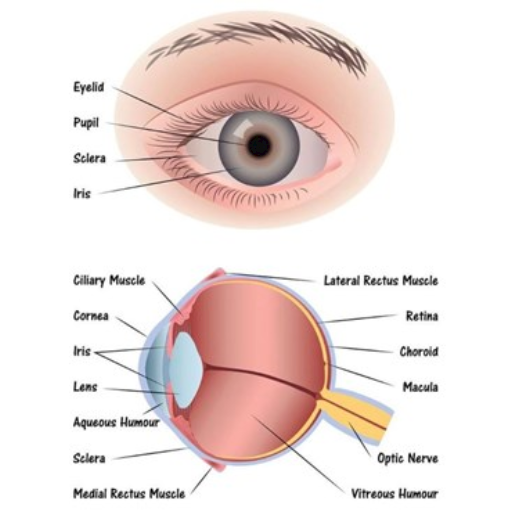
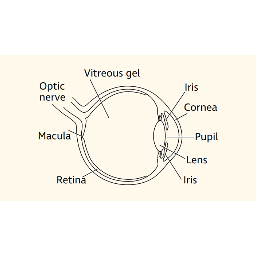
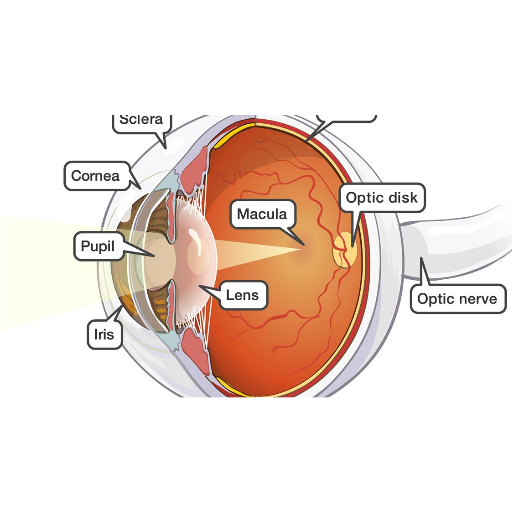
Eyesight. We all know we can see because of our eyes, but have you ever wondered what the black part in your eye is or why your eye shows color. Well here is the anatomy of your eye, the white part of your eye is your sclera (protection), Then your cornea refracts light, then our vitreous humor maintains your eyeball shape. THen you have your retina, and in your retina, you have your rods which carry the black and white vision, also in the retina, it has your cons which helps you see the color vision. The nerve that connects to your brain that helps you see all this is your optic nerve. All these parts of your eye play a part to help you see. Now to break down the process, light hits your pupil, passes through the lenses, and vitreous humor to the back of the eye( retina), then in your retina, it has photoreceptor cells that help you detect light. After all that then an impulse is sent through the rods and cones to the optic nerve, then the optic nerve sends a signal to your occipital lobe which is in your brain. That helps your process what you see. Overall this is how we see out of our eyes.
HEARING
Hearing. I wonder how I hear people talking? The source for you to hear people talking in our ear. There are several parts of your ear, these parts are your outer ear, middle ear, and inner ear. Your outer ear contains your pinna and Auditory canal. Your middle ear contains your eardrum(tympanic membrane), Euschican tube, and Ossicles( which are three smaller bones). Then you have your inner ear including your Semicircular canals and Cochlea. That is the breakdown of your ear; Know if you wonder how we use all this to hear it is a step-by-step process. You get a sound wave that goes from your auditory canal to the eardrum then the eardrum vibrates. THen the vibration causes the hammer( Malleus) to hit the incus( anvil). After the vibration hits the necessary places, the vibration passes through to the fluid than the cochlea. Once a certain area of the cochlea is hit the auditory nerve takes a hit to the brain. Overall I know that was a lot but that is how you hear
TASTE
Taste. Do you know why you can taste or how? Well, I am here to give you information on why you can. Your tongue has a chemical sense. Which means your taste has a chemical sense. That chemical sense helps your taste buds contain chemoreceptors. Which are found in the epithelium of your tongue. Have you ever looked closely at your tongue and seen bumps. Well, those bumps are called papillae. Papillae mean the bumps on your tongue contain receptors. Those receptors in your tongue distinguished between sweet, sour, salty, and bitter tastes.
- Full access to our public library
- Save favorite books
- Interact with authors
- < BEGINNING
- END >
-
DOWNLOAD
-
LIKE
-
COMMENT()
-
SHARE
-
SAVE
-
BUY THIS BOOK
(from $2.99+) -
BUY THIS BOOK
(from $2.99+) - DOWNLOAD
- LIKE
- COMMENT ()
- SHARE
- SAVE
- Report
-
BUY
-
LIKE
-
COMMENT()
-
SHARE
- Excessive Violence
- Harassment
- Offensive Pictures
- Spelling & Grammar Errors
- Unfinished
- Other Problem





COMMENTS
Click 'X' to report any negative comments. Thanks!