It's Fun To Learn The Piano!

This book can teach you how to play the piano, and the parts of the sheet music, which include the piano notes, pitch, tempo, and many more.
This book can also tell you my experiences in how I have learned the digital piano.

Table of Contents: Page:
1. What is the Piano?................................................................................3
2. How I have learned
how to play the Piano..............................................................................5
3. The Sheet Music...................................................................................6
4. Parts of the Sheet Music.....................................................................8
5. Songs to Practice.................................................................................18
6. Keywords..............................................................................................22
7. Questionnaires....................................................................................24
8. References...........................................................................................25
Topic #1: What is the Piano?
What is a Piano?
A piano is a type of musical instrument that consists of 88 keys in total. It consists of both white and black keys. The piano is a percussion instrument that requires the use of hands. Touching one of the keys produces an interesting sound depending on the position. The pitch describes how loud or soft the sound is being played. To describe the pitch onthe piano, follow these steps:
1. Look at the Piano, and find its middle key. (Hint: The middle should always be a C key)
2. If you want to see how soft the piano is, look at any key on the left of the middle you want to know how loud the piano is, look at any key on the right of the middle.
3. Play the note, and differentiate between each pitch of the piano.
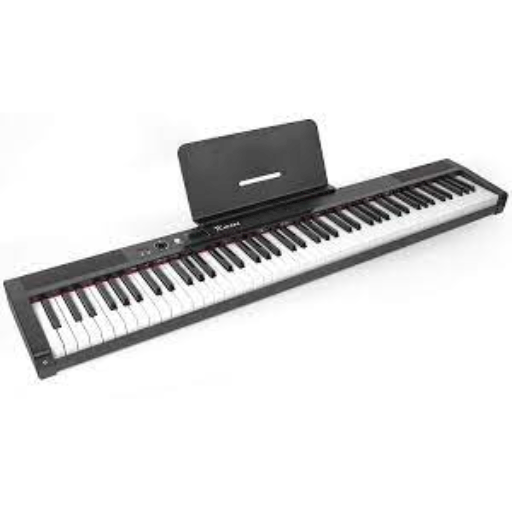
This is what a Piano should look like. It has 88 keys in total.
Topic #2: How I have learned how to play the Piano
I began playing the piano, when I was 13 years old. I have found an interest in playing an instrument, and when I got to learn how to play the piano, I thoroughly enjoyed and learned some parts of the Sheet Music. My piano class is every Thursday, and I happily learn something new every single week. At first, it may take some practice to completely become an expert in playing the piano. But eventually, you can get used to it, and produce a faster tempo, which then assists you to play the musical piece with confidence. This lesson taught me that I must always never give up and that, I must always be confident and always take my time to be able to play a piano piece properly.
Always remember the moral of this lesson, when you experience any anxiety or fear when playing the piano.
Topic #3: The Sheet Music
What is Sheet Music?
It is a musical guide that helps you perform the music on any instrument using any notes and time signatures. The guide is printed on a piece of sheet. (paper) The Sheet Music consists of two musical staffs, one bass clef, one treble clef, and many more parts. It also has a title on top, a subtitle (optional), the composer (the original creator) of the music, the lyricist, (who created the sheet music), and the copyright.
Fun Fact: An Italian music theorist named, "Guido d'Arezzo", invented the sheet music.
Topic #4: Parts of the Sheet Music
The Sheet Music consists of two musical staffs, a bass and treble clefs, a time signature, rests and notes, some texts (which define the tempo and pitch), and many more. Here are the definitions for each of the following:
Musical Staff -- It is a set of five horizontal lines and four spaces representing a musical pitch.
Bass Clef -- It is a type of clef played using the left hand. It usually provides a soft pitch that can be played like a bass guitar or trombone.
Notes -- A symbol that produces a loud or soft sound in the piano for a long or short period of time, depending on the note.
Treble Clef -- It is another type of clef played using the right hand, which provides a louder pitch. The instruments can be played like a violin or a flute.
Time Signatures -- It consists of two numbers (one on the top explaining how many measures are written, and another one at the bottom representing the total value of each beat), which represent how many beats are in each measure.
Rests -- It is an amount of time that does not play a sound on any note. This means that you are pausing and releasing your hands from the piano for several seconds.
Let's study the position of each note!
A clue to remember what the notes on the lines of the treble clef are, "Every Good Bird Does Fly", and for the spaces are, "Fly Around Czechia and Estonia."
Another clue to remember the notes on the lines of the bass clef is, "Grab Behind Daily and Face Appreciation", and for the spaces are, "Act Cunningly and Eat Gleefully.
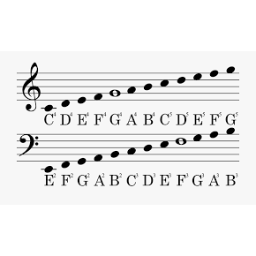
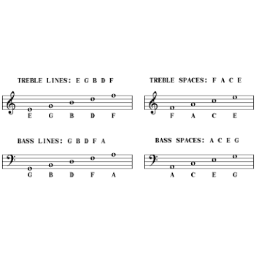
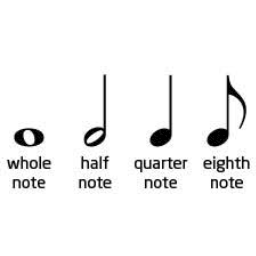
Here are the four basic types of notes:
1. Whole Note -- It is a circled-shaped note with no stem. This note counts 4 beats, which specifically means that you have to play any key and hold for 4 seconds.
2. Half Note -- It is a type of note that is similar to the whole note, but has a stem. This note counts 2 beats or two seconds.
3. Quarter Note -- It is a note with a shaded head and a stem. This note counts only 1 beat or 1 second of pressing and holding any key.
4. Eight Note -- It is a note that consists of a flag on top of the stem. This note counts 1/2 beat or 0.5 seconds. Combining two of these notes produces a grouped note that is similar to the quarter note's beat. This note is known as the "rushing note".
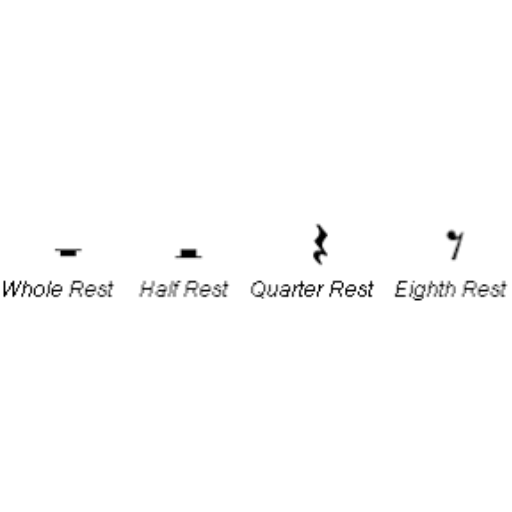
Here are the four basic types of rests:
1. Whole Rest -- It is a type of rest that is a rectangle under the line of a staff. This usually counts 4 beats. So, this means that you have to pause or rest both hands from the keyboard for 4 seconds.
2. Half Rest -- It is a type of rest that is a rectangle over the line of a staff. This counts only 2 beats or 2 seconds of pausing.
3. Quarter Rest -- It is a type of rest that looks like a lightning bolt. It counts only 1 beat or 1 second.
4. Eighth Rest -- It is a type of rest that looks like a 7 with a dark-shaded head. It counts 1/2 beat or 1/2 second. Combining these two rests can make 1 whole quarter rest. So, this rest is played for a rapid amount of time.
Remember this: Every one beat is one second.
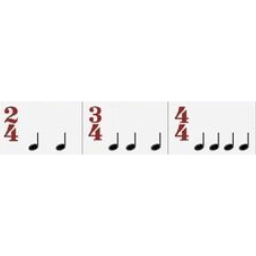
Here are the four basic types of time signature:
1. 2/4 -- It is a time signature that can fit any amount or any type of notes (including rests) that represents no longer than 2 beats in each measure.
2. 3/4 -- A time signature that can only fit 3 beats in each measure or bar using notes or rests.
3. 4/4 -- Another time signature that fits in a total of 4 beats in each bar. A whole note is an example that can fit in one measure, as it represents all 4 beats.
4. Common Time -- A C-Shaped Semi Circle time signature that also represents a total of 4 beats or the 4/4 time signature.

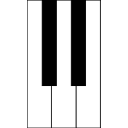
Let's study the position of the letter "C".
Every pianist needs to know the positions of each keyboard. If you see a keyboard with these keys. You need to know the letter "C". This is the most centered key in the piano. It can be found with two other letters (D and E) along with two sharps or flats, depending on the position of each letter.
C
D
E
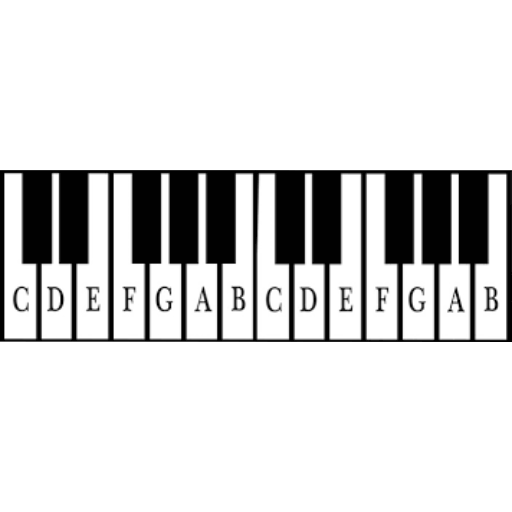
And these here are the remaining letters of the piano. A normal piano, guitar, and many other instruments only range from A to G in sheet music. When it reaches G, you have to go back to A.
The Do, Re, Mi, Fa, So, La, Ti, Do represents the range of keys from A to G.
Take a look at the piano keys down below:
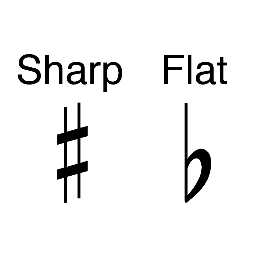
And finally, we are going to study the Accidentals of the piano keys.
1. Sharp -- It is an accidental that takes a half step forward to one of the black keys of the piano from a white key.
2. Flat -- It is another type of accidental that takes a half step backwards to one of the black keys from a white key.
- Full access to our public library
- Save favorite books
- Interact with authors
The Piano is always a fun instrument to play, and I do suggest you give it a try. Please, have fun!
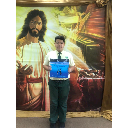
Rem Jaen Krafft is a 13-year-old student from the Philippines. He likes to do a couple of hobbies like playing basketball, learning new languages, playing chess, playing video games, and especially playing the piano. He continues striving to write more books, as he enjoys it himself. His favourite subjects are the following: Mathematics, English, Science, I.T., and many more.
ALL ABOUT THE AUTHOR
- < BEGINNING
- END >
-
DOWNLOAD
-
LIKE
-
COMMENT()
-
SHARE
-
SAVE
-
BUY THIS BOOK
(from $4.99+) -
BUY THIS BOOK
(from $4.99+) - DOWNLOAD
- LIKE
- COMMENT ()
- SHARE
- SAVE
- Report
-
BUY
-
LIKE
-
COMMENT()
-
SHARE
- Excessive Violence
- Harassment
- Offensive Pictures
- Spelling & Grammar Errors
- Unfinished
- Other Problem





COMMENTS
Click 'X' to report any negative comments. Thanks!