
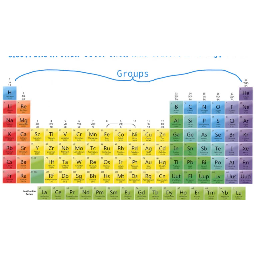
Families/ groups in the periodic table
The vertical columns on the periodic table are known as groups or families, because of the similar chemical behavior. There are 18 groups in the periodic table. All the elements in a group have the same amount of valence electrons. The different families in the periodic table contain Alkaline earth metals, transition metals, post transition metals, metalloids, halogens, and noble gasses.
Periods in the periodic table
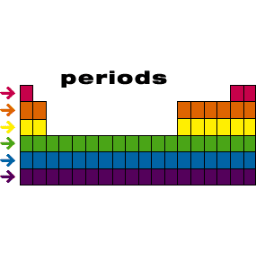
A period is a horizontal row of a periodic table. There are 7 periods, with each one beginning at the far left. The Periods increase by 1 left to right, hence the atomic numbers are listed in numerical order by rows. The periods correspond to the relationship of orbitals inside the outermost shell of the atom.
Role of Protons
The number of protons in an atom's nucleus determines the property of the element. Protons contribute to the mass of an atom, and provides a positive electrical charge. It is referred to as the atomic number, and is located in the tiny dense region at the center of an atom. The elements are arranged from left to right and top to bottom in the order of increasing atomic number otherwise called the number of protons located inside of the atom ´ s nucleus which also affects the atom´s mass.
Elemental properties (Metals, non-metals, and metalloids)
There is a jagged line on the periodic table used to differentiate the metals from non-metals. The metals are located on the left side of the line except for hydrogen which is a non-metal. Metals are good conductors of heat and electricity, are malleable (can be pressed permanently out of shape), and are ductile (can be stretched into wire). Non metals on the other hand are located on the right side of the line, they join the line of metalloids. Non metals have a dull appearance, are generally brittle (hard to break), are insulators (poor conductors of heat and electricity, and have a low melting point. The metalloids create a zig zag line down the table. Metalloids contain properties of both metals and non-metals. They are semi conductors, a little malleable, and semi-ductile.
Valance electrons
Valence electrons are the outer shell electrons that participate in the formation of chemical bonds. The number of valence electrons in atoms may cause them to be unreactive or highly reactive. Valence electrons determine whether atoms tend to give up or gain electrons during chemical reactions. If an atom has a full outer shell (8 electrons) than the element is unreactive since it can gain or give any electron
The Families/groups in the periodic table
Alkali Metals, Alkaline Earth Metals, Transition Metals, Boron Family, Carbon Family, Nitrogen Family, Oxygen Family, Halogens, and Noble Gases
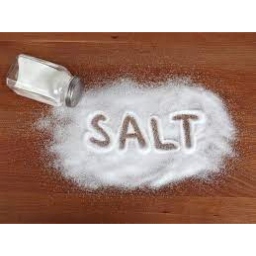
Salt is a mineral composed mainly of sodium chloride
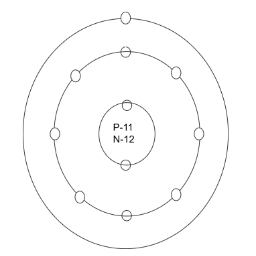
Sodium Bohr Model
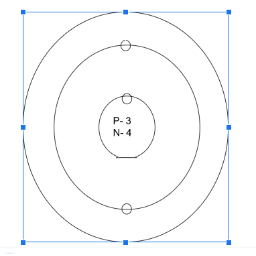
Lithium Bohr model
Alkali metals
The alkali metals have a high thermal and electrical conductivity , lustre (a glow of reflected light), ductility, and malleability. Each element in the alkali metals group has one valence electron in their outermost shell. Some elements in the alkali group are Lithium (Li), Sodium (Na), and Hydrogen (H). Sodium is used as a heat exchanger in some nuclear reactors, and as a substance used in a chemical analysis. However the most common use of sodium is sodium chloride (common salt) a spice that is added to foods. Hydrogen can be used to fuel cells to generate electricity, or heat. Hydrogen is mostly used in petroleum refining and fertilizer production.
Calcium carbonate is added to toothpaste
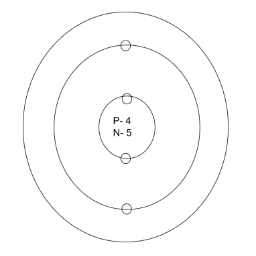
Beryllium Bohr model
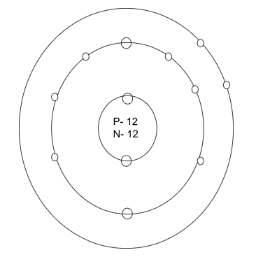
Magnesium Bohr model
Alkaline Earth Metals
The alkaline earth metals are highly metallic, are good conductors of electricity, are malleable, and ductile. They have low melting and boiling points. Each element in the alkaline earth group has 2 electrons in their outermost shell. Some elements that are in the alkaline earth metal group are Beryllium, Calcium, and Magnesium. Calcium is used to make cement, and is also used in the glass industry as a stabiliser that improves the quality of the glass. Calcium carbonate is also added to toothpaste and mineral supplements. Magnesium on the other hand ignites easily and hence is used in fireworks, flares, and sparklers. It is also used in products that can benefit from being lightweight such as laptops, and power tools.

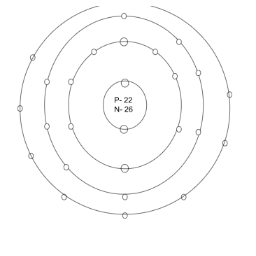
Titanium Bohr model
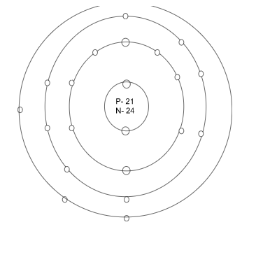
Scandium Bohr model
Transition Metals
Transition metals are good conductors of heat and electricity, they are also malleable and ductile. They have high melting points, and their texture is generally hard and tough. Some elements that are located in the transition metal group are Titanium (Ti), Chromium (Cr), and Copper (Cu). Copper is used in electrical equipment such as wirings and motors. Chromium is used to harden steel, manufacture stainless steel, and produce alloys (a metal made by combining 2 or more metallic elements).

Touch screen indium tin oxide
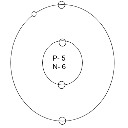
Boron Bohr model
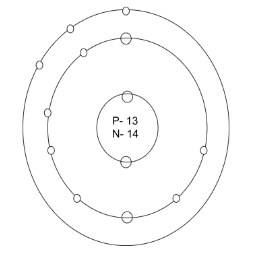
Aluminium Bohr model
The Boron family is located in group 13 of the periodic table. It is called the boron family because boron is the first element at the top of the group, and is the only metalloid in the group. The other four elements in the group are aluminum (Al), gallium (Ga), indium (In), and thallium (Tl), and they are all post transition metals. Post transition metals are soft and brittle, with poor mechanical strength. They have lower melting and boiling points than transition metals have. They are malleable, ductile, and are good conductors of heat and electricity like most metals. They also have a fairly high density. Boron is a black, lustrous (shiny) semiconductor. Boron conducts electricity like metals do at high temperatures, but at low temperatures they are almost like insulators. Indium is used to make indium tin oxide, which is an important part in screens, flat screen Tvs, and Solar panels. Gallium is primarily used in electronic circuits, semiconductors, and light-emitting diodes (a device that emits light when an electric current passes through it).
- Full access to our public library
- Save favorite books
- Interact with authors
- < BEGINNING
- END >
-
DOWNLOAD
-
LIKE
-
COMMENT()
-
SHARE
-
SAVE
-
BUY THIS BOOK
(from $4.79+) -
BUY THIS BOOK
(from $4.79+) - DOWNLOAD
- LIKE
- COMMENT ()
- SHARE
- SAVE
- Report
-
BUY
-
LIKE
-
COMMENT()
-
SHARE
- Excessive Violence
- Harassment
- Offensive Pictures
- Spelling & Grammar Errors
- Unfinished
- Other Problem






COMMENTS
Click 'X' to report any negative comments. Thanks!