I dedicate this book to Ms.Thompson for teaching me science this school year.

What are the "families" in the periodic table?
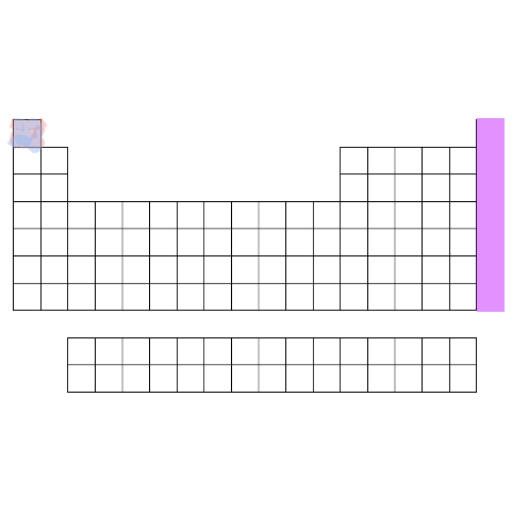
The "families" more commonly known as "groups" are the columns in the periodic table. There are a total of 18 groups, and what makes each group so special and different is that each family has a set amount of valence electrons (explained on page 4). Each family also has similar chemical properties/reactivity.
Ex. Helium and Neon are in the same Group/Family and have the same amount of valence electrons.
What are the "periods" in the periodic table?
The "periods" are the rows of the periodic table. They go horizontally across the table, and there are a total of 7 periods. What makes periods so special is that elements in the same period have the same number of energy shells/levels. For example, Hydrogen in period 1 has one energy level, same as Helium who is also in period 1.

k
k
RED = Family/Group
BLUE = Period
Note that where red and blue intersect red is still present
What are Valence electrons?
As explained prior, each element has an energy shell(s) with electrons located there. *Electrons are the negative charge an atom has that is located outside the nucleus* The first energy shell holds two electrons, the second hold, 8, and the third holds 18. (There are more than just 3 shells though). The biggest energy shell that is present(one that has electrons in it) is the one that we'll focus on when counting valence electrons. The number of electrons on the last energy shell is the number of valence electrons an element has. Valence electrons also determine how reactive an element is. (If an element has 8 valence electrons, then it's stable and won't react with others)

What are protons?
Protons are what make up an atom's identity. To identify which element it is, count the number of protons present and that's the atomic number of the element. (Same goes for electrons). *The atomic number justifies how many protons and electrons are in an atom*. The protons are located inside the nucleus of an atom, and each has a positive charge to the atom. They also add to the atomic mass of the atom.
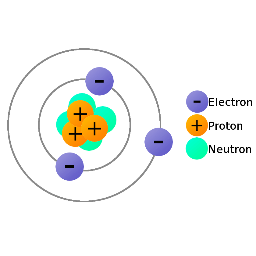
*The orange circles with a plus sign are the protons
*The purple circle with a minus sign that is located on the second "ring" is the valence electron. In this case, there is only one but there could be more in other elements.
Metals in the periodic table
Metals are usually solid atoms that are shiny, malleable (able to be crafted into another shape), ductile (able to be made into a thin wire), and a good conductor of electricity. They are located mainly on the left side of the periodic table and include the two periods below the table.
Non-metals in the periodic table
Non-metals are exactly what their name suggests. They're the opposite of metals, usually dull and crumble if they're even a solid, as most are gases. Non-metals are located on the right side of the periodic table, except for helium located at the top-left of the table.
Metalloids in the periodic table
Metalloids are extremely unique as they contain both properties of a metal and a non-metal. They can be shiny or dull, ductile or not, malleable or not, and can be a semiconductor of electricity. They're located around the "staircase" of the periodic table.
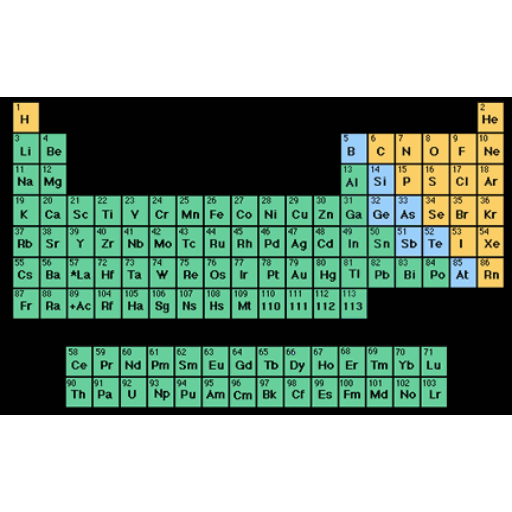
Orange = non-metal
Blue = Metalloids
Green = metals
Alkali Metals
Located in family 1, these are the most reactive metals as they only have 1 valence electron. They're highly conductive and have all characteristics of a metal. Note that the first one (Helium is not an Alkali metal).
Alkaline Earth Metals
These are located to the right of Alkali metals in family 2. They aren't as reactive as Alkali metals, but they interact with other elements pretty well. They're also highly conductive and have all characteristics of a metal.
Transition metals
These weird metals are located in the center of the periodic table. Even though they have all the physical properties of a metal, their chemical properties aren't. They're not reactive and have interesting chemical properties.
Boron Family:
As the name already states, this group includes Boron and all other elements in group 13. Each element here has three valence electrons. There is one metalloid, boron, so the physical property this family shares is luster/shiny.
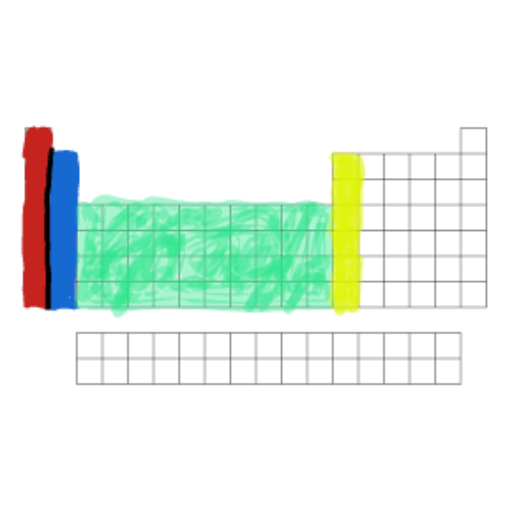
RED = ALkali metals
BLUE - Alkaline Earth metals
GREEN = Transition metals
YELLOW Boron Family
Carbon family
To the right of the boron family, the Carbon family is located in group 14. It has one non-metal, two metalloids, and 3 metals. This family has 4 valence electrons and all known elements in this family are either colorless, white, or gray.
Nitrogen family
The nitrogen family is to the right of the Carbon family in group 15. It contains two non-metals, two metalloids, and two metals. This family has 5 valence electrons and takes away from other atoms. They are all solid at room temperature.
Oxygen family
The Oxygen family is to the right of the Nitrogen family in group 16. All elements here have 6 valence electrons and contain two metals, one metalloid, and 3 nonmetals. All except oxygen are solid at room temperature.
Halogens
Located in group 17, this group includes two nonmetals and four metalloids. They all have 7 valence electrons, so they are highly reactive. The colors of each element are darker as you go down the column, and their physical state also changes, as Fluorine and Chlorine are gases, Bromine a liquid, and iodine a solid.
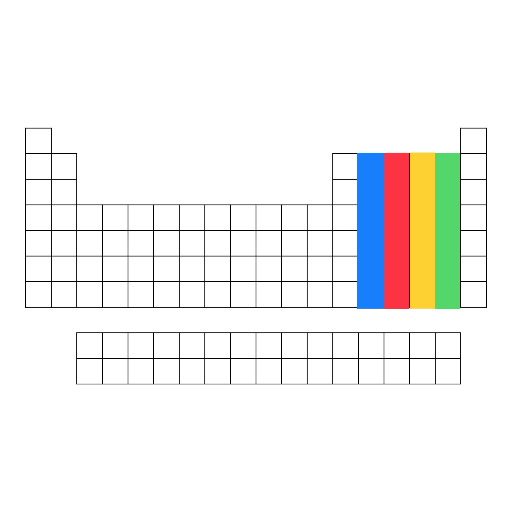
BLUE = Carbon family
RED = Nitrogen family
YELLOW = Oxygen family
GREEN = Halogens
Noble gases
The noble gases are located in group 18 (and helium in group 1) and are the least reactive elements each with 8 valence electrons. They're all nonmetals and are colorless, odorless, and tasteless under normal circumstances.
Magenta = Noble gases
Some elements in the Alkali metals family: Sodium (Na), Lithium (Li), and Potassium (K)
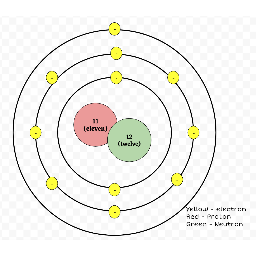
Hydrogen Bohr model
Sodium Bohr model
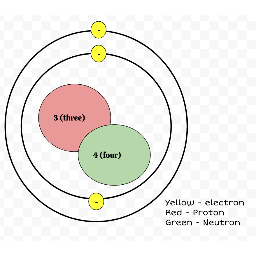
Some elements in the Alkaline Earth Metals are Berylium(Be), Magnesium(Mg), and Calcium(Ca).
Berylium Bohr model
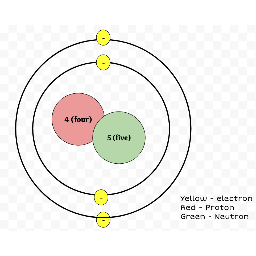
Magnesium Bohr model
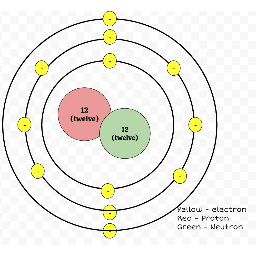
Some elements in Transition Metals are Titanium(Ti), Nickel (Ni), and Copper (Cu).
Titanium Bohr model
Copper Bohr model
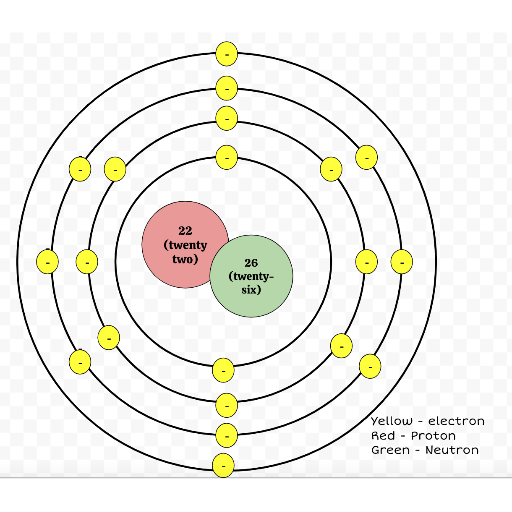
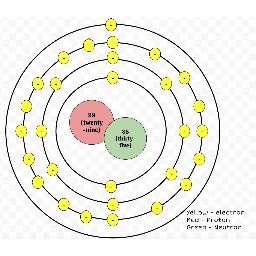
Some elements in the Boron family include Boron (B), Aluminum (Al), and Gallium (Ga).
Boron Bohr model
Aluminum Bohr model
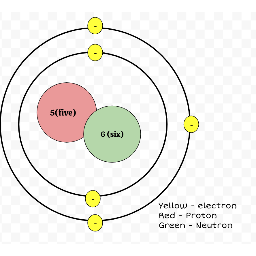
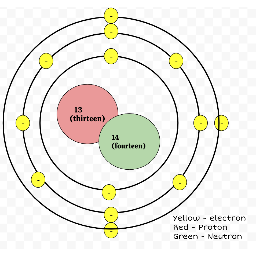
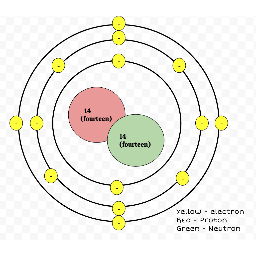
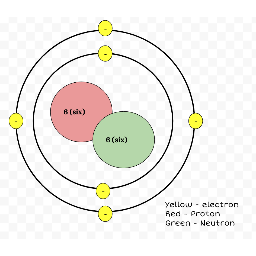
Some elements in the Carbon family include Carbon (C), Silicon (Si), and Germanium (Ge).
Carbon Bohr model
Silicon Bohr model
- Full access to our public library
- Save favorite books
- Interact with authors
Periodic table book
- < BEGINNING
- END >
-
DOWNLOAD
-
LIKE
-
COMMENT()
-
SHARE
-
SAVE
-
BUY THIS BOOK
(from $5.19+) -
BUY THIS BOOK
(from $5.19+) - DOWNLOAD
- LIKE
- COMMENT ()
- SHARE
- SAVE
- Report
-
BUY
-
LIKE
-
COMMENT()
-
SHARE
- Excessive Violence
- Harassment
- Offensive Pictures
- Spelling & Grammar Errors
- Unfinished
- Other Problem






COMMENTS
Click 'X' to report any negative comments. Thanks!