
For Donovan on his ninth birthday
From Grandpa Jamieson

Chapter 1: Departure
Our story begins on a cool day in May in rural Virginia's Louisa County, just a hop-skip-and-a-jump from Lake Anna. Nestled warmly in their spacious home are the Christian family - Mom, Dad, and their two boys, eleven-year-old Roman and nine-year-old Donovan. Their dog Charlie and their cat Marbles are lazing comfortably in the great room. Mom is working on a watercolor painting downstairs and Dad is making homemade pizza in the kitchen. The boys are working, or at least pretending to work, on a homework assignment. Everything seems perfectly normal.
A few minutes later, Donovan experiences a strange sensation as a feeling of lethargy begins to envelop him. He looks around and everything seems to be slowing down, including himself. "Weird," he thinks to himself. Then everything goes black.
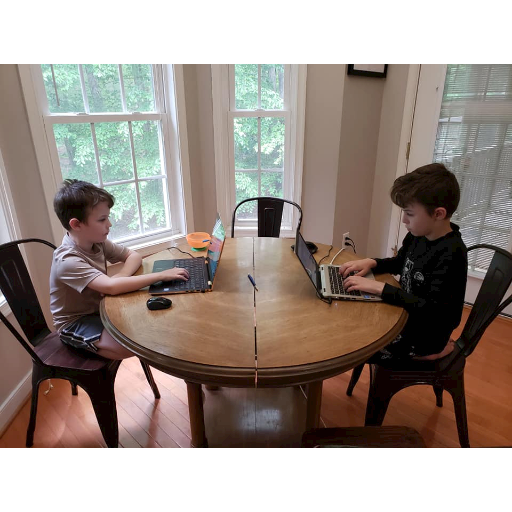
Wacky Wonder Boy
Lake Anna, Virginia
May 2023
Suddenly, Donovan awakes in a brightly lit place that resembles the bridge of the Starship Enterprise from Star Trek. Standing before him is a crazed-looking character in a white lab coat with an unkempt shock of white hair. Extending a hand in greeting, the man steps forward to introduce himself. "My name is ..." he begins, stopping short as Donovan completes his sentence with, "Professor Warp Speed!"
"Uh ... well, yes," answers the professor. "How do you know that?"
"Easy," replies Donovan. "My brother told me all about you. And my mom, and my dad, and my grandma, and my grandpa. It looks like I am the last one in my family to make your acquaintance." Donovan then bows with a dramatic flourish and smiles triumphantly.
"Hmm," says Professor Warp Speed, "you do know that they were not supposed to say anything about that, don't you? And just who, may I ask, is this brother of yours? What was his zippy name. You know what that means, I presume."
"Oh, sure," says Donovan. "His zippy name was Johnny Whizbang. My mom's name was Suzi Sunshine. My dad's was Mighty Morphin' Math Boy. My grandma's was Fanny Fluffyhead. And my grandpa's was Rocky Rocket Boy."
"I don't remember any of those names", says the professor. "Let me check my logs. Alexa, did you hear those names?" "Yes, sir," replies a female voice. "Would you like me to do a search?" "Yes, please," replies the professor and Alexa immediately says, "None of those names are in the logs. Perhaps you have not met them yet."
"That's impossible," says Donovan. "How could they have told me about you if they had not already been hornswoggled by you? And how would I know about hornswoggling? And how would I know that your real name is Irving Schmidlap, and all of the other things that I know about you?"
"Time travel is a tricky thing, my boy," says the professor, chuckling. "It takes a bit of getting used to. You see, just because they were hornswoggled before you were from your time perspective does not mean that they were hornswoggled before you were from my time perspective. Understand?"
"Oh, wow," says Donovan. "I never thought of of it that way. Huh." Then, abruptly changing the subject, Donovan asks, "So what are we going to do on this adventure? More medical history?"
"Medical history," repeats the professor. "What an interesting idea! That would be perfect if we were to hornswoggle some kids during the 21st-century Covid epidemic! But, to get back to your question, this adventure will be about football. Or, as you old-time Americans used to call it back in your day, soccer. Sound interesting?"
"Sure," replies Donovan, "I love soccer!"
"I know," says the professor. "What is that 21st-century saying? Oh, I remember now,
it was 'LOL'! It means 'laugh out loud' or something like that, right?"
"Yep!' replies Donovan. "You know your stuff, Doc!"
"Doc?" thinks the professor, wondering if this kid is going to be trouble.
"Well," says the professor, "since you know so much about our little explorations in time, perhaps you can tell me what happens next."
"Oh, sure," replies Donovan, "first you give me a zippy name and then you introduce me to the rest of the kids that you have hornswoggled onto your timeship."
"That's right," says the professor. "And I think your zippy name should be Wacky Wonder Boy. What do you think about that?"
Donovan shrugs. "Sure," he says, "Why not? It is a wonder how wacky I am, isn't it? Now let's meet the rest of the crowd. It'll be interesting to see if I know anyone."
"I don't believe that you will," replies the professor. "We try to be careful about that."
As they turn to face the other children seated in the timeship, the professor motions toward Donovan and then says to the group, "Everyone, please give a warm welcome to Wacky Wonder Boy. And please keep in mind that we will use only our zippy names on this adventure. Do not share your real names with each other."
The other children say "Hi!" in unison and then the professor guides Wacky Wonder Boy over to the group for individual introductions. As he is introduced to each one using his or her zippy name, Wacky Wonder Boy inquires of each child where he or she is from, and when he or she was born. He doesn't recognize anyone, so - looking a bit disappointed - he takes his seat and straps himself in for the trip through time to the next pickup. But he wonders why they are not allowed to share their real names.
"Just one more pickup," says the professor, "this one from Argentina in the year 1999."
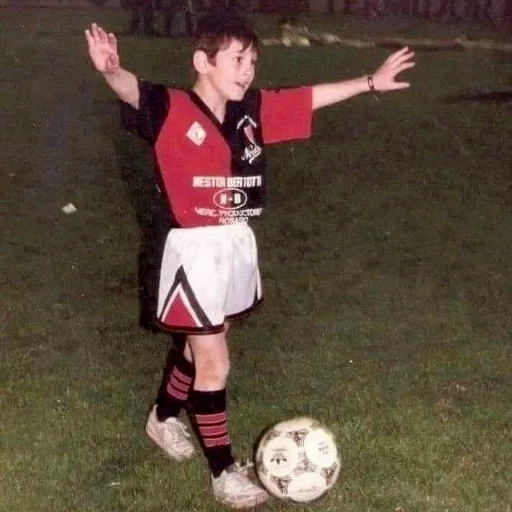
Leo the Lion
City of Rosario,
Santa Fe Province, Argentina
September 1999
"Tally-ho!" he exclaims and they are off. Wacky Wonder Boy watches in awe as the years fly by outside his window. Soon they come to a stop near a soccer field, the professor freezes time, hornswoggles a young soccer player onto the timeship, and then introduces the young boy to the others as Leo the Lion.
"Now that we are all aboard," says the professor, "please settle in for the long trip to our first adventure. We will be going to ancient China to witness the birth of what we now call futbol or football or soccer, depending on where you are from. We will have dinner in a few minutes and then relax for a couple of hours before retiring for the night. Take some time to get to know one another but please do NOT share your real names. I know that might seem like an odd rule, but I can assure you that there is a good reason for it. You will just have to trust me on that." Everyone nods in agreement and they begin to get acquainted.
Chapter 2: Leo the Lion
Wacky Wonder Boy and Leo the Lion hit it off right away because of their shared passion for the game of soccer. Wacky Wonder Boy is skeptical, though, about Leo's claim that he is one of the best payers in Argentina.
"No offense," says Wacky Wonder Boy, "but you seem pretty small for a nine or ten year old."
Leo the Lion laughs and says, "I'm actually twelve years old. Some people call me 'The Magician'. Wanna see some of my moves?" He asks Professor Warp Speed if he has a soccer ball aboard the timeship, considering that they are on a futbol tour, and the professor quickly produces one.
"I'd be interested in seeing this myself," says the professor. All the other travelers gather round as Leo the Lion and Wacky Wonder Boy prepare to square off in an open area of the timeship. Wacky Wonder Boy is prepared to go easy on his smaller opponent, even if he is three years older.
"OK," says one of the other boys, pointing to a small opening between two chairs, "this will be the goal." "OK," respond Leo and Wacky Wonder Boy in unison.
Wacky Wonder Boy defends the goal as Leo the Lion quickly spins past him and scores. It only takes three seconds. Then he does it again. And again. And again.
"OK," says Wacky Wonder Boy, "no more Mr. Nice Guy!" He gives it his all, but Leo the Lion continues to run rings around him.
After a few minutes, Wacky Wonder Boy says, "OK, I'm convinced! I think I know why Professor Warp Speed named you Leo the Lion."
"Coincidentally," says Leo the Lion, "Leo is my nickname back home in Argentina."
The professor clears his throat dramatically, looks pointedly at Leo, and says, "No real names, remember? Not even nicknames."
"Sorry," says Leo, "it won't happen again."
"How can you be so good?" asks Wacky Wonder Boy, "especially considering your size. And how come you're so small for your age?"
"I've always been small for my age," says Leo. "Last year, shortly after I turned eleven I was diagnosed with something called GHD. It stands for Growth Hormone Deficiency and it prevents me from growing. Without treatment, I would have become a dwarf and that treatment costs about a thousand dollars a month. I come from a middle class family, so my parents really can't afford it and my father's health insurance will only cover two years of treatments, which are just about to come to an end. My soccer club promised to help but it doesn't look like that is going to happen. I was scouted by another club, but when they found out about the cost of treatments, they lost interest. I'm not sure what we are going to do now."
"Don't give up just yet, Leo," says the professor. "You never know what might happen." Then he smiles, winks knowingly, and wanders off.
"Wow," says Wacky Wonder Boy, "do you think he knows something about your future?"
"I'm sure he does," says Leo the Lion, "but it doesn't appear that he is going to share that knowledge with us. He doesn't want to change the future, I suppose. Isn't that what they say in all those time travel movies?"
The boys continue talking late into the night, long after the professor says, "Lights out!" Eventually, though, they both drift off to sleep like the rest of the group.
Chapter 3: Tsu'Chu
In the morning, the professor awakens the sleeping group and announces that breakfast will be served in precisely thirty minutes. "Please be ready to go. We don't want to be late for the Tsu'Chu match!"
"I thought this was a soccer tour!" someone shouts and everyone laughs.
"It is," responds the professor, "and Tsu'Chu is the earliest example of a truly soccer-like game. There had been similar games all over the world for hundreds of years, but they all allowed the use of hands. Tsu'Chu was the first to prohibit the use of hands."
"Are we in China?" asks a girl from Italy.
"Indeed we are," responds the professor, "and the year is 225 BC. We will discuss this further over breakfast, so let's cut the chatter, people, and get ready."
Everyone arrives at breakfast on time and the professor begins to speak. "Good morning, everyone. As you already know, we are currently in China in 225 BC, which is roughly midway through the Tsin Dynasty. It was during this dynasty, which ran from 255 BC to 206 BC, that the game of Tsu'Chu was invented."
"The word 'tsu' means 'to kick the ball with feet' and the word 'chu' refers to a stuffed ball made of leather. The name Tsu'Chu, then, could be roughly translated as 'kicking the ball.' The game was originated as a physical exercise program to train soldiers. It was also played extensively during the Han Dynasty, which lasted until 220 AD. In those days, an exhibition match was played every year on the emperor's birthday. A
similar game called Kemari was played in Japan around this time as well."
"We have a special problem in going back this far. Only two of you are Chinese, so it would be hard to explain the rest of us, descended as we are from European, African, and American stock. Therefore, we will watch the match from our timeship as we hover over the playing field."
"Won't that be even harder to explain?" asks someone from the back of the room, as muffled laughter ripples through the crowd.
"No," says the professor. "We will cloak the ship, making it invisible from below, and run the engines in silent mode. We won't even cast a shadow. Modern technology is a wonderful thing!"
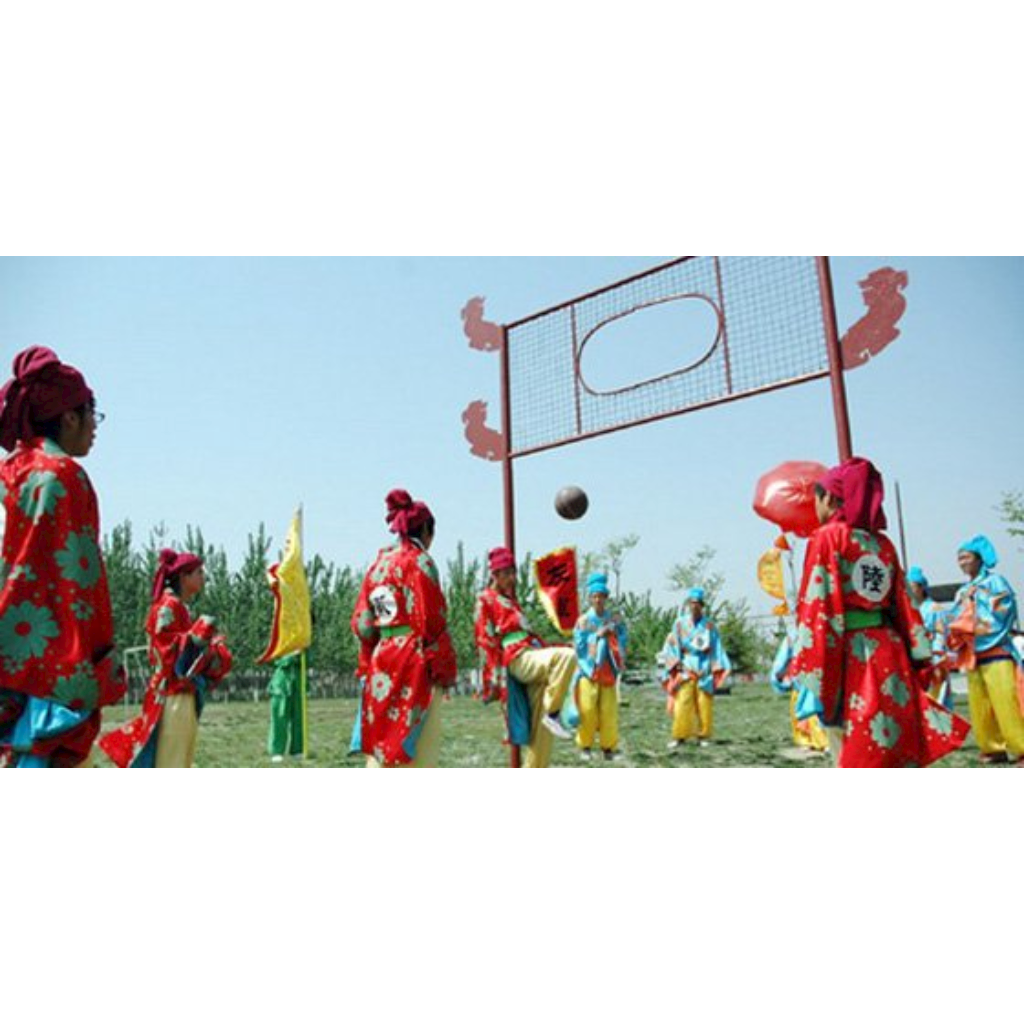
Tsu'Chu ("kicking the ball") was invented in China during the Tsin Dynasty as a military training exercise. It was the first game anywhere to prohibit the use of the hands.
Here, the cloaked timeship hovers above the playing field in 225 BC.
Professor Warp Speed sets the controls appropriately and maneuvers the timeship into position above the playing field. The game begins and the young travelers watch in rapt attention as the professor explains the finer points of the game. It is somewhat similar to the game they know, but also different in many respects.
The most striking difference is that the goal is a net suspended about thirty feet above the ground between two bamboo poles. "If you think it is hard to score a goal in the modern game," says the professor, "imagine what that must have been like!"
"Similar games were played in other parts of the world. We've already talked about Kemari in Japan, which may have been influenced by Tsu'Chu. However, even in cultures with no connection to Asia, similar games arose over time. Native Americans played a soccer-like game called Pahsaherman, indigenous Australians played a game
called Marn Grook, and the Maoris of New Zealand played Ki-o-rahi, to name just a few. The point is that many cultures found value in games that involved kicking a ball."
"Why is it so hard to score in soccer?" asks one of the American boys. "In American football, baseball, and basketball, there is a lot more scoring. That's why a lot of Americans don't like soccer."
"No way!" yells one of the boys from Mexico. "Futbol es numero uno!" Most of the other kids cheer and applaud in support. This starts an argument between the defenders of soccer and those who claim that its lack of scoring make it uninteresting or even boring.
"OK, OK," says the professor, "let's not do this. The fact is that soccer is by far the world's most popular sport, played in every country in the world. It was true in your time and it is also true in mine. But it's also true that scoring is very rare in this game."
"Soccer," he continues, "is one of a class of games played on a rectangular field with a goal at each end. American football, rugby, basketball, and hockey are all included in that class. So why do you suppose that scoring is so high in, say, basketball and so low in soccer and hockey?" No one answers.
"In basketball," continues the professor, "you have a tiny goal, barely bigger than the ball, located ten feet above the floor and parallel to it. Nevertheless, there is a lot of scoring. Many shots taken from more than twenty feet away are 'nothing but net'."
"In soccer, the goal is the size of small truck and yet it is nearly impossible to score. How do you explain the difference?"
"Well," says a girl from Japan, "in soccer you have a goalie, but goaltending is prohibited in basketball. Also, you get more than one point per score in basketball."
"Well, yes," agrees the professor, but how do you explain the accuracy of those long-range three point shots? A good outside shooter can score twenty or thirty points a game on a good night. How is that possible?"
"In basketball, you can use your hands," says Leo the Lion, "but in soccer, you have to use your feet, you head, your shoulder, and so on - anything but your hands."
"Precisely!" says the professor. "The same is true of hockey, where the players must use a curved stick to direct the puck toward the goal. They do use their hands, but only indirectly, and of course there is also a goalie. In a power play, where the goalie is pulled temporarily, scoring is much easier."
"Hey," exclaims Wacky Wonder Boy, "my grandpa says the exact same thing about the use of the hands in basketball and soccer. Are you sure you haven't met him yet?"
"Quite sure," says the professor. "In any event, some people like games with lots of scoring, which they see as a just reward for excellent performance. Others prefer games where scoring is difficult, so that each score is of great significance. It's all a
matter of taste. As they say in France, viva la difference!"
"Next, we will be traveling forward in time to the birth of the modern game of soccer. Would anyone care to take a guess as to where we will be going?"
"That's easy!" shouts a young boy with a British accent. "England!"
"Jolly good!" says the professor. "Take your seats, everyone, and belt yourselves in for the acceleration portion of the trip as we depart. It's a long trip and we won't get there until morning. Lunch will be served as soon as we reach cruising speed and then we will just relax for the rest of the day."
Chapter 4: Mob Football
"Good morning, everyone! And welcome to jolly old England," says Professor Warp Speed at the breakfast table. As you can see, the robotic waiters are serving breakfast, so please take a seat at the table and we will discuss the development of what has become known as mob football in England."
"It all began in the Middle Ages. As early as the ninth century, entire towns would turn out to kick an inflated pig's bladder from one landmark to another. It became such a nuisance that some towns banned the practice, but it survived and eventually evolved into something often referred to as either folk football or mob football. These games pitted two huge mob-like teams against one other and the 'field' might stretch from one end of the town to the other."
"Such games were often low scoring because of the great distance between the goals, and there were no standard rules. In fact, there were very few rules at all. Hands could be used as well as feet and almost anything was allowed. As you might imagine, these games often became violent as tempers flared."
"The biggest games of the year were played on Shrove Tuesday, the day immediately preceding Ash Wednesday, and these were big social events. We will be observing one of these Shrovetide matches, hovering above a small town in England on Shrove Tuesday in the year 1423. The cloaked ship is needed for the same reasons I cited for the Tsu'Chu match, but there is another reason as well: Safety. These games could be quite violent and I don't want to return any of you to your homes with a broken arm or a broken leg, as I am sure you can understand."
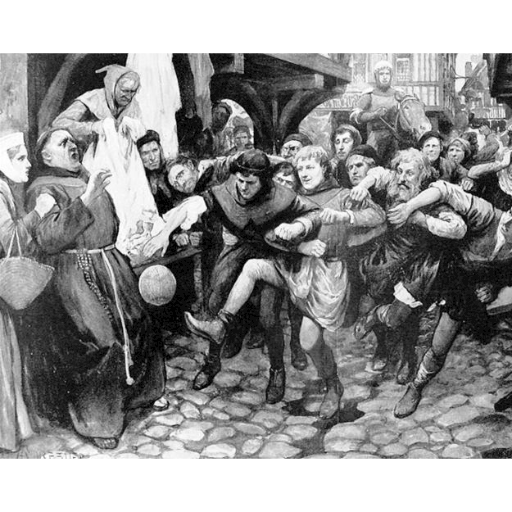
Mob football in medieval England
As the match progresses, another advantage of watching it from above becomes apparent. It would be very difficult to see the action at street level because there is always a huge throng of people around the ball. Most of the players never even get to see the ball, let alone have an opportunity to touch it.
It appears that anything short of murder is allowed in this free-for-all and possession of the ball changes frequently. In addition, it is difficult to tell the members of one team from the members of the other, but no one seems to mind. The goals are simple markers, one at each end of the town, and the pig's bladder seldom gets anywhere near either one of them. Finally, someone manages to drag it to the goal on the east end of town and just about everyone is so exhausted that they decide to call it quits. Many are sprawled along the sides of the streets tending to their wounds, but most appear to have enjoyed themselves.
"This sort of thing continued for hundreds of years," says the professor at the conclusion of the match, but there were many attempts to ban the games. King Edward II, who reigned from 1307 to 1327, banned the game from the city of London. In 1349, his son Edward III banned football entirely. He needed as many archers as possible to pursue his military ambitions and, in the wake of the Black Death, there was a shortage of able-bodied men. His concern was that the games were producing too many casualties."
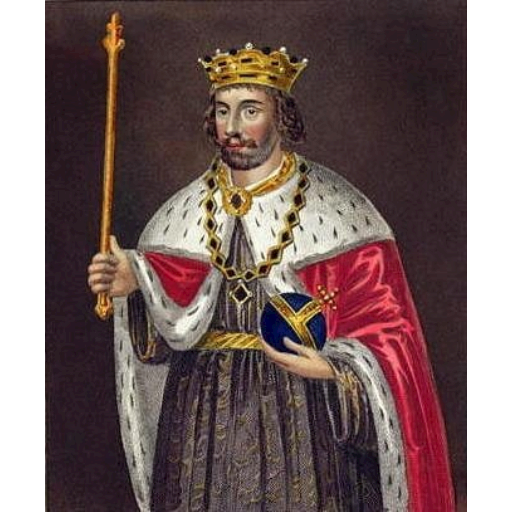
King Edward II
"The notorious Henry VIII, who reigned from 1509 to 1547, was known for his sporting prowess as a young man, and an inventory of the royal footwear in 1526 shows that he owned at least one pair of leather soccer boots. As he grew older, his waistline grew wider, making it impossible to compete at the highest level. Perhaps that is why he later banned the game, but he claimed that he did it because the games incited riots."
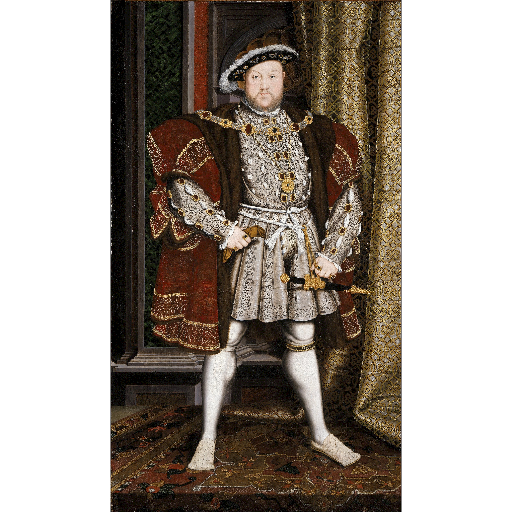
King Henry VIII
"Mob football began to decline sharply as the British Isles entered the industrial age in the nineteenth century. Some of the decline was the result of a loss of interest and some the result of law. For example, the Highway Act of 1835 banned the playing of football on the public highways, presumably because it interfered with commerce."
"Our next stop will take us forward in time to the nineteenth century, still in England, where we will witness one of the earliest examples of association football. Let's get belted in for the start of the trip, followed by lunch and an afternoon of relaxation. We'll arrive before nightfall, but won't actually see a match until tomorrow morning."
And then they are off, once again gliding effortlessly through time.
Chapter 5: Cambridge and Sheffield Rules
"The modern game of soccer emerged from 18th and 19th century English public schools, such as Eton, Westminster, Harrow, and Charterhouse, to name just a few," says the professor at breakfast. "The game was played at Eton as early as 1747."
"You Americans should not be confused by that 'public school' label. These schools are sometimes called independent schools, which more accurately describes what they really were back then and what they remain to this day. They are not run by the government and they do not receive any government funding. Most of them date back several centuries and were established to educate the children of the British aristocracy. It was in these schools that the modern game of soccer was developed as a suitable pastime for the aristocratic sporting gentleman."
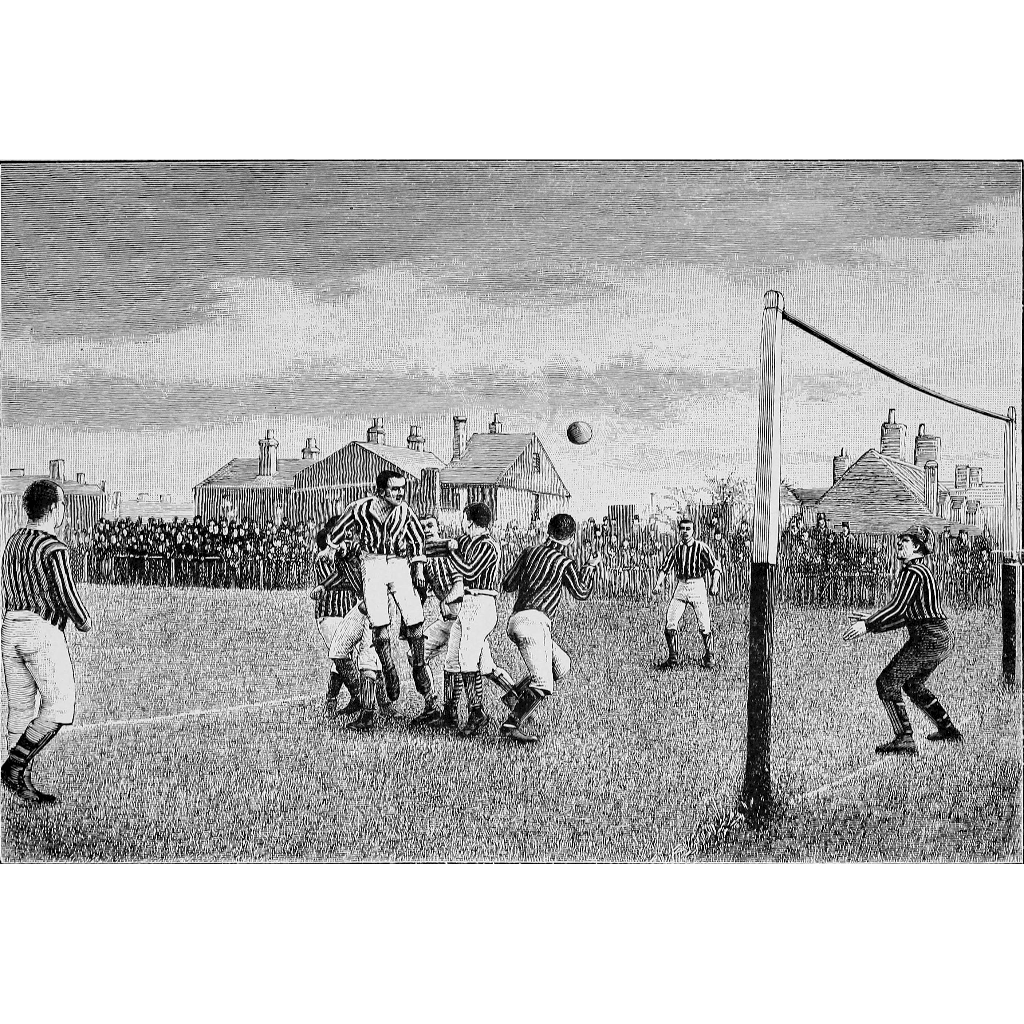
"Each school established its own rules, so the game could vary considerably from one school to the next. Many of these rules were influenced by the nature of the facilities available at each school. Eton and Harrow, for instance, had large playing fields, so they developed games that involved kicking the ball long distances. At Charterhouse, on the other hand, space was limited and the game was played within the cloisters of the old monastery. Because of this, their game emphasized the dribbling skills of the players."
"Other rules were more whimsical. For example, some schools allowed the ball to be caught if kicked below the hand or the knee. If the ball was caught near the opposing goal, the catcher could score if he could carry the ball into the goal using three standing jumps. The level of permissible violence also varied from one school to the next, as did the number of players on a team."
"With all of these different rules, it was very difficult for one school to compete against another. Something had to be done to standardize the rules, so in 1848 a meeting was arranged at Cambridge University to do just that. Delegations from Eton, Harrow, Shrewsbury, Rugby, Marlborough, and Westminster agreed on what became known as the Cambridge Rules."
"It was a contentious meeting and progress was slow, but they eventually managed to settle on a set of rules that were acceptable to all. It was agreed that goals would be scored for balls kicked between the uprights and under the crossbar. All players were allowed to catch the ball direct from the foot, providing that the catcher kicked it immediately. They could not run with it. Only the goalkeeper was allowed to hold the ball and he could also punch it anywhere in his own half. Goal kicks and one-handed throw-ins were allowed and all players had to wear a cap with his team's colors."
"Following the adoption of these rules, boys from the public schools would often participate in matches with boys from the local town. These matches often ended in fights, but they did help to spread knowledge of the Cambridge Rules among the general population."
"After graduation from the public schools, many of the boys attended university, where they continued to play using the Cambridge Rules. And upon graduation from university, many joined existing soccer clubs or formed new ones. Most of these clubs also adopted the Cambridge Rules."
"Not everyone was happy with these rules. Students at the Sheffield Collegiate School established the Sheffield Football Club, publishing a set of rules in 1857 that allowed for more physical contact between teams than the Cambridge Rules allowed."
"The Sheffield Rules were widely adopted in the northern parts of England and the Cambridge Rules were followed everywhere else. This divide was eventually bridged by the formation of the Football Association, often abbreviated as 'FA', in 1863. The game that emerged from the FA was called association football. Over time, it became colloquially known as soccer to distinguish it from other forms of football. We'll explore the Football Association in more detail later on."
"The Cambridge Rules were amended in 1862, specifying eleven-man teams, an umpire for each side, and a neutral referee. Goals were to be twelve feet across and twenty feet high. An offside rule was adopted, and the length of each game was limited to precisely one hour and a quarter. The first game using these rules took place between the Old Etonians and the Old Harrovians in November 1862. This is the game that we will be attending. And this time, we will be at the field."
Being at the field adds a whole new dimension to the experience of travelling back in time. The travelers are dressed in period costumes and instructed to avoid speaking any more than necessary within earshot of the denizens of this time. Unusual accents are not unknown in imperial Britain and the people of this time are becoming accustomed to the presence of faces from Asia, Africa, and the Americas, but modern slang and other expressions might attract unwanted attention.
The students watch the game with a good deal of interest. It resembles the modern game a lot more than Tsu'Chu or mob football, but there are still differences. Of even more interest, though, are the people in the stands and on the sidelines. The sights, the sounds, even the smells of this time are so different from those of the modern era. History is no longer the dry subject matter of ancient manuscripts and musty tomes. It is a living spectacle unfolding before their eyes.
Eton and Harrow battle to a draw on this fateful day. Then, after having dinner in one of the local inns, the travelers make their way through the gathering darkness to the secluded glade in a forested area just outside of town where the cloaked ship has been parked.
"How did you like today's events?" asks the professor once everyone is aboard. There is general agreement that it was a wonderfully exciting day.
"Tomorrow at breakfast," concludes the professor, "we will attend one of the most important gatherings in the history of the game of soccer. It takes place in a tavern in the city of London in the year 1863."
Chapter 6: The Football Association 1863
"Overnight," says the professor at breakfast the next morning, "we traveled forward in time to 1863 - October 26, 1863 - to be more exact. I will be attending a meeting at Freemason's Tavern on Great Queen Street here in London and I will be wearing a tiny camera to record and broadcast the events of the day back to the timeship. I'm afraid that you all would stand out a bit because of your youth, so I'm sorry to sat that the rest of you cannot be there."
- Full access to our public library
- Save favorite books
- Interact with authors
- < BEGINNING
- END >
-
DOWNLOAD
-
LIKE(1)
-
COMMENT()
-
SHARE
-
SAVE
-
BUY THIS BOOK
(from $12.99+) -
BUY THIS BOOK
(from $12.99+) - DOWNLOAD
- LIKE (1)
- COMMENT ()
- SHARE
- SAVE
- Report
-
BUY
-
LIKE(1)
-
COMMENT()
-
SHARE
- Excessive Violence
- Harassment
- Offensive Pictures
- Spelling & Grammar Errors
- Unfinished
- Other Problem






COMMENTS
Click 'X' to report any negative comments. Thanks!