
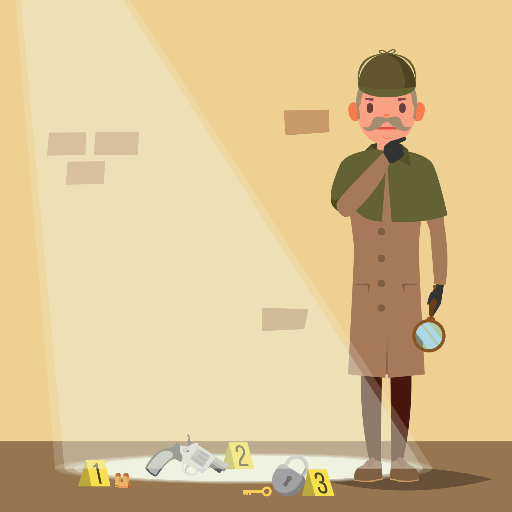





Hmmm I wonder what happened here
It was only a couple of decades ago when bad guys would get away with murder all the time. Why is this? Back then, there was nowhere in Canada and the US for police to learn to be good murder detectives. Police officers were not even taught to look for *forensic evidence at crime scenes. Imagine that!
*Forensic evidence is like hidden clues that detectives use to solve mysteries. It can be tiny things, like fingerprints or hair, that help find them out who did something wrong. Just like a puzzle piece, forensic evidence helps put together the story of what happened!

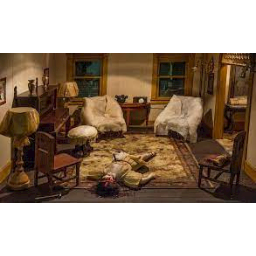
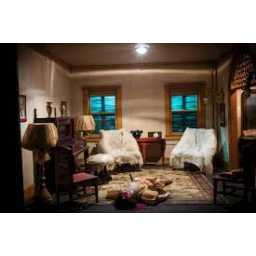





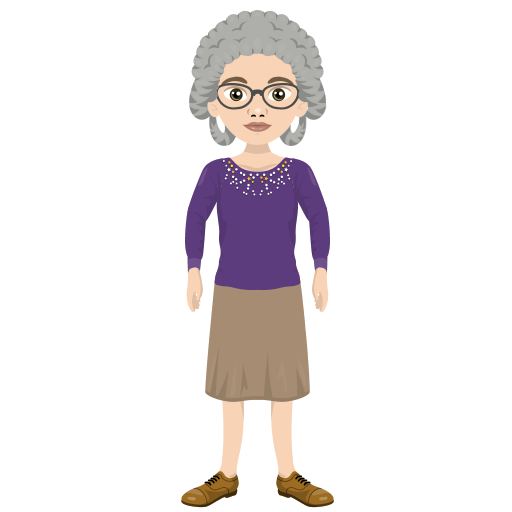
But in the midst of this mystery, there was a woman who saw the world differently. Her name was Frances Glessner Lee, but her friends and family called her Fanny. Fanny loved solving puzzles and figuring out the secrets hidden in small details. Now, picture a world without smartphones or advanced technology. A world where detectives didn't know how to carefully examine a crime scene, where clues were missed, and mysteries stayed unsolved. This was the world Fanny lived in. It was a world waiting for someone to change it.
Fanny, with her clever mind and money, helped create something incredible. She helped create the study of *forensic science and made dioramas called the Nutshell studies to help detectives learn to solve murders. Let's dive into how Fanny became known as the 'mother of forensic science!'
*Forensic science is like being a detective but using science to solve mysteries. It helps figure out what happened by studying clues like fingerprints, footprints, or even tiny bits of evidence invisible to the eye.











I want to go to Harvard one day like dad!
Me too!
Once upon a time, in the bustling city of Chicago, a little girl named Fanny was born. She was born on March 25, 1878, to her mom and dad, John Jacob and Frances Macbeth Glessner. Her dad was a very clever businessman who became very rich when he was still young. Fanny and her brother George didn't go to regular school like most kids. They were homeschooled! They both learned a lot about literature, art, music, and science [1]. From the time Fanny could hold a needle and thread in her tiny fingers, she practised sewing, knitting, crocheting and more [2]!
When Fanny was still very little, she became very interested in medicine. She was fascinated by ancient mummies and drawings that showed what the inside of our bodies looked like [3]. But back then, things were a bit different for girls like Fanny. Even though she was smart and wanted to learn more, rich little girls were not supposed to continue going to school when they grew up, and they weren’t supposed to work outside of the house [4].
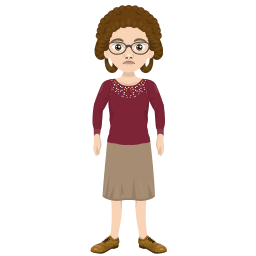




While her brother went to Harvard University to study law, Fanny got married and became a mom. At only 19 years old, Fanny married a lawyer named Blewett Lee. The couple seemed to be happy. They had 3 children, but eventually, they got divorced. Blewett was uninterested in Fanny’s hobbies and her crafts. Fanny would have bursts of creative energy, sometimes working all day and all night long. She likely felt unappreciated and lonely with her husband [5].
Fanny was very independent and decided to raised her 3 kids alone. It was only later in her life, after marriage, divorce and children, that Fanny could finally follow her passion for medicine and crafts. She was free to learn more about how the law and medicine worked together and to let her imagination run wild!




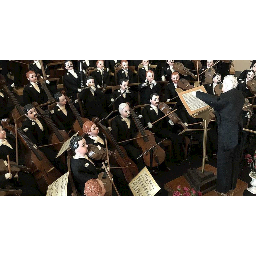


In 1912, Fanny took on a big project. She wanted to re-create the entire Chicago Symphony Orchestra as a miniature model to give to her mom. Her mom said that she wished that the orchestra was at her house every day, so Fanny wanted to make this dream a reality! She decided that she was going to re-create all 90 musicians in their fancy performance clothing with their instruments.
Fanny wanted the figures of the orchestra to be as close as possible to the real-life musicians. This was before the internet, so she couldn’t simply look up photos of the musicians to paint them. Instead, Fanny attended orchestra rehearsals and noted every detail about the musicians' appearances- their hairline, their facial hair and even the bushiness of their eyebrows! Fanny used all the skills she learned as a little girl to make an amazing model [6]! Little did anyone know, Fanny’s life’s work would be the creation of a very different type of miniature model many years in the future.


Fanny became close friends with her brother’s classmate, George Burgess Magrath, who was a *medical examiner and *legal medicine expert. He helped Fanny learn all about forensic investigation [7]! His fancy methods and important cases made people call him a “crime doctor,” kind of like Sherlock Holmes.
*Imagine a medical examiner as a very special doctor who investigates how and why someone has died. They use their knowledge of the human body and special tools to examine it, just like a detective would examine clues at a crime scene.
*Legal medicine is like a detective game for doctors. It helps doctors understand how people got hurt or became sick. They use clues from the body, like bones or blood, to help judges and the police solve mysteries about someone's health or how they got hurt.

You won't believe the things people get away with because the police miss important clues!
That's unacceptable! There has to be a solution!
The two would talk for hours about these sorts of things, and he told Fanny all about the problems in forensic investigations. Medical examiners relied on the police to notice when a dead body died because of violence. The problem was that police did not really know what violence looked like on a dead body. Sadly, the signs of violence were usually only seen when the dead body was already on its way to the funeral home.
At this time, it was very easy for murderers to make a murder look like a suicide or to hurt the body very badly so that it was too difficult for the police to examine it. Police and medical examiners did not bother looking at these dead bodies because they thought that any important evidence was gone. They were almost always wrong, and a lot of murderers and bad guys got away [8]!

I would like to use my family's fortune to make a donation to pay for legal medicine studies at Harvard

Let's make this happen!
Fanny started to study and learn all about crime. She became convinced that experts needed better training and that all deaths that did not seem to have an explanation should be investigated. As a woman, Fanny was not allowed to study at Harvard Medical School, but she had an idea of how she could make a difference with the money she had inherited from her parents [9]. By 1931, Fanny used her money to convince Harvard University to make her friend George the boss of a new subject at the school: legal medicine. Fanny bought a whole library of important books for the school so that students could learn all about criminal investigations [10]! In the next couple of years, the school would do *autopsies to find new evidence in old cases. This new evidence made a big difference in actually solving the old crimes [11].
*An autopsy is a tool in forensics and legal medicine. A special doctor looks very closely inside the body to find out why someone died or got hurt. They take pictures, look at organs, and collect clues to understand what happened to the person.
Enough is enough! It's about time that we see some change in how this city investigates crimes. I am going to make my voice heard!

Fanny worked really hard to change laws around criminal investigations and to prove to the government and public that legal medicine was important.
She wanted police to have better training so that they would handle evidence correctly. All of her hard work paid off because the government listened to her concerns [12]!


Congratulations on becoming police captain Frances! You deserve it!
When Fanny was 66 years old, the police colonel made her a police captain and the principle of education for the New Hampshire Police. The police colonel thought that Fanny’s education was very important and useful, so he let her be in charge. She was the first woman in the United States to be in this position [13].
Her position was so important that she was allowed to arrest people, but she never actually did because she was focused on teaching [14]. Sadly, George died in 1938, but Fanny continued to train students and police officers at Harvard.
- Full access to our public library
- Save favorite books
- Interact with authors
- < BEGINNING
- END >
-
DOWNLOAD
-
LIKE
-
COMMENT()
-
SHARE
-
SAVE
-
BUY THIS BOOK
(from $6.39+) -
BUY THIS BOOK
(from $6.39+) - DOWNLOAD
- LIKE
- COMMENT ()
- SHARE
- SAVE
- Report
-
BUY
-
LIKE
-
COMMENT()
-
SHARE
- Excessive Violence
- Harassment
- Offensive Pictures
- Spelling & Grammar Errors
- Unfinished
- Other Problem






COMMENTS
Click 'X' to report any negative comments. Thanks!