This book has a special dedication; clearly, personal effort has been evident throughout the subject, but without the motivation of our teacher, this effort would not have been noteworthy. Thank you, Mr. Chicas, for supporting us and consistently motivating us to explore the world of English. We hope to see you again along the way.

Block 1
Content 1 - Meeting and greeting people
1.1.1 Verb” to be” Simple present
Content 2 - Finding lost personal objects
2.1.1 Demostrative Pronouns
2.1.2 Possessive Adjectives
Content 3 - Talking About Jobs and Activities
3.1.1 Simple Present
1.1.1 Verb "To Be" Vocabulary
1.1.1 Verb "TO BE" Vocabulary
- Journalist: a person who writes new stories or articles for a newspaper or magazine or broadcast them on a radio or television.
Example: He’s a journalis on CNN.
-How old are you?: We use "How old" + verb "to be" form + subject pronoun+ complement, for asking the age of someone.
Example: How old is she? She is 20 years old.
-Where are you from? It´s refer to a question about the place of origin or nationality of someone.
Example:
Where are you from? I am from El Salvador
1.1.1 Verb "To Be" Grammar
Uses:

Usually, the verb to be as main verb can be used to describe a person, object, quality, job or activity, country, or to indicate a permanent or even temporary state.

The verb to be is used either with singular and plural nouns and pronouns
Examples:
I’m Joanna.
I am from El Salvador.
He’s a journalist
He is happy.
SINGULAR
I am I am at home
You are You are my favorite soccer player
She/He/It is -She/He is Good at math
-It is a good day
VERB TO BE WHIT SINGULAR AND PLURAL NOUNS
PLURAL
You are -We are musicians.
We are -You are singers.
They are -They are from El Salvador.


Rigth structure of a verb "TO BE"
POSITIVE
I am I´m (contraction) from Japan.
you / we / they are You’re / We’re / They’re from Brazil.
he / she / it is He’s / She’s / it’s from India.
NEGATIVE
I am not I’m not (contraction)
you / we / they are not You’re not/You aren’t We’re not/We aren’t They’re not/They aren’t
he / she / it is not He isn’t/He’s not She isn’t/She’s not It isn’t/It’s not
INTERROGATIVE
Am I beautiful? Yes, I am. / No, I’m not.
Are you / we / they a teacher? Yes, We/They are. / No, We/They Aren’t.
Is he / she / it tall? Yes, He is. / No, He isn’t.
2.1.1 Demostrative Pronouns Vocabulary
-Misunderstanding: occurs when people don't understand each other correctly, causing confusion or mistakes in communication.
Example: Lisa thought her friend liked chocolate ice cream, but there was a misunderstanding, and her friend actually preferred vanilla.
-Guarantee: is a promise that something will happen or be as expected.
Example: The college gave a guarantee that students who completed the program would receive a diploma upon graduation.
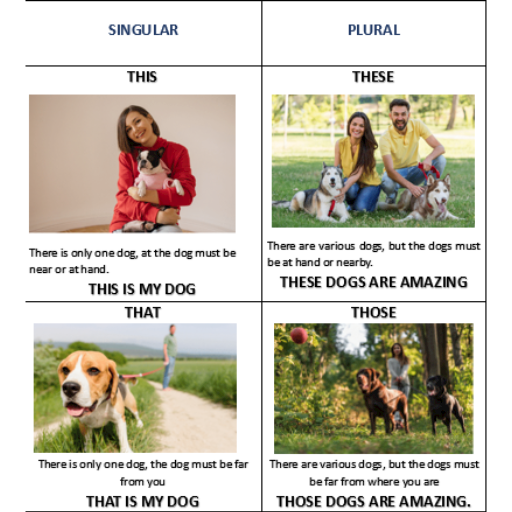
-This: Is when an object is near or at hand and is only one.
Example: This is my cellphone.

-That: When an object is far from you and is only one.
Example: That is his dog.
-These: When there are objects near or at hand and are more than one.
Example: These are my pencils colors.
-Those: When there are objects far and are more than one.
Example: Those houses are identical with each other.



2.1.1 demostrative pronouns Grammar
Uses
To identify individuals, objects, or even conceptions.
Help to clarify and identify specific words or noun phrases being discussed.
There are four main demonstrative pronouns in the English language as follows:
2.1.2 Possessive Adjectives vocabulary
-Able: It means capable or having the capacity to do something.
-Belonging: is a feeling of being comfortable as part of a group and having a good relationship with the other members.
Example: I felt a good feeling of belonging when we were whit your family
-Ownership: refers to the state or fact of possessing, controlling, or having legal rights to something.
Example: He takes ownership of his mistakes and learn from them.
2.1.2 Possessive Adjectives grammar
Definitions
Adjective: A word belonging to one of the major form classes in any of numerous languages and typically serving as a modifier of a noun to denote a quality of the thing named.
Possessive adjectives: Are adjectives which modify nouns to convey a sense of ownership or possession of a particular individual, animal, or thing.
We will study adjectives to denote possession.
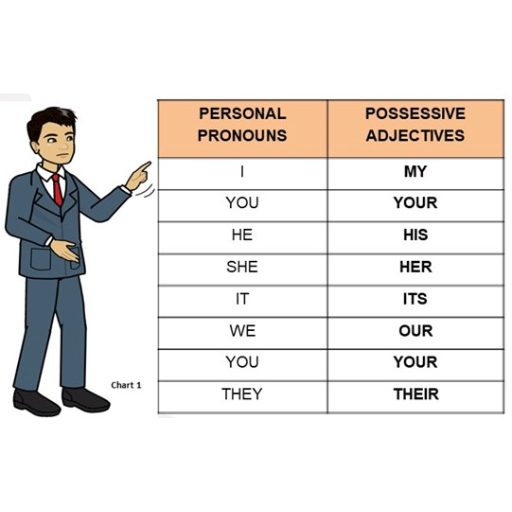
Your:
-It is always used for the pronoun "You" in singular or in plural.
- It is for male or female owners.
EXAMPLE:
Your name is Ricardo.
My:
-It is always used for the pronoun "I".
-It is used for singular or plural nouns.
-It is used for a girl or a man
EXAMPLE:
My dog is black.


His:
-It is used when the subject is a male person.
- It is for plural or singular nouns.
EXAMPLE:
Harry lives in Paris, his house is near the Eiffel tower.

Her:
-It is used when the subject is a female person.
- It is for plural or singular nouns.
EXAMPLE:
What is her name?

Its:
- It is used when the subject is only one thing or one animal.
- It is for plural or singular nouns.
EXAMPLE:
The table has its four legs.
Our:
- It is used when the subject is "We".
-It is used with singular or plural nouns.
EXAMPLE:
Our dogs aren’t dangerous.


Their:
- It is used when the subject is "They". EXAMPLE:
- It is used for people, animals, or things. The boys have their own
-It is used for plural or singular nouns. apartment.

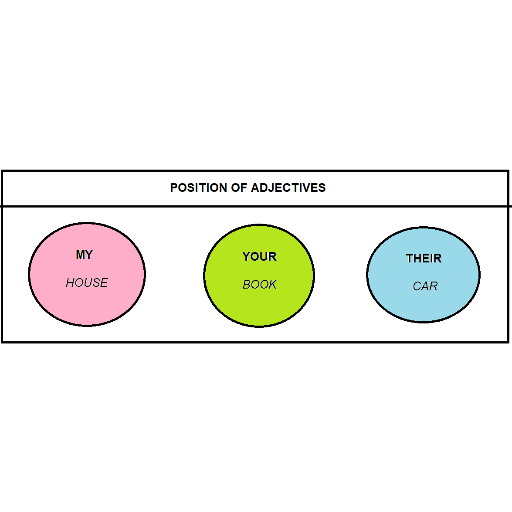
Possessive adjectives are place just like other adjectives, that is, before the noun they modify, Examples:
NOTE: Possessive adjectives are used in the same form for plural or singular nouns. They do not suffer any modification.
EXAMPLES:
-Our cellphone is expensive (a singular thing)
-Our cellphones are expensive (plural things).
3.1.1 Simple Present Vocabulary
-Routines: are regular, habitual sequences of activities or behaviors that provide structure to daily life.
EXAMPLE: His daily routins incluide take a shower, brush his teeth and eat.
-Habits: are regular behaviors or routines that become ingrained through repetition, often occurring automatically or unconsciously.
EXAMPLE: One of my habits is reading a little, before to sleep each night.
-Scheduled: something planned to occur at a specific time or within a predetermined timeframe
EXAMPLE: The concert is scheduled for 8 PM tomorrow
-Upcoming: refers to events, situations, or things that are anticipated or expected to happen in the near future
EXAMPLE: I'm excited about the upcoming weekend trip to the beach.
3.1.1 Simple Present Vocabulary
-Chart: is a visual tool, like a graph or diagram, that helps represent and organize information for better understanding.
EXAMPLE: Dany creates a chart to ilustrate the topic.
-What does Sofia do?: is a question, asking about what is sofia doing for to live.
EXAMPLE: What does Sofia do? She is a nurse.

3.1.1 Simple Present GRAMMAR.
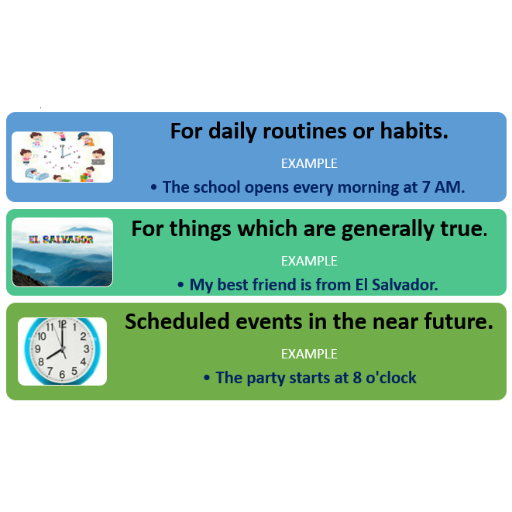
There are 3 main uses of the simple present tense as follows:
STRUCTURE OF THE SIMPLE PRESENT
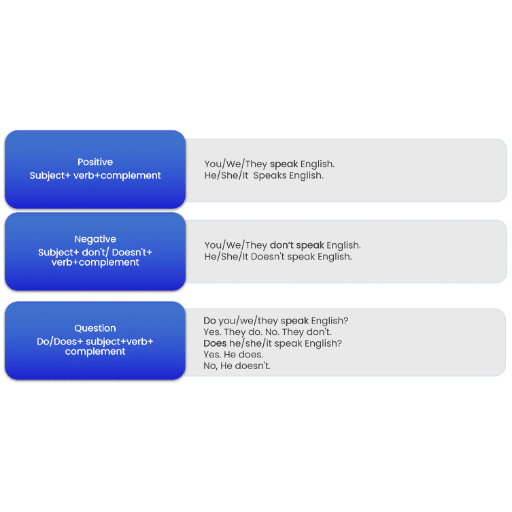
In order to write sentences properly in the simple present it is important for you to follow the right structure as you will see in the following chart:

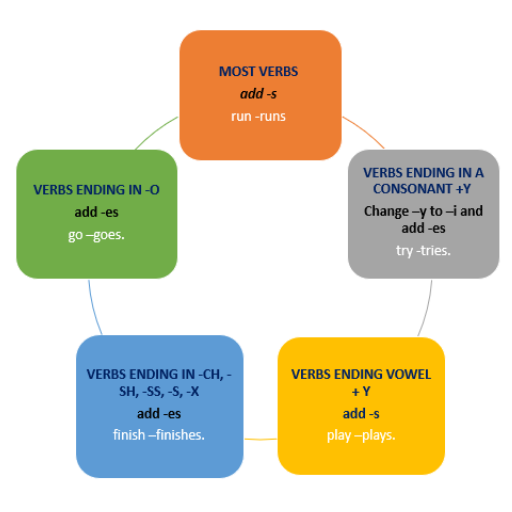
What about the rules (Third person)?
DIALOGUE BLOCK 1
When we meet someone for fisrt time is common to aks about their jobs, hobbies, family, and dreams,
well I´m so happy because I have a new friend now.
I met Lucia in a library last Year. She is a very kind and friendly person. When I saw her for first time, she was a little confusing because the library was full, naturally I offered her my help, because I work there,
and I was free that day. I went there because I whanted to take a especial book to my mother. (Our surprice was, we were looking for the same book).
I decided to take a few minutes for helping her, and I said:
Juan: "Hi, I'm Juan. How are you?" Lucia smiled and replied warml
Lucia"Hello, Juan! Nice to meet you. I´m Lucia
Juan: Is a pleasure to meet you Lucia, Are you ok?, do you need help? because, I work here.
Lucia: thank you for asking me, actually yes, I´m looking for This book
(she Showed me her phone with a picture of the book)
Do you know where It is?
Juan: Yes I do, I´m looking for the same book to my mom, she loves read
Lucia: That´s hilarious, but you know I´m so glad, I´m new in this country, and honestly i don´t know anything about here.
Juan: Don´t worry, also I can help you with that, Will be a pleasure to be your friend. What do you do?
Lucia: Awesome, thank you, and, I´m a teacher, I´m going to start to work a few meters from here.
Juan: Where are you from?
Lucia: I´m from El Salvador
Juan: Well, congrats, I hope you have a good time here. You know what?, we can exchang our contac information and if you need something you can call me.
Lucia: Thank you, that could be nice.
After that day, we are like best friends.
It was great meeting Lucia, and I look forward to sharing more fun moments together in the future.

Block 2
Content 1 - Family gatherings
1.1.1 Apostrophe s – Meanings and uses
1.1.2 Frequency adverbs
Content 2 - Acepting or Declining an invitation
2.1.1 Prepositions of time
Content 3 - Talking About Holidays
3.1.1 Present Continuous
1.1.1 Apostrophe "s" Vocabulary
Apostrophe: a punctuation mark ( ’ ) used to
indicate either possession
Example: Sofia´s parents.
They are Sofia’s parents: That refers they are
parents of Sofia, or they are her parents.
Example: Who are they? They are Sofia´s
parents
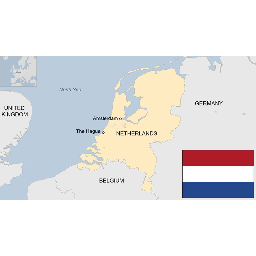
Netherlands: The country name Nederland
(the Netherlands) is Dutch for "low country".
Example: Netherlands is an European
country and is Belgium and Germany's
neighbor.

1.1.2 Apostrophe s – Meanings and uses GRAMMAR
Apostrophe "s" in the possessive form is a punctuation mark used in English to indicate ownership or possession. It is added to nouns, pronouns, or proper names to show that something belongs to or is associated with the person or thing mentioned.

It's quite common to use apostrophe s while discussing relationships with family members.
What does an apostrophe S mean?
The apostrophe + s has 3 different meanings in English:
When an apostrophe S is followed by an adjective like in the first example: -John’s tall.
When an apostrophe S is followed by a past participle like in the second example: -John’s studied.
When an apostrophe S is followed by a noun like in the last
example: -John’s car.
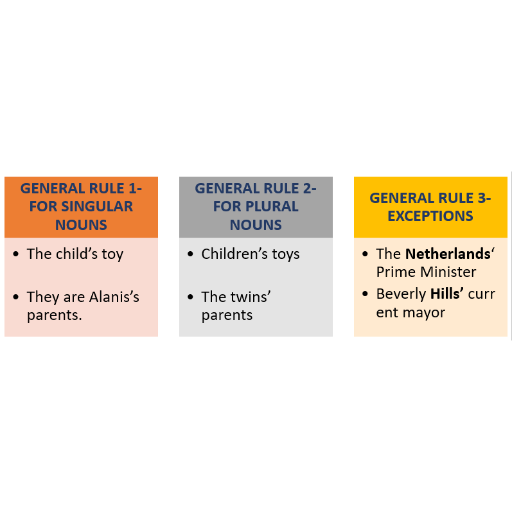
In order to use apostrophe s for possession you must take into account the following information:
1.1.2 Frequency adverbs vocabulary.
-whether: is a conjunction used to introduce a choice between two alternatives or to indicate a condition.
Example: I'm undecided whether to go to the party or stay home and relax.
-convey: means to communicate or express something in a clear and understandable manner.
Example: She used her eyes to convey gratitude since she couldn't speak in that moment.
-She is never in a bad mood: that´s refer to the person to is talking about unussually feel bad, or she don´t have negative emotions.
Example: How many times is she in a bad mood? She is never in a bad mood.
Hardly ever: almost never or rarely.
Example: They hardly ever arrive late to meetings.
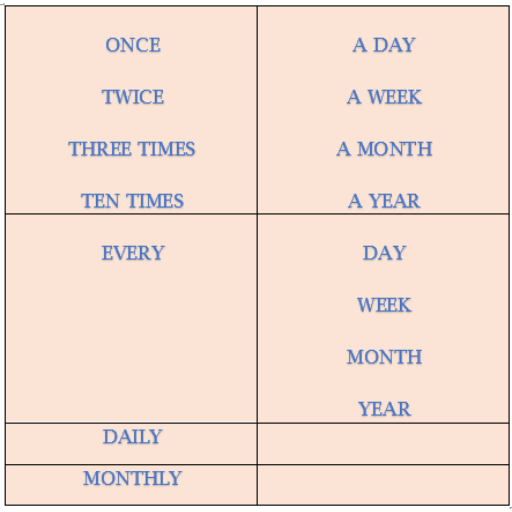
-Twice: It means two times.
Example: I´m doing exercise twice a week

1.1.2 Frequency adverbs grammar.

Important Note:
Frequency adverbs are most used in the simple present because they express occurrence and repetition which is a characteristic of the simple present tense.
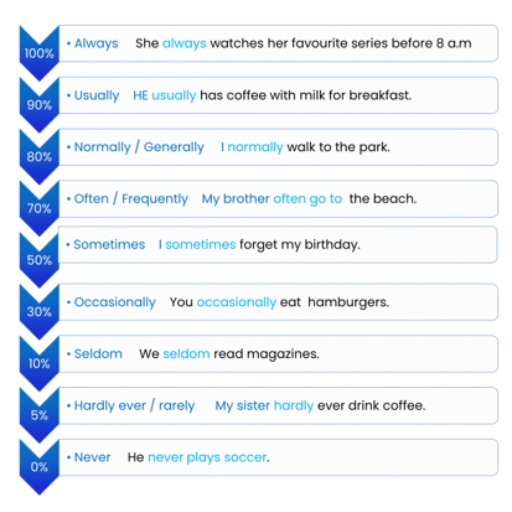
Adverbs of indefinite frequency
These are also known as Adverbs of INDEFINITE frequency as the exact frequency is not defined.
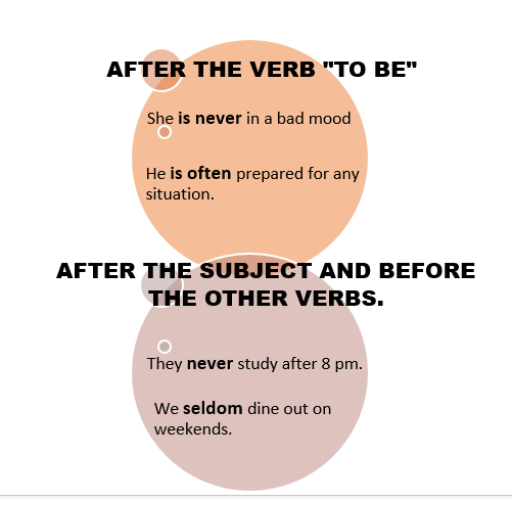
The position of the Adverbs of Frequency depends on the main verb:

IMPORTANT!
We can also use the following adverbs at the start of a sentence (don’t forget to use comma when you place the adverb at the star of a sentence)
Usually, normally, often, frequently, sometimes, occasionally
Examples:
Occasionally, I like to eat pupusas.
Usually, I go to the movies.
BUT we cannot use the following at the beginning of a sentence:
Always, seldom, rarely, hardly, ever, never.
The word “sometimes” can appear in three different positions:
In front of a sentence, in the middle of a sentence, or at the end of a sentence.
Examples:
Sometimes, we practice together.
We sometimes practice together.
We practice together sometimes.


We use hardly ever and never with positive, not negative verbs.
Examples:
They hardly ever come to my parties. Correct.
They don’t never come to my parties. Incorrect.
Adverbs of definite frequency
2.1.1 Prepositions of time Vocabulary
Century: a period of one hundred years.
Example: A century ago most people walked to work.
Age: the length of time that a person has lived
or a thing has existed.
Example: Cavemen lived in the stone age
O'clock: according to the clock, used when
the time is a specific hour.
Example: It's three o'clock in the afternoon.


Christmas: the annual Christian festival
celebrating Christ's birth, held on December
25 in the Western Church.
Example: I have such happy childhood memories
of decorating the house for Christmas
At night: it is during the time when it is dark
and is before midnight.
Example: It's eleven o'clock at night in Moscow


- Full access to our public library
- Save favorite books
- Interact with authors
HLKDGRDHGJDFVBFDVB NBJDFB
- < BEGINNING
- END >
-
DOWNLOAD
-
LIKE(1)
-
COMMENT()
-
SHARE
-
SAVE
-
BUY THIS BOOK
(from $11.59+) -
BUY THIS BOOK
(from $11.59+) - DOWNLOAD
- LIKE (1)
- COMMENT ()
- SHARE
- SAVE
- Report
-
BUY
-
LIKE(1)
-
COMMENT()
-
SHARE
- Excessive Violence
- Harassment
- Offensive Pictures
- Spelling & Grammar Errors
- Unfinished
- Other Problem





COMMENTS
Click 'X' to report any negative comments. Thanks!