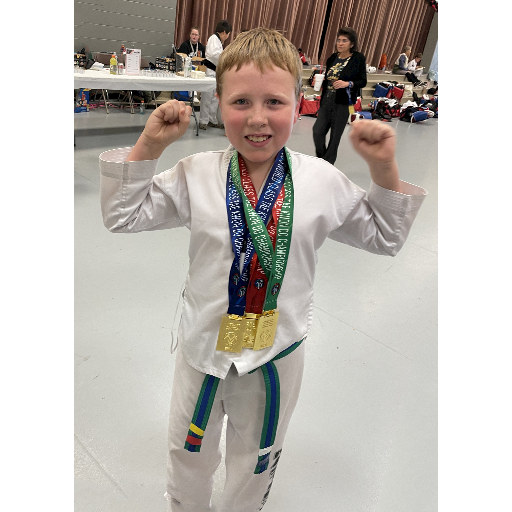
From Grandpa Jamieson

Chapter 1: Hornswoggled!
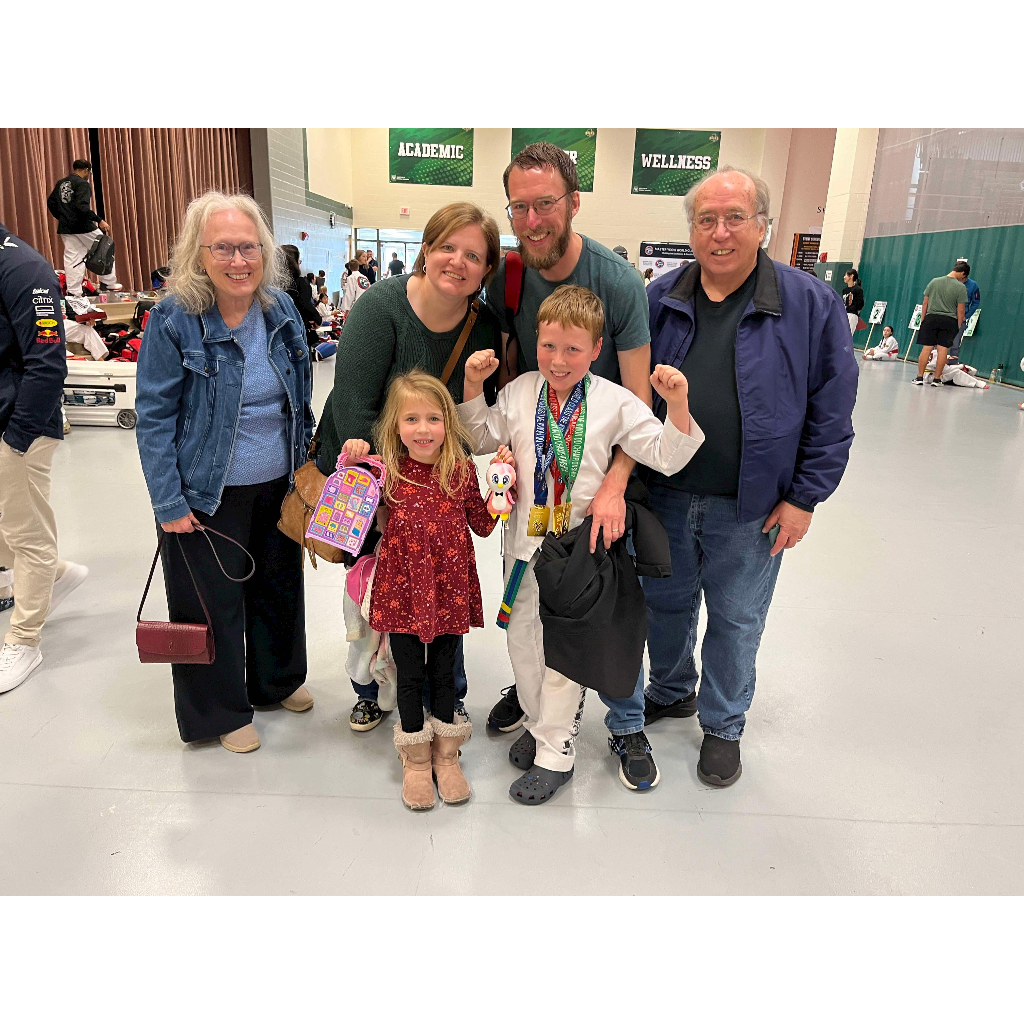
It was a beautiful Saturday afternoon in Indianapolis. The Jamieson family had gathered at a local high school for a Tae Kwon Do contest at which Ollie had scarfed up three medals, so they took the picture on the opposite page. And then, in a flash, everything changed. Suddenly Oliver was inside some kind of very modern and spacious indoor environment. It reminded him of the sorts of futuristic spaceships that he had seen in science fiction movies. "Am I dreaming?" he wondered and then realized that he was not alone.
"Welcome aboard, young man!" exclaimed a man with a crazed look in his eye. "Hello, young man!" shouted a group of children behind him. Wheeling around, he saw about a dozen boys and girls around his age, smiling and laughing.
"What is going on?" asked Oliver. "Who are you people and how did I get here and what do you want?" He wasn't sure whether he should be angry or afraid or perhaps something else. What he actually was, for the most part, was confused.
"Allow me to introduce myself," said the man with the crazed look in his eye. "My birth name is Irving Shmidlap, but my zippy name is Professor Warp Speed. What's your zippy name?"
"Huh?" was all Oliver could say.
"Huh is not very zippy," replied Professor Warp Speed. "How about Tai Kwon Donut?"
"Well, uh, I don't know," mumbled Oliver, still not quite sure what was going on.
"Great!" shouted Professor Warp Speed. "Then Tae Kwon Donut it is! We'll just call you Donut for short." Then, motioning toward the children behind them, he said, "Tae Kwon Donut, this is the Peanut Gallery. Peanut Gallery, this is Tae Kwon Donut."
"Zip! Zip! Zip!" the group shouted. Donut just stood there, still hoping that he would awaken soon from this dream. Or maybe it was a nightmare. But it sure seemed real.
Professor Warp Speed went on to explain that he was from the future, a professor of history at Third Millennium University, and that he was authorized to hornswoggle children from his past - Donut's present - and take them on field trips through time to explore historical events. This trip, a revisiting of natural disasters, was unusual in that it would also involve traveling to the sites of prehistoric events. He noted, however, that with the advent of time travel, there were no truly prehistoric events.
"OK," said Donut when Professor Warp Speed stopped talking to catch his breath. I think I got all of that except the part about you being authorized to hornswoggle children from the past. What is hornswoggling?"
"Well," began the professor, "it means that we freeze time and then walk right up to a person and just carry that person onto the timeship, the craft that we are currently standing in. Then we leave for a trip that may last a few days or even, in some cases, a few months. When we return, we de-hornswoggle the person right back to where and when we originally hornswoggled him. Finally, we get back aboard the timeship and make our escape, unfreezing time as we go. Got it?"
"Sure," replied Donut unconvincingly. He didn't really get it, but so what? After all, this was just a dream, and crazy things are supposed to happen in dreams. Right?
"What happens when everyone realizes that a hornswoggled person is missing?" asked Ollie. "How do you explain that to them?"
"We don't have to explain it," replied the professor. "Remember what I said: we can freeze and unfreeze time. We leave the site of the hornswoggling frozen until we return and place the hornswoggled person right back where he was when we originally hornswoggled him. Then, after making our escape, we unfreeze time. The hornswoggled person will remember everything, but for everyone else it will be as if nothing had happened. It's absolutely seamless."
"Sounds kinda crazy!" said Donut.
"I suppose so," said the professor, "but let me explain what we are trying to do."
"Once we developed the technology to visit the past, we could study it as if it was the present," said the professor, "we could go back again and again, looking at it from different perspectives, noticing things that we might have missed on earlier visits. All of history, including what used to be called prehistory, is now available to us as firsthand experience. And now, my boy, it can all be yours as well."
He went on to explain that this trip would be different from most trips. Instead of starting in the past and coming forward through time, this trip would be done in reverse order. In other words, the most recent events would be visited first and then they would work their way back to the more distant past. Also, because of the nature of the events, they would have to be viewed, to some extent, from Earth orbit. And, he proudly proclaimed, the timeship in which they would be traveling had been upgraded with new technology to reach the very distant past.
Donut was still not completely convinced that what appeared to be happening was really happening, but he decided to play along with it to see where it might lead. There was one thing, though, that didn't sit well with him - that silly zippy name - so he decided to see if he could get a better one.
"Professor Warp Speed, I'm not sure I want to be called Donut. Why did you pick such a silly name? And is there any chance you could give me a better one?"
"Uh, well," said the professor, "I chose that name because my research indicated that you are a bit of a tae kwon do nut, so I just turned 'do nut' into 'donut'. Get it?"
"Well, sure, I get it, but ..." began Donut, but the professor interrupted him with an explanation that left no room for negotiation.
"I'm sorry, son, that you do not like your zippy name, but I cannot change it. Zippy names are like the names of racehorses. Each one is unique and has to be approved by the IZNA, the International Zippy Name Association. I submitted Tae Kwon Donut on your behalf and it was approved. There has never been a Tae Kwon Donut before and there will never be another one. It may grow on you, but whether it does or not, I'm afraid that you are stuck with it."
"OK, professor," said Donut. "So where are we going?"
"Wrong question, my boy," said the professor. "What you should be asking is where and when are we going?"
"OK," replied Donut, "where and when are we going?"
"It's a natural disaster tour, which is all I can tell you at this point. We'll discuss it in more detail soon enough," said the professor. "But first we will have to pick up a few more travelers, so sit back and enjoy the ride. Dinner will be served as soon as we hornswoggle them. In the meantime, my assistant will show you to your quarters."
After Donut was shown his room, he was brought back to the Peanut Gallery and was introduced to several new guests. They all got to know each other over dinner and during the free time following dinner. Finally, Professor Warp Speed told them all that it was time for bed.
"While you are sleeping, we will be travelling back to 1908. This will be the first stop on our natural disaster tour, so I want to be sure that you all get a good night's sleep." And with that, the Peanut Gallery retired for the night.
Chapter 2: The Tunguska Event
In the morning, Professor Warp Speed greeted the Peanut Gallery in the cafeteria. "Good morning, everyone! Today we will visit the site of our first natural disaster. It occurred in Siberia on the morning of June 30, 1908. Does anyone know what it was?"
The Peanut Gallery was silent, so the professor said, "OK, has anyone ever heard of the Tunguska Event?" More silence. Then, from the back of the room, someone asked, "The Tung-what-ska Event?"
"The Tunguska Event," repeated the professor. "I guess I shouldn't be surprised by the fact that none of you have heard of it. Unlike most of the more famous natural disasters, it claimed only three human lives."
"Nevertheless, it was a major event and, had it occurred in a highly populated area, would have been one of the greatest disasters in human history. It is still very interesting and we are going to witness it twice, first on the ground and then again from earth orbit."
"What kind of a disaster was it?" asked a girl from China.
"That's an interesting question, young lady," said the professor. "There were a few witnesses on the ground that morning and their reports led to a lot of speculation by scientists as to just what did happen at Tunguska. We will observe it first on the ground, as they did, and then I will ask you all to come up with your own theories. We'll compare those theories to the ones that scientists came up with in the twentieth century. Then we will observe the event a second time from space."
"Oh, man," moaned Donut, "you didn't tell us there was going to be homework!"
"Don't worry," chuckled the professor, "it will just be for fun. You'll enjoy it, I promise." Then, to the group, he said, "Finish your breakfast and then put on the warm outerwear that we have put in your closets. It will be a bit chilly out there because the event takes place at 7:17 in the morning. It's June 30th - early summer - but this is Siberia, one of the coldest places on the planet."
When everyone gathered in the meeting room, all decked out in cold weather attire, the professor called them to order. We have set the time machine down in a meadow about fifty Kilometers away from where the event takes place. We're just minutes away from the big show, so let's all go outside and get settled in. We have already scanned the area for danger and there is none to be found, so let's go!"
With that, the group descended the steps that took them down to the ground. It was chilly but the sky was clear. The early morning sun, very low in the eastern sky, was shining brightly. All in all, it was a very peaceful scene.
"We've got about five minutes," said the professor once everyone was on the ground.
"Let's move away from the timeship, then form a line, standing side by side but at least six feet apart. Make sure that there are no rocks or other hard objects behind you for about ten feet or so."
"Pourquoi?" asked someone. The professor understood the question, which meant "why?" in French. "You'll see," he answered. "But please speak in English, if you don't mind. This group was selected in part because everyone here is fluent in English and we want to be sure that everyone understands what is being said."
"OK," said the boy from France who had asked the question.
"Now," said the professor, "everyone put on your protective goggles and face this direction. And brace yourselves. In about fifteen seconds, you are going to experience something that you will never forget." As the professor looked at his watch, he began his countdown. " 10 ... 9 ... 8 ... 7 ... 6 ... 5 ... 4 ... 3 ... 2 ... 1 ... 0."
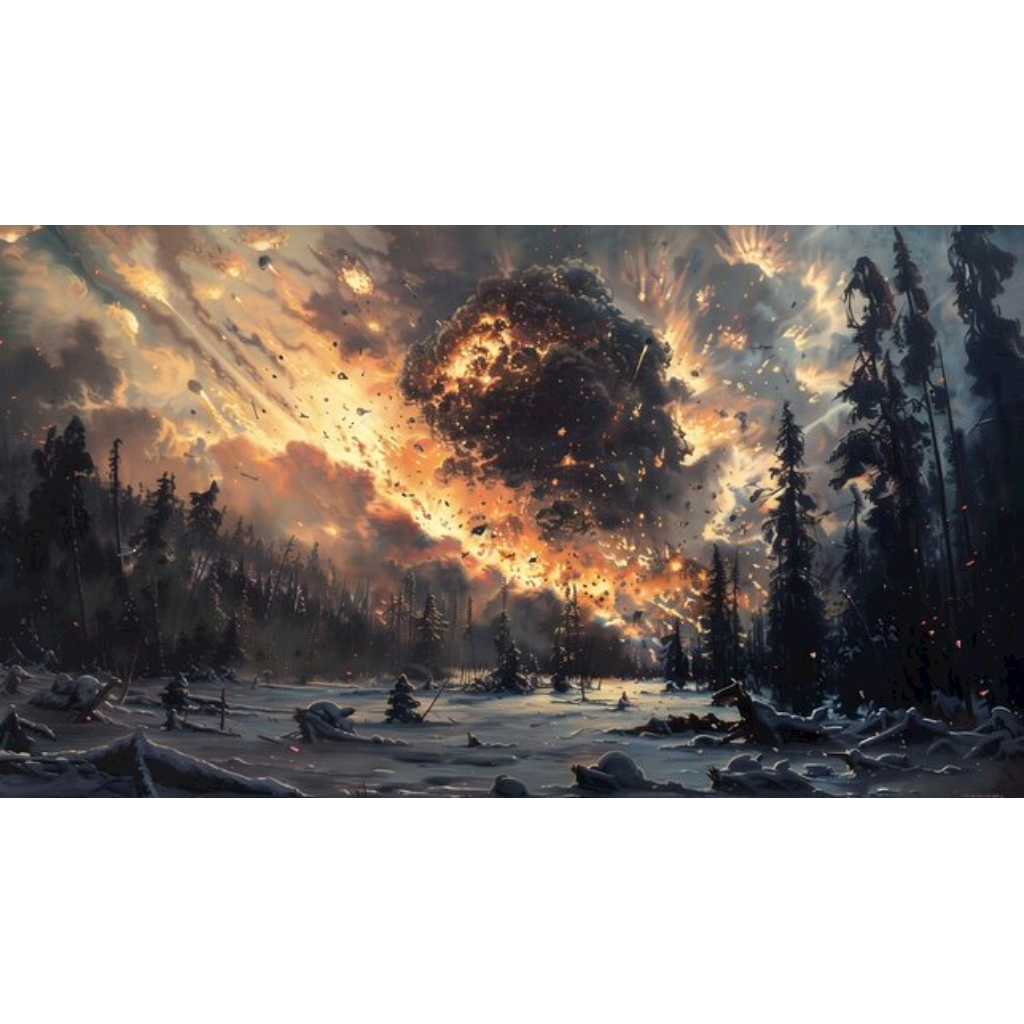
Suddenly, from behind the small group of time travelers, there came a disturbance. It began as a bright bluish-white light high in the northwest sky. It descended for about ten minutes, growing brighter and brighter as it came closer. Before long, it was as bright as the morning sun. A strong wind arose and there was a loud whistling sound as it whooshed by overhead. The ground shook violently as it passed and then it kept going, racing off into the distance.
The object appeared to be roughly cylindrical in shape, trailed by a small dark cloud. A loud series of explosions, a bright flash, and a pillar of smoke and fire appeared off in the distance. A powerful shockwave knocked everyone to their feet, which explained the professor's insistence that they stand in an open area with no rocks or other hard objects behind them. It was a terrifying experience, but the professor quickly assured everyone that there was no longer any danger. It was over.
After a few minutes, the professor asked everyone to climb back into the timeship and they began to survey the area from about five thousand meters in the air. An entire forest had been flattened and it was still burning. The fallen trees were arranged in a concentric pattern around the area where the blast occurred.
"Now," said the professor, "what do you suppose just happened?"
"Was it an atomic bomb?" asked a girl from Japan. "Nope," answered the professor. "Keep in mind that this took place in 1908. The atomic bomb did not exist until 1945."
"Space aliens?" asked a boy from Roswell, New Mexico. Everyone laughed except the professor, who said, "That's not as crazy as it sounds, but no, they were not involved."
"What?" exclaimed Donut, surprised by that response. "Does that mean that you have encountered space aliens in the future?" The professor looked uncomfortable, as if he had accidentally let slip some information about the future that he should not have. He cleared his throat and then said, "I'm sorry, but I cannot answer questions about the future." That led to a flurry of questions from the Peanut Gallery, but the professor would not budge. Finally, he said, "Let's move on. Any more theories as to what might have happened at Tunguska?"
"Was it a volcano?" asked a boy from Australia. "No," responded the professor, "if that were the case, how would you explain the object that flew by overhead?" "Oh, right," replied the boy.
"How about a comet?" asked a boy from Samoa. "That's a good guess," replied the professor. "In fact, many scientists at the time had the same idea, for reasons that we will discuss in a minute. However, that is not correct."
"Anybody else?" asked the professor. "Was it a meteorite?" asked Donut. "Give that boy a hand!" shouted the professor. "It was indeed a meteorite, and a pretty big one at that. In fact, it was the biggest meteorite in all of human history, at least all of recorded history known at that time. A meteorite, as most of you probably already know, is just another name for an asteroid that has entered Earth's atmosphere."
"How big was it?" someone asked. "Well," answered the professor, "as asteroids go it was fairly small, only about 200 feet in diameter, but as meteorites go, that was huge. It flattened trees over a 2150 square kilometer area in a butterfly-shaped pattern."
"When the solar system was being formed, there were a lot of space rocks floating about and crashing into each other. Eventually, as a result of these collisions, planets began to form. As they grew in size, their own gravity crushed them into spherical bodies. The remaining debris continued to rain down on these new planets, leaving vast numbers of craters on their surfaces. Today, we call this the heavy bombardment period. On the earth, those craters were smoothed out by surface erosion. But on the moon, where there is no wind or water, there was no erosion. The scars of that heavy bombardment of the moon remain to this day."
"We can still see evidence of more recent meteor strikes on the surface of the earth. It takes a long time for erosion to eliminate a large crater. There is an enormous crater in Arizona, for instance, and several other less obvious ones can be found if you know what to look for. The more recent craters, of course, are the most obvious."
"The interesting thing about the Tunguska event is that there was no impact crater, causing scientists to speculate that it was a comet rather than a meteor. Since comets are composed mostly of ice, the theory was that when it exploded the ice turned to water or water vapor. In fact, though, it was an asteroid. The reason that it did not form a crater was that it exploded about five to ten kilometers above ground."
"Did anyone know that before time travel was invented?" asked Donut.
"Oh, sure," answered the professor. "This was what is known as an air burst meteorite. It approached Earth at a somewhat shallow angle at very high speed, in this case about 27 kilometers per second or 98,000 kilometers per hour. Because of this, it sailed almost horizontally through the atmosphere and then exploded about five or ten kilometers above ground. Despite the lack of a crater, many fragments were eventually dug out of the ground. In addition, there was evidence of selenium, a substance that does not occur naturally on Earth or in comets but is very common in meteorites. And, of course, now that we have mastered time travel, we have confirmed that the scientists who proposed this theory were right."
"Now," said the professor, "we are going to rewind time, as we like to say, and observe this event from space." Everyone settled in for the rewind and the professor started the engines. Just minutes later, he told them to go to the viewing ports.
"OK," said the professor once everyone was standing before the large glass viewing ports, "we are now in orbit above the earth. If you look to your right you might just be able to able to make out the asteroid as it approaches the earth. It will appear larger as it comes closer and should pass just a few kilometers away from the timeship. When it does, don't blink or you may miss it because it will be travelling very fast. We will follow it as it approaches the blast area but will not follow it down into the atmosphere."
Everything played out just as the professor had anticipated and the children watched as the asteroid entered the atmosphere. When that happens, an asteroid becomes a meteorite, and this one began to glow brightly within seconds of coming into contact with the air. It streaked across the Asian continent, and everyone watched as it exploded above the Tunguska impact site.
"Wow!" exclaimed one boy. "Cool!" said another. Others just watched in awed silence. They could see the fallen trees and the fires that engulfed the area, even from earth orbit.
"I'll bet that is the coolest thing that we will see on this whole trip!" said one girl.
"Don't count on that," replied the professor. "Remember that we are looking at these natural disasters in reverse order, and there's a good reason for that. The further back we go, the better they get. We are saving the best for last!"
"And what might that be?" asked Donut.
"Ah," said the professor, smiling, "you will just have to wait and see."
Chapter 3: The Year Without a Summer
The next morning, the professor set the timeship down on a snow-covered landscape and asked the Peanut Gallery what time of year they thought it was.
"That depends," said the boy from Australia, "on where we are. When it is winter in the northern hemisphere it is summer in the southern hemisphere, and vice versa. It also depends on the latitude, which tells us how far we are from the equator."
"Very good, young man," said the professor. "I'll make it simple: We are in the state of Indiana, in the American midwest, so it's the northern hemisphere. It's high noon, the temperature is 4 degrees Celsius, which is about 39 degrees Fahrenheit, and, as you can see, there is snow on the ground."
"OK," continued the boy from Australia, "then it's obviously winter. My guess would be January or February."
"Donut," said the professor, "you're from Indiana, aren't you?" Donut nodded. "So what do you think? Does January or February sound about right?" Donut nodded again, indicating that he agreed with the boy from Australia.
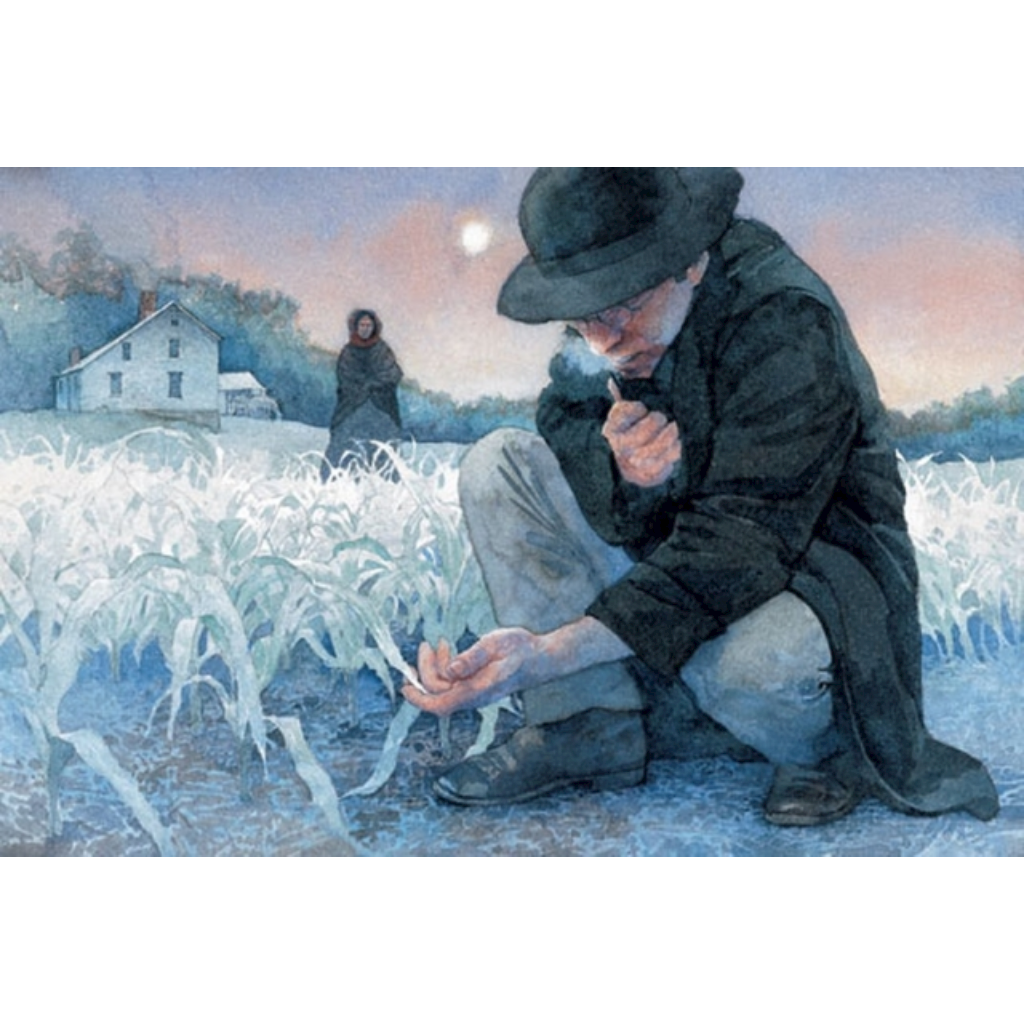
"Wrong-o Bongo!" exclaimed the professor. "It's actually July, and the year is 1883, known to history as the year without a summer. Now, the question is, why was there no summer that year?"
No one had any idea, so the professor said, "Tambora. Does that ring a bell?" Again, there was no response from the Peanut Gallery.
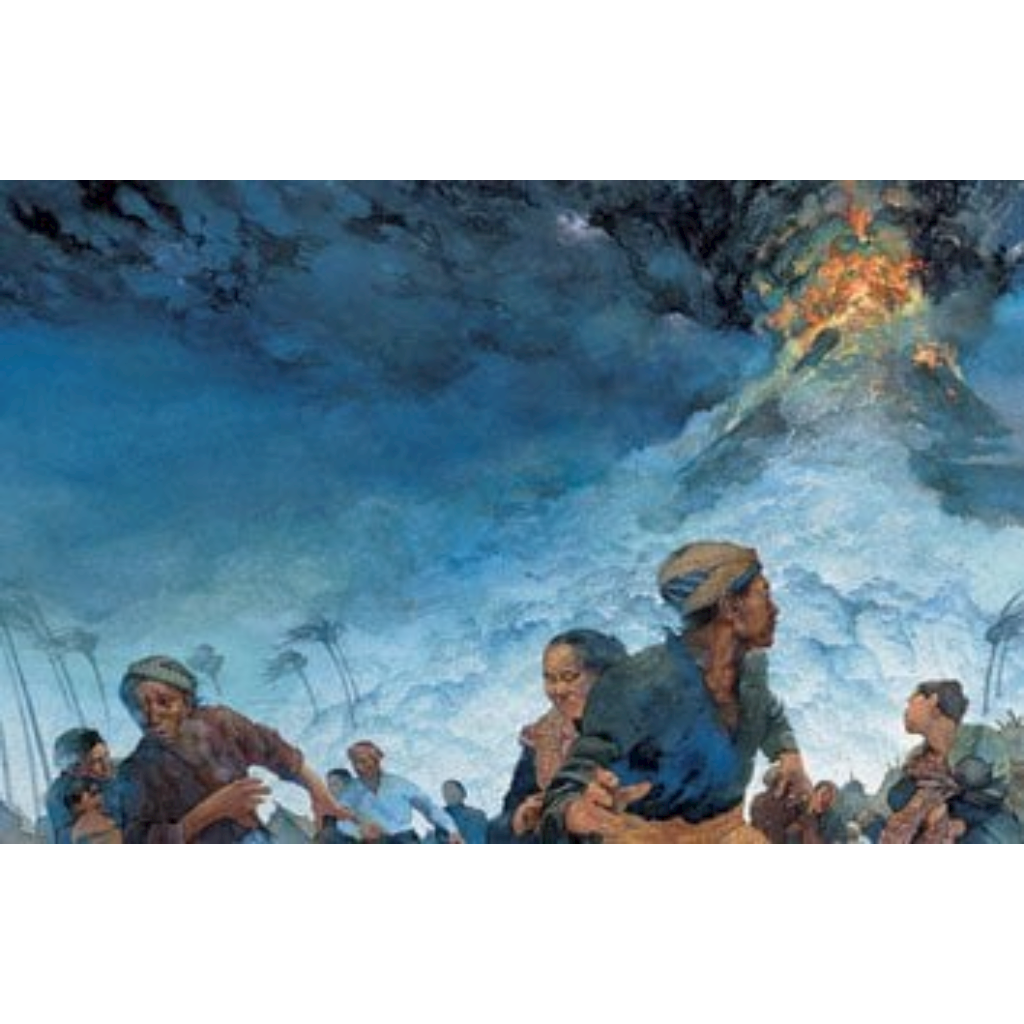
"Tambora," continued the professor, "was a volcano in the Philippines, which is located in the Pacific Ocean just off the coast of Asia. This was the biggest volcanic eruption in what you know as recorded history and one of the biggest ever. It hurled so much dust and gas into the atmosphere that it covered the entire globe, blocking out the sun and creating a summer that was so cold that it seemed like winter. The winter, too, of course, was much colder than normal. These effects persisted for an entire year, resulting in crop failures and starvation in many parts of the world."
They flew over many of the countries that were so severely affected and saw the devastating effects of the eruption. The professor told them that the world quickly recovered the following year and soon it was all forgotten. That was especially true in North America and Europe, where the Industrial Revolution was in full flower and it was beginning to seem that nothing was impossible.
"Now that you have experienced the effects of the Tambora eruption at ground level," said the professor, "we will watch the whole spectacle enfold from earth orbit. We will watch it all in what I call fast forward mode. In other words, we will travel through time at an accelerated pace so that we can watch the eruption and all of its consequences in just a few minutes. Days will pass in mere seconds, including the daily transition from day to night and back again. Ready?"
"Yes!" everyone shouted as they rushed to the viewing portal, a huge window on the side of the timeship. Within minutes, they were in orbit and the professor put the timeship in fast forward mode. Everyone watched as Tambora darkened the skies and the thick dust encircled the earth. Peering through the dust, they watched as snow fell to the ground and remained there for long periods of time. Gradually, the dust settled and things began to return to normal.
Chapter 4: The Ice Age
"Several times in the history of this planet," said the professor at breakfast, "we have experienced ice ages, especially pronounced in the northern latitudes. Great glaciers formed, 3 to 4 kilometers (2 to 2.5 miles) thick, and they pushed southward from the polar regions to cover large portions of the European, Asian, and North American continents. Once established, these great sheets of ice remained for about 11,000 years. It was milder in the southern hemisphere, mainly due to landmass distribution and the effects of ocean currents."
"The water to form these glaciers came from the oceans in the form of snowfall, and as a result sea levels dropped about 120 meters (400 feet). This exposed a lot of land that today is under water. When the ice age ended, this land was submerged again."
"Are we going to visit the Ice Age?" asked someone in the back.
"Yes, we are!" answered the professor. "Do any of you have any questions about the Ice Age?" A half dozen hands flew up. "Yes," said the professor, pointing to a girl in the front row.
"Were there any people living in the Ice Age?" she asked.
"Indeed there were," said the professor. "In fact, there were several species of humans at that time. In addition to homo sapiens - us - there were the Neanderthals, mostly in Europe, and the Denisovans, mostly in Asia. There were several other human species on the earth as well in those days. Today, we are the only surviving species, but many of us have some Neanderthal or Denisovan DNA.
"So we're part cave man?" asked a boy from the back.
"Yes," answered the professor, "I suppose you could put it that way."
"What caused the Ice Age?" asked Donut.
"Ah! Great question!" said the professor. "Actually, there were a series of ice ages, not just one. They were caused by what are known as Milankovitch Cycles. These are cyclical changes in the earth's orbit, which alter the amount of solar radiation reaching different parts of the planet. These cycles last about 20,000 years and include both a cooling period and a warming period. Then the cycle repeats. We are currently in one of the warm periods, but it will not last forever. There should be another Ice Age in a few thousand years or so."
"Were there dinosaurs during the Ice Age?" asked a boy in the middle row.
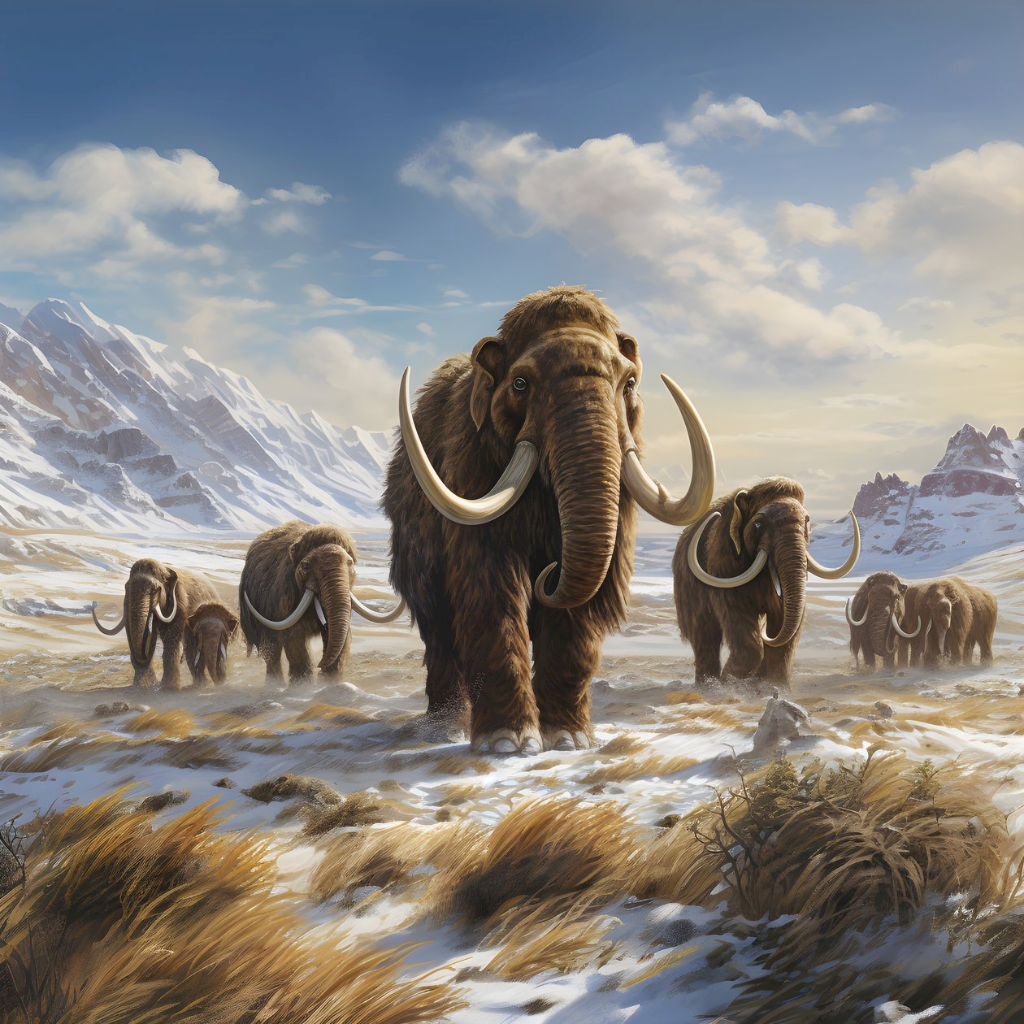
"Nope," said the professor. Noticing the look of disappointment in the boy's eyes, he added, "but there were woolly mammoths, saber-toothed tigers, and other megafauna. Their massive size helped to insulate them from the cold."
After a moment of silence, it appeared that there were no additional questions, so the professor said, "Alright! Let's finish breakfast and then we will begin to see the real thing, the Ice Age as it really was."
As everyone lined up at the timeship's huge viewing port, the professor said, "We are currently in orbit around the earth at the very height of the last Ice Age. As you can see, a large portion of the northern hemisphere is buried under the ice."
"Are we going down to the surface?" asked one of the children.
"Yes we are," answered the professor. "Keep in mind that it is very cold out there. In addition to that, there are a lot of very hungry animals out there, including a number of very large and dangerous predators. I will be scanning the area for megafauna, some of which we might be happy to see. We might even locate a small group of Neanderthals, so I will put the ship into incognito mode."
"What is incognito mode?" asked Donut.
"It means that we will be running in silent mode and cloaked for invisibility," replied the professor, "so that they cannot detect our presence."
"Cool," said Donut. Nothing seemed impossible anymore in this futuristic timeship.
About fifteen minutes later, the timeship set down onto the icy surface and the professor stood up to make an announcement. "We are near the southern edge of the ice and will be leaving the timeship here as we proceed to the non-glaciated areas below. We will board a smaller shuttle craft that will take us to see a herd of woolly mammoths and a Neanderthal village. If we're lucky, we might even get to see a mammoth hunt. In order to do all of this, we will have to pass ourselves off as a group of early homo sapiens, which means that we will have to dress like them. Fortunately, we will be able to do that without freezing. We are not quite as tough as these people, who have adapted to the cold, but we have developed a warming pill that will cause our metabolism to generate enough heat to keep us warm. It will allow us to wear the animal skins just for show."
"Are the Neanderthals dangerous?" asked someone. "No. Not this group anyway. We have visited them several times on previous trips. They believe that I am the leader of a group of early homo sapiens and I have always gotten along well with the Neanderthals in this area."
"Do they speak English?" asked a girl from Australia, causing a ripple of laughter from the Peanut Gallery.
"No," said the professor, smiling. "English did not exist in their world, and it would be many thousands of years before it would. By that time, the Neanderthals were gone and homo sapiens had populated all of Europe and Asia. We still don't know for sure why the other human species disappeared, but we are still researching that. Time travel will surely lead us to the answer."
"The Neanderthals and the early Homo sapiens in this area had their own languages, but it appears that they were able to learn enough of each other's language to enable them to communicate and trade. There was even a bit of intermarriage between the two groups. Their children were part Neanderthal and part homo sapiens. You might be surprised to know that most modern humans with European ancestry have some Neanderthal DNA."
Everybody took their warming pills and donned their animal skins. They boarded the shuttle and flew down to the surface beyond the glacier. Stepping outside for the first time, they were surprised at how cold it was. "It will take a few minutes for the warming pills to really kick in," said the professor. "In the meantime, I will turn on the shuttle's invisibility shield and we will head out toward the Neanderthal village."
Once outside, the group began trudging through the ice and snow toward the village. As they walked, the professor began talking about the people they were about to meet. The Neanderthals were well-suited to the cold, far more so than the homo sapiens who had ventured north from Africa. Nevertheless, it was the homo sapiens who survived when the glaciers retreated as the world began warming again.
"We will be able to converse with this group," said the professor. "At least I will because our artificial intelligence has been able to decipher their language. I have learned a bit of it, just enough to communicate the essentials with them. It would not have been uncommon in those times for the various tribes to have a limited understanding of each other's languages, so that will not seem unusual. I will translate for the rest of you. That would not be unusual either."
As the little group approached the top of a small hill, they began to hear a rumbling sound. It grew steadily louder until someone asked, "What is that, professor?" Before he could answer, a large hairy elephant-like beast with huge tusks charged over the hill, followed by another and another and another, all heading directly toward the group. They were woolly mammoths!
As the group stood stunned, watching the small herd of about fifteen bearing down on them, Professor Warp Speed pulled a small device from a hidden pocket inside his animal skin. He quickly pushed a button. When the lead mammoth got within about twenty feet of the group, it suddenly hit what appeared to be an invisible wall. The professor turned around, beaming triumphantly, and exclaimed, "Force field! An invisible protective dome! It's brand new and has never been tried in the field before. By golly, it works!"
They watched as several more of the beasts slammed into the force field, but they all quickly returned to their feet and ran off as if they were in a panic about something. The professor had a pretty good idea what that something was. "I would bet dollars to donuts that they are fleeing human hunters, and since we are very close to a Neanderthal village, we are probably going to encounter our Neanderthal friends a lot sooner than we anticipated."
No sooner had he said that than a small group of Neanderthal hunters came running over the hill. The professor quickly brought down the force field and began waving at them. They approached the group and smiled, suggesting that they already knew the professor. They were shouting excitedly and gesturing in the direction of the fleeing mammoths. Were they inviting the professor and his friends to join the hunt?
Following a brief discussion with the Neanderthals, the professor confirmed that he had been invited to join the hunting party. It would be a great honor and might be regarded as a serious breach of etiquette to decline, so the professor nodded in agreement.
Turning to the Peanut Gallery, he quickly explained the situation and slipped the remote control for the force field to Donut. "You're in charge while I'm gone," he said. "Use this button to put the force field up and keep it in place until I return. It could be an hour or more." Donut nodded in agreement.
As the professor and the Neanderthals ran off in the direction of the herd, Donut raised the force field. "Well, what do we do now?" asked someone. "Tell stories?" suggested Donut. And that's just what they did.
Hours passed and the sun was hanging very low in the sky. It would be dark soon and everyone began to worry. It was also getting colder and effects of the warming pills were beginning to wear off.
"I hope the professor is OK," said one of the girls with a worried look on her face. "Should we try to return to the shuttle?"
"No," said Donut after thinking about it for a while. "The professor knows where we are and I'm sure that he will be back."
"Yeah," said a boy, "but he said he would only be gone for an hour. It's been several hours, most of the day, actually. Maybe we should return to the ship while it's still daylight and before we freeze to death."
"He said that it could be an hour or more," replied Donut.
"But it's been much longer," said the boy. "Let's go back to the shuttle."
"Alright," said Donut, "let's take a vote." Everyone agreed and they voted overwhelmingly to return to the shuttle.
"How are we going to find it?" asked the girl who started the discussion. "The professor turned on the invisibility shield, remember?"
"We'll just follow our footsteps," replied Donut. "When we reach the end of the trail, we will be at the shuttle." And with that, Donut took down the force field and the little group set out for the shuttle.
When they reached the end of the footsteps, they knew that they had reached the shuttle. Donut began inching toward it, being careful not to bang his head on the metal. Finally, with his hand outstretched, he felt the fuselage. "Here it is!" he shouted. "Does anyone remember where the door was?"
"Uh-oh," said someone. "That could be a problem. It will be at the top of the stairs that we came down, so let's find those. But what if the professor locked the door?"
"That would be bad," agreed Donut, "but let's solve one problem at a time."
Stumbling around the shuttle, one of the boys shouted "Ow!" as he banged his knee on the metal steps. "I found them!" he yelled and everyone began to converge on the area. Climbing up the steps, he reached the door and found the latch.
"It's locked!" he yelled in disappointment. Everyone else groaned. "Now what?" said someone.
After a few minutes, Donut had an idea. "Hey, this remote that the professor gave me has a lot of buttons. Maybe it can unlock the door!"
"Yeah!" said several voices in the crowd. "Are the buttons labeled?" someone asked. Donut looked at the buttons and replied, "Well, they are all labeled by symbols, not actual words. We are going to have to be careful because I'm not sure what these symbols mean and this remote may do a lot of things that we don't know about."
"Well, we have to do something!" said a girl in the crowd. "Look for a key symbol or something like that."
"OK," said Donut. "This looks sort of like a key symbol. Let's give it a try."
Everyone held their breath as Donut pushed the button. The door didn't unlock, but the shuttle instantly reappeared. Obviously, that button was for the invisibility shield. On a hunch, Donut pushed it a second time and the shuttle disappeared. A third push brought it back. "Aha! These buttons are on-off switches!" proclaimed Donut.
Donut tried several other buttons, most of which had no obvious effect, but was careful to push each one a second time to reset whatever it had changed to its previous condition. Finally, he pushed a button and heard the door unlock. "Yes!" he shouted. Everyone clambered up the steps and back into the shuttle. Then Donut pushed the button to make the shuttle invisible once again and everyone settled in to wait for the professor's return.
After a couple of hours, there was a knock at the door. Donut opened it and there was the professor, beaming with pride. "We've been invited to a mammoth roast!" he proclaimed. "Everybody, take another warming pill and let's head over to the Neanderthal camp."
"Now?" said somebody.
"You're hungry, aren't you?" said the professor.
"Yes!" shouted the entire Peanut Gallery. "We're starving!"
"Then let's go," said the professor. And off they went into the icy darkness, holding primitive torches to light the way.
Off in the distance, they heard wolves howling, which sent chills down their spines. "Don't worry about the wolves," said the professor. "Remember that we still have the remote, so we can throw up a force field anytime we need it. You do have it, don't you, Donut?"
"Uh," said Donut. "Didn't I give it back to you?"
"No," said the professor, "I don't believe so. Check your pocket."
"What pocket?" exclaimed Donut. "I'm wearing an animal skin!"
"Got ya!" laughed the professor. "I've got the remote."
"Not funny!" yelled everyone, especially Donut. But they were glad that the professor had the remote.
After about fifteen minutes, the group arrived at the Neanderthal camp. In the camp there was a group of about 35 people, including men, women, and children. Some of the adults appeared ancient, but the professor explained that even the oldest ones were only bout 40 or 45 years old. The professor explained that the Neanderthals led a tough life, especially in these icy conditions.
The village itself consisted of a few huts constructed of mammoth bones and tusks with animal skins draped over them. There was a huge bonfire and they were roasting large chunks of mammoth meat. "Mmmm!" said the professor, "that smells delicious!"
- Full access to our public library
- Save favorite books
- Interact with authors
- < BEGINNING
- END >
-
DOWNLOAD
-
LIKE(1)
-
COMMENT()
-
SHARE
-
SAVE
-
BUY THIS BOOK
(from $15.99+) -
BUY THIS BOOK
(from $15.99+) - DOWNLOAD
- LIKE (1)
- COMMENT ()
- SHARE
- SAVE
- Report
-
BUY
-
LIKE(1)
-
COMMENT()
-
SHARE
- Excessive Violence
- Harassment
- Offensive Pictures
- Spelling & Grammar Errors
- Unfinished
- Other Problem






COMMENTS
Click 'X' to report any negative comments. Thanks!