 To Trenton and Parker
This book was created and published on StoryJumper™
©2014 StoryJumper, Inc. All rights reserved.
Publish your own children's book:
www.storyjumper.com





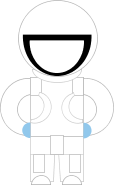

 I'm Ali
 I'm Andy






2

Can you guess where we are going on a trip today?
That's right! Outer space!
We are dressed like astronauts!
An astronauts job is to explore our solar system.
Come on a trip with us while we learn about the planets
in our solar system just like astronauts!
3



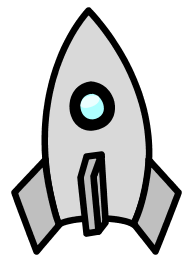





 All aboard the rocket ship!
4
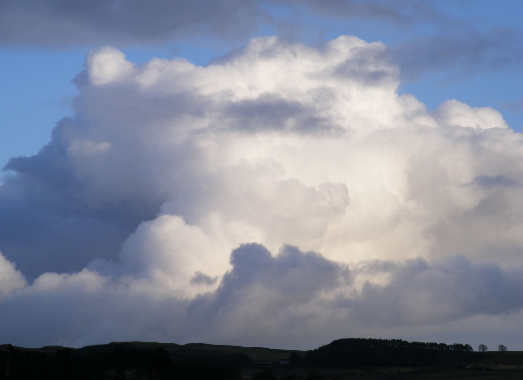

 Let's count down...
 10 9 8 7 6 5 4 3 2 1
 Blast off!
5
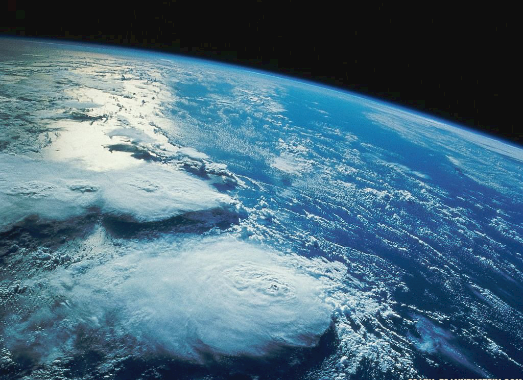

 We fly up high until we leave
Earth's atmosphere.
 The atmosphere is a layer of gases
that surround the Earth.
 The atmosphere protects us from
 harmful radiation from the sun.
6


 Our solar system is made up of the sun, nine planets, and
 their moons.
 Our solar system is part of the spiral galaxy
 known as the Milky Way.
 First we will fly to the sun! We will have to pass two
 planets: Mercury and Venus. We will explore them later!
7
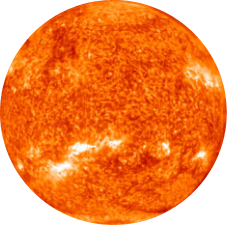

 The sun is a star found in the
 center of our solar system. It is a
big ball of burning gases.
 The temperature of the sun's
 surface is around 10 million
degrees fahrenheit. That is hot!
The hottest it's ever been on the
surface of the Earth is only 134
degrees fahrenheit.
 The distance between the Earth and the
Sun is almost 93 million miles!
 Compared to Earth, the sun is huge!
It would take 1.3 million Earth's to
fill up the sun!
8


 Now let's fly to Mercury!
 The planet closest to
the sun.
9
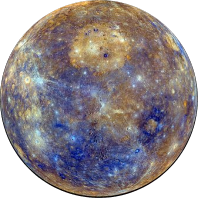

 Mercury is the smallest planet
and closest to the sun.
 Mercury turns very slow.
On Earth it takes 24 hours to go
from day to night, but on Mercury
it takes about 59 days!
 Mercury has no moons.
 Mercury has no atmosphere to protect
 it from the sun. It's surface is very dry
and covered in craters.
 The sunny side of Mercury gets as hot as 750 degrees
fahrenheit. The dark side of mercury gets as cold as
-328 degrees fahrenheit.
10
 Now let's fly to Venus!
 The planet in between Mercury
and Earth!

11

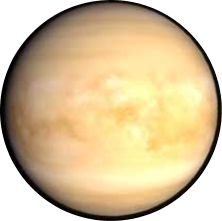
 Venus is the brightest planet in the
 solar system.
 Venus has no moons.
 Planet Venus is closest to the Earth
and is just a little bit smaller than
Earth. The diameter of Earth is
7,928 miles and Venus is 7,520 miles.
 Venus is 67 million miles
from the sun.
 Venus is the hottest planet in the
solar system, even though Mercury is
closest to the sun. The surface of Venus
is about 860 degrees fahrenheit.
12
 The next planet is our home planet Earth. It is in
 between Venus and Mars. Let's learn some more about
our home!

13
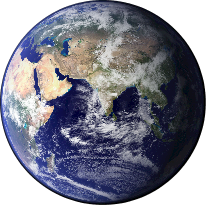

 The Earth is 93 million miles
from the sun.
 Planet Earth has one moon.
It's name is Luna.
 The Earth's diameter (the distance around
the middle of the Earth) is 7,928 miles.
 It takes 365 1/2 days for the Earth
to orbit the sun.
 About 71% of the Earth's
 surface is water.
14
 Now let's fly to Mars!
 The planet in between Earth
and Jupiter.

15
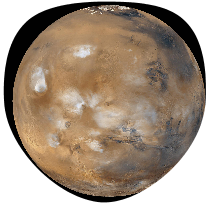

 Mars is almost 142 million miles
from the sun.
 Mars is often called "The Red Planet",
 because of a red-tinted mineral called iron
oxide on its surface.
 It takes 1 year and 320 days for Mars to
orbit the sun, but only 24 hours and 39
minutes to go from day to night.
 Mars has seasons like Earth, but it has no
 atmosphere to store heat from the sun, so in
the summer it only gets to 23 degrees fahrenheit.
 Mars has two moons: Phobus
 and Deimos.
16
 The next planet is Jupiter.
To get to Jupiter we have to first
fly through the Asteroid Belt!

17
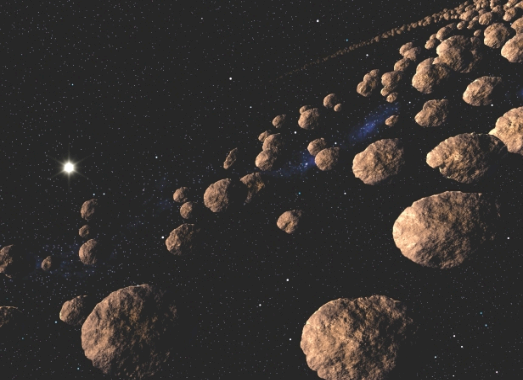
 Most of the asteroids in our solar system are located in the
 Asteroid Belt between Mars and Jupiter. Asteroids are different sizes
and made of rock and metal.
18


 Help us get from
 Mars to Jupiter!

 Use your finger to trace the path through the asteroids.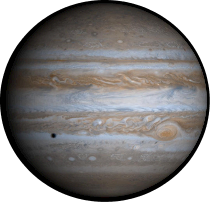


19
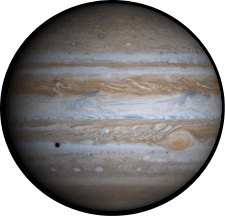

 Jupiter is about 483 million miles
from the sun.
 Jupiter is the largest planet. It's
diameter is 88,700 million miles.
 It takes 11.9 years for Jupiter to
orbit the sun.
 Jupiter spins much faster than Earth.
It only takes about 9 hours to make a
complete turn on its axis.
 We made it!
 The fast spinning creates lots of strong
weather. Jupiter is the stormiest planet.
Jupiter has a permanent whirlpool of
storms called "The Great Red Spot."
 Jupiter has 64 moons!
20
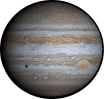
 Now let's fly to Saturn!
 The planet in between
Jupiter and Uranus.
21
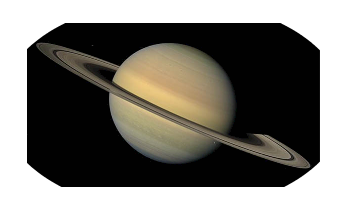

 Saturn is surrounded by rings which
 are made of dust, rock, and ice.
 Saturn has 18 moons.
 Saturn is the second largest planet
 in the solar system. It's diameter is
75,098 miles.
 Saturn is 886 million miles from the sun.
 It takes Saturn 29 1/2 years to
orbit the sun and 10 hours to make a
complete turn on its axis.
 Since Saturn spins fast like
 Jupiter, there are very strong
storms on Saturn too.
22
 Now let's fly to Uranus!
 The planet in between
Saturn and Neptune.
23

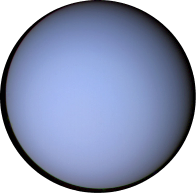
 Uranus is 1.8 billion miles from the sun.
 The diameter of Uranus is 29,297 miles.
 Uranus has rings like Saturn, but
they are hard to see and scientists
do not know what they are made of.
 It takes Uranus 84 years to orbit
 the sun and 17.9 hours to make a
complete turn on its axis.
 Uranus is mostly made of
frozen gases.
 Uranus has 27 moons.
24
 Now let's fly to Neptune!
 The planet in between
Uranus and Pluto.

25
You've previewed 25 of 38 pages.
To read more:
Click Sign Up (Free)Benefits:
- Full access to our public library
- Save favorite books
- Interact with authors
26

READ

- < BEGINNING
- END >
-
DOWNLOAD
-
LIKE(110)
-
COMMENT()
-
SHARE
-
SAVE
BUY THIS BOOK (from $7.59+)
-
BUY THIS BOOK
(from $7.59+) -
BUY THIS BOOK
(from $7.59+) - DOWNLOAD
- LIKE (110)
- COMMENT ()
- SHARE
- SAVE
- Report
Liked By
X
Encourage this author
-
BUY
-
LIKE(110)
-
COMMENT()
-
SHARE
Problem with this book
X
- Excessive Violence
- Harassment
- Offensive Pictures
- Spelling & Grammar Errors
- Unfinished
- Other Problem
Which pages have problems?
Please describe the problem:
left text
right text
"Ali & Andy's Trip Through Space"
Join Ali and Andy as they journey through space and discover the planets like astronauts!
(39 pages)
Privacy level:
PUBLIC
2112 reads
110 fans
Report





COMMENTS
Click 'X' to report any negative comments. Thanks!