TEACHING EXPERIENCE
YEAR 4
NAME: Sinenjabulo Dladla
ST NO: ST10091301

lassroom Managaement


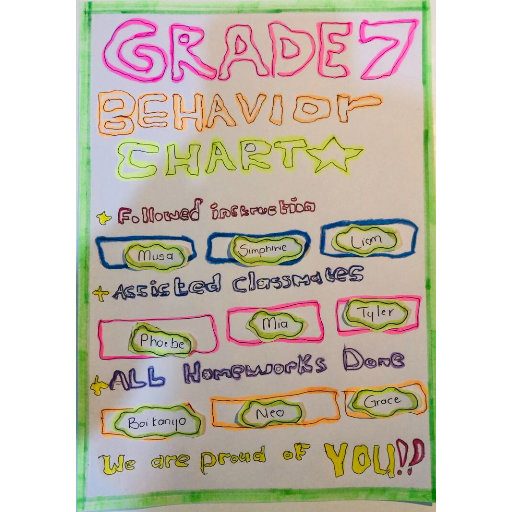
My classroom management tool the Grade 7 Behavior Chart; is based on positive reinforcement and draws upon Behaviorist Theory by B.F. Skinner and Choice Theory by William Glasser.
According to Skinner’s Behaviorist Theory, desired behaviors can be strengthened when followed by a positive consequence (Woolfolk, 2016). The chart rewards learners for specific behaviors such as following instructions and assisting classmates, thus reinforcing and encouraging those actions in the future.
Furthermore, the tool is informed by Glasser’s Choice Theory, which emphasizes the importance of internal motivation and personal responsibility for behavior
(Glasser, 1998). By giving learners agency to choose their behavior and see the results of those choices publicly celebrated, the chart fosters self-regulation and responsibility.
This tool avoids punitive measures and instead creates a positive and respectful classroom culture, promoting intrinsic motivation, belonging, and achievement (Glasser, 1998).
The Grade 7 Behavior Chart is a colorful and visible classroom display, divided into three behavior categories
How the Tool Works
During the week, I observe learner who demonstrate these behaviors.
At the end of each week, their names are added to the relevant section of the chart.
Verbal praise is given in class to reinforce the positive behavior.
The tool is non-punitive; learners not listed are encouraged to reflect and try again next week. This approach supports a positive, strengths-based classroom environment where learners are guided to meet behavioral expectations through motivation and recognition.
Successes of the tool
- Learners were excited and motivated by public recognition.
- Positive behaviors such as peer assistance increased.
- Learners began self-monitoring their actions, aiming to be recognized.
Challenges of the tool
- Some learners felt left out if not recognized initially, which required sensitive handling and explaining that the chart rotates weekly.
- Maintaining consistency in tracking behaviors was time-intensive.
- A few learners relied on external validation, which highlighted the need to pair this tool with strategies that build intrinsic motivation (Glasser, 1998).
urriculum Vitae

https://www.canva.com/design/DAGzHh6YtrE/_jPsBaROxEYkyDSuV8yyVA/edit?utm_content=DAGzHh6YtrE&utm_campaign=designshare&utm_medium=link2&utm_source=sharebutton
inkedIn
https://www.linkedin.com/in/sinenjabulo-dladla-a80115371/

- Full access to our public library
- Save favorite books
- Interact with authors

- < BEGINNING
- END >
-
DOWNLOAD
-
LIKE
-
COMMENT()
-
SHARE
-
SAVE
-
BUY THIS BOOK
(from $2.99+) -
BUY THIS BOOK
(from $2.99+) - DOWNLOAD
- LIKE
- COMMENT ()
- SHARE
- SAVE
- Report
-
BUY
-
LIKE
-
COMMENT()
-
SHARE
- Excessive Violence
- Harassment
- Offensive Pictures
- Spelling & Grammar Errors
- Unfinished
- Other Problem

COMMENTS
Click 'X' to report any negative comments. Thanks!