In this article, we will tell the life and achievements of Türkiye's founder Mustafa Kemal Atatürk.

Created & published on StoryJumper™ ©2026 StoryJumper, Inc.
All rights reserved. Sources: storyjumper.com/attribution
Preview audio:
storyj.mp/afytuibfw3ks
Atatürk, who changed the fate of the Turkish nation, was born in 1881 in Thessaloniki, where new ideas and political movements found great echo. There is no definite information about the month and day of his birth. His father, Ali Rıza Bey, was a forward-thinking man who said, "It is necessary to learn to read in order to become a man. There is no other way." His mother, Zübeyde Hanım, was an intelligent, sensible and traditional Ottoman woman. His siblings Ahmet, Ömer and Naciye passed away at a young age. Makbule Hanım is his only sister.
2
3
Atatürk's schools of education are as follows; he received his primary education at the Neighborhood School and Şemsi Efendi School, his secondary education at the Selanik Mülkiye Rüştiyesi and the Selanik Military Rüştiyesi, his high school education at the Manastır Military High School, and his university education at the Military Academy and War Academy in Istanbul. When he graduated from the Military Academy in 1902, he received the rank of lieutenant, and when he graduated from the Military Academy in 1905, he received the rank of staff captain.
4
Mustafa Kemal, who graduated from the War Academy with the title of captain, was first assigned to Damascus. The years he started his duty were the most turbulent years of the Ottoman Empire. He and his friends searched for solutions regarding the painful process they were in. For this purpose, he founded the "Vatan ve Hürriyet Cemiyeti" in his first duty station. However, he could not find the working environment he expected in this geography. When he secretly came to Thessaloniki, he joined the Committee of Union and Progress. In the following years, . As an Ottoman officer, he had to struggle
5
with colonialism, nationalism, minority rebellions and political turmoil in the lands of the empire that was living its last century. He participated in the Tripoli War, the Balkan Wars and World War I. Mustafa Kemal was assigned to the 5th Army in Damascus in 1905 and to the 3rd Army in Macedonia in 1907. While he was on duty in Monastir and Thessaloniki, he took part in the Action Army that suppressed the uprising in Istanbul (March 31 Incident) in 1909 and the uprising was successfully suppressed in a short time. He participated in the operation to suppress the Albanian rebellion.
6
In 1911, he was sent to Tobruk after Italy landed troops in Tripoli. After successfully commanding the Turkish forces in Tobruk and Derna, he participated in the Balkan War in 1912-1913 with the rank of major; he served in the corps that recaptured Edirne from Bulgaria. He was an attaché in Sofia in 1913-1915. In World War I, in 1915, he participated in the Battle of Çanakkale as the Commander of the 19th Division. He successfully stopped enemy attacks in Gallipoli; he gained fame as the "Hero of Anafartalar".
7
8
In 1916, he was appointed as Corps Commander to the Eastern Front and promoted to the rank of General. Mustafa Kemal, who stopped the Russian attacks, took back Bingöl and Muş from the enemy. In 1917, he was appointed as the 7th Army Commander in Palestine and Syria. In the same year, he went to Germany with Crown Prince Vahdettin. He conducted inspections at the German General Headquarters and the German war fronts. In 1918, while he was the 7th Army Commander on the Syrian front, to which he was reassigned, he came to Istanbul after the Armistice of Mudros was signed at the end of World War I.
9
Mustafa Kemal, who arrived in Samsun via the Black Sea on May 19, 1919, published the Amasya Circular on June 22, 1919. He informed the Turkish nation that "the integrity of the homeland and the independence of the nation are in danger, and that a congress will be held in Sivas to save the homeland with determination and resolve." When he was called to Istanbul after publishing the Amasya Circular, he resigned from both his duty and military service and, in his own words, returned to the "heart of the nation." As a civilian, he joined the resistance of the Anatolian people.
10
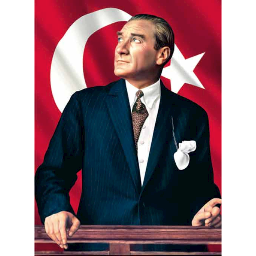
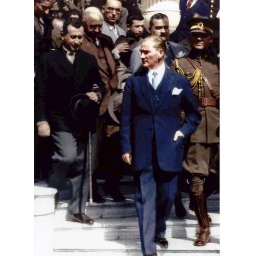
He presided over the congresses held in Erzurum on July 23, 1919 and in Sivas on September 4, 1919. Thus, he assumed, the leadership of the story of the liberation of the Turkish nation.
11
In these congresses, decisions were made and announced that "the nation will defend the homeland against enemy occupation, a temporary government will be established for this purpose and a national assembly will be convened, and mandate and protection will not be accepted". With his efforts, the Grand National Assembly began its historic duty in Ankara on April 23, 1920; Mustafa Kemal was elected as the President of the Assembly and Government. He took over the Turkish army as the commander-in-chief on the Sakarya and Great Offensive fronts and signed the decisive victory.
12
Benefits:
- Full access to our public library
- Save favorite books
- Interact with authors
READ
storyjumper.com
- < BEGINNING
- END >
-
DOWNLOAD
-
LIKE
-
COMMENT()
-
SHARE
-
SAVE
BUY THIS BOOK (from $3.79+)
-
BUY THIS BOOK
(from $3.79+) -
BUY THIS BOOK
(from $3.79+) - DOWNLOAD
- LIKE
- COMMENT ()
- SHARE
- SAVE
- Report
Liked By
X
Encourage this author
-
BUY
-
LIKE
-
COMMENT()
-
SHARE
Problem with this book
X
- Excessive Violence
- Harassment
- Offensive Pictures
- Spelling & Grammar Errors
- Unfinished
- Other Problem
Which pages have problems?
Please describe the problem:
left text
right text
"The Life and Struggle of Mustafa Kemal Atatürk..."
A comprehensive biography of Mustafa Kemal Atatürk, detailing his early life, military career, and his pivotal role in founding the Republic of Turkey and implementing national reforms.
(20 pages)
Privacy level:
PUBLIC
1 read
Report





COMMENTS
Click 'X' to report any negative comments. Thanks!