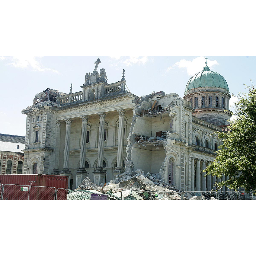

The 2011 Christchurch Earthquake was a 6.3-magnitude intraplate earthquake. It may have been an aftershock of the 7.1-magnitude 4 September 2010 Canterbury earthquake. New Zealand's GNS Science has stated that the earthquake was part of the aftershock sequence that has been occurring since the September magnitude-7.1 quake, however a seismologist from Geoscience Australia considers it a separate event given its location on a separate fault system.
Although smaller in magnitude than the 2010 earthquake, the February earthquake was more damaging and deadly for a number of reasons. The epicentre was closer to Christchurch, and shallower at 5 kilometres (3 mi) underground, whereas the September quake was measured at 10 kilometres (6 mi) deep. The February earthquake occurred during lunchtime on a weekday when the CBD was busy, and many buildings were already weakened from the previous quakes. The peak ground acceleration (PGA) was extremely high, and simultaneous vertical and horizontal ground movement was "almost impossible" for buildings to survive intact. Liquefaction was significantly greater than that of the 2010 quake, causing the upwelling of more than 200,000 tonnes of silt which needed to be cleared. The increased liquefaction caused significant ground movement, undermining many foundations and destroying infrastructure, damage which "may be the greatest ever recorded anywhere in a modern city". 80% of the water and sewerage system was severely damaged. The earthquake also caused an increased spring activity in the Avon and Heathcote Rivers.
The upwards (positive acceleration) was greater than the downwards, which had a maximum recording of 0.9 g; the maximum recorded horizontal acceleration was 1.7 g. The force of the earthquake was "statistically unlikely" to occur more than once in 1000 years, according to one seismic engineer, with a PGA greater than many modern buildings were designed to withstand. Although the rupture was subsurface, satellite images indicated that the net displacement of the land south of the fault was 50 cm westwards and upwards; the land movement would have been greater during the earthquake. Land movement was varied around the area horizontally—in both east and west directions—and vertically; the Port Hills were raised by 40 cm.
The 2011 Christchurch Earthquake was a 6.3-magnitude intraplate earthquake. It may have been an aftershock of the 7.1-magnitude 4 September 2010 Canterbury earthquake. New Zealand's GNS Science has stated that the earthquake was part of the aftershock sequence that has been occurring since the September magnitude-7.1 quake, however a seismologist from Geoscience Australia considers it a separate event given its location on a separate fault system.
- Full access to our public library
- Save favorite books
- Interact with authors

- < BEGINNING
- END >
-
DOWNLOAD
-
LIKE
-
COMMENT()
-
SHARE
-
SAVE
-
BUY THIS BOOK
(from $2.99+) -
BUY THIS BOOK
(from $2.99+) - DOWNLOAD
- LIKE
- COMMENT ()
- SHARE
- SAVE
- Report
-
BUY
-
LIKE
-
COMMENT()
-
SHARE
- Excessive Violence
- Harassment
- Offensive Pictures
- Spelling & Grammar Errors
- Unfinished
- Other Problem





COMMENTS
Click 'X' to report any negative comments. Thanks!