
Sugashima is an inhabited island located in Toba, Mie Prefecture off the coast of Honshu, Japan. Small communities live along the coastline of the island and depend on the sea for their livelihood. Despite the rugged mountainous interior, small farms grow Kaki (persimmons), Mikan (mandarins) and Amanatsu (grapefruit like fruit). Mt Oyama provides a skyline feature and in January and February, it turns a brilliant red due to the numerous Japanese Boxwood trees. The mountains give way to sacred beaches and coves. The island is dotted with historical shrines and temples that play a role in the daily lives of the local people. During May to October, Sugashima experiences extreme typhoons. Powerful winds and torrential rain hit the island. Wild waves batter the coastline, landslides happen in the mountains, significant disruption takes place. In July, the Shirongo Matsuri is celebrated to pay respect to the sea god, Shirohige Myojin. The festival brings the island and mainland people together. More importantly, Sugashima is known for the rich tradition of Ama, female divers who free dive. Sugashima is the setting for this story.
The date is 1588 and Toyotomi Hideyoshi is in power. He was born a peasant but through sheer determination he rose to the ranks of samurai and became a daimyo. His persistent nature and military know-how meant that he became known as the great unifier of Japan. He was installed as the shogun, however, because of his low born status he was given the title of Kanpaku (Imperial Regent). Toyotomi served the emperor and carried out several reforms to make Japan stronger. He was a lover of the arts and became a patron of culture. At the age of 25, he fell in love with a young girl called Nene. Despite being 14 years old, Nene loved Toyotomi and married him.
To show his power, love and support for Nene, Toyotomi undertook major building works throughout Japan. His notable works include Osaka, Ishigakiyama and Himeji Castles, The Golden Tea Room, Jurakudai Palace and various religious restorations to name among many. He wanted to make sure he showed his gratitude to Nene as she became his most trusted political advisor and a mother figure to his best generals. During his construction projects, Toyotomi would look for special things he could find to give to his wife to express his love and devotion. Whilst carrying out his building works on the island of Sugashima, Toyotomi came across something quite unusual.
The Yamakawa family owned a traditional mikan farm. The farm had been passed down from generation to generation. They were going about their work when a typhoon hit. The mikan trees swayed and many became uprooted. Part of their land moved into the next-door neighbour’s farm. The simple wooden house collapsed. Genki, Akiko and young Momoko ran further up the hill to try to get to safety. People from surrounding farms were also doing the same thing. Shouting, yelling and cries for help filled the air. Noises of creaking, banging and howls could be heard. It was difficult to know where to go and what to do.
After several hours, the typhoon had passed, the rain had eased and the local people started to survey the damage. Momoko looked desperately for her parents, but Genki and Akiko were nowhere to be found. Local neighbours helped her search for them but to no avail. The people gathered at a small shrine and took refuge. They banded together to look after one another as they found that all the farms had been destroyed. The shrine priest suggested that everyone move to a shrine near Shirongo. The Shirohige Shrine was more suitable to look after the people. Reluctantly, whoever was left moved down the mountain to the shrine. Momoko went too.
Once at the shrine the local people from the coastal villages came and brought food and clothing. Makeshift huts were erected to provide shelter. Momoko joined others who also had family members missing or known to be dead. It was a very difficult time for everyone.
Each day Momoko would notice females coming to the shrine to pray when the sun rose. She became fascinated by their simple white garments. Their tenugui (headscarf) was most noticeable as it had a five-pointed star and a lattice pattern embroidered into the material. She found out from a local that the women were known as “sea women”. The women could take a single breath and dive to extreme depths. The star and lattice provided them with protection from evil spirits. The white clothing was thought to keep away sharks. Momoko wanted to know more.
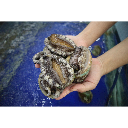
Momoko’s curiosity meant that the following day she followed the women from the shrine to the beach. She sat on the sand and watched the women dive down into the water and seemed to disappear for a long time and then they would come to the surface. When they came to the surface of the water a unique whistling sound could be heard. The women finished diving, and they came to shore with baskets. Seaweed, oysters, abalone and urchins could be seen in their nets. They noted that Momoko had watched them all morning. One recognized her as one of the mountain people staying at the shrine. She approached Momoko and invited her to join the women at the Amagoya (traditional hut). Momoko was surprised at the invite and gladly accepted.
At the Amagoya, the women changed clothes, repaired nets, shared stories about their dive that day and gossiped. They cooked abalone, lobster and turban shells over a charcoal fire. The heat from the fire warmed their bodies and enabled them to rest before returning to the water for the afternoon session. The women ranged in age from 14 to 95. Ama asked Momoko to share her story of what happened during the typhoon.They were all saddened by her tale. After much deliberation, the women suggested that Momoko join them and said they would teach her how to dive. Momoko returned to the shrine that night and wondered what she should do. She shared her newfound information with those around her, and they all thought it was a good idea.
The next day, Momoko gathered her things and joined the women when they came to pray. They took her to a house near the Amagoya and gave her a simple white costume and headscarf. The women then all gathered at the beach. An older lady took Momoko’s hand and they walked slowly into the water. In a shallow section, the Ama taught Momoko how to breathe, another came up and started to teach Momoko how to dive. It was more difficult than Momoko thought, but Momoko practised every day. Her goal was to learn to hold her breath for two minutes.
As the months rolled by, Momoko became better at breathing and diving. She followed the routine of waking early and going to the shrine to thank the gods for their protection and a bountiful catch. Momoko was able to meet with the mountain people to hear any news. Breakfast, diving, lunch, diving, visit to the shrine, going to the market to sell the catch, dinner and relaxation became her schedule. Momoko was able to find some peace in the structured routine.
July was soon approaching and all the Ama were constantly chatting about the Shirongo Matsuri festival. All the Ama wanted to compete. Momoko wasn’t sure if she would be allowed and wasn’t sure what it was about. The women explained that it was a competition. The aim was to catch one female and one male abalone. The person to get the first two would then become the leader of the Ama for a year. Momoko asked if she could participate as she thought it would be good fun and extra practice for her to dive. The Ama reluctantly agreed and said for her to swim next to a more experienced diver as the current could get strong.
The day of the festival attracted many people. The water was full of boats with flags on them. People lined the beach to witness the Ama. The Ama gathered and received a blessing from the shrine priest. Once the Ama were purified, a traditional dance was carried out. The Ama then waited for the sound of a conch and then went quickly into the water. Momoko attempted to find an abalone and continued to dive up and down in the water. She heard a sound from the beach and saw an Ama carrying something in her hand.
All the Ama were called back to the beach. An Ama called Hanako had found a red and black abalone, one male and one female. The priest collected the abalone as an offering for the gods to ensure prosperity for the up-and-coming fishing season. Everyone celebrated. The Ama returned to the Amagoya to feast on seaweed, seafood and tea. Hanako would be in charge for the year.
Momoko felt inspired by Hanako and the other Ama. The Ama shared more knowledge and traditions through their stories. On the anniversary of the typhoon, Momoko returned to the family farm. The farm had overgrown and very few trees survived. The home was a crumpled mess of timber. Momoko walked through the farm area and went to where her father had kept bees. The broken bee hives had also been destroyed, but she noticed pink pebbles had been brought to the surface by the rain and landslide. Momoko collected a handful and placed them in her pocket.
- Full access to our public library
- Save favorite books
- Interact with authors
- < BEGINNING
- END >
-
DOWNLOAD
-
LIKE
-
COMMENT()
-
SHARE
-
SAVE
-
BUY THIS BOOK
(from $5.19+) -
BUY THIS BOOK
(from $5.19+) - DOWNLOAD
- LIKE
- COMMENT ()
- SHARE
- SAVE
- Report
-
BUY
-
LIKE
-
COMMENT()
-
SHARE
- Excessive Violence
- Harassment
- Offensive Pictures
- Spelling & Grammar Errors
- Unfinished
- Other Problem






COMMENTS
Click 'X' to report any negative comments. Thanks!