The survey was conducted among 7 teachers - participants of the international eTwinning project "Green Steps". The results will help assess the effectiveness of environmental initiatives, the level of partners' satisfaction with cooperation, and the impact of the tools used on the educational process.

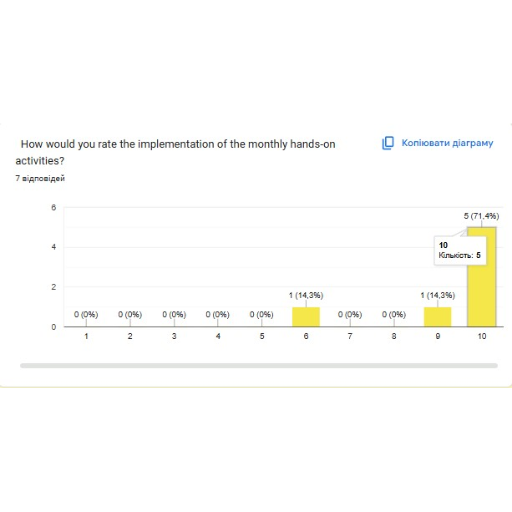
How would you rate the implementation of monthly practical classes?
The results indicate an extremely high level of satisfaction of partner teachers with the organization and implementation of the practical part of the project:
The vast majority (71.4%) of participants gave the highest score — 10 points, 14.3% of respondents gave it 9 points.
Only one participant (14.3%) gave it a score of 6 points, which may indicate certain technical difficulties or lack of time to complete the tasks in a particular class.
Conclusion:
The high average score confirms the success of the chosen approach of "learning through action". Practical tasks have become an effective tool of the project, as teachers consider their implementation to be effective and high-quality.
To what extent did the project strengthen students' environmental awareness?
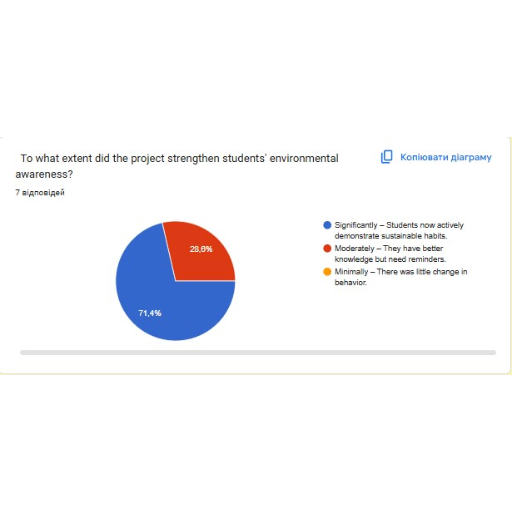
Partner teachers confirm the high educational value of the Green Steps project. 71.4% of respondents note significant changes in the behavior of schoolchildren: students have become more aware of the environment and have integrated environmental habits into their daily lives.
The absence of negative or zero indicators indicates that the integrated approach (combination of theory and practical STEAM tasks) turned out to be the most effective for the formation of environmental competence in primary school students.
These data are excellent evidence that your project has a long-term positive effect on the development of the child's personality.
How effective was the collaboration between partner schools in creating shared products?
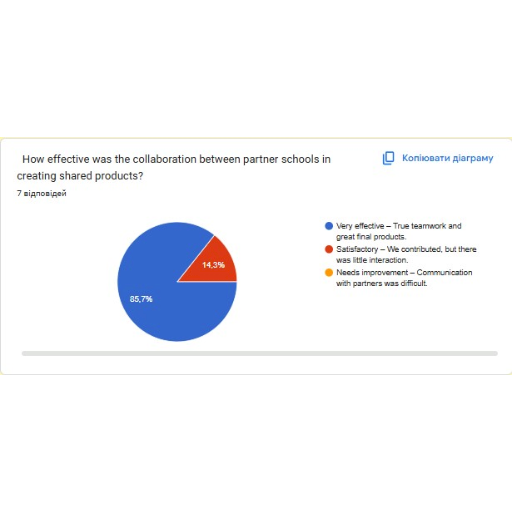
The efficiency of cooperation is one of the highest in the project - 85.7% of participants described the interaction as "real teamwork". This confirms that the Green Steps project has become not just a set of parallel activities, but a holistic partnership where schools work as one organism.
The results demonstrate that joint products (such as joint virtual galleries or e-books) were created through active dialogue and mutual assistance. The positive feedback from the majority of partners is strong evidence of the successful communication strategy of the project.
Which area of student development showed the most growth?
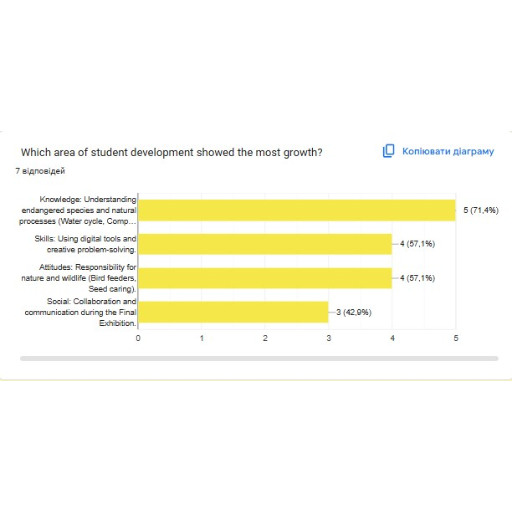
The project ensured the holistic development of the student’s personality. The greatest progress was recorded in the field of cognitive development (71.4%) — students significantly deepened their knowledge of complex natural processes.
Equally high indicators (57.1% each) in the “Skills” and “Attitudes” categories prove that theoretical knowledge was successfully transformed into practical skills and value orientations. The project helped children not only master digital tools, but also cultivate a sense of responsibility for the environment.
The social aspect (42.9%) complements the overall picture, indicating the development of students’ communicative abilities within the international community.
- Full access to our public library
- Save favorite books
- Interact with authors
- < BEGINNING
- END >
-
DOWNLOAD
-
LIKE
-
COMMENT()
-
SHARE
-
SAVE
-
BUY THIS BOOK
(from $2.99+) -
BUY THIS BOOK
(from $2.99+) - DOWNLOAD
- LIKE
- COMMENT ()
- SHARE
- SAVE
- Report
-
BUY
-
LIKE
-
COMMENT()
-
SHARE
- Excessive Violence
- Harassment
- Offensive Pictures
- Spelling & Grammar Errors
- Unfinished
- Other Problem





COMMENTS
Click 'X' to report any negative comments. Thanks!