 This book is dedicated to all dancers who want their stories to be shared
 with the world.
Keep expressing yourself through dance. I promise you that the more you
dance, the better you will feel. Dance is a kind of therapy. It keeps you fit,
while making you happy at the same time. Whatever you do, just keep
dancing!
This book was created and published on StoryJumper™
©2015 StoryJumper, Inc. All rights reserved.
Publish your own children's book:
www.storyjumper.com

Who can tell me what an elevé
is? A fish dive? A tilt? After
reading this book, you will be
able to answer all of those
questions and lots more, such
as;
-"What is the difference between
a grand jeté and a saut de
chat?"
-"How do I do a z-sit?"
-"What is quickstep dancing?"
-"Where did salsa dancing
come from?"
-"How do I do an aerial?"
-"What is the difference
between an open turn and an
inside turn?"
Read on to find out...
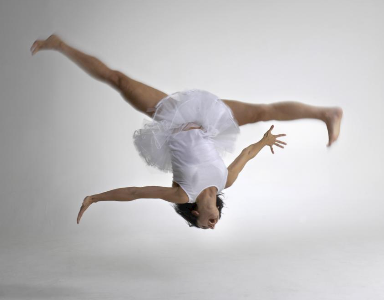
This photo is showing a side aerial. A side aerial, which is a non-handed cartwheel, is
different than a front aerial, which is a non-handed front-walkover. (“A dancer in mid-air
performing an aerial cartwheel” by Ilana Bressler is licensed under CC BY-SA 2.5.)
The letter A stands for Aerial, a dance
move in which one's feet leave the floor.
Here are four steps in doing an side-aerial;
Run into a hurdle, swing your arms
overhead, push hard off of the front leg,
and lift your chest to help you rotate. If you
do these steps in order, you will be able to
complete a side-aerial.
The letter B stands for Ballet, a type of
performance dance that originated in the
Italian Renaissance courts of the 15th
century and later developed into a concert
dance form in France and Russia. Ballet is a
French word which had its origin in the
Italian word balletto, a diminutive of ballo
(dance) which comes from Latin ballo,
ballare, meaning "to dance".
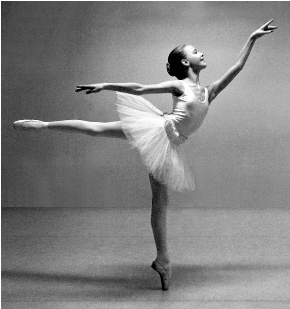
This is a ballerina preforming a dance move called an arabesque, a dance move in which you raise
your leg to 90 degrees and lift your arms up as well, all while keeping your upper body completely
still. ("Arabesque position with working leg à la hauteur (forming a 90° angle with supporting
leg)" by Frode Inge Helland is licensed under CC BY-SA 3.0.)
enter text here
This woman is happily doing a cartwheel down the hallway of her new office building.
(“Cartwheel” by DAXCO is licensed under CC BY 2.0.)
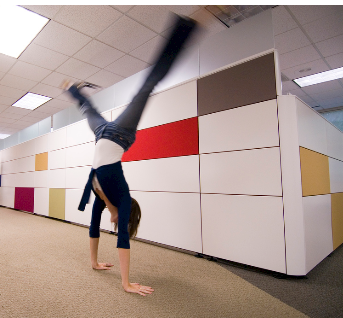
C stands for Cartwheel, a sideways rotary
movement of the body. It is performed by
bringing the hands to the floor one at a
time. The legs travel upwards over the
arms while one or both hands are on the
floor, and then the feet return to the floor
one at a time, ending with the person
standing up.
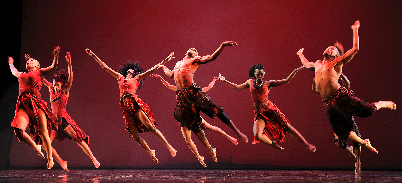
D stands for dance. There are many
different types of dance, such as jazz,
lyrical, contemporary, tap, ballet, hip hop,
ballroom, salsa, and many more.
These dancers from Jazzart Dance Theatre are preforming a jazz piece for a large
audience. (“Jazzart Dance Theatre – 69185” by Jazzart Dance Theatre is licensed under
CC BY 3.0.)
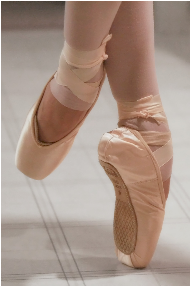
This ballet student is in elevé. This student is in pointe shoes,
which means that she can go on the full platform of her toes
(the very tip of her toes). Ballerinas that are not on pointe can
just rise to the balls of their feet. (“Modern Pointe Shoes” by
Lambtron is licensed under CC BY 2.0.)
E stands for elevé. An
elevé is a movement in
which a dancer rises up
high onto the balls of
the feet, or all the way
up to full-pointe, from
flat feet. This step is
often confused with a
relevé, which is a
similar movement, only
the dancer rises up
from a plié. In
conclusion, an elevé is
simply a relevé without
the plié.
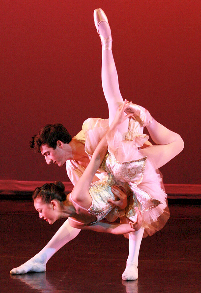
The letter F stands for
Fish Dive, a
partnering lift in which
the ballerina is in
retiré position and
held low to the ground
by a male dancer. This
lift is often preformed
during a classical
ballet, such as The
Nutcracker or Don
Quixote.
To do this lift, the female stands in arabesque. Then, the male
dancer lifts her up, and the female bends her bottom leg. He
then dips her down to this pose. (“A Fish Dive Lift” by
Lambtron is licensed under CC BY –SA 4.0.)
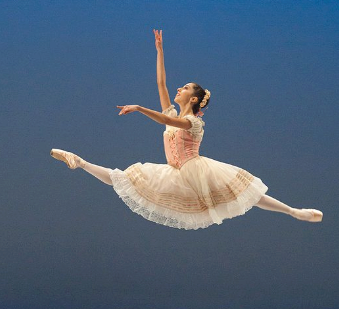
The difference between a grand jeté and a saut de chat is that to do a grand jete, you do
not bend your legs unless you are landing. In a saut de chat, you bend your front leg to
get it up in the air. (“Français : Variation extraite de Coppélia au Prix de Lausanne 2010.”
by Fanny Schertzer is licensed under (CC BY-SA 3.0).)
G stands for
grand jeté, a
leap in which a
dancer jumps
from one foot to
the other with
one leg forward
of their body and
the other
stretched
backward while
in the air. The
dancer does this
without bending
their legs on the
way up.
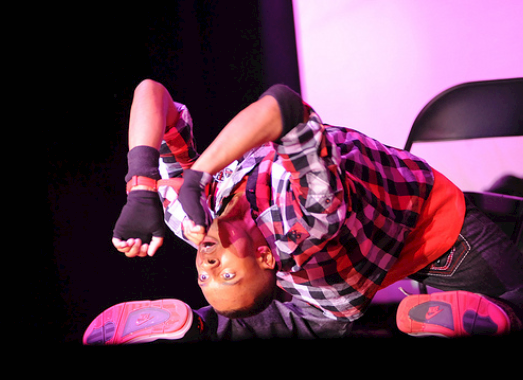
The letter H stands for Hip Hop.
Hip hop is an upbeat style of dance
that includes a wide range of styles
of sharp movements. It is very
common for hip hop dancers to
dance to a huge mash-up of
different pop songs.
This is a picture of hip-hop dancer Joseph Coine performing in 2011 in Wallace
Theater at Fort Belvoir, Virginia. (“Hip-hop dancer Joseph Coine performing in
2011 in Wallace Theater at Fort Belvoir, Virginia.” by Tim Hipps is licensed under
CC BY 2.0.)
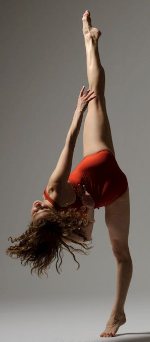
I stands for Illusion,
which is a dancer turning in
the position you see on the
right. The dancer turns 180
degrees in a position with
one leg straight up, and
one leg supporting the
dancer.
This is a dancer in the middle of her illusion. Illusions
are hard to do, but with training and flexibility,
illusions can come naturally to any dancer. (“How to
Do an Illusion” by Courtney Broderick.)
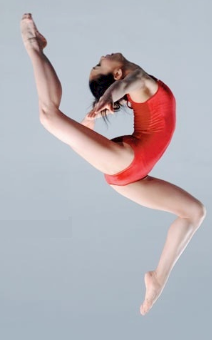
J stands for Jump! In the
dance world, there are
many different types of
jumps, such as Temps
levé sautés, Échappé
sautés, Entrechat quatres,
Tours en l’air, Tuck jumps,
Straddle jumps, Firebirds,
and Pas de poissons, just
to name a few. There are
also Tour jetés, Petit
jetés, Glissades, Barrel
turns, Stag jumps, and
Calypso leaps.
This dancer is preforming a Stag jump. The difference
between a Stag jump and a Firebird is the bottom leg; in
a Stag jump, the bottom leg is bent, while in a Firebird,
the bottom leg is straight. (“The difference between a
stag jump and a firebird jump” by Regan Norton.)
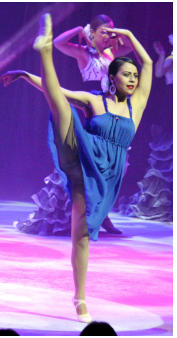
The letter K stands for kick.
Depending on the choreographer's
preference, the toes can be flexed
or pointed; the top leg and be
bent or straight; the bottom leg
can be bent or straight; the arms
could be up, down, out, or
hanging limply by the dancer's
sides. It really just depends on
your choreographer and the style
of dance.
In this picture, the dancer has straight legs, pointed
toes, and her arms are up. Most choreographers prefer
this clean, sharp look to any other kick. (“Flamenco
Dancer at Battle Of The Dance” by Prayitno / Thank you
for (9 millions +) views is licensed under CC BY 2.0.)
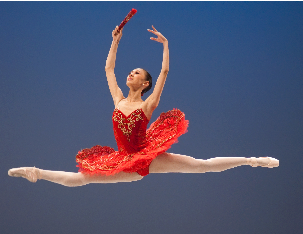
The letter L
stands for leap.
There are
Switch leaps,
Straddle leaps,
Supported
leaps, grand
jetés, and Saut
de chats, just to
name a few.
This dancer is in the middle of a very beautiful saut de chat.
Before this picture was taken, the dancer took a great big
chasse forward. She then pushed off of her left leg and
developped her right leg, bringing her left leg up behind her,
making a perfect split. ( “Variation extraite de Don Quichotte
au Prix de Lausanne 2010.” by Fanny Schertzer is licensed
under CC A-S 3.0, 2.5 Generic, 2.0 Generic and 1.0 Generic.)
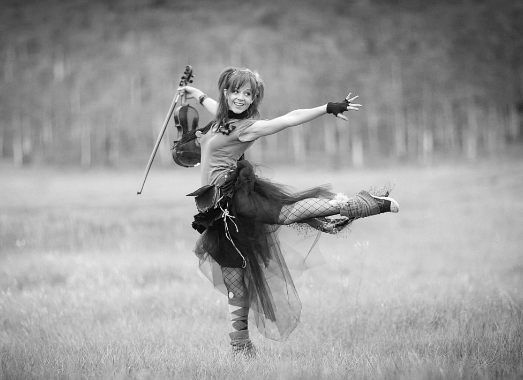
The letter M stands for music. Music is
very crucial to a dancer. Almost every
dance routine is choreographed to
music. Music keeps the beat, sets the
mood of the dance, and it helps to aid
the dancer in sharing messages to the
audience.
This amazing musician, Lindsey Stirling, loves to dance and play her violin
at the same time. This requires a lot of talent and skill, but Lindsey has
worked hard, and hard work pays off. She now has over 7,590,000
subscribers on her YouTube channel, and her music has really been a
success. ("Lindsey Stirling” by Glittermistress is licensed under
Attribution-NonCommercial-NoDerivs 3.0 Unported.
The letter N stands for
Needle, a pose in
which one leg is
pointed up to the sky,
while the other leg is
underneath the dancer,
supporting them. The
arms can be up,behind,
or on the ground,
supporting the dancer.
Both legs are straight in
this move.
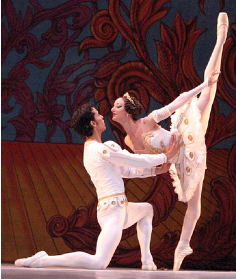
This picture is showing a partner needle, where the female dancer leans into the male and developpes the leg
upwards, hitting the needle pose. In a partner needle pose, the male is usually kneeling and the female's
arms are usually back. ("Arabesque penché" by Luiscaraqueño is licensed under This file is licensed under the
Creative Commons Attribution-Share Alike 4.0 International, 3.0 Unported, 2.5 Generic, 2.0 Generic and 1.0
Generic license.)
The letter O stands for
Open Turn. An open turn
is when a dancer rises into
passé and turns in a set
direction, depending on
what foot is in passé. In
this case, the dancer's
right foot is in passé, so
she would turn to the
right. If the left foot was in
passé, then the dancer
would have turned to the
left.
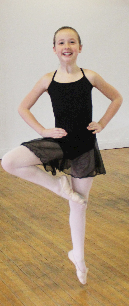
As opposed to an open turn, an inside turn is just the
opposite. For an inside turn, if the dancer's right leg is in
passé, then the dancer would have to turn to the left. (“How
to Skip and Tips!” by Alyssa. )
You've previewed 23 of 35 pages.
To read more:
Click Sign Up (Free)- Full access to our public library
- Save favorite books
- Interact with authors


- < BEGINNING
- END >
-
DOWNLOAD
-
LIKE(4)
-
COMMENT()
-
SHARE
-
SAVE
-
BUY THIS BOOK
(from $6.99+) -
BUY THIS BOOK
(from $6.99+) - DOWNLOAD
- LIKE (4)
- COMMENT ()
- SHARE
- SAVE
- Report
-
BUY
-
LIKE(4)
-
COMMENT()
-
SHARE
- Excessive Violence
- Harassment
- Offensive Pictures
- Spelling & Grammar Errors
- Unfinished
- Other Problem






COMMENTS
Click 'X' to report any negative comments. Thanks!